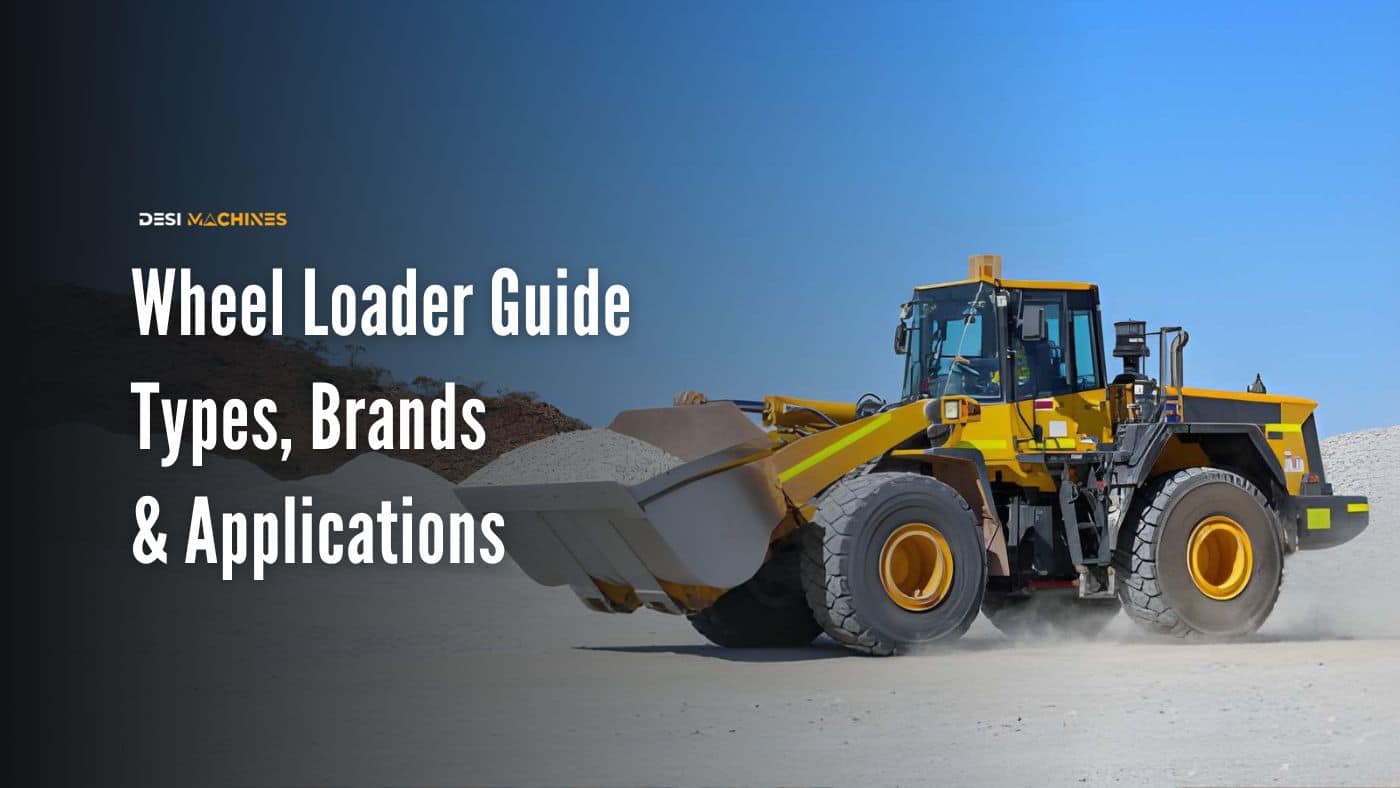
A wheel loader — called a payloader on most Indian sites — is the machine you reach for when material needs to move fast. Sand, aggregate, coal, ore, debris. If it’s loose and needs to go from stockpile to truck, a wheel loader does it quicker than anything else on four wheels. The construction and mining industries in India run on these machines. Every highway project, every quarry, every cement plant, every port yard has at least one. Understanding different loader machine types in India helps contractors choose the right equipment for specific job conditions. This guide covers everything an Indian contractor or fleet owner needs to know: how wheel loaders work, the different types by tonnage, the major brands operating in India — Caterpillar, Volvo, JCB, Hyundai, XCMG, Tata Hitachi — and what to look for before signing that purchase order. Pehle compare karo, phir kharido.
What is a Wheel Loader?
A wheel loader is a heavy equipment machine built to scoop, lift, and transport loose materials. It runs on four large rubber tyres, has a front-mounted bucket attached to lifting arms, and is powered by a diesel engine (though electric models are entering the market). The operator sits in a cab at the rear, controlling bucket movements and steering through hydraulic systems. Unlike a track loader that moves on continuous tracks, a wheel loader offers speed and mobility on hard surfaces. It can travel at 30–40 km/h between work areas — something a tracked machine simply cannot do. That’s why wheel loaders dominate applications where material handling happens across distances: loading trucks at quarries, feeding batching plants, managing stockpiles at ports. The key difference from a backhoe loader? A backhoe has a rear excavator arm for digging. A wheel loader is purpose-built for loading — bigger bucket, higher lift capacity, faster cycle times. Different tools for different jobs.
| Class | Operating Weight | Bucket Capacity | Best Use |
|---|---|---|---|
| Compact | 1–8 Ton | 0.3–1.2 m³ | Yards, farms, small sites |
| Small | 8–15 Ton | 1.2–2.5 m³ | RMC plants, construction sites |
| Medium | 15–30 Ton | 2.5–4.5 m³ | Quarries, industrial projects |
| Large | 30+ Ton | 4.5–15+ m³ | Mining and large quarries |
Key Components of a Wheel Loader Machine
Every wheel loader, regardless of brand or size, shares these core components:
- Front-end loader bucket: The business end. Measured in cubic metres, bucket capacity determines how much material moves per cycle. General purpose buckets handle most materials; rock buckets have reinforced edges for abrasive loads.
- Lifting arms/boom: Two heavy-duty arms connect the bucket to the machine body. Hydraulic cylinders raise, lower, and tilt the bucket through these arms.
- Operator cabin: Positioned at the rear for visibility. Modern cabs include ROPS/FOPS certification (rollover and falling object protection), air conditioning, and joystick controls.
- Articulated steering system: The machine bends in the middle — front and rear frames pivot at a central hinge. This gives tight turning radius despite the machine’s size.
- Hydraulic system: The muscle. Pumps, cylinders, and valves convert engine power into bucket movement. Hydraulic pressure typically ranges from 200–350 bar depending on machine size.
- Engine: Diesel engines from 50 HP (compact loaders) to 800+ HP (mining loaders). Cummins, Deutz, and proprietary engines are common. CEV Stage IV compliance is now standard for new machines in India.
- Tyres: Large pneumatic tyres designed for load-bearing and traction. Tyre costs add up — a set of four on a medium loader runs ₹4–6 Lakh.
- Counterweight: Positioned at the rear to balance the loaded bucket. Without it, the machine tips forward under load.
These components work as a system. The engine powers the hydraulic pumps. The pumps drive the cylinders. The cylinders move the arms and bucket. The articulated frame lets the operator position the bucket precisely. Simple in concept, demanding in execution.
How Does a Wheel Loader Work?
The operating mechanism starts with the engine. A diesel engine (typically 100–300 HP for medium loaders) drives a hydraulic pump that pressurises fluid to 200–350 bar. This pressurised fluid flows through control valves — operated by the driver via joysticks or levers — to hydraulic cylinders attached to the lifting arms and bucket. When the operator pushes the joystick forward, hydraulic fluid flows to the tilt cylinder, rotating the bucket downward to scoop material. Pull back, and the bucket tilts up to hold the load. A separate control raises or lowers the entire arm assembly. The cycle — approach, scoop, lift, travel, dump, return — takes 25–40 seconds depending on machine size and operator skill. Articulated steering is what makes wheel loaders manoeuvrable despite their bulk. The machine body is split into front and rear frames connected by a central pivot. Hydraulic cylinders push or pull the front frame left or right, bending the entire machine. A 20 Ton (20,000 kg) loader can turn in a tighter radius than a pickup truck. That matters when you’re working in a confined quarry face or a crowded port yard. The transmission — usually powershift or hydrostatic — transfers engine power to all four wheels. Most loaders operate in a load-and-carry cycle: drive into the stockpile, load, reverse, travel to the truck, dump, return. Fuel efficiency depends heavily on how well the operator matches engine RPM to the task. Over-revving burns diesel. *Kharcha* goes up.
Types of Wheel Loaders
Wheel loaders are classified by operating weight and bucket capacity. The right size depends on your application — a compact loader for a warehouse is useless in a coal mine, and a mining loader in a warehouse is absurd. Here’s how the categories break down in the Indian market.
1. Compact Wheel Loader (1-8 ton)
- Operating weight: 1,000–8,000 kg
- Bucket capacity: 0.3–1.2 m³
- Engine power: 25–75 HP Price range: ₹9–25 Lakh (indicative)
Compact wheel loaders handle light material in confined spaces. Warehouses, small farms, landscaping projects, municipal yards. They fit through standard gates, work on paved surfaces without damage, and require minimal operator training. In India, these machines see use in brick kilns, small-scale aggregate handling, and agricultural operations. The ACE ALN 100 & LiuGong 818N are common choices. But here’s the reality: compact loaders are a niche segment in India. Most contractors jump straight to small or medium loaders because the price difference doesn’t justify the capacity gap.
2. Small Wheel Loader (8-15 ton)
- Operating weight: 8,000–15,000 kg
- Bucket capacity: 1.2–2.5 m³
- Engine power: 75–160 HP
- Price range: ₹25–60 Lakh (indicative)
This is where the Indian market gets serious. Small wheel loaders handle construction sites, ready-mix concrete plants, small quarries, and material yards. They’re big enough to load a tipper truck efficiently but compact enough for urban sites. Popular models include the JCB 433-5, Tata Hitachi TL340H Prime, and L&T 9020. A contractor running a batching plant near Pune told me his ZW140 loads 80–100 trucks per day during peak season. That’s the kind of output this segment delivers.
3. Medium Wheel Loaders (15-30 ton)
- Operating weight: 15,000–30,000 kg
- Bucket capacity: 2.5–4.5 m³
- Engine power: 150–400 HP
- Price range: ₹55 Lakh–1.3 Crore (indicative)
The workhorse segment. Medium wheel loaders dominate Indian quarries, large construction projects, cement plants, and steel mills. They load 20–25 Ton tippers in 3–4 passes, handle coal and ore efficiently, and run 16–20 hour shifts during dry season. CAT 950 GC and 966 series, Volvo L120, LiuGong 856H MAX, Hyundai HL650 — these are the machines you see on NHAI highway packages and large infrastructure projects. A medium loader on a busy quarry site moves 1,500–2,500 tonnes per shift. The math works.
4. Large/Heavy Wheel Loaders (Above 30 ton)
- Operating weight: 30,000–80,000+ kg
- Bucket capacity: 4.5–15+ m³
- Engine power: 300–800+ HP
- Price range: ₹1.2–5+ Crore (indicative)
Mining territory. Large wheel loaders work in open-cast coal mines, iron ore operations, and large limestone quarries. They load 100+ Ton dump trucks, handle overburden removal, and operate in conditions that would destroy smaller machines. Caterpillar 980, 988, and 992 series dominate this segment globally. Komatsu WA600 and WA800 are also present in Indian mining operations. These machines require specialised operators, dedicated maintenance teams, and infrastructure to support them. Not for general contractors. **Compare wheel loader models side-by-side on Desi Machines — check specs, get transparent pricing, and connect with a local dealer at desimachines.com.**
Top Wheel Loader Brands in India & Globally
Brand matters more than most contractors realise. Not just for the machine quality — though that varies — but for what happens after purchase. Service network reach. Spare parts availability in Tier 2 and Tier 3 towns. Resale value three years later. A ₹5 Lakh price difference at purchase can become ₹15 Lakh in total cost of ownership if the cheaper brand leaves you waiting two weeks for a hydraulic pump in Raipur. India has both international giants and domestic players. Here’s what each brings to the table.
1. Caterpillar Wheel Loader (CAT Wheel Loader)
Caterpillar is the global benchmark. Founded in 1925, CAT has been in India since the 1930s through various partnerships. Today, Gmmco and Gainwell are the primary dealers.
- Popular models: CAT 950 GC, CAT 988 , CAT 990
- Key features: Proven durability, excellent resale value, Cat Connect telematics, fuel-efficient powertrains
- Price range: ₹80 Lakh–2.5 Crore depending on model (indicative )
CAT wheel loaders command premium prices — typically 15–25% higher than competitors. But they hold value. A 5-year-old CAT 950 sells for 55–60% of purchase price. Try that with lesser-known brands. The service network is strong in metros and mining belts but thinner in some agricultural regions. Parts availability is generally excellent. For large mining operations and contractors who prioritise uptime over initial cost, CAT remains the default choice.
2. Volvo Wheel Loader
Volvo Construction Equipment brings Scandinavian engineering to Indian sites. Known for operator comfort, fuel efficiency, and safety features.
- Popular models: Volvo L90H, Volvo L120H, Volvo L150H
- Key features: OptiShift transmission, Load Assist weighing system, ROPS/FOPS certified cabs, excellent visibility
- Price range: ₹50 Lakh–1.8 Crore depending on model (indicative )
Volvo loaders are fuel-efficient — the OptiShift system reduces consumption by 15–18% compared to conventional torque converters. Operators love the cabs. Site managers love the fuel bills. The challenge? Service network density. Volvo is strong in metros and major industrial hubs but coverage drops in remote areas. If your site is 300 km from the nearest Volvo service centre, factor that into your decision.
3. JCB Wheel Loader
JCB dominates the Indian backhoe market, and they’ve leveraged that presence into wheel loaders. Strong dealer network, parts availability even in small towns, and machines designed for Indian conditions.
- Popular models: JCB 433-5, JCB 440-5-4, JCB 455-5N
- Key features: LiveLink telematics, EcoMAX engines, excellent service network, competitive pricing
- Price range: ₹30 Lakh–1.1 Crore depending on model (indicative)
JCB’s advantage is reach. With 60+ dealers and 600+ service points across India, getting a mechanic to your site within 24–48 hours is realistic even in Tier 3 locations. That matters when downtime costs ₹15,000–25,000 per day. The 432ZX is particularly popular for construction and ready-mix applications. The 455Z-5N handles quarry work well. For contractors already running JCB backhoes, adding JCB loaders simplifies parts inventory and operator training.
4. Hyundai Wheel Loader
Hyundai Construction Equipment (now HD Hyundai Infracore) offers Korean engineering at competitive prices. Growing presence in India with improving service infrastructure.
- Popular models: Hyundai HL630I-v, Hyundai HL650I-V
- Key features: Hi-Mate telematics, Weichai engines, competitive pricing, solid build quality
- Price range: ₹35 Lakh–95 Lakh depending on model (indicative)
Hyundai loaders offer good value — typically 10–15% below CAT and Volvo for comparable specs. The HL650 competes directly with the CAT 950 and Volvo L90 at a lower price point. Service network is the consideration. Hyundai has expanded significantly but still trails JCB and Tata Hitachi in remote area coverage. Verify dealer proximity before committing. *Dealer se seedha baat karo* — ask about service response time, not just machine specs.
5. XCMG Wheel Loader
XCMG is China’s largest construction equipment manufacturer, and they’ve made serious inroads into India. The value proposition is clear: comparable specs at 20–30% lower prices.
- Popular models: XCMG XE938, XE958 & XE928 EV
- Key features: Competitive pricing, decent build quality, improving service network
- Price range: ₹25 Lakh–75 Lakh depending on model (indicative)
For budget-conscious buyers, XCMG makes sense — if you’re near a service centre. The machines work. They’re not CAT or Volvo, but for applications where uptime isn’t mission-critical, the price difference funds a lot of maintenance. The honest assessment: resale value is lower than established brands. Parts availability outside major cities can be challenging. But for a contractor who maintains machines well and plans to run them into the ground rather than resell, XCMG delivers value.
6. Tata Hitachi Wheel Loader
Tata Hitachi combines Japanese engineering with Indian manufacturing and the Tata service network. A strong choice for contractors who value local support.
- Popular models: Tata Hitachi TL340H Prime, Tata Hitachi ZW225
- Key features: Made in India, extensive service network, Hitachi hydraulics, competitive pricing
- Price range: ₹30 Lakh–1 Crore depending on model (indicative)
The Tata network is the differentiator. Service centres across India, parts availability in most towns, and technicians who understand Indian operating conditions. For contractors working in remote areas — think Jharkhand mining belt or Rajasthan quarries — that network coverage matters. The ZW225 is popular in medium-duty applications. Build quality is solid. Resale value holds reasonably well due to brand recognition. *Paisa vasool machine hai* — if you factor in total cost of ownership, not just purchase price.
7. LiuGong Wheel Loader
LiuGong has built a strong reputation in India for offering rugged machines at competitive pricing, especially in quarrying and heavy material handling segments. The brand focuses on durability and higher payload efficiency, making it a preferred choice for cost-conscious contractors.
- Popular models: LiuGong 835H, LiuGong 848H
- Key features: Heavy-duty structure, high breakout force, fuel-efficient engines, simple maintenance design
- Price range: ₹28 Lakh–₹95 Lakh (indicative)
LiuGong machines are known for their solid build and ability to handle tough conditions like stone quarries and sand loading. The 835H is widely used in mid-sized operations where reliability matters more than premium features.
Where LiuGong stands out is value for money — you get higher capacity machines at a lower upfront cost compared to some premium brands. Service support has improved in recent years, though still developing in remote regions.
For contractors focused on output per rupee spent, LiuGong loaders deliver strong ROI. Kaam nikalne wali machine hai.
8. Komatsu Wheel Loader
Komatsu is known globally for its advanced engineering, reliability, and long machine life. In India, Komatsu wheel loaders are widely used in mining, large infrastructure projects, and high-duty cycles where performance consistency is critical.
- Popular models: Komatsu WA380-6, Komatsu WA470
- Key features: Advanced hydraulics, high fuel efficiency, operator comfort, long service intervals
- Price range: ₹45 Lakh–₹1.2 Crore+ (indicative)
Komatsu loaders are built for heavy-duty applications where machines run long hours with minimal downtime. The WA380-6 is a common choice in mining and bulk material handling due to its balance of power and efficiency.
The brand’s strength lies in engineering precision and machine longevity. Maintenance costs are predictable, and machines hold value well over time. However, initial pricing is on the higher side compared to budget brands.
For contractors who prioritize performance, durability, and uptime over upfront cost, Komatsu is a dependable investment. Long-term ka game hai yeh machine.
Wheel Loader Applications & Uses
A wheel loader’s versatility comes from one simple fact: the bucket can be swapped for other attachments. Forks for pallets. Grapples for logs. Snow pushers for — well, snow. But even with just a standard bucket, the applications span nearly every industry that moves bulk material.
Construction & Infrastructure
On construction sites, wheel loaders handle material movement that would otherwise require multiple machines or manual labour. Loading sand and aggregate into transit mixers. Moving excavated soil to dump trucks. Feeding crushers at batching plants. Stockpile management — building, shaping, and reclaiming material piles. Specific Indian applications: NHAI highway packages use medium loaders (15–25 Ton) for aggregate handling at hot-mix plants. Metro rail projects deploy loaders for tunnel muck removal and station excavation support. Smart City projects use compact and small loaders for urban infrastructure work where space is tight. A site incharge on a Bharatmala project in Gujarat mentioned his loader runs 18 hours daily during dry season — October to May. That’s the intensity of Indian infrastructure timelines.
Mining & Quarrying
Mining is where wheel loaders earn their keep. Loading ore into haul trucks. Removing overburden. Managing coal stockpiles. Feeding primary crushers. The conditions are brutal — dust, abrasion, 24/7 operations — and the machines need to match. Large loaders (30+ Ton) work in open-cast coal mines across Jharkhand, Odisha, and Chhattisgarh. Medium loaders handle limestone quarries in Rajasthan and Andhra Pradesh. The requirement: machines that survive abrasive materials, high running hours, and minimal downtime tolerance. Durability matters more than initial price in mining. A breakdown in a quarry face stops the entire operation. That’s why CAT and Komatsu dominate large mining applications despite premium pricing.
Agriculture & Farming
Compact and small wheel loaders serve agricultural operations — grain handling, silage loading, manure management, general farm material movement. The requirement is different from construction: lower intensity, varied materials, operators who may not be equipment specialists. In India, agricultural loader use is growing in Punjab, Haryana, and Maharashtra — states with mechanised farming operations. Cooperative sugar mills use loaders for bagasse handling. Large farms use them for fertiliser and grain movement.
Waste Management & Recycling
Waste handling requires loaders that can work with varied, often unpredictable materials. Municipal solid waste. Scrap metal. Recyclables. The machines need corrosion resistance and easy cleaning. Indian municipal corporations increasingly deploy wheel loaders at landfill sites and transfer stations. Recycling facilities use them for scrap handling and material sorting support. The application is growing as waste management infrastructure develops.
Port & Logistics Operations
Ports use wheel loaders for bulk cargo handling — coal, iron ore, fertiliser, grain. Container yards use them with fork attachments for container positioning. The requirement: high productivity, reliability, and often specialised configurations for specific cargo types. Major Indian ports — Mundra, JNPT, Paradip, Visakhapatnam — deploy fleets of medium and large loaders. The machines run multiple shifts, handling thousands of tonnes daily. Uptime is critical; a loader breakdown delays ship loading and incurs demurrage charges.
Wheel Loader Specifications to Understand
Before comparing models, understand what the specifications actually mean for your operation. Numbers on a spec sheet translate to real-world performance — if you know how to read them.
Engine Power & Performance
Engine power is measured in horsepower (HP) or kilowatts (kW). More power means faster cycle times and ability to handle heavier loads — but also higher fuel consumption. For Indian buyers, emission standards matter: CEV Stage V is now mandatory for new equipment. Older CEV Stage IV machines are still in circulation but cannot be registered new. Government tenders increasingly specify CEV V compliance. Torque matters as much as peak horsepower. A high-torque engine at low RPM moves material efficiently without over-revving. That’s where fuel savings come from.
Bucket Capacity & Configurations
Bucket capacity is measured in cubic metres (m³). But the number on the spec sheet is “heaped capacity” — material piled above the bucket edge. “Struck capacity” (level with the edge) is 15–20% less. Bucket types matter:
- General purpose: Standard bucket for mixed materials — sand, soil, gravel
- Rock bucket: Reinforced edges and floor for abrasive materials
- Light material bucket: Larger volume for low-density materials like coal or wood chips
- High-dump bucket: Extended reach for loading high-sided trucks
Quick-attach systems allow bucket changes in minutes. Worth the investment if your operation handles varied materials.
Operating Weight & Dimensions
Operating weight affects stability, ground pressure, and transport logistics. A 20 Ton (20,000 kg) loader needs a low-bed trailer for transport — you can’t drive it on public roads. Overall dimensions determine site access. Check height (for low clearances), width (for gates and narrow passages), and length (for turning in confined spaces). Turning radius is critical for tight work areas. Ground clearance matters for rough terrain. Articulation angle determines manoeuvrability. These specs translate directly to where the machine can and cannot work.
Hydraulic System Specifications
Hydraulic system capacity determines how fast the bucket moves. Key specs:
- Pump flow rate: Measured in litres per minute (LPM). Higher flow = faster movements
- System pressure: Measured in bar. Higher pressure = more lifting force
- Cycle times: Raise time, dump time, lower time. Faster cycles = higher productivity
Auxiliary hydraulic circuits matter if you plan to use powered attachments — hydraulic grapples, sweepers, or snow blowers.