
 Excavator
294 models
Excavator
294 models  Backhoe Loader
51 models
Backhoe Loader
51 models  Crane
68 models
Crane
68 models  Concrete Mixer
79 models
Concrete Mixer
79 models  Wheel Loader
54 models
Wheel Loader
54 models  Compactor / Roller
45 models
Compactor / Roller
45 models  Motor Grader
42 models
Motor Grader
42 models  Concrete Pump
66 models
Concrete Pump
66 models  Skid Steer Loader
11 models
Skid Steer Loader
11 models  Telehandler
13 models
Telehandler
13 models 


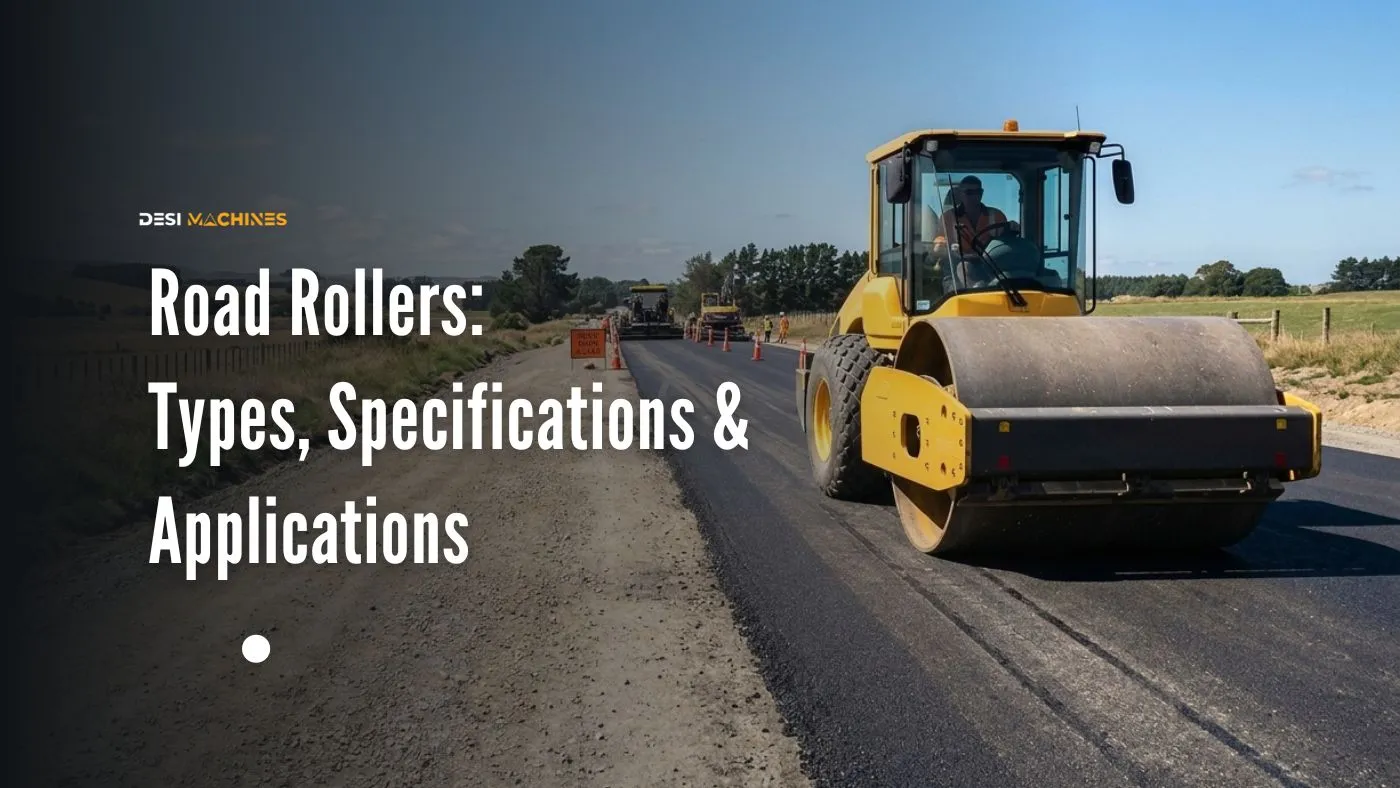
A road roller — called a compactor on most Indian sites — is the machine that turns loose soil, gravel, or hot asphalt into a stable, load-bearing surface. Without proper compaction, roads crack within months, embankments settle unevenly, and parking lots develop potholes before the first monsoon ends. Every NHAI highway package, every state PWD tender, every metro rail corridor in India depends on getting compaction right. And getting compaction right starts with choosing the correct roller for the material you’re working with.
What is a Road Roller?
A road roller is compaction equipment that uses static weight, vibration, or kneading force to reduce air voids in soil, aggregate, or asphalt — improving ground strength and stability. You’ll hear them called asphalt compactors, roller compactors, or simply “rollers” on site. The working mechanism is straightforward: a diesel engine powers one or more heavy drums (steel or rubber-tired) that roll over the material, applying downward pressure. Vibratory models add rapid oscillation to the drum, multiplying the effective compaction force without adding dead weight.
The result? Soil particles pack tighter. Air pockets collapse. The surface becomes denser, stronger, and more resistant to water infiltration. That’s the difference between a road that lasts 15 years and one that needs patching every monsoon.
Types of Road Rollers
Different materials need different compaction methods. Clay behaves nothing like sand. Hot asphalt needs a different approach than crushed aggregate. Here’s what actually works for each situation on Indian sites.
1. Vibratory Rollers
Vibratory rollers combine static weight with rapid drum vibration — typically 25–45 Hz — to achieve deep compaction of granular soils and asphalt surfaces. The vibration rearranges soil particles more effectively than weight alone, which is why these machines dominate highway construction, airport runways, and any project involving sand, gravel, or crushed stone.
Two main variants exist. Single-drum vibratory rollers (soil compactors) have one steel drum at the front and rubber tires at the rear — ideal for subgrade and base course work. Double-drum vibratory rollers (tandem rollers) have steel drums front and rear — the standard choice for asphalt compaction. On NHAI projects across Rajasthan and Madhya Pradesh, you’ll see both working in sequence: single-drum for the subgrade, tandem for the asphalt layers. The guide to tandem rollers in India covers that double-drum class in detail, from 1.6 Tonne machines up to 10 Tonne.
The compaction depth advantage is real. Vibratory rollers can compact 2.5 to 3 times faster than static rollers on granular materials. That’s not marketing — that’s the difference between finishing a highway package on schedule and paying liquidated damages.
2. Smooth Drum Rollers (Static Rollers)
Smooth drum rollers — also called static rollers — rely entirely on the weight of their steel drums for compaction. No vibration. No fancy mechanisms. Just heavy steel pressing down on the surface.
Types include single-drum static rollers and double-drum (tandem) static rollers. The tandem configuration is what you’ll see on most asphalt finishing work in India. Static rollers excel at final passes on asphalt — after the vibratory roller has done the heavy compaction, the static roller smooths the surface without risking aggregate fracture. They’re also the default choice for sidewalks, parking lots, and any application where surface finish matters more than deep compaction.
Here’s the trade-off: static rollers are slower. They need more passes to achieve the same density as vibratory machines. But for thin asphalt lifts and finishing work, that slower, gentler approach produces a better result.
3. Pneumatic Tire Rollers
Pneumatic tire rollers (PTR rollers) use multiple rubber tires — typically 7 to 11 — arranged in two rows to provide uniform pressure across the compaction width. The rubber tires create a kneading action that seals the asphalt surface, closing small cracks and improving density in the top layer. Our pneumatic tyre roller guide covers ballasting, wheel load per tyre and current India prices in detail.
The coverage advantage is significant: pneumatic rollers achieve approximately 80% surface coverage compared to 40–50% for steel drums. That kneading action also helps with asphalt finishing, pavement rehabilitation, and airport runway work where surface sealing matters. On Bharatmala projects in coastal Karnataka, PTR rollers are standard for the final compaction pass — the kneading action handles the variable aggregate better than steel drums.
Across the pneumatic rollers we list, operating weights run from 10,500 kg to 18,000 kg, and ballasting takes the heaviest of them to 30,000 kg. The L&T 2490 HD, for example, operates at 12,800 kg and can be ballasted up to 24,000 kg (24 Ton), priced around ₹35–37 Lakh (indicative, as of September 2026). Verify the figure with our team before committing.
4. Sheepsfoot Rollers (Padfoot/Tamping Rollers)
Sheepsfoot rollers — also called padfoot or tamping rollers — have rectangular lugs or “feet” projecting from the drum surface. These feet penetrate into cohesive soils like clay and silt, compacting from the bottom up rather than from the surface down.
This is the only roller type that works properly on wet clay. Ask any site incharge working on embankments near Nagpur’s black cotton soil belt. The projecting feet concentrate pressure at specific points, achieving high contact pressure that breaks up clay clods and expels trapped air. Compaction depths of 40–50 cm are achievable — far deeper than smooth drum rollers can manage on cohesive materials.
Applications include clay and silt compaction, dam embankments, foundation work, and any project involving cohesive soils. The Indian Railways’ RDSO guidelines specifically recommend sheepsfoot rollers for heavy clays and silty clays — and that recommendation exists because decades of track bed failures taught the lesson the hard way.
Compare compactor models side-by-side on Desi Machines — check specs, get transparent pricing.
Road Roller Specifications
Specs determine whether a roller is right for your project — or an expensive mistake. Here’s what actually matters.
Operating Weight
Operating weight across the rollers we list runs from 1,575 kg on a baby roller like the Dynapac CC800, for small residential and repair work, to 22,000 kg on a heavy soil compactor like the SANY SSR220C-8H, for large highway and infrastructure projects. Heavier rollers provide greater compaction force and deeper compaction capability. That’s the physics — more weight means more pressure per square centimetre.
In the Indian market, most road rollers used in construction typically range between 3 and 14 Ton depending on the application. Baby rollers like the Dynapac CC800 at 1,575 kg handle patch repairs and small areas. The mini roller (baby roller) guide covers this class in detail, from drum widths to how thin a layer it can compact. Mid-range tandem rollers like the CASE 952NX at 9,200 kg (9.2 Ton), priced around ₹32–34 Lakh (indicative, as of September 2026), handle most urban road and parking lot work. Heavy soil compactors like the Dynapac CA405D CEV-V at 13,960 kg (14 Ton) tackle highway subgrade compaction.
The math is simple: underweight roller = insufficient compaction = road failure. Overweight roller = crushed aggregate = road failure. Match the weight to the material and layer thickness.
Drum Width
Drum width determines how much area you cover per pass. Ride-on rollers we list range from 800 mm (about 31 in) on the Dynapac CC800 baby roller up to 2,150 mm (about 85 in) on the CASE 1107NX soil compactor. We do not list walk-behind rollers, so 800 mm is the narrowest drum available on our books.
Wider drums mean faster coverage on large highway projects — a 2,130 mm drum on a soil compactor covers about 1.8 times the width per pass of a 1,200 mm drum on a small tandem roller. But wider isn’t always better. Narrow drums offer better maneuverability in confined spaces, around utilities, and on urban roads with frequent obstacles. For PMAY housing projects with tight site access, an 800 mm baby roller often makes more sense than a full-size tandem.
Drum width is not the same as the width of the machine, and the two are often confused: the guide to road roller dimensions gives the overall length, width, height and ground clearance for every roller listed, which is what decides whether a machine can actually reach the work.
Compaction Depth
Compaction depth varies dramatically by roller type and weight. Light rollers compact shallow layers — 10–15 cm maximum. Heavy vibratory rollers can compact 30–40 cm in granular materials. Sheepsfoot rollers achieve 40–50 cm in cohesive soils.
This matters because compaction must happen in lifts. You can’t dump 60 cm of soil and expect any roller to compact it properly. The rule on most Indian sites: lift thickness should not exceed the roller’s effective compaction depth. Ignore this rule and you’ll have a beautifully compacted surface sitting on loose material underneath. The first heavy monsoon will show you exactly where you cut corners.
Engine Type
Modern road rollers are diesel-powered, with engine outputs ranging from 24 HP on a baby roller like the Dynapac CC800 to about 197 HP on the heaviest soil compactor we list. CEV IV and CEV V compliant engines are now standard for government tenders and NHAI specifications.
Key brands available in India include Dynapac, HAMM, Volvo, L&T, CASE, JCB, SANY, ACE, Escorts Kubota, Ammann, and XCMG. Dealer network matters as much as the brand name — a breakdown 150 km from the nearest service centre means 2–3 days of lost production, EMIs still running, client still calling. Tell us what your sites actually need before you sign anything.
How to Choose the Right Road Roller?
Selection depends on four factors: what you’re compacting, how deep, how fast you need to finish, and how much space you have to work. Get any of these wrong and you’re either renting a second machine mid-project or explaining delays to the client.
Soil Type & Material
Match the roller to the material. Every time.
- Clay and silt: Sheepsfoot (padfoot) rollers — the projecting feet penetrate cohesive soils that smooth drums just ride over
- Granular soils (sand, gravel, crushed stone): Vibratory rollers — vibration rearranges particles for maximum density
- Asphalt: Smooth drum tandem rollers for compaction, pneumatic tire rollers for finishing and sealing
- Coarse soils with rock fragments: Grid rollers — though these are less common on Indian sites
Am I overcomplicating this? No. Using the wrong roller type is how contractors end up with failed compaction tests and rejected work. The material dictates the machine. Simple as that.
Layer Thickness
Shallow layers (under 20 cm) work fine with light single-drum rollers or tandem rollers. Deep layers — 40–50 cm — require heavy vibratory rollers or padfoot rollers. There’s no shortcut here.
The mistake I see constantly: contractors trying to compact 40 cm lifts with a 9 Ton tandem roller because that’s what they have on site. The surface looks fine. The compaction test fails. They bring in a heavier machine, recompact, and lose three days. Making do with whichever roller is already on site does not work for compaction.
Project Size & Timeline
Large highway projects need heavy rollers with wider drums, 1,675 mm to 2,150 mm, to cover ground efficiently. A 10 km highway package worked with an 800 mm baby roller would take months longer than necessary.
Small driveways and residential work need rollers under 3 Ton (3,000 kg). The CASE 450NX baby roller at 2,900 kg, priced around ₹15–18 Lakh (indicative, as of September 2026), handles most residential and small commercial work. Faster project completion requires higher capacity machines. That’s the trade-off: bigger machine = higher rental/ownership cost but faster completion.
Operating Space
Confined areas — urban roads, utility corridors, around existing structures — need combination rollers or single-drum machines with high maneuverability. Articulated steering helps in tight spaces.
Open highways and large sites benefit from tandem/double-drum rollers that cover more area per pass. The efficiency gain on open ground is significant — but that same wide roller becomes a liability when you’re working around manholes, kerbs, and utility boxes.
Whatever the size class, the setting that decides compaction depth is amplitude. The guide to vibratory rollers covers what those spec-sheet numbers mean on site.
For a closer look at the two ways a drum can compact, read our guide to static vs vibratory rollers.
If you are choosing a machine rather than learning the type, the compactor buying guide sets the listed soil compactors, tandem rollers and pneumatic rollers side by side on weight, drum width and price.
If you want to know what each part of the machine actually does before you compare models, the guide to road roller parts and components explains the drum, the eccentric vibration unit inside it, the hydrostatic drive and the water spray system.
Engine ratings across these roller types are set out class by class in the guide to road roller engine power, which counts the HP band of every roller listed and explains why more horsepower does not mean better compaction.
Price note: all figures above are indicative, dated September 2026 and taken from listings on DesiMachines at the time of writing. Diesel-price changes, emission-norm variants (CEV Stage IV/V), drum type and dealer offers all move the number. Prices, specifications and features are indicative, vary by variant, location and date, and should always be confirmed with the official OEM or authorised dealer before any purchase decision. DesiMachines is not liable for decisions taken on the basis of information that may have changed after publication.
Rollers are the machines that stay for the whole contract, and our guide to road construction equipment shows where each roller type fits in the sequence.

