Excavator
  Backhoe Loader
  Motor Grader
  Wheel Loader
  Crane
Crane  Concrete Mixer
  Compactor
  Skid Steer Loader
  Concrete Pump
  Telehandler


Every road you drive on, every foundation that holds a building, every airport runway that handles 200-ton aircraft — all of it starts with compaction. Get it wrong, and the asphalt cracks within two monsoons. Get it right, and the surface lasts 15–20 years with minimal maintenance. The difference? Choosing the right type of compactor for the job — and following a complete compactor buying guide before making that investment.
In India, compactors — commonly called road rollers — are the backbone of infrastructure projects. From NHAI highway packages to Smart City road upgrades, from PMAY housing foundations to industrial park development, compaction equipment determines whether your earthwork holds or fails. And here’s the thing most contractors learn the hard way: there’s no universal compactor. A machine that excels on sandy soil in Rajasthan will struggle on black cotton soil near Nagpur. Jaise site, waisi machine.
This guide breaks down every type of compactor available in the Indian market — soil compactors, tandem rollers, pneumatic tyre rollers, sheepsfoot rollers, and more. You’ll understand which machine works for which application, what specs matter, and how to avoid the ₹5–10 Lakh mistakes that come from buying the wrong equipment.
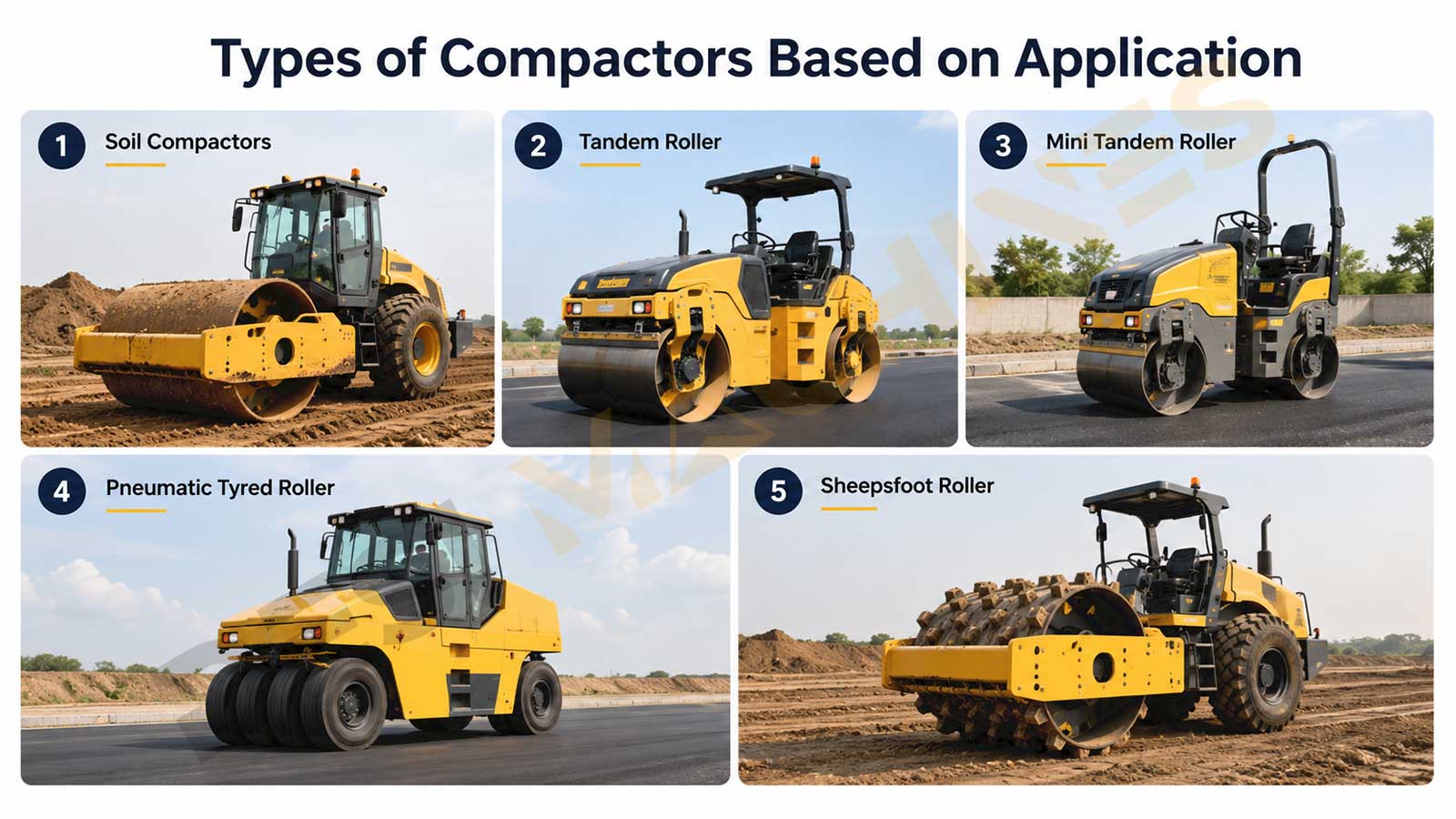
Types of Compactors Based on Application
Compactors are classified primarily by what they compact and where they’re used. A machine designed for deep soil compaction on highway embankments works completely differently from one built for finishing asphalt surfaces. Understanding this classification helps you match equipment to your specific project requirements.
1. Soil Compactors
Soil compactors — also called single drum rollers or single drum vibratory rollers — are the workhorses of earthwork projects. They feature a heavy steel drum at the front and rubber tyres at the rear, combining vibratory compaction with the manoeuvrability needed for uneven terrain.
These machines excel at compacting embankments, subgrades, and base layers. The single drum design allows them to work on slopes and confined areas where tandem rollers would struggle. Operating weights range from 9,700 kg to 22,000 kg, with the 10–12 Ton segment being most popular for Indian highway projects. Many contractors compare different soil compactor models in India before finalizing the right machine for their site conditions and budget.
Typical specifications:
- Operating weight: 9,700–22,000 kg
- Engine power: 74–197 HP
- Drum width: 2,100–2,200 mm
- Centrifugal force: 180–350 kN
Popular models in India include the JCB VM117 (₹36–38 Lakh indicative), Dynapac CA305 CEV-V (₹34–36 Lakh indicative), and SANY SR110C-10 PRO (₹31–33 Lakh indicative). The L&T 1190 at ₹27–29 Lakh indicative offers strong value for contractors watching their budget.
2. Tandem Roller
The tandem roller — also called a double drum roller, vibratory roller, or asphalt compactor — features two steel drums of equal size, one at the front and one at the rear. Both drums are powered and can vibrate independently or together.
Unlike soil compactors, tandem rollers are built for surface finishing. They’re the machine you see making final passes on freshly laid asphalt, creating that smooth, even surface. The twin-drum design provides excellent operator visibility and consistent compaction across the full width.
Understanding tandem roller price and specs is essential before selecting the right model, as performance and cost vary based on drum size, vibration force, and brand.
Key applications:
- Asphalt compaction on roads, highways, and parking lots
- Base course finishing
- Driveways and residential streets
- Airport taxiways and runways
Operating weights for full-size tandem rollers range from 8,700 kg to 10,000 kg, with drum widths of 1,200–1,700 mm. The Volvo DD90 (₹42–44 Lakh indicative) and Dynapac CC425 CEV-V (₹35–37 Lakh indicative) are premium choices. For budget-conscious contractors, the SANY TR90C-10 PRO at ₹32–34 Lakh indicative delivers solid performance.
3. Mini Tandem Roller
Mini tandem rollers — commonly called baby rollers — are compact double drum machines weighing 1,500–3,500 kg. They’re designed for confined spaces, patch repairs, and small-scale projects where full-size rollers can’t operate.
These machines are essential for municipal work, footpath construction, trench backfilling, and residential projects. Their compact size allows them to work in spaces as narrow as 600–800 mm, making them indispensable for urban contractors. If you’re planning a purchase, understanding the baby roller price in India helps compare models and choose the right machine within budget.
Popular baby roller models:
- Dynapac CC800 — 1,575 kg — ₹13–17 Lakh (indicative)
- CASE 450NX — 2,900 kg — ₹15–18 Lakh (indicative)
- JCB VMT330 — 3,300 kg — ₹15–20 Lakh (indicative)
- L&T 491 — 3,450 kg — ₹15–17 Lakh (indicative)
- Escorts Kubota EC3664 — 3,300 kg — ₹12–16 Lakh (indicative)
For contractors handling Smart City projects or municipal tenders, a baby roller is often mandatory equipment. *Budget mein fit hota hai* — and the ROI comes fast on urban jobs.
4. Pneumatic Tyred Roller
The pneumatic tyre roller (PTR roller) uses multiple rubber tyres instead of steel drums to achieve compaction through a kneading action. This design creates a different compaction effect — the tyres flex and overlap, sealing the surface and eliminating air voids that steel drums might miss.
PTR rollers typically have 4–5 tyres at the front and 5–6 at the rear, arranged in a staggered pattern so every point on the surface gets covered. Tyre pressure is adjustable (typically 3–9 bar), and ballast can be added to increase operating weight from 10,000 kg to over 24,000 kg.
Best applications:
- Intermediate and finishing passes on asphalt layers
- Fine-grained soils (silt, clay mixtures)
- Airport runways requiring superior surface sealing
- Projects where surface texture matters
The L&T 2490 HD (₹35–37 Lakh indicative) handles operating weights up to 24,000 kg when ballasted. The SANY SPR260C-10 PRO at ₹30–40 Lakh indicative offers 26,000 kg ballasted weight for heavy-duty applications. Dynapac CP275 (₹25–30 Lakh indicative) provides 30,000 kg ballasted capacity for major infrastructure projects. Contractors often compare different PTR roller models to match tyre pressure range, ballast capacity, and project requirements.
5. Sheepsfoot Roller
The sheepsfoot roller — also called a padfoot roller — features a drum covered with protruding rectangular or tapered feet. These projections penetrate into the soil, compacting from the bottom up rather than from the surface down.
This inside-out compaction is critical for cohesive soils like clay and silt. Smooth drums simply slide over clay surfaces without achieving deep compaction. The sheepsfoot’s projections break up soil clods, expel air from lower layers, and create a thoroughly compacted lift. For a deeper look at this machine, read our full guide to the sheepsfoot roller.
Where sheepsfoot rollers excel:
- Black cotton soil compaction (common in Maharashtra, Karnataka, MP)
- Clay-heavy embankments
- Landfill compaction
- Dam and reservoir construction
Sheepsfoot drums are available as attachments for single drum compactors. Models like the Dynapac CA405PS CEV-V (₹34–36 Lakh indicative) come with padfoot drum options. For contractors working extensively in central India’s black cotton soil belt, a sheepsfoot configuration isn’t optional — it’s essential.
Compare compactor models side-by-side on Desi Machines — check specs, get transparent pricing, and connect with Desi Machines.
Types of Compactors Based on Size and Mobility
Beyond application type, compactors are classified by their size and how they’re operated. This classification determines which projects a machine can handle and how much ground it covers per shift.
1. Ride-On Compactors
Ride-on compactors feature an operator cabin or seat, allowing the operator to control the machine while seated. These medium-to-large machines are the standard for most commercial construction projects.
The category includes:
- Single drum rollers — 9–14 Ton operating weight, used for soil and base compaction
- Tandem rollers — 8–10 Ton operating weight, used for asphalt finishing
- Pneumatic tyre rollers — 10–26 Ton operating weight (with ballast)
Applications: State PWD road projects, NHAI highway packages, industrial park development, airport construction, large residential townships. Any project covering more than 500 metres of road length typically requires ride-on equipment for productivity.
Operator comfort matters on 10–12 hour shifts. Modern ride-on compactors from JCB, Dynapac, and Volvo include air-conditioned cabins, ergonomic controls, and vibration-dampened seats. That’s not luxury — it’s productivity. A fatigued operator makes mistakes, and mistakes on compaction show up as failures two monsoons later.
2. Heavy-Duty/Large Compactors
Heavy-duty compactors are the largest machines in the category, designed for major infrastructure projects where production speed and compaction depth are critical.
Specifications for heavy-duty soil compactors:
- Operating weight: 13,000–22,000 kg
- Engine power: 120–200 HP
- Drum width: 2,100–2,200 mm
- Compaction depth: 400–600 mm per lift
The SANY SR220C-8H at 22,000 kg operating weight represents the upper end of what’s commonly used on Indian highway projects. Dynapac CA405D CEV-V (13,960 kg) and HAMM HC 139iD (13,160 kg) handle the 13–14 Ton segment that’s popular for Bharatmala and Sagarmala projects.
Project suitability: National highway construction, expressway projects, airport runways, large dam embankments, port development. These machines cover 2,000–3,000 square metres per hour under optimal conditions.
Types of Compactors Based on Compaction Method
The mechanism that applies compactive force determines which soil types a machine handles effectively. This is where many contractors make expensive mistakes — using the wrong compaction method for their soil type.
1. Vibratory Compactors
Vibratory compactors use eccentric weights rotating at high speed inside the drum to generate rapid vibrations. These vibrations — typically 25–45 Hz frequency — cause soil particles to rearrange into a denser configuration.
The vibration mechanism works by momentarily liquefying granular soils, allowing particles to settle into tighter arrangements. This achieves deeper compaction than static weight alone — often 300–600 mm per lift compared to 150–200 mm for static rollers.
Types of vibratory equipment:
- Vibratory single drum rollers — Most common for earthwork, 10–14 Ton class
- Vibratory tandem rollers — Standard for asphalt, 8–10 Ton class
Best for: Granular soils (sand, gravel, crushed stone), asphalt base courses, well-graded materials. Vibratory compaction is the default choice for 70% of Indian construction projects.
But here’s where contractors go wrong. Vibration doesn’t work well on cohesive soils. Clay particles don’t rearrange under vibration — they just bounce. If your site has clay content above 20%, you need a different approach. Ask any site incharge who’s tried to vibrate black cotton soil. Doesn’t work.
2. Pneumatic/Rubber Tire Compactors
Pneumatic compactors achieve compaction through a kneading action. Multiple rubber tyres (typically 4–6 front, 5–7 rear) flex and overlap as they roll, working the material from multiple angles.
This kneading action is particularly effective for:
- Fine-grained soils — Silt and clay mixtures respond well to kneading
- Asphalt intermediate layers — Seals the surface, eliminates air voids
- Cohesive materials — Where vibration alone doesn’t achieve density
The variable tyre pressure system (3–9 bar adjustable) allows operators to match compaction intensity to material requirements. Lower pressure for initial passes, higher pressure for finishing. Ballast compartments add weight — the L&T 2490 HD goes from 12,800 kg operating to 24,000 kg fully ballasted.
Key advantage: Uniform compaction and superior surface sealing. PTR rollers leave a tighter surface that resists water infiltration — critical for projects in high-rainfall areas like coastal Karnataka or Kerala.
Detailed Breakdown of Major Compactor Types
Now let’s go deeper into the machines you’ll actually encounter on Indian job sites. This section covers specifications, working mechanisms, and practical guidance for the most commonly used compactor varieties. For a closer look at the drum machines on their own, see road roller types and their specifications.
Smooth Wheel Roller Compactors
Smooth wheel rollers — whether single drum or tandem — use cylindrical steel drums with a smooth surface to apply compactive force. They’re the most versatile compactor type and handle the widest range of applications.
Design configurations:
- Single drum — Steel drum front, rubber tyres rear. Better traction on slopes, more manoeuvrable on uneven ground.
- Tandem drum — Steel drums front and rear. Superior finish quality, better for flat surfaces.
Weight ranges available in India:
- Mini/Baby rollers: 1,500–3,500 kg
- Light tandem: 8,000–10,000 kg
- Standard single drum: 10,000–12,000 kg
- Heavy single drum: 13,000–22,000 kg
Static vs vibratory: Static rollers rely purely on weight. Vibratory models add high-frequency vibration for deeper compaction. For most Indian projects, vibratory is standard — static rollers are used mainly for finishing passes on asphalt where vibration might damage the surface.
Best practices:
- Maintain 10–15% overlap between passes
- Start from edges and work toward centre on crowned roads
- Keep water spray system functional — dry drums pick up asphalt
- Reduce speed on final passes for better finish
Pneumatic Tire Roller Compactors
Wait — let me back up. I covered PTR basics earlier, but the practical details matter more than the theory.
Tyre configuration: Front axle carries 4–5 tyres, rear axle carries 5–6 tyres. The staggered arrangement ensures 100% coverage — no strip of surface goes uncompacted. Tyre spacing is adjustable on some models.
Ballast system: Empty compartments in the frame accept sand, water, or steel plates to increase operating weight. This flexibility is the PTR’s biggest advantage — one machine handles light finishing work (10,000 kg) and heavy compaction (24,000–30,000 kg) depending on ballast loading.
Applications in India:
- NHAI projects requiring superior surface sealing
- Airport runway construction (AAI specifications often mandate PTR passes)
- Coastal road projects where water infiltration is a concern
- Urban roads with high traffic loads
The kneading action also helps with fine-grained soils that don’t respond to vibration. On sites with mixed soil conditions — sandy patches alternating with clay — a PTR often achieves more consistent results than a vibratory roller.
Sheepsfoot/Padfoot Roller Compactors
The sheepsfoot drum’s protruding feet — typically 100–150 mm long — penetrate into the soil layer and compact from the bottom up. As the roller makes multiple passes, the feet gradually “walk out” of the soil as lower layers densify. When the feet no longer penetrate, compaction is complete.
Why projections work for cohesive soils: Clay particles have cohesion — they stick together. A smooth drum compacts only the surface, leaving lower layers loose. The sheepsfoot’s feet break through the surface, apply pressure at depth, and force air out of lower layers. This inside-out compaction is the only effective method for high-plasticity clays.
Applications:
- Black cotton soil (expansive clay) — Maharashtra, Karnataka, Madhya Pradesh, Telangana
- Silty clay embankments
- Landfill compaction — the feet help integrate waste layers
- Dam cores and reservoir linings
Static vs vibratory padfoot: Static padfoot rollers work well for highly plastic clays. Vibratory padfoot combines penetration with vibration for mixed soils (clay with some sand/gravel content). The Dynapac CA405PS CEV-V offers both modes.
Tandem Rollers
The twin-drum design is what makes tandem rollers the default choice for asphalt work. Both drums are powered, both can vibrate, and the operator has clear visibility to both edges of the compaction path.
Size range in India:
- Walk-behind mini: 600–1,000 kg — trench work, patch repairs
- Baby rollers: 1,500–3,500 kg — municipal work, footpaths, driveways
- Standard ride-on: 8,000–10,000 kg — road construction, parking lots
Advantages:
- Excellent surface finish — no drum marks, uniform texture
- Superior operator visibility — critical for edge work
- Versatility — handles base, binder, and wearing courses
- Articulated steering — tight turning radius for confined areas
For asphalt contractors, a tandem roller is non-negotiable equipment. You might rent a soil compactor for occasional earthwork, but the tandem roller runs every day during paving season. *Kaam ka machine* — that’s what experienced contractors call it.
On granular soil it is the drum’s shaking, not its dead weight, that does most of the work. The guide to vibratory rollers explains how amplitude and frequency decide how deep that force reaches.
For the small, tight jobs a roller cannot reach, such as paver bedding, footpaths and trench backfill, a plate compactor is the right tool.
Ready to find the right machine for your project? Explore all compactor models and request a quote on Desi Machines