Excavator
294 models
Excavator
294 models  Backhoe Loader
51 models
Backhoe Loader
51 models  Crane
68 models
Crane
68 models  Concrete Mixer
79 models
Concrete Mixer
79 models  Wheel Loader
54 models
Wheel Loader
54 models  Compactor / Roller
45 models
Compactor / Roller
45 models  Motor Grader
42 models
Motor Grader
42 models  Concrete Pump
66 models
Concrete Pump
66 models  Skid Steer Loader
11 models
Skid Steer Loader
11 models  Telehandler
13 models
Telehandler
13 models  Dozer
Dozer 


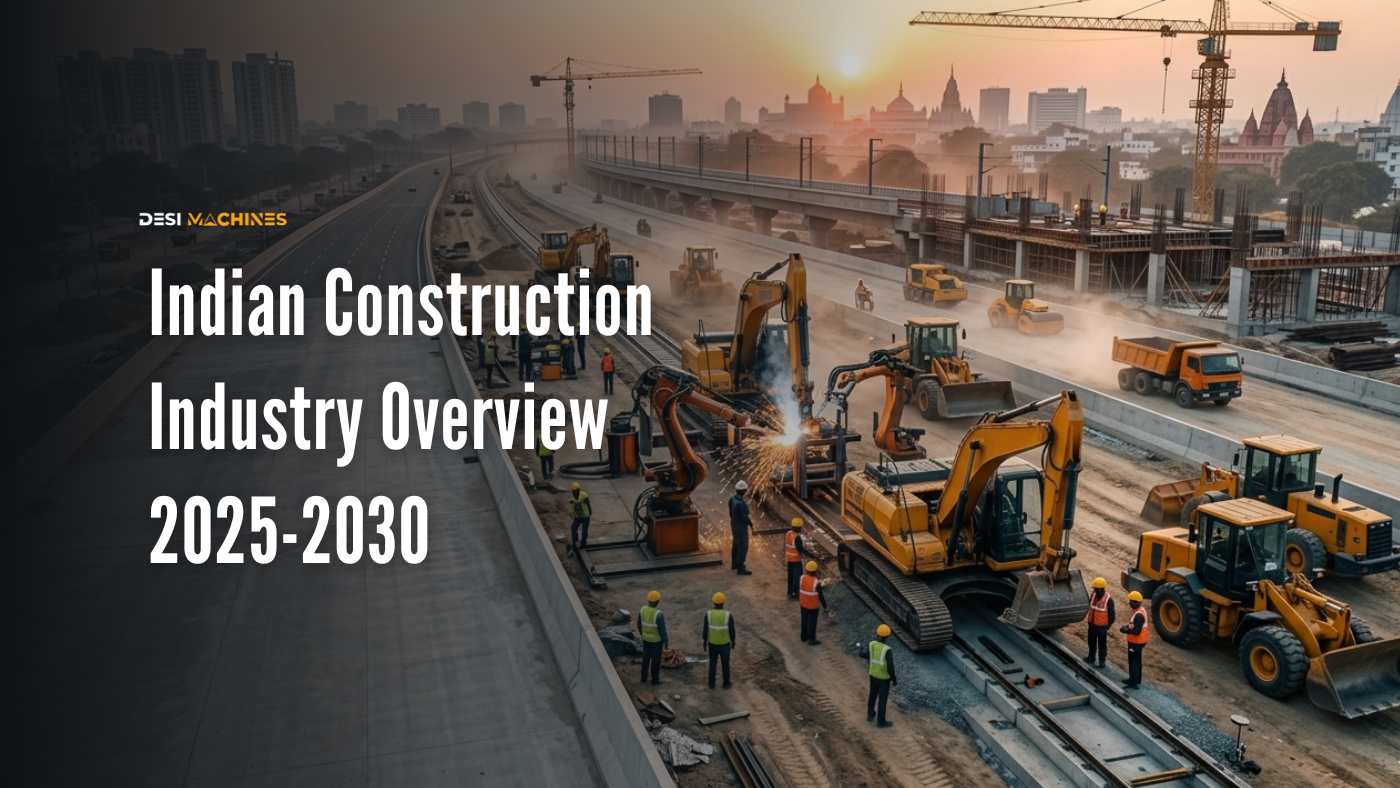
The Indian construction industry is the sector that builds the country’s roads, metros, housing, factories and power infrastructure. It is in the middle of a transformation that most contractors haven’t seen in their careers. The market hit USD 1.21 trillion in 2025 — up 11.2% from the previous year — and projections point to USD 2.13 trillion by 2030 at a 12.1% CAGR. That’s not a forecast buried in a government document. That’s the ground reality playing out on highway sites from Rajasthan to Tamil Nadu, metro corridors in Bengaluru and Hyderabad, and housing projects in tier-2 cities most people couldn’t locate on a map five years ago.
The sector now contributes roughly 8% to India’s GDP and employs over 50 million people. By 2030, some analysts expect it to account for 15% of GDP and employ more than 70 million. Government initiatives — the National Infrastructure Pipeline, Smart Cities Mission, Pradhan Mantri Awas Yojana — aren’t just policy announcements. They’re translating into contract awards, equipment procurement cycles, and sustained demand for excavators, wheel loaders, compactors, and cranes across every region.
This overview covers what contractors, fleet owners, and equipment buyers need to understand: market dynamics, sector breakdowns, regional hotspots, technology shifts, and where the equipment demand is heading through 2030. Compare first, then buy — and that starts with understanding where the work actually is.
Market Size and Growth Projections (2025-2030)
The numbers vary depending on which research firm you ask, but the direction is consistent: India’s construction market is expanding faster than most Asian economies and shows no signs of slowing through the decade.
Current Market Valuation in 2025
The Indian construction market reached USD 1.21 trillion in 2025, up from USD 1.04 trillion in 2024 — an 11.2% year-on-year jump. In rupee terms, that’s approximately INR 22.77 trillion, though some reports place it higher at INR 25.31 trillion depending on exchange rate assumptions.
Construction output expanded 8.1% in real terms in 2025, with projections of 6.4% growth in 2026. The Union Budget FY 2025-26 allocated INR 11.21 lakh crore (USD 128.64 billion) for infrastructure — a 3.1% share of GDP dedicated purely to building.
Here’s what that means on the ground: more highway packages getting awarded, more metro rail extensions breaking ground, more housing projects moving from sanction to construction. The industrial production index for infrastructure and construction goods grew 8.4% year-on-year in the first ten months of 2025. Equipment demand follows that curve — not immediately, but within 6-12 months as projects move from tender to execution.
Projected Market Growth Through 2030
The optimistic projection: USD 2.13 trillion by 2030 at a 12.1% CAGR. The conservative projection: USD 1.10 trillion by 2031 at a 6.87% CAGR. Both can be true depending on how you define the market boundaries and which segments you include.
What matters for equipment buyers: even the conservative estimate means 6-7% annual growth sustained over five years. That’s not a boom-bust cycle. That’s structural demand.
The growth phases break down roughly like this:
- 2025-2027: Acceleration phase — infrastructure spending peaks, highway and metro projects in full execution, residential demand rebounds in tier-2 cities
- 2027-2029: Stabilisation phase — average annual growth moderates to 6.1% as base effects kick in, but absolute volumes remain high
- 2029-2030: Maturation phase — India potentially becomes the world’s second-largest construction market by volume
For contractors and fleet owners, this translates to sustained equipment utilisation rates. Machines bought in 2025-26 will see full running hours through their depreciation cycle. That’s the math that matters when you’re evaluating a medium-class (15–25 Ton / 15,000–25,000 kg) excavator, where the models we list run ₹50–94 Lakh (indicative, as of Sep 2026).
Compare excavator models side-by-side on Desi Machines — check specs, get transparent pricing.
Key Sectors Driving Growth
Not all construction is equal. Infrastructure dominates spending, but residential drives volume. Commercial is where the margins are. Understanding the sector mix helps you position equipment for the right projects.
Infrastructure Construction
Infrastructure accounts for 55.32% of 2025 construction spending with a projected 9.49% CAGR through 2031. This is where the big equipment works — excavators above 20 Ton (20,000 kg), motor graders, large wheel loaders, crawler cranes.
Transportation corridors make up roughly 38% of infrastructure spending. Highway contract awards totalled 8,500 kilometres in 2025 alone. The Mumbai-Ahmedabad High-Speed Rail, Chennai-Bengaluru Expressway, and Delhi-Mumbai Industrial Corridor Phase II (USD 2.4 billion) are the headline projects, but the real volume is in state highway upgrades and rural road connectivity under Bharatmala.
Renewable energy infrastructure is the fastest-growing sub-segment. India added significant solar-wind capacity in 2025, targeting 500 GW of non-fossil fuel capacity by 2030. Wind energy capacity alone has grown from 21 GW in 2014 to 52.68 GW by August 2025. Solar and wind farm construction requires earthmoving equipment, access roads, foundation work — steady demand for excavators and wheel loaders in Gujarat, Rajasthan, Tamil Nadu, and Karnataka.
Power transmission and grid infrastructure saw USD 2.16 billion in high-voltage transmission awards. Bihar approved 11 new satellite cities. Every megawatt of renewable capacity needs transmission infrastructure to evacuate power — that’s civil construction work that doesn’t make headlines but keeps equipment running.
Equipment implications: 20-25 Ton excavators (JCB NXT 205, SANY SY210C-9, Tata Hitachi EX210LC Prime), motor graders for road formation, wheel loaders for material handling, and cranes for bridge and transmission tower erection.
Residential Construction
The India Residential Construction Market was valued at USD 263.89 billion in 2025, which is roughly 22% of the country’s USD 1.21 trillion construction spend. Read the headline sector split carefully. The 44.68% that sits outside infrastructure is not residential alone. It covers every building segment put together: residential, commercial, industrial and institutional.
The demand driver is simple: 600 million people expected in urban centres by 2030, creating demand for approximately 25 million residential units. That’s not a projection — that’s demographic reality.
Pradhan Mantri Awas Yojana-Urban (PMAY-U) has sanctioned 1.18 crore houses, with 86.6 lakh completed as of September 2024. The government approved 1.41 lakh additional homes under PMAY-Urban 2.0 in October 2025. Under PMAY-Gramin, 2.82 crore rural houses have been completed out of a 4.95 crore target.
Tier-2 and tier-3 cities are where the action is shifting. Lucknow, Indore, Jaipur, Coimbatore, Visakhapatnam — these markets are seeing residential construction volumes that rival metros from five years ago. Affordable housing dominates, but mid-segment is growing.
Technology adoption remains low but is changing. Prefabricated construction holds only 2-3% market share currently, but developers are investing in precast technology for faster project completion. Aluminum formwork adoption is increasing for repetitive floor construction.
Equipment implications: backhoe loaders (JCB 3DX remains the default), concrete mixers including self-loading concrete mixers (SLCMs), mini excavators for basement excavation in constrained urban sites, and compact equipment for interior work.
Commercial Construction
The commercial construction market reached USD 181.31 billion in 2025, projected to grow to USD 240.58 billion by 2030 at 5.82% CAGR. Office space leads with 61.5% revenue share.
The data centre boom is the story within the story. India’s data centre capacity hit 1.3 GW in 2025, with 2.9 GW more expected by 2030. The India Data Center Construction Market is estimated at USD 9.38 billion in 2025, expected to reach USD 35.82 billion by 2031 at a 25.03% CAGR. Maharashtra’s data-centre corridor is attracting billions from AWS, Microsoft, and Google.
Industrial and logistics is the fastest-growing commercial sub-segment at 7.1% CAGR, driven by e-commerce fulfilment centres and manufacturing relocation. West India commands 40.77% of 2025 commercial spending.
REITs (Real Estate Investment Trusts) are changing how commercial projects get financed and built — USD 1.72 billion in distributions, USD 7.47 billion gross asset base. Tax incentives are making institutional-grade office development more attractive.
Equipment needs: tower cranes (not currently on Desi Machines), material handling equipment, and specialised machinery for data centre construction including precision earthmoving and foundation work.
Industrial Construction
Manufacturing plants, warehouses, power plants, refineries, chemical plants — industrial construction is where heavy earthmoving equipment earns its keep.
Warehousing demand is projected at 159 million square feet by 2047 at 4% CAGR. Madhya Pradesh received INR 366 billion (USD 4.4 billion) in industrial development investment proposals in November 2025. Singapore’s CapitaLand is investing INR 192 billion (USD 2.3 billion) in Maharashtra for business parks, data centres, logistics, and industrial parks by 2030.
Defence corridors in Uttar Pradesh and Tamil Nadu are creating demand for specialised industrial construction — avionics labs, composites foundries, precision manufacturing facilities. These projects require heavy earthmoving for site preparation, followed by specialised industrial construction.
Refinery expansions by Indian Oil, Bharat Petroleum, and Hindustan Petroleum are booking USD 1.8 billion in Odisha alone. The Dankuni-Kharagpur corridor has USD 960 million allocated for automotive manufacturing infrastructure.
Equipment requirements: large excavators (25-50 Ton class), heavy-duty wheel loaders, material handling equipment, and specialised industrial machinery.
Institutional Construction
Healthcare, education, and research infrastructure is expanding rapidly. New AIIMS hospitals, IITs, IIMs, and PM SHRI schools are under construction across the country. Government capital expenditure of USD 135.1 billion for FY 2025-26 supports institutional projects.
Smart Cities Mission has completed 7,555 projects (94% of total 8,067 projects) amounting to ₹1,51,361 crore as of May 2025. That includes 1,740 km of smart roads and 1,320+ public space projects.
Urban Infrastructure Development Fund allocated USD 1.2 billion in 2025 for metro-rail, BRT, and water upgrades in cities of 0.5-2 million people. Public-private partnerships are accelerating specialty hospitals and research facilities. Green campus initiatives are driving sustainable construction practices in educational institutions.
Regional Market Dynamics
Geography matters for equipment buyers. Dealer proximity, spare parts availability, and project concentration vary dramatically across regions. Understanding where the work is helps you position equipment — and negotiate better service terms.
West India: Leading Market Share
West India commands 40.77% of 2025 construction spending. Maharashtra leads with its data-centre corridor attracting major cloud providers, Mumbai Metro Line 3 commissioning extending the network to 180 km, and sustained commercial real estate demand in Mumbai and Pune.
Gujarat is India’s renewable energy hub. The state added 12 GW of solar-wind capacity, capturing 45% of new solar megawatts along with Rajasthan thanks to high irradiation levels. The Delhi-Mumbai Industrial Corridor Phase II impacts Gujarat, Rajasthan, and Maharashtra simultaneously.
Equipment demand is concentrated here. JCB, Tata Hitachi, SANY, and Hyundai all have strong dealer networks across Maharashtra and Gujarat. Service response times are typically 24-48 hours in major cities, 48-72 hours in district headquarters. Tell us what you need — and verify service centre locations before committing to any major purchase.
South India: Fastest Growing Region
South India is projected to expand at 7.87% CAGR through 2030. Technology corridors in Bengaluru, Hyderabad, and Chennai are driving commercial construction demand. IT hub expansion means Grade-A office space, data centres, and supporting infrastructure.
Offshore wind projects with 10 GW seabed leases off Tamil Nadu are slated for construction starting 2027. That’s a new category of construction work requiring specialised equipment and coastal logistics.
Major investments include Eli Lilly’s Global Capability Centre in Hyderabad and Brigade Enterprises’ INR 4,500 crore housing project. Renewable energy infrastructure across Karnataka and Tamil Nadu is creating sustained demand for earthmoving equipment.
The south has strong dealer networks for most major brands. Hyundai and Volvo have particularly good coverage in Karnataka and Tamil Nadu. Kobelco has a loyal following in Andhra Pradesh and Telangana.
East India: Emerging Opportunities
East India is projected to grow at 7.24% CAGR through 2031. The Eastern Dedicated Freight Corridor — 1,200 kilometres — is anchoring petrochemical and metal clusters in Odisha and West Bengal.
Refinery expansions by Indian Oil, Bharat Petroleum, and Hindustan Petroleum are booking USD 1.8 billion in Odisha. The Dankuni-Kharagpur corridor has USD 960 million allocated for automotive manufacturing.
Infrastructure catch-up is creating equipment demand in states that historically lagged. But — and this matters — dealer networks are thinner. Service response times can stretch to 4-5 days in remote areas. Factor that into your equipment selection. A machine with a 48-hour service guarantee in Kolkata might mean 96 hours in Rourkela.
North India and Tier-2/3 Cities
Growing infrastructure allocations to tier-2 and tier-3 cities are broadening the geographic base of construction activity. Road development in Delhi received INR 260.7 billion (USD 3.1 billion) for 128 km of roads in August 2025.
Bihar’s 11 new satellite cities — including Sonepur and Sitapuram greenfield projects — represent a new category of construction demand in states that previously saw limited activity. Metro-rail and water infrastructure expansion is moving beyond the eight metro cities into Lucknow, Kanpur, Patna, and Jaipur.
This broadening matters for equipment buyers. Markets that were too small to support dedicated dealer infrastructure five years ago now have service centres. But verify before buying — call the service centre directly, not the sales team. Ask how many mechanics they have within 100 km of your site.
Technology and Innovation Trends
Digital transformation is changing how construction projects get planned, executed, and managed. For equipment buyers, this means new capabilities to evaluate and new questions to ask dealers.
Digital Technologies: BIM, AI, and IoT Integration
The National Building Information Management (BIM) Program launched in September 2022 by NIBS is pushing digitalisation across infrastructure projects. BIM adoption is improving project planning, efficiency, coordination, and communication — though adoption rates remain low outside major contractors and government projects.
Construction technology investment is predicted to reach USD 10 billion by end of 2025. That includes AI-driven project management, lifecycle cost analysis, and ROI calculations. IoT and telematics are becoming standard on new equipment — fleet tracking, fuel consumption monitoring, machine health, and productivity measurement in real-time.
Digital twin modelling is gaining traction on large infrastructure projects. Drone-enabled progress monitoring and surveying are now common on highway and metro projects. These technologies don’t change what equipment you need, but they change how you track utilisation and plan maintenance.
For equipment buyers, the question is: does the machine have telematics capability? Can you track running hours, fuel consumption, and maintenance alerts remotely? Most new machines from JCB, SANY, Tata Hitachi, and Hyundai offer this. Verify what’s included versus what’s an add-on.
Green and Sustainable Construction
India’s green building market is projected to reach USD 85 billion by FY32 at a 10.50% CAGR. The Indian Green Building Council (IGBC) is driving certifications, with leasing activity in certified buildings exceeding new supply by around 6% between 2020 and H1 2025.
The renovation segment is expanding at 7.96% CAGR as 1990s towers pursue LEED and GRIHA upgrades. Green building retrofits are creating a specialty contractor niche with 20-25% pricing premiums.
Electric and hybrid construction equipment is gaining traction. LiuGong offers electric excavators including the 908FE EV (7,600 kg) at ₹33–38 Lakh and the 926FE EV (26,000 kg) at ₹72–80 Lakh (both indicative, as of Sep 2026). SANY has the SY215EP electric excavator. Stricter emission norms are driving the shift toward eco-friendly machinery.
Maharashtra targets 50% energy from renewable sources by 2030. India targets carbon neutrality by 2070. ESG-linked lending by the Reserve Bank of India is pushing emissions reporting and recycled material use. These aren’t distant policy goals — they’re affecting tender specifications today.
Modular and Prefabricated Construction
Precast construction holds only 2-3% market share currently, but it’s growing rapidly. Aluminum formwork adoption is increasing, though limitations in repetitions and modularity remain.
Developers are investing in precast technology infrastructure for structural requirements. Government agencies are promoting precast for faster project completion — particularly relevant for mass housing under PMAY where speed matters.
The benefits are clear: reduced project timelines, lower costs, improved quality control, less site labour dependency. Integration with digital workflows and off-site fabrication is creating what some call “Construction 4.0” — combining IoT, automation, factory-based manufacturing, and advanced project management.
Equipment implications differ for modular construction. Less on-site earthmoving, more material handling and precision placement. If your clients are moving toward prefab, your equipment mix needs to shift accordingly.
Smart Construction Equipment and Connectivity
Telematics and connected equipment are reducing downtime, lowering operational costs, and increasing ROI. Real-time fleet management systems let you track every machine across multiple sites. Predictive maintenance through machine health monitoring catches problems before they become breakdowns.
India is the 3rd-largest construction equipment market globally with USD 9.5 billion turnover and 26% growth in FY24. Per ICEMA, the industry is projected to become the 2nd-largest by 2030 with a market size of USD 25 billion.
The Indian construction equipment market size is expected to grow from USD 8.55 billion in 2025 to USD 9.24 billion in 2026. Another projection puts it at USD 15.37 billion in 2025, reaching USD 29.50 billion by 2034 at 7.52% CAGR.
When comparing equipment on Desi Machines, look at smart features: telematics packages, remote diagnostics, fuel monitoring, operator performance tracking. These capabilities pay for themselves in reduced downtime and better fleet utilisation. That saving is real money — but only if you actually use the data.
Government Initiatives and Policy Support
Policy drives demand. Understanding government schemes helps you anticipate where equipment demand will concentrate over the next 3-5 years.
National Infrastructure Pipeline (NIP)
The National Infrastructure Pipeline is mobilising USD 1.5 trillion in investments across transport, urban infrastructure, roads, railways, and metro systems. As of March 2025, NIP covered 13,000 projects with a total cost of Rs. 185 trillion, nearly half concentrated in the transport sector.
Capital expenditure increased 11.1% to INR 11.11 trillion (3.4% of GDP) for FY 24-25. Investment is projected to reach USD 5 trillion by 2030 per the National View on Infrastructure Investment.
This multi-year pipeline sustains demand. Equipment procurement cycles follow project awards by 6-18 months. When you see highway packages getting awarded today, excavator and motor grader demand follows next year. That’s the rhythm.
Housing and Urban Development Schemes
PMAY-Urban has sanctioned 1.18 crore houses, with 86.6 lakh completed and 1.15 crore grounded as of September 2024. The target is 2 crore housing units over the next five years.
Smart Cities Mission has completed 7,555 projects (94% of 8,067 total) worth ₹1,51,361 crore. Urban Infrastructure Development Fund allocated USD 1.2 billion in 2025 for metro-rail, BRT, and water upgrades in cities of 0.5-2 million people.
Mass housing projects create sustained demand for backhoe loaders, concrete mixers, and compact equipment. The volumes are predictable — government housing follows sanction-to-construction timelines that you can track.
Make in India and FDI Policies
The construction sector is among the largest FDI recipients: USD 36.16 billion during April 2000 to March 2025. FDI inflow in FY 2024-25 (USD 80.62 billion) was the highest in the last three financial years.
Make in India is boosting office space demand in IT and financial hubs. Tax incentives for REITs are attracting institutional capital. 100% FDI is allowed under automatic route in construction development.
Foreign investment drives quality standards and equipment upgrade needs. International contractors influence equipment selection preferences — they often specify brands and capabilities that local contractors then adopt. That’s how telematics and emission compliance became standard expectations rather than premium features.
Renewable Energy and Sustainability Mandates
India targets 500 GW of non-fossil fuel electricity generation capacity by 2030. As of January 2025, total renewable energy capacity stood at 217.62 GW. Reaching 500 GW requires adding roughly 280 GW in five years — that’s massive construction activity.
Solar Energy Corporation auctions have cleared 40 GW at record-low tariffs. NTPC is planning 20 GW of hydropower, with 3-5 GW by 2032. Pumped-storage hydropower projects include 4 plants for 6.5 GW generation with INR 320 billion investment. Offshore wind has 10 GW of seabed leases awarded.
Grid infrastructure to evacuate renewable generation is a construction category that didn’t exist at scale a decade ago. Transmission lines, substations, converter stations — all require civil construction work and equipment.
Domestic demand is only half of the demand story. Indian plants now ship roughly a fifth of their output overseas, a shift explained in the guide to construction equipment exports from India.
Ready to find the right machine for your project? Explore all models and request a quote on Desi Machines.
Prices, specifications and features are indicative, vary by variant, location and date, and should always be confirmed with the official OEM or authorised dealer before any purchase decision. DesiMachines is not liable for decisions taken on the basis of information that may have changed after publication.