Excavator
316 models
 Backhoe Loader
54 models
 Crane
68 models
 Concrete Mixer
79 models
 Wheel Loader
54 models
 Compactor / Roller
45 models
 Motor Grader
42 models

 Concrete Pump
66 models
 Skid Steer Loader
11 models


The short answer: choosing the right motor grader for an Indian infrastructure project comes down to blade width against the road you are building, engine power against the material you are cutting, and a dealer who can reach the site. For rural and PMGSY-scale roads an 8–12 ft blade at roughly 75–150 hp is enough; for national highway and airport formation work you want 14 ft and 180 hp upward. CEV Stage V is the emission baseline for new construction machines sold since 1 April 2024, so check the emission plate before anything else. Everything after that (hydraulics, cabin, attachments) is refinement on top of getting those three right.
Figures here are indicative ranges based on listed prices as of November 2026 and move with variant, dealer and state levies, so confirm the on-road figure with the OEM dealer before you commit.
Choosing the right motor grader is essential when building strong roads, highways, and other key infrastructure in India. These machines are experts in surface finishing, slope grading, and road construction.
In India, many brands manufacture motor graders, and multiple models are found from each brand. So selecting the right motor grader for your project is a tough job. In this blog, you will learn the factors to decide the right motor grader, along with popular models.
The motor grader buying guide walks through every specification class in detail; the sections below match the machine to Indian project types and price the models contractors ask about most.
What is a Motor Grader?
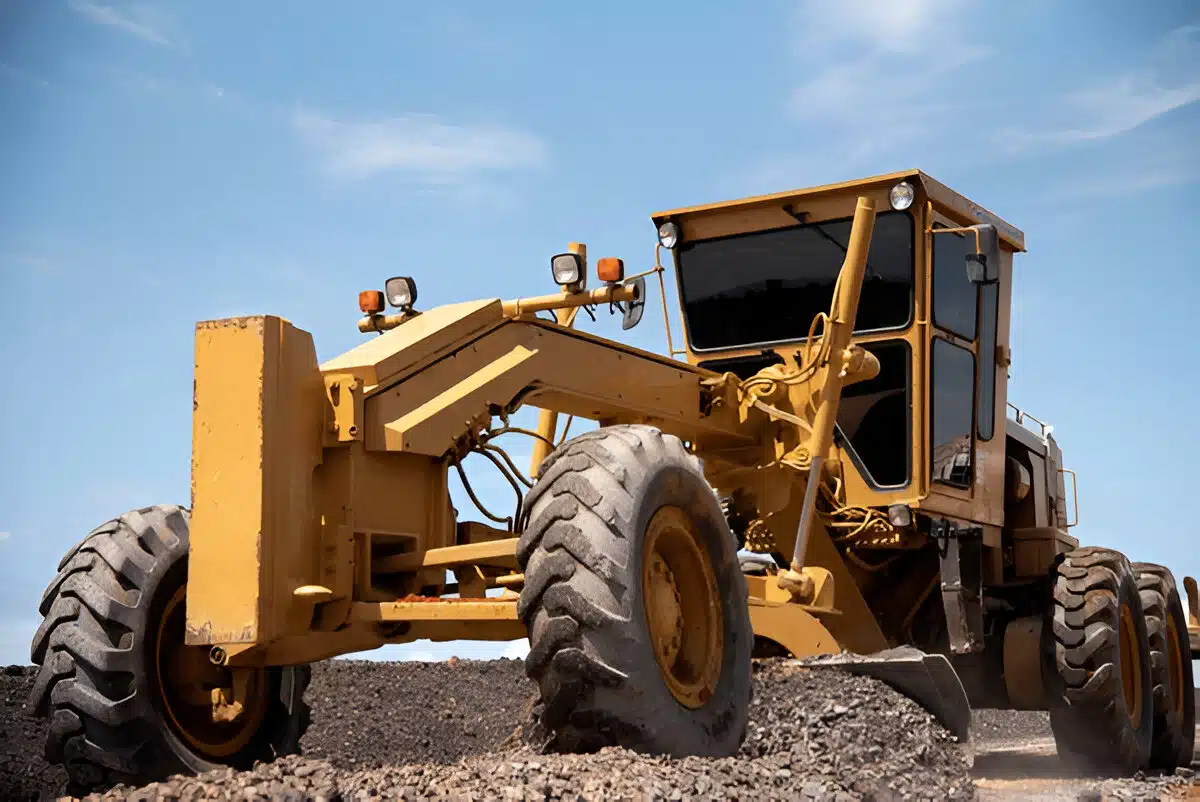
A motor grader is a construction machine that is used to create flat surfaces during grading operations. A long blade is installed for levelling, shaping the ground, cutting ditches, and snow removal in colder regions.
In India, there are varied terrain comprising of unique challenges, and road construction vary from one place to another. For every condition, there are different motor grader. Hence, motor graders are important pieces of equipment in making timely and cost-effective completion of projects.
Why Choosing the Right Motor Grader Matters
Selecting a motor grader that is tailored to the task assures optimal performance, economical operation, and accomplishment of the project. Here are reasons why your choice matters:
- Ensures Accuracy: Selecting the right motor grader provides accurate grading results, particularly in road grading, ditching, or site levelling. This gives a smoother surface, better drainage and a longer-lasting road.
- Reduces Cost: The right grader has a fuel-efficient engine, strong components, and high-tech performance specifications that reduce fuel consumption, repair costs, and overall operating costs.
- Reduces Downtime and Enhances Performance: A reliable motor grader is crucial for your project. It performs consistently without frequent breakdowns, hence incurs minimum downtime, allowing it to maintain the project timeline.
- Improves Productivity and Fuel Efficiency: The technological features such as automatic controls and adjustable blade angles, and user-friendly operator controls, modern graders allow operators to complete tasks faster while reducing fuel consumption.
- Ensures Appropriateness to Terrain and Jobsite Conditions: Choosing the right motor grader designed for specific terrain ensures fast movement, traction and stability on hilly terrain, rural paved roads or urban construction areas.
Key Factors to Consider While Choosing the Right Motor Grader
The right motor grader affects the efficiency, costs, and timeline of the project. The motor grader can be used for village roads or expressways. The following elaborate guidelines will assist you in choosing the right motor grader, adhering to your working criteria:
1. Understand Your Project Needs
The project should be clearly defined. It is very important to ascertain the project type or the terrain it will work on. Rural terrain will have a different motor grader compared to hilly or mining sites.
Before selecting a motor grader, ask:
- Are you working on national highways or rural roads?
- Is the project large-scale or compact?
- Will you work in hilly terrain or flat land?
Match the grader’s specs with the application.
2. Engine Power & Performance
Engine power means how productively the grader can cut, move, and finish material.
| Project Type | Ideal Engine Power |
|---|---|
| Rural Roads | 120 – 140 HP |
| State Highways | 150 – 180 HP |
| Expressways / Mining | 180+ HP |
On graders listed in India (November 2026) the compact class built for village and PMGSY roads starts lower than the table’s first row: the Mahindra RoadMaster G75 Smart and G9075 run 74 HP, the RoadMaster G9595 95 HP and the BEML BG405A 125 HP. The 12 to 18 tonne graders used on state highways sit at about 150 to 225 HP, and blades of 4.2 m (about 14 ft) or longer come on graders of roughly 240 HP and up, such as the CAT 14M3. The motor grader engine power guide sets out every class.
Top Motor Grader in India:
- Mahindra RoadMaster G75 Smart (74 HP) – Best for rural and PMGSY road projects. Listed at about ₹32–36 lakh.
- CASE 845B (173 HP) – Mid-power grader with solid performance in highways. Listed at about ₹76–84 lakh.
- CAT 120 GC (171 HP) – A well-balanced performer, fit for both urban and rural needs. Listed at about ₹1.05–1.15 crore.
Prices above are indicative bands around each model’s listed price as of November 2026. More power is not always the right option: a large-power grader on a small project means inefficiency and expenditure, paying for fuel and capacity the job never uses.
3. Blade Width & Grading Reach
The grader’s blade directly affects the quantity of material moved with one pass.
- Blade length on listed graders: about 2.6 to 3.4 m on compact graders, 3.4 to 4 m on 12 to 18 tonne graders, and 4.2 to 7.3 m on large and mining graders, up to the CAT 24M (November 2026).
- Look for adjustable blades with multi-angle positioning.
- Greater reach means fewer passes, saving time and fuel.
- The motor grader cutting depth and blade reach guide compares cutting depth and shoulder reach by class.
4. Hydraulics & Controls of the motor grader
Modern motor graders come with advanced hydraulics and joystick controls.
- Choose graders with load-sensing hydraulics.
- Electro-hydraulic controls improve precision.
- Intuitive joystick layouts reduce operator fatigue, and modern operators’ cabin enhances operators’ comfort.
5. Fuel Efficiency & Emission Compliance
In Indian conditions, fuel efficiency is critical.
- New graders sold in India since 1 April 2024 must meet CEV Stage V emission norms; on a used machine, check the plate for CEV Stage IV or V.
- Choose machines with Eco-mode or intelligent power modes.
- Real-time fuel tracking is important and should be checked while buying.
6. Operator Comfort & Cabin Features
Motor Grader should be designed ergonomically, which enhances operators’ comfort during long working hours.
- Look for spacious, air-conditioned cabins for long hours of work.
- Adjustable seats and armrests help reduce fatigue for the operator.
- Clear visibility, noise insulation, and rearview cameras improve safety.
7. Brand Reputation & Service Network
After-sales support is very crucial for a right motor grader as it helps reduce breakdowns and downtime.
Some top brands in India:
| Brand | Notable Models | Service Strength | Listed price (Nov 2026) |
|---|---|---|---|
| Mahindra Construction Equipment | RoadMaster G75, RoadMaster G9075 | Good in rural & tier 2 cities. | G75 about ₹32–36 lakh; G9075 about ₹33–37 lakh |
| Caterpillar | 120 GC, 140 GC | Global reputation, reliable service. | 120 GC about ₹1.05–1.15 crore; 140 GC about ₹1.33–1.47 crore |
| CASE | 845B, 865B | Strong in urban and infrastructure hubs. | 845B about ₹76–84 lakh; 865B about ₹85–95 lakh |
| Komatsu | GD535-6, GD955-7 | Reliable, but the service can be city-centric. | GD535-6 about ₹76–84 lakh; GD955-7 on request |
| BEML | BG405A, BG605A | Reliable and has a wide service network | BG405A about ₹42–48 lakh; BG605A about ₹81–89 lakh |
8. Initial Investment vs. Long-Term ROI
- Purchase of the right motor grader: Never just go for the lowest; always evaluate all features and quality.
- Warranty & AMC: Longer warranty and comprehensive AMC on the machines give peace of mind.
- Maintenance Interval: Machines with longer maintenance intervals lead to less downtime and lower costs. Shorter intervals would often lead to more downtime and greater expenditures.
- Fuel Consumption: Go for graders that are fuel-efficient and save your operating costs in the long run.
- Resale Value: Brands recognized by all, with their high and consistent performance, will be able to demand a higher resale value.
- Used or rented: the used motor grader buying guide and the motor grader rental guide cover the checks when a new machine is more than the job needs.
- Smart Investment: A slight increase in the initial investment offers the promise of a better performance factor lower maintenance and better ROI over 5-7 years.
9. Safety Features while choosing the right motor grader
- ROPS/FOPS Certified Cabins: The operator’s safety is very important from rollovers and falling objects, especially in rough and challenging terrain.
- Emergency Stop Switches: Allow quick machine shutdown in case of unexpected hazards or malfunctions.
- Anti-Slip Steps & Safety Lockouts: Ensure safe entry and exit from the cabin while preventing accidental operations.
- Advanced Braking Systems: The modern braking systems offer better control, especially on slopes or during sudden stops, enhancing site safety.
The above features are of utmost importance as these features reduce the risk of accidents, improve operator confidence, and ensure site safety regulations.
10. Availability of Attachments
Modern projects demand versatility with attachments used in the motor grader.
- Look for the right motor graders compatible with rippers, scarifiers, and snowplows.
- Attachments should be easy to mount and replace.
- Flexible use enhances better ROI.
Indian Motor Grader Market is Changing (2026)
- Increasing Demand of Low Power Graders: There are schemes like PMGSY which are further assisting in the growth in demand of the 90-130 HP graders that are best suited and cost-effective for small road projects, thus affecting the rural infrastructure development.
- Efficiency in Fuel: Fuel prices keep fluctuating, which is driving demand for electronically controlled, fuel-efficient engines with power management.
- Emission Norms Conformity: CEV Stage V engines have been required on new construction machines since 1 April 2024, and the industry is moving towards cleaner, more efficient engines.
- Conformance to Telemetry and IoT: The advanced features in this particular field include telematics and GPS, which have been installed for real-time monitoring, preventive maintenance, and remote diagnostics.
Conclusion: Making a Smart Choice is Easy
In the construction and mining industry, it is very important to choose the right motor grader for your work. The right motor grader can help you reduce cost, meet deadlines, maintain quality, and ensure safety. The Indian infrastructure industry is diverse, and so are the requirements for motor graders. There are different models of motor graders from multiple brands, and each is suitable for a particular type of job.
By understanding your job site requirements and aligning them with the correct features (engine, blade width, hydraulics and support), you ensure long-term profitability and productivity. Contractors, builders and government agencies can compare the leading motor grader models, from budget options to high-performance machines, at Desi Machines, and check equipment finance before they commit. Confirm the current on-road price and variant with the dealer or OEM before you buy.