
 Excavator
294 models
Excavator
294 models  Backhoe Loader
51 models
Backhoe Loader
51 models  Crane
68 models
Crane
68 models  Concrete Mixer
79 models
Concrete Mixer
79 models  Wheel Loader
54 models
Wheel Loader
54 models  Compactor / Roller
45 models
Compactor / Roller
45 models  Motor Grader
42 models
Motor Grader
42 models  Dozer
41 models
Dozer
41 models  Concrete Pump
66 models
Concrete Pump
66 models  Skid Steer Loader
11 models
Skid Steer Loader
11 models  Telehandler
13 models
Telehandler
13 models 


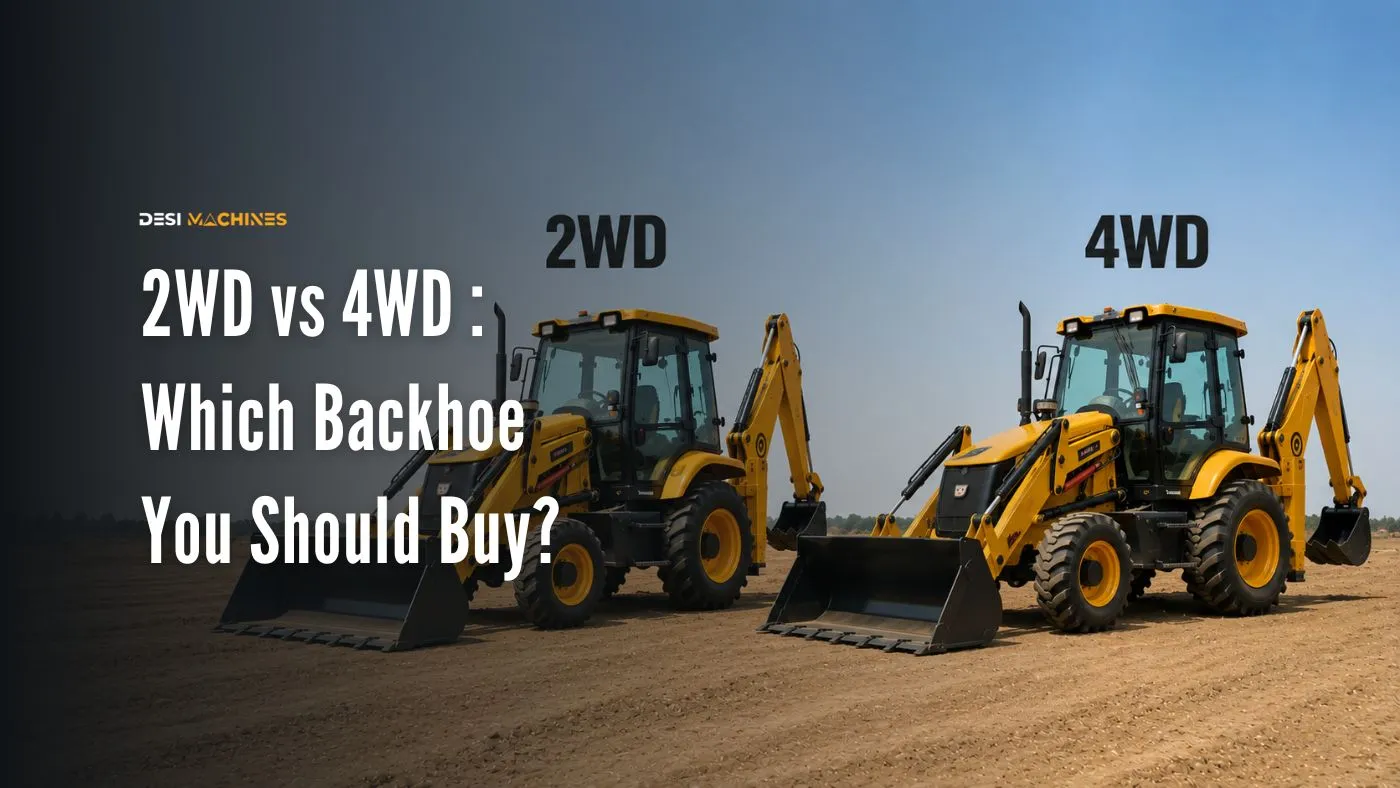
If you are buying a backhoe loader in India, the first question the dealer will ask is simple: 2WD or 4WD? Two-wheel drive, or four-wheel drive. It sounds like a small thing. It is not. This one choice changes the price you pay, the kind of ground the machine can work on, the diesel it drinks, and the money you get back when you sell it.
The short answer: a 2WD backhoe is enough for hard, level ground — town roads, city work, dry sites. A 4WD backhoe is worth the extra money on soft, wet, or sloping ground — fields, sand, hill roads, and the monsoon months. This guide explains the difference in plain words, with real prices from our own machines like the JCB 3DX and JCB 4DX, so you buy the right one and not a rupee more.
Watch: 2WD vs 4WD decided in 6 minutes
Key moments: 0:58 hard ground vs soft ground — the real difference · 3:05 the live price gap (JCB 3DX vs 4DX) · 4:33 the one-line rule to decide.
First, What Is a Backhoe Loader?
A backhoe loader is the yellow machine you see on almost every worksite in India. Most people just call it a JCB, because JCB was the first big name — but many companies make them now.
It does two jobs in one machine:
- In front, it has a loader bucket — to lift and carry mud, sand, gravel, or bricks, and to load a truck.
- At the back, it has a digging arm, called the backhoe — to dig trenches, pits, and building foundations.
One machine, two jobs. That is why a backhoe earns money on so many kinds of work — roads, buildings, water pipelines, farms, small mines. And that is why choosing the right one matters.
2WD and 4WD: What Do They Mean?
Every backhoe has four wheels. The question is: how many of those wheels get power from the engine to pull the machine?
- 2WD (two-wheel drive): only the two big back wheels get engine power. The small front wheels only turn for steering. This is the most common backhoe in India. It is simpler and costs less.
- 4WD (four-wheel drive): all four wheels get engine power. The front wheels also pull, and they are usually bigger. This gives the machine much better grip — what mechanics call traction — on loose or wet ground.
That size difference is measurable, and it is the quickest way to tell the two apart in a yard: the 2WD front tyre is a 9 x 16 and the 4WD front is a 12.5 x 18, as set out in the guide to backhoe loader tyre sizes. Replacing a set? The backhoe loader tyres page lists front and rear sizes by model and passes your price request to a tyre dealer near you.
Here is the key point. On hard, dry ground, a 2WD and a 4WD feel almost the same. You will not notice the difference. The difference shows up only when the ground goes soft — wet mud, loose sand, a slope. There, the 2WD’s back wheels start to spin and dig a hole for themselves. The 4WD keeps moving, because all four wheels are pulling together. *Simple baat hai — jitne pahiye zameen ko pakadte hain, utni takat.*
When 2WD Is Enough (and Saves You Money)
For a very large part of the work done in India, a 2WD backhoe is the right choice — not a compromise. Buy 2WD if your machine will mostly work on:
- Town and city roads, dry and level ground — where grip is never a problem.
- Digging trenches for water pipes, drains, and cables — the machine stands in one place and digs; it does not need to climb anything.
- Building sites on firm plots, factory yards, and finished campuses.
- Small contractors on a tight budget — the lower price, simpler parts, and slightly better mileage all help when every rupee counts.
This is exactly why the 2WD JCB 3DX became the most common backhoe in the country. For everyday town and road work, four-wheel drive would just be extra weight and extra cost you never use. If your work is like this, see the full 2WD backhoe loader range — the two-wheel-drive machines we list start at ₹22–24 Lakh for the CASE 770 NXe Series and run up to ₹30–35 Lakh for the Bull HD76 2WD (indicative, as of August 2026), depending on the brand and model (prices shown on each product page; always confirm the final figure with our team).
When You Need 4WD (and It Pays Back)
4WD is not about going faster. It is about not getting stuck, and about pushing more power into the digging and loading. It earns back its higher price when the ground fights you:
- Loose or sandy soil — riverbeds, freshly filled land, farm fields. A 2WD sinks and spins here; a 4WD keeps working.
- Slopes and hill roads — embankments, quarry steps, uneven ground. The front wheels pulling too is what keeps the machine climbing steadily.
- Monsoon and wet sites — this is the real reason many buyers pick 4WD. For months every year, sites across India turn to mud. That is where 4WD saves your working days.
- Loading trucks all day, small mining, and heavy work — when you push the front bucket hard into a big pile again and again, four driven wheels turn engine power into pushing force instead of wheel-spin.
The best-known 4WD machine is the JCB 4DX, along with machines like the Tata Hitachi Shinrai Power and other 4WD backhoe models (the four-wheel-drive machines we list start at ₹23–28 Lakh for the Tata Hitachi Shinrai Power 4 and run to ₹36–38 Lakh for the Shinrai Power itself, indicative, as of August 2026; the ACE Phantom 4WD is price on request). If your machine will spend real time on soft, wet, or sloping ground, the extra grip is not a luxury. It is the reason the machine keeps earning on days a 2WD would sit idle in the mud. *Kaam nahi ruka, matlab machine paisa vasool.*
The Real Price Difference (From Our Own Machines)
People think 4WD costs a lot more. On the same model, the gap is usually smaller than you expect. Look at the two most popular JCB machines on our site:
| Machine | Drive | Gross power | Price on DesiMachines |
|---|---|---|---|
| JCB 3DX Super | 2WD | 74 HP (55 kW) | ₹35–39 Lakh (indicative, as of August 2026) |
| JCB 3DX | 2WD | 49 HP (37 kW) | ₹30–32 Lakh (indicative, as of August 2026) |
| JCB 4DX | 4WD | 74 HP (55 kW) | ₹36–40 Lakh (indicative, as of August 2026) |
Compare machines of the same engine power and the gap is small. The JCB 3DX Super (2WD, 74 HP) is listed at ₹35–39 Lakh and the JCB 4DX (4WD, the same 74 HP) at ₹36–40 Lakh — about ₹1 Lakh between them. The 49 HP JCB 3DX at ₹30–32 Lakh is cheaper than both, but that is a smaller engine, not a saving on drive. Other brands say the same thing: BEML lists the BL9H 4×2 at ₹30–32 Lakh against the BL9H 4×4 at ₹32–36 Lakh, and Bull prices its HD76 2WD and HD76 4WD identically at ₹30–35 Lakh (indicative, as of August 2026). The real question is not, “Can I afford 4WD?” It is, “Will my job site need it?” If you regularly work on muddy, uneven, or off-road terrain, the extra investment can easily pay for itself by reducing downtime and improving productivity. These are the prices currently listed on Desi Machines. Your OEM or authorised sales executive will confirm the final on-road price, taxes, and any state-specific offers.
Diesel and Mileage
Many buyers worry that 4WD drinks a lot more diesel. The truth is simpler.
On easy, hard ground, a 4WD burns only a little more, because it has a few more moving parts to turn. Nothing big. But on the difficult ground it is built for — mud, sand, slopes — the 4WD actually wastes less diesel, because the wheels are not spinning uselessly. Less spinning, fewer stuck moments, more real work done for each litre.
So do not choose 2WD only to save diesel. Choose by your ground. On the right ground, a 4WD can do more work per litre, not less.
Fuel type is not yet part of this decision either: there is still no electric backhoe loader in India, and the reason has more to do with a full shift of work than with the battery.
The front axle does more than drive or steer. The steering type, the working pressure and the 16 degree oscillation that keeps both front wheels down on broken ground are set out in the guide to backhoe loader steering and the front axle.
Resale: What the Machine Is Worth Later
A backhoe is a big investment. What you get back when you sell it also matters.
Drive layout also changes how tightly the machine turns, which matters most on a cramped plot. The figures sit alongside width, height and ground clearance in our guide to backhoe loader dimensions and site access.
The same points work in reverse when you are the buyer. What to inspect, how to read the hours and which papers must come with the machine are set out in our used backhoe loader buying guide.
In areas with soft, wet, or hilly ground — and in the rental business, where the machine goes to all kinds of sites — a 4WD holds its value better, because the next buyer wants that same grip. In areas that are mostly dry city and road work, a clean, well-kept 2WD sells just as easily, because that is what buyers there need.
The lesson is the same as before: match the machine to the ground your region actually has. Resale follows demand, and demand follows the land. If you plan to rent the machine out, or you are not sure what sites will come, lean towards 4WD — the extra grip keeps more doors open.
Which JCB — 3DX or 4DX? And Other Brands
People often search “types of JCB” while really asking which model to buy. Here is the simple ladder in the JCB family, and where the others fit:
- JCB 3DX (₹30–32 Lakh, 2WD, 49 HP; indicative, as of August 2026): the everyday workhorse — the machine most Indian contractors buy for general road and building work.
- JCB 3DX Super (₹35–39 Lakh, 2WD, 74 HP; indicative, as of August 2026): the same two-wheel drive, but a bigger engine for heavier loading and longer days.
- JCB 4DX (₹36–40 Lakh, 4WD, 74 HP; indicative, as of August 2026): the 74 HP machine again, this time with four-wheel drive for tough ground.
Those 49 HP and 74 HP ratings are the whole reason two different prices get quoted for what sounds like one machine. The full power and torque spread across every brand is in the guide to backhoe loader engine power and torque.
JCB is not the only good choice. On our site you will also find the Mahindra Earthmaster range, which opens with the Earthmaster VX IV at ₹23–28 Lakh, CASE machines like the 770 NX at ₹33–36 Lakh (indicative, as of August 2026), and Tata Hitachi Shinrai — several of which come in 4WD too. Compare them side by side on the backhoe loader listing, and read our roundup of the top backhoe loaders in India before you decide. *Apni requirement humein batao* — and ask for a demo on ground like your own.
The Simple Rule to Decide
Forget the brochure talk. Ask yourself one question: what does the ground under my machine look like on most days?
| Your ground / work | Buy |
|---|---|
| Hard, level, dry — town roads, city sites, pipe trenching | 2WD — save the money for more work or a better machine |
| Soft, wet, sandy, sloping — fields, riverbeds, hills, monsoon sites, heavy loading | 4WD — the grip is the whole reason you can keep working |
| Mixed, or you will rent the machine out to unknown sites | 4WD — the flexibility is worth the small extra cost |
Do not pay for grip you will never use. And do not save one lakh on a machine that then sits stuck on the very sites you bought it for. If you want to understand the machine fully first, read our complete backhoe loader guide. One thing four-wheel drive does not buy is road speed: backhoe loader speed and gears puts 2WD machines at 28 to 41 km/hr against 32 to 41 km/hr for 4WD, an almost complete overlap. And when it is time to talk money, an equipment loan spreads the cost over easy monthly payments — see our equipment finance options and bank pages like SBI, and protect the machine with the right equipment insurance.
Still unsure whether a backhoe is the right machine at all? See which machine fits your site.
Whichever drive type you pick, the machine runs the same backhoe loader attachments, from buckets to a breaker or auger, so plan for the tools your work needs as well.
If you are still new to the class, it helps to settle what a tractor-loader-backhoe (TLB) actually is before you weigh 2WD against 4WD.
Ready to choose? Compare 2WD and 4WD backhoe loader models, see prices and get the best current offer on DesiMachines.
If you are hiring rather than buying, the same 2WD or 4WD choice decides your day rate, and the guide to backhoe loader rental explains when the extra cost of 4WD is worth paying.
Prices, specifications and features are indicative, vary by variant, location and date, and should always be confirmed with the official OEM or authorised dealer before any purchase decision. DesiMachines is not liable for decisions taken on the basis of information that may have changed after publication.
