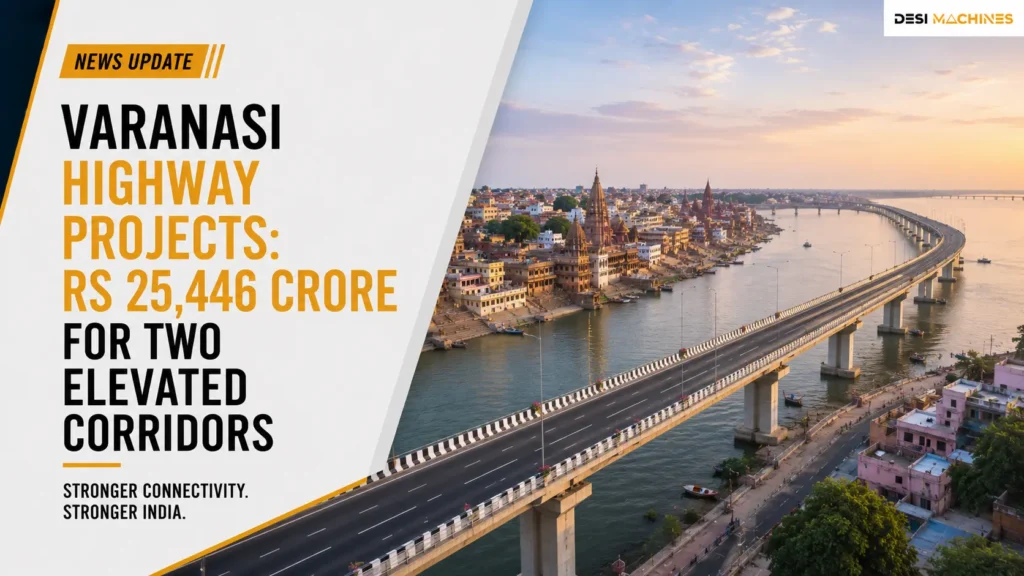
The Cabinet cleared two elevated highway corridors in Varanasi on 15 July, worth Rs 25,445.96 crore between them. For equipment buyers in eastern Uttar Pradesh, the figure that matters is not the headline cost. It is the shape of the work: roughly 89 km of mostly elevated carriageway, a 910-metre cable-stayed bridge over the Ganga, and both packages running on the Hybrid Annuity Model. That combination points to a very specific fleet, and it is not the one a greenfield highway needs.
The quick facts
- Rs 25,445.96 crore total across two corridors, cleared by the Cabinet Committee on Economic Affairs on 15 July 2026.
- Ganga corridor: NH-19 to the Varanasi Ring Road, 46.039 km, Rs 14,447.64 crore. Six-lane elevated carriageway plus a 910-metre cable-stayed bridge across the Ganga.
- Varuna corridor: NH-31 to the Varanasi Ring Road, 43.218 km, Rs 10,998.32 crore. Six or four lanes, predominantly elevated.
- Both go to NHAI on the Hybrid Annuity Model. NH-31 to Kashi railway station is projected to drop from about 40 minutes to 20.
What the Cabinet approved
Union minister Ashwini Vaishnaw briefed reporters after the meeting, which the Prime Minister chaired. The Federal and Business Standard both carried the corridor-level breakup the same evening. The two capital costs add up to the announced total exactly, a useful check on a number several outlets rounded differently on the night.
The Ganga package is the heavier of the two and the more unusual one. Most of its carriageway sits on structure rather than on ground, and the river crossing is a cable-stayed span rather than a conventional girder bridge. The Varuna package is longer in road terms but simpler in engineering terms.
What it means for buyers
Elevated work does not call for the same fleet as a greenfield expressway, and that is where this announcement is easy to misread. A greenfield alignment is an earthmoving job first, running on excavators, dozers and compactors shifting dirt for months before any structure goes up. An elevated corridor inverts that: the earthwork is comparatively small, and the volume goes into foundations, concrete and lifting.
Demand here concentrates in piling rigs, in transit mixers and boom pumps feeding pier caps and segments, and in cranes in the 50 to 100 tonne class for girder erection. The cable-stayed span sits above that tier again, and lifting of that kind usually arrives with a specialist contractor running its own heavy crawler fleet, so it rarely turns into local buying.
The delivery model matters as much as the machine list. Under HAM, NHAI pays part of the construction cost in instalments and the concessionaire funds the balance, so the winning contractors carry real working-capital and equipment finance needs well before a machine reaches site. Payment cycles also run steadier than on pure BOT, which is what a rental operator or small fleet owner weighs before committing machines.
Timing is the discipline. An approval is not an order. These packages still have to be tendered, bid, awarded and taken to an appointed date, and on NHAI corridors this size that sequence has usually run six to twelve months before real mobilisation.
Our take: the pipeline across eastern Uttar Pradesh is now thick enough to plan around, but not thick enough to buy against yet. Stacked on the Kanpur to Kabrai greenfield highway cleared a fortnight earlier, the state is quietly becoming the densest block of approved highway work in the country.
What to watch
- NHAI bid documents and tender dates for both packages. That is the first hard signal of when machines move.
- Who wins the Ganga corridor, and whether they bring their own heavy lifting fleet or hire it in. That single choice decides whether crane demand shows up locally at all.
- The appointed date on each package, which is the point mobilisation actually starts rather than the approval date.
Planning a fleet around the eastern UP pipeline? Compare machines side by side on specs and running cost before the tenders land.
FAQ
When will work actually start on the Varanasi highway projects?
No start date has been announced. Cabinet approval is the funding clearance, not a work order. NHAI still has to tender and award both packages and set an appointed date, and on corridors of this size that has typically taken six to twelve months.
Which machines will these Varanasi corridors need most?
Because roughly 89 km of the alignment is predominantly elevated, the work leans towards piling and foundation rigs, transit mixers and boom pumps, and cranes in the 50 to 100 tonne class for erection, rather than the large earthmoving fleet a greenfield highway would absorb.
What does the Hybrid Annuity Model mean for contractors on these packages?
Under HAM, NHAI funds part of the construction cost in instalments while the concessionaire arranges the rest. Contractors therefore need financing in place early, though payment cycles are generally steadier than on a pure BOT toll project.
Related on DesiMachines: CCEA approves Rs 14,115 crore Kanpur-Kabrai highway and Dwarka Expressway tunnel
Source: The Federal
Machines, tenders and news for this industry: Road Construction

 Excavator
294 models
Excavator
294 models  Backhoe Loader
51 models
Backhoe Loader
51 models  Crane
68 models
Crane
68 models  Concrete Mixer
79 models
Concrete Mixer
79 models  Wheel Loader
54 models
Wheel Loader
54 models  Compactor / Roller
45 models
Compactor / Roller
45 models  Motor Grader
42 models
Motor Grader
42 models  Dozer
41 models
Dozer
41 models  Concrete Pump
66 models
Concrete Pump
66 models  Skid Steer Loader
11 models
Skid Steer Loader
11 models  Telehandler
13 models
Telehandler
13 models