Key facts
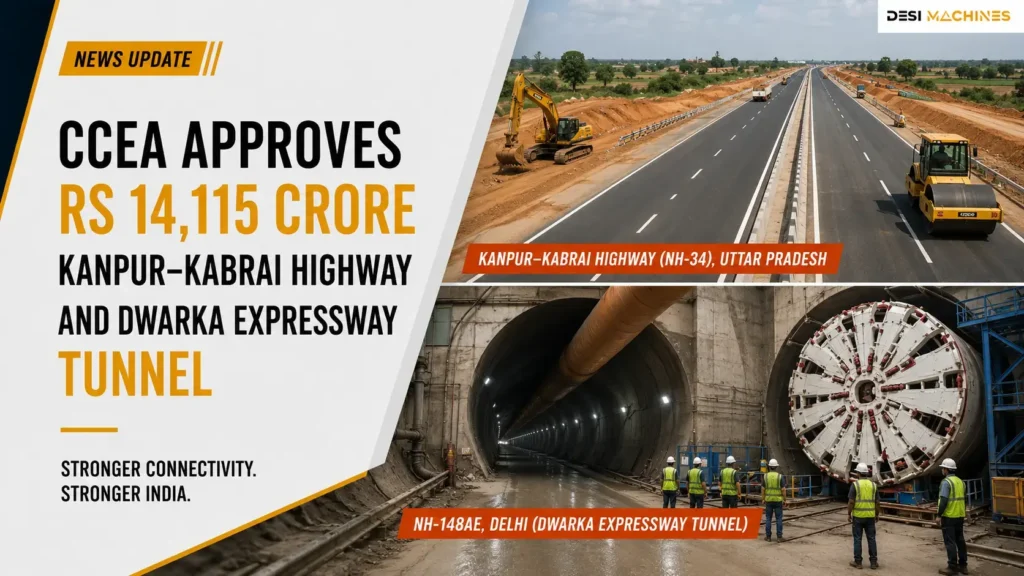
- The Cabinet Committee on Economic Affairs (CCEA) approved two NHAI corridors worth Rs 14,114.81 crore on 1 July 2026.
- Kanpur–Kabrai (NH-34), Uttar Pradesh: 117.7 km four-lane access-controlled greenfield highway, Rs 7,145.14 crore, BOT (Toll) mode, part of the Bhopal–Kanpur Economic Corridor.
- NH-148AE, Delhi: 8.1 km six-lane twin-tube road tunnel (bored by TBM) linking the Dwarka Expressway to Vasant Kunj, Rs 6,969.67 crore, on Hybrid Annuity Mode (HAM).
- Both are NHAI-implemented; the highway’s structures are designed for future six-laning.
What the CCEA approved
On 1 July 2026 the CCEA cleared two National Highways Authority of India (NHAI) projects with a combined outlay of Rs 14,114.81 crore, per the Ministry of Road Transport and Highways, as reported by Business Standard and DD News. The first is a 117.7 km greenfield Kanpur–Kabrai highway on NH-34 in Uttar Pradesh (Rs 7,145.14 crore, BOT-Toll), a leg of the Bhopal–Kanpur Economic Corridor that also touches the Kabrai stone-mining belt. The second is an 8.1 km twin-tube road tunnel for NH-148AE in Delhi (Rs 6,969.67 crore, HAM) linking the Dwarka Expressway to Nelson Mandela Marg at Vasant Kunj, with a 1.98 km stretch bored under the Southern Ridge forest.
Which Machines Will These Projects Pull?
For equipment buyers, an approval is a demand signal, not an order. Both projects still have to reach financial close and mobilisation, so the real machine pull is a 2027 story — but it is a clear one.
The Kanpur–Kabrai highway is built on a fresh alignment, which means earthmoving from scratch. Expect steady demand for 20-tonne-class excavators, motor graders, soil compactors, wheel loaders, backhoe loaders and a large tipper fleet, followed by pavers and concrete equipment for structures. Because the corridor runs to the Kabrai stone belt, aggregate, crushing and haulage demand should firm up too. BOT (Toll) means a private concessionaire finances and builds it, so watch which developer wins — they and their earthwork sub-contractors drive the buying and renting.
The Delhi tunnel is a different animal. Twin-tube TBM tunnelling is specialised and concentrated among a few large contractors (L&T, Afcons, J Kumar and the like), and the TBMs themselves are usually imported. For most DesiMachines buyers the opening is the support fleet: muck-handling excavators and tippers, segment-handling cranes, concrete pumps and batching plants for the approaches, ramps and the elevated road. HAM helps here — the government funds part of the cost during construction, so financial close and execution tend to be quicker and more certain than pure BOT.
What Should Equipment Buyers and Rental Owners Do Now?
DesiMachines view: a Rs 14,000-crore twin approval will not move machine prices this quarter, but a steady NHAI award pipeline like this typically lifts rental utilisation and holds up used-equipment values 12–18 months out — most visibly for 20-tonne excavators, tippers and compactors in UP/Bundelkhand and the NCR. Whether it becomes orders you benefit from depends on how fast the concessionaires mobilise. If you are financing a machine now on the strength of this work, confirm your dealer’s order book and lock equipment-finance terms before committing.
What to watch:
- The concessionaire/contractor awards and appointed dates — that is when equipment demand turns real.
- Aggregate and crushing demand around the Kabrai mining belt as earthwork ramps up.
- TBM and support-fleet mobilisation on the Delhi tunnel, and any rental-rate movement in the NCR.
Related on DesiMachines: Indian Construction Industry Overview 2025–2030: Market Size, Growth & Outlook
Machines, tenders and news for this industry: Bridges and Tunnels · Road Construction

 Excavator
294 models
Excavator
294 models  Backhoe Loader
51 models
Backhoe Loader
51 models  Crane
68 models
Crane
68 models  Concrete Mixer
79 models
Concrete Mixer
79 models  Wheel Loader
54 models
Wheel Loader
54 models  Compactor / Roller
45 models
Compactor / Roller
45 models  Motor Grader
42 models
Motor Grader
42 models  Dozer
41 models
Dozer
41 models  Concrete Pump
66 models
Concrete Pump
66 models  Skid Steer Loader
11 models
Skid Steer Loader
11 models  Telehandler
13 models
Telehandler
13 models