
 Excavator
294 models
Excavator
294 models  Backhoe Loader
51 models
Backhoe Loader
51 models  Crane
68 models
Crane
68 models  Concrete Mixer
79 models
Concrete Mixer
79 models  Wheel Loader
54 models
Wheel Loader
54 models  Compactor / Roller
45 models
Compactor / Roller
45 models  Motor Grader
42 models
Motor Grader
42 models  Dozer
41 models
Dozer
41 models  Concrete Pump
66 models
Concrete Pump
66 models  Skid Steer Loader
11 models
Skid Steer Loader
11 models  Telehandler
13 models
Telehandler
13 models 


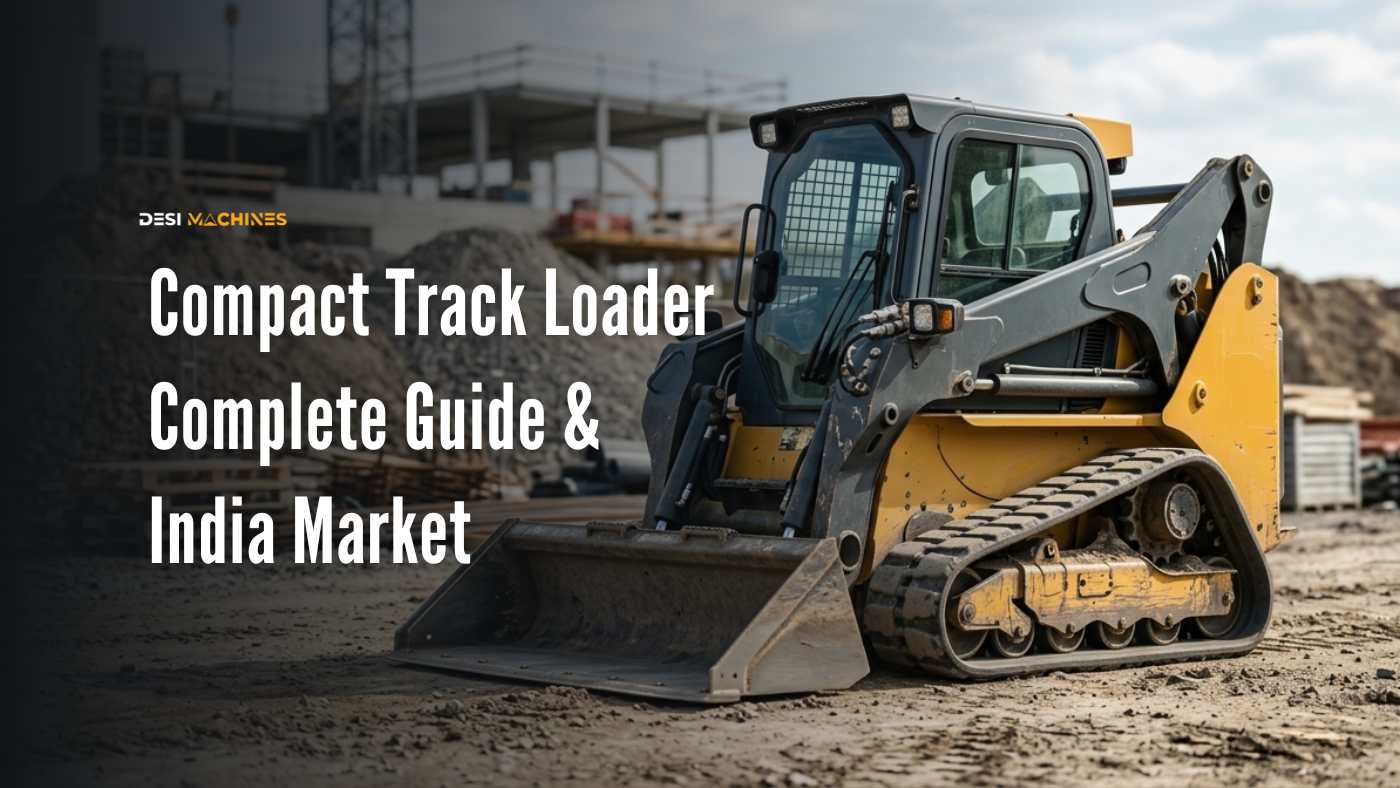
A compact track loader (CTL) is a skid-steer-sized loader that runs on two rubber tracks instead of four wheels, so its weight is spread over a much larger contact area. That one change is why a CTL keeps working on soft, wet or sloping ground where a wheeled machine sinks, slips or churns the surface. With the National Infrastructure Pipeline pushing road, canal and urban work deeper into the districts, contractors across the country are looking at CTLs for everything from highway grading to agricultural material handling. These rubber-tracked machines combine the manoeuvrability of a skid steer with superior traction on challenging terrain — black cotton soil near Nagpur, waterlogged clay in Bengal, sandy riverbeds in Rajasthan. Desi Machines does not list compact track loaders. Our compact-loader range is the wheeled skid steer loader, which shares the CTL’s frame size, its universal attachment plate and most of its jobs — so read the model names on this page as examples of the format worldwide, and price any CTL with the manufacturer or its authorised dealer.
What is a Compact Track Loader (CTL)?
A compact track loader is a compact construction machine that uses rubber tracks instead of wheels for mobility. Think of it as a skid steer loader‘s more capable cousin — same compact footprint, same attachment versatility, but with tracks that distribute weight across a larger surface area. That weight distribution is the key differentiator. A wheeled skid steer puts all its load on four small contact patches. A CTL spreads it across two continuous tracks. The result? Lower ground pressure, better flotation on soft ground, and superior traction on slopes.
The core architecture includes a tracked chassis with rubber or steel-embedded rubber tracks, a loader arm system (either radial or vertical lift), a universal attachment interface, and a hydraulic system that powers everything from movement to attachments. The operator sits in an enclosed or open cab with joystick controls — left stick for travel, right stick for loader functions on most machines. Modern CTLs run engines from 50 HP to over 100 HP, with rated operating capacities ranging from under 900 kg to over 2,800 kg.
Where a wheeled skid steer would spin and dig ruts in monsoon-soaked soil, a CTL keeps moving. Where wheels would slip on a 15-degree slope, tracks grip. That’s why CTLs have become the default choice for landscaping, agriculture, and construction work on anything other than hard, dry surfaces.
Key Components of a Compact Track Loader
- Rubber Tracks and Undercarriage System: The defining feature. Rubber tracks with steel-embedded cores wrap around front idlers, rear drive sprockets, and multiple rollers. Track patterns vary — bar tread for hard surfaces, multi-bar for general use, block patterns for soft ground. The undercarriage takes the most abuse and determines track life.
- Hydraulic System (High-Flow vs Standard): Standard flow runs around 57–76 litres per minute (15–20 GPM) — enough for buckets, forks, and basic attachments. High-flow systems push 114–189 litres per minute (30–50 GPM) for demanding attachments like mulchers, cold planers, and trenchers. Check the hydraulic specs before buying attachments.
- Loader Arms (Radial vs Vertical Lift): Radial lift arms follow an arc — bucket reaches furthest from the machine at mid-lift. Better for digging and ground-level work. Vertical lift arms raise straight up — bucket stays closer to the machine throughout the lift cycle. Better for loading trucks and high-reach work.
- Quick Attachment System: Universal mounting plates (Bob-Tach is the most common standard) allow attachment changes in under a minute. Hydraulic quick couplers make it even faster — no leaving the cab.
- Operator Cab with Controls: Enclosed cabs with HVAC, ROPS/FOPS protection, and either hand-foot controls or dual joystick (ISO or H-pattern). Visibility matters — check sightlines to the bucket edge and tracks before buying.
- Engine and Powertrain: Diesel engines from Kubota, Yanmar, Cummins, or proprietary OEM engines. Power ranges from 50 HP on small-frame units to 110+ HP on large-frame machines. Hydrostatic transmission drives the tracks independently for zero-radius turning.
How Does a Compact Track Loader Work?
The operating principle is straightforward but the engineering is clever. A diesel engine drives a hydraulic pump that pressurises fluid throughout the system. This hydraulic power splits into two main circuits: the travel circuit that drives the tracks, and the implement circuit that operates the loader arms and attachments. The operator controls both through joysticks — push forward to move forward, pull back to reverse, push left or right to turn.
Here’s where CTLs differ from wheeled machines: each track has its own hydraulic motor. Push both joysticks forward equally and both tracks spin at the same speed — you go straight. Push the left joystick forward and pull the right back, and the tracks counter-rotate — the machine spins on its own axis. Zero-radius turning. That’s how a 3,000 kg machine can work in spaces where a Bolero wouldn’t fit.
Most CTLs offer two-speed travel — low range for working (pushing, digging, grading) and high range for travelling across the site. Attachment hydraulics run through quick-connect couplers at the front of the machine. Plug in an auger, and hydraulic flow spins the bit. Plug in a breaker, and flow powers the hammer. The machine becomes whatever the attachment makes it. One CTL with five attachments replaces five single-purpose machines. That is where the money comes back.
Types of Compact Track Loaders
CTLs are classified by lift path design (how the arms move), frame size (rated operating capacity), and intended application. Understanding these categories helps match the machine to the job — and prevents the expensive mistake of buying too much or too little machine for your actual needs.
| CTL Size | ROC | Best For |
|---|---|---|
| Small-Frame | Under 900 kg | Residential and confined-space work |
| Mid-Frame | 900–1,600 kg | General construction and agriculture |
| Large-Frame | 1,600 kg+ | Forestry, mining support, heavy-duty work |
1. Radial Lift Compact Track Loaders
Radial lift CTLs have loader arms that follow an arc pattern during the lift cycle. At mid-lift, the bucket reaches its furthest point from the operator — then curves back in as it reaches full height. This geometry creates maximum breakout force at ground level, making radial lift machines ideal for digging, trenching, and earthmoving applications. If your primary work involves moving dirt, cutting grades, or loading from ground level, radial lift is the right choice.
The trade-off? Less reach at full height compared to vertical lift machines. Loading a high-sided tipper or feeding a crusher hopper requires more positioning. Popular radial lift models include the Bobcat T450, T550, and CAT 239D3. For sites in Madhya Pradesh doing canal lining or Rajasthan doing rural road grading, radial lift handles the digging-heavy work better.
2. Vertical Lift Compact Track Loaders
Vertical lift arms rise almost straight up, keeping the bucket at a consistent distance from the machine throughout the lift cycle. The result: greater reach and lift capacity at full height. These machines excel at material handling — loading trucks, stacking pallets, feeding hoppers, working with high-sided containers. If you’re moving material more than digging it, vertical lift is the answer.
Vertical lift CTLs typically cost slightly more and have marginally lower breakout force at ground level. But for applications like loading aggregates into transit mixers, handling bagged cement, or feeding concrete batching plants, the extra reach pays for itself in cycle time savings. Models like the Bobcat T650, T770, and CAT 259D3 are popular vertical lift options. Construction sites near urban centres — where material handling dominates over earthmoving — favour this configuration.
3. Small-Frame CTLs (Under 900 kg ROC)
Small-frame compact track loaders have rated operating capacities under 900 kg (roughly 2,000 lbs). These machines fit through standard doorways, work in residential backyards, and navigate tight urban construction sites where larger equipment simply cannot go. Examples include the ASV RT-25, Bobcat T450, and similar models in the 50-65 HP range.
Applications: residential landscaping in Pune and Bangalore, interior demolition in commercial renovations, nursery and greenhouse work, tight urban infill projects. Lower operating costs, easier transport on small trailers, and the ability to work where nothing else fits. The trade-off is limited lifting capacity and slower cycle times on heavy material.
4. Mid-Frame CTLs (900-1,600 kg ROC)
Mid-frame CTLs hit the sweet spot for most Indian applications. Rated operating capacities between 900-1,600 kg, engines in the 65-80 HP range, and enough versatility to handle general construction, agriculture, and landscaping work. This is the most popular segment globally — and the segment most relevant for Indian contractors looking at CTLs.
These machines balance power, size, and cost. They’re large enough to run demanding attachments like trenchers and brush cutters, compact enough to work in semi-confined spaces, and priced in a range that makes ownership viable for mid-sized contractors. For PMAY housing projects, Smart City infrastructure work, and agricultural operations across Punjab and Haryana, mid-frame CTLs deliver the best value.
5. Large-Frame CTLs (Above 1,600 kg ROC)
Large-frame CTLs push rated operating capacities above 1,600 kg — some exceeding 2,800 kg. These are serious machines for heavy-duty applications: forestry mulching, land clearing, mining support, large-scale construction. Engines run 90-110+ HP with high auxiliary flow rates of 151–189 litres per minute (40–50 GPM) to power demanding attachments.
Models like the CAT 299D3 XE, Case TV620B, and ASV RT-135 deliver industry-leading lift heights of 3.4-3.8 metres and the hydraulic capacity to run forestry mulchers and cold planers. For contractors working on Bharatmala highway packages or large industrial park developments, large-frame CTLs handle the heavy lifting. The trade-off: higher purchase price, higher operating costs, and overkill for lighter applications.
Applications & Uses of Compact Track Loaders
CTLs are versatile machines used across construction, agriculture, landscaping, and industrial sectors. Their ability to work with over 100 different attachments — from buckets and forks to augers, trenchers, and mulchers — makes them indispensable on sites where multiple tasks need one machine. The rubber tracks provide particular value on challenging terrain: soft soil, slopes, wet conditions, and surfaces where ground protection matters.
Construction Applications
Site Preparation and Grading: CTLs excel at rough grading, final grading, and site cleanup. The low ground pressure prevents rutting on prepared subgrades — critical for road construction and foundation work. On NHAI highway packages, CTLs handle shoulder grading and slope work where larger graders cannot reach.
Excavation and Trenching: With trencher attachments, CTLs cut utility trenches faster than manual labour and more precisely than excavators. Ideal for laying cables, pipes, and drainage lines on residential and commercial sites. The compact footprint allows trenching close to existing structures.
Demolition and Material Handling: Grapple attachments turn CTLs into demolition support machines — sorting debris, loading trucks, clearing sites. Breaker attachments handle light concrete demolition. For urban redevelopment projects in Mumbai, Delhi, and Bangalore, CTLs work in spaces where excavators cannot fit.
Backfilling and Compaction Support: After utility installation, CTLs backfill trenches and grade surfaces for compaction. The tracks provide stability on loose fill material where wheeled machines would struggle.
Agricultural Applications
India has over 150 million farming households, and agricultural mechanisation is accelerating. CTLs serve farms in ways that tractors cannot — particularly on soft ground, in confined spaces, and for material handling tasks.
Material Handling: Moving hay bales, feed bags, fertiliser, and harvested produce. Pallet forks and grapples make quick work of loading and unloading. For dairy operations in Gujarat and Punjab, CTLs handle feed distribution and barn cleaning more efficiently than manual labour.
Land Management: Brush cutting, fence line clearing, and pasture maintenance with rotary cutter attachments. Auger attachments drill post holes for fencing. For orchards in Himachal and Karnataka, CTLs navigate between rows where larger equipment cannot.
Barn and Facility Maintenance: Cleaning stalls, moving bedding, managing manure. The compact size allows work inside structures. The tracks handle the soft, uneven surfaces typical of agricultural facilities.
Landscaping Applications
Landscaping contractors value CTLs for one reason above all others: minimal ground disturbance. The low ground pressure means working on finished lawns, golf courses, and residential properties without leaving ruts and damage that require repair.
Land Clearing and Grading: Removing brush, small trees, and debris. Grading for drainage and aesthetics. For residential landscaping projects in Gurgaon, Noida, and Pune, CTLs prepare sites without destroying surrounding landscape.
Material Spreading: Distributing mulch, topsoil, gravel, and decorite. Bucket work combined with the ability to traverse soft ground makes CTLs ideal for landscape installation.
Hardscape Support: Moving pavers, retaining wall blocks, and stone. Augers for post holes. Trenchers for irrigation and lighting. One machine handles multiple phases of landscape construction.
Mining & Industrial Applications
CTLs support mining and industrial operations in roles where their compact size and terrain capability provide advantages over larger equipment.
Material Handling in Confined Spaces: Moving material in underground operations, between structures, and in areas where excavators and wheel loaders cannot manoeuvre. Quarry support for cleanup and secondary material handling.
Industrial Site Maintenance: Warehouse yard work, loading dock support, facility maintenance. The ability to work on paved and unpaved surfaces without damage makes CTLs suitable for industrial environments.
Disaster Recovery: Debris clearing, access road creation, emergency earthwork. CTLs deploy quickly and work in conditions that stop wheeled equipment.
Snow Removal Applications
While less relevant for most of India, CTLs with snow blower and blade attachments serve northern hill stations, cold storage facilities, and high-altitude infrastructure projects.
Considerations for Snow Work: Bar tread track patterns provide best traction on ice and packed snow. Three-point turns (instead of zero-radius spins) reduce track wear on abrasive frozen surfaces. CTLs clear medium to large areas faster than manual labour, slower than dedicated snow equipment. For facilities in Ladakh, Himachal, and Uttarakhand, CTLs provide year-round utility with seasonal snow capability.
Compare wheeled skid steer loader models on Desi Machines — check specs, get transparent pricing.
What is the difference between a compact track loader and a skid steer?
The fundamental difference is mobility system: CTLs use rubber tracks while skid steers use wheels. That single change creates cascading differences in capability, cost, and application suitability.
Traction and Stability: CTLs provide superior traction on soft, wet, and uneven terrain. The tracks distribute weight across a larger surface area — typically 21–28 kPa (3–4 psi) ground pressure versus 172–241 kPa (25–35 psi) for wheeled skid steers. On black cotton soil, monsoon-wet clay, or sandy riverbeds, CTLs keep working while wheeled machines dig themselves in.
Ground Protection: Lower ground pressure means less surface damage. For landscaping on finished lawns, working on sensitive agricultural land, or operating on prepared subgrades, CTLs leave lighter footprints.
Speed and Surface Wear: Wheeled skid steers travel faster — 11-13 km/h versus 8-11 km/h for most CTLs. On hard surfaces like concrete and asphalt, wheels cause less wear than tracks. For operations primarily on hard surfaces with minimal soft-ground work, wheeled skid steers cost less to operate.
Cost: CTLs cost more upfront — typically 15-25% premium over comparable wheeled skid steers. Track replacement adds ongoing cost that tyres don’t match. But for applications requiring soft-ground capability, the productivity gains justify the premium.
Choose CTL for: soft/uneven terrain, ground protection requirements, slope work, wet conditions. Choose wheeled skid steer for: hard surfaces, faster travel, lower cost, primarily paved operations. Desi Machines lists wheeled skid steer loaders and does not list compact track loaders, so if you need tracks, price the CTL with the OEM and use our skid steer listings as your reference for size, attachments and running cost.
What are the main applications of CTLs in India?
Primary applications driving CTL adoption in India include construction site preparation and grading (particularly on challenging terrain), agricultural material handling and land management, landscaping with minimal ground disturbance, mining and quarry support operations, and infrastructure development projects under Bharatmala, Sagarmala, and Smart City missions.
The National Infrastructure Pipeline’s investment push is accelerating adoption. Contractors working on rural roads, canal lining, and agricultural infrastructure find CTLs handle conditions that stop wheeled equipment. Agricultural mechanisation policies are driving farm adoption. Urban landscaping and commercial property maintenance create steady demand in tier 1-2 cities.
How much does a compact track loader cost in India?
We do not list compact track loaders, so Desi Machines publishes no CTL price and this guide will not print one. Ask the manufacturer or its authorised dealer for a written quote on the exact model and variant you want, and get that quote in hand before you plan the finance.
What we can give you is the nearest real number on our own books. Across the eleven wheeled skid steer loaders we list, prices run from the Bobcat S70 at ₹13–15 Lakh to the Bobcat S770 at ₹30–32 Lakh (both indicative, as of September 2026). The tracked undercarriage is the expensive part of a CTL, so a compact track loader will not come in below a wheeled skid steer of the same rated operating capacity — treat that band as a floor to start your budget from, not as a CTL price.
What moves the number: brand and the strength of its service network, rated operating capacity, engine power, standard versus high hydraulic flow, cab and telematics options, emission compliance (CEV Stage IV/V), and whether the machine is new or used. Attachments are a real part of the budget and we do not list CTL attachments either, so price each one with the dealer at the same time as the machine — a forestry mulcher or a cold planer can cost a serious fraction of the loader itself.
What size CTL do I need for my project?
Size selection depends on application type, typical load weights, lift height requirements, jobsite constraints, and terrain conditions.
Small-frame (under 900 kg ROC): Residential landscaping, interior work, confined urban sites, light material handling. If you’re working in spaces where a Bolero barely fits, small-frame is your answer.
Mid-frame (900-1,600 kg ROC): General construction, agriculture, commercial landscaping, most infrastructure work. This is the default choice for contractors who need versatility without excess capacity. Handles 80% of typical applications.
Large-frame (above 1,600 kg ROC): Forestry, land clearing, mining support, heavy construction, high-volume material handling. If you’re running demanding attachments like forestry mulchers or moving heavy material continuously, large-frame delivers the power and capacity.
When in doubt, rent before buying. A week with the machine on your actual site tells you more than any spec sheet. Compare first, buy second.
Should I buy or rent a compact track loader?
Buy if: Long-term projects (2+ years continuous use), multiple ongoing projects requiring the machine, consistent equipment needs across seasons, building a fleet for contracting business, tax depreciation benefits desired. Ownership makes sense when utilisation exceeds 1,000-1,200 hours annually.
Rent if: Short-term specific projects (under 6 months), trying equipment before committing to purchase, limited capital for down payment, seasonal work with long idle periods, avoiding maintenance responsibility and downtime risk.
India’s equipment market remains ownership-focused, but rental is growing in tier 1-2 cities. Total cost of ownership analysis matters — factor in EMI, insurance, maintenance, track replacement, and resale value. A machine sitting idle 8 months per year costs money whether you use it or not.
What attachments can I use with a CTL?
CTLs accept over 100 attachment types through universal quick-attach systems. Common categories include:
- Buckets: Standard, high-capacity, 4-in-1 (clam), light material, skeleton
- Forks: Pallet forks, bale spears, debris forks
- Grapples: Root grapples, rock grapples, log grapples, industrial grapples
- Augers: For post holes, tree planting, foundation piers
- Trenchers: Chain trenchers, wheel trenchers for utility installation
- Breakers: Hydraulic hammers for concrete and rock demolition
- Land Management: Brush cutters, forestry mulchers, stump grinders, rotary cutters
- Snow Equipment: Blades, pushers, blowers
- Specialty: Sweepers, cold planers, concrete mixers, laser box blades
Critical consideration: verify hydraulic flow requirements before purchasing attachments. Standard-flow CTLs, at 57–76 litres per minute (15–20 GPM), cannot power high-flow attachments, which need 114 litres per minute (30 GPM) and up. Mismatched hydraulics mean the attachment won’t perform — or won’t work at all. Quick-change systems like Bob-Tach enable attachment swaps in under a minute without tools.
How long do CTL tracks last?
Rubber track life typically ranges from 1,200-2,000 hours under normal operating conditions. Some operators report 2,500+ hours with excellent maintenance; others burn through tracks in 800 hours on abrasive surfaces.
Factors affecting track life:
- Operating surface: Abrasive materials (concrete, rock, gravel) wear tracks faster than soft ground
- Turning practices: Zero-radius turns on hard surfaces accelerate wear. Three-point turns extend track life significantly
- Track tension: Too tight causes accelerated wear; too loose causes detracking and damage
- Undercarriage cleaning: Debris packed in the undercarriage accelerates wear on all components
- Load management: Consistently overloading stresses tracks beyond design limits
Track replacement is the biggest single running-cost item on a CTL, and we list no CTL tracks, so this guide will not quote a figure — get a written price for a pair of tracks from the dealer before you buy, then divide it by the hours you expect from them to get your real per-hour track cost. Multi-bar tread patterns generally offer the best balance of traction and tread life. Budget for a set of tracks in your cost of ownership from day one; every set wears out.
What maintenance does a CTL require?
CTLs require disciplined maintenance to maximise uptime and equipment life. Track care is particularly critical — more so than wheeled equipment.
Daily (every shift): Greasing pivot points, visual inspection of tracks and undercarriage, cleaning debris from undercarriage, checking fluid levels (engine oil, hydraulic fluid, coolant), inspecting for leaks.
Every 50 hours: Engine oil and filter change, air filter inspection/replacement, hydraulic filter check, track tension adjustment, comprehensive undercarriage inspection.
Every 250 hours: Major service including all filters, hydraulic system inspection, cooling system service, comprehensive inspection of all wear components.
Every 500-1,000 hours: Track replacement assessment, undercarriage component evaluation (idlers, rollers, sprockets), major hydraulic service.
Follow manufacturer maintenance schedules — they exist for a reason. A breakdown 200 km from the nearest service centre means 3-5 days idle. Three to five days of zero output, EMIs still running, client still calling. Regular servicing prevents that scenario.
Are electric CTLs available in India?
Electric CTLs are emerging in the India market but remain limited. Pilot programs were demonstrated at EXCON 2023, and government policies are aligning with global green-equipment trends. CEV Stage V emission regulations are driving manufacturer interest in electric alternatives.
Current status: CAT, Bobcat, and other major manufacturers offer electric or hybrid models globally. Availability in India is limited to pilot programs and special orders. LiuGong has introduced electric excavators to India — electric CTLs may follow similar paths.
Benefits: Lower operating costs (electricity versus diesel), reduced emissions, quieter operation (important for urban and residential work), potential government incentives.
Challenges: Higher upfront cost than the diesel equivalent, limited charging infrastructure outside major cities, battery replacement costs, range/runtime limitations for continuous heavy work.
Adoption will grow as charging infrastructure develops and battery costs decline. For contractors working in urban areas with emission restrictions or noise-sensitive environments, electric CTLs offer advantages worth the premium. For remote sites with no charging infrastructure, diesel remains the practical choice.
How do I finance a CTL purchase in India?
Multiple financing options exist for CTL purchases in India:
Construction Equipment Loans: Available through banks (IDFC First, Central Bank, HDFC) and NBFCs (Shriram Finance, Cholamandalam, Mahindra Finance). Interest rates range from 9-20% per annum depending on credit profile, loan amount, and tenure. Tenure typically 3-7 years with 15-30% down payment required.
OEM Financing: Cat Financial, JCB Finance, and other manufacturer-affiliated financiers offer equipment-specific loans. Often competitive rates for new equipment purchases with streamlined approval for established contractors.
Documents Required: PAN card, GST registration, business registration documents, 2-3 years financial statements, 6-12 months bank statements, KYC documents.
Government Subsidies: Agricultural applications may qualify for subsidies under various state and central schemes. Check with local agricultural offices for current programs.
Compare rates across multiple lenders — over a five-year tenure, the difference between 10% and 15% interest works out to roughly ₹15,000 of extra interest for every ₹1 lakh you borrow. Tell us what you need and we will point you at the right machine — but talk to independent financiers as well, not only the dealer’s tied lender.
Which CTL brand is best for India?
No single “best” brand exists — the right choice depends on your specific requirements, location, and priorities.
Established International Brands (CAT, Bobcat, Case, John Deere): Proven reliability, comprehensive service networks in major cities, strong resale value, higher initial cost. Best for contractors who prioritise uptime and can access dealer networks. CAT and Bobcat have the strongest CTL reputations globally.
Strong India Presence (JCB): JCB dominates the backhoe loader market and is expanding into other compact equipment. Extensive dealer network reaching tier 2-3 towns, local manufacturing, strong parts availability. JCB has no compact track loader in our listings — what it does supply is the wheeled SSL 135 and SSL 155 skid steers — so if service reach is your deciding factor, check what JCB actually stocks in your district before you commit to tracks.
Emerging Options (SANY, XCMG, LiuGong): Chinese manufacturers generally quote below the established international brands for comparable specifications, though we list no CTL from any of them and cannot put a figure on the gap. Quality has improved significantly. Service networks are expanding but remain weaker in smaller towns. Best for cost-conscious buyers in areas with dealer presence.
Selection Factors: Dealer proximity (critical — a breakdown far from service is expensive), parts availability in your region, service response time commitments, application requirements, budget constraints, financing options. A cheaper machine with poor service support costs more in the long run than a premium machine with 24-hour service response.
Before you compare brands at all, define your actual requirements: What applications? What terrain? What utilisation rate? What’s the nearest service centre for each brand you’re considering? Answer those questions first. The brand comparison follows from there.
Ready to find the right machine for your project? Explore the wheeled skid steer loader models Desi Machines lists today — compare specifications, check prices and request a quote at Desi Machines
Prices, specifications and features are indicative, vary by variant, location and date, and should always be confirmed with the official OEM or authorised dealer before any purchase decision. DesiMachines is not liable for decisions taken on the basis of information that may have changed after publication.

