Excavator
294 models
Excavator
294 models  Backhoe Loader
51 models
Backhoe Loader
51 models  Crane
68 models
Crane
68 models  Concrete Mixer
79 models
Concrete Mixer
79 models  Wheel Loader
54 models
Wheel Loader
54 models  Compactor / Roller
45 models
Compactor / Roller
45 models  Motor Grader
42 models
Motor Grader
42 models  Concrete Pump
66 models
Concrete Pump
66 models  Skid Steer Loader
11 models
Skid Steer Loader
11 models  Telehandler
13 models
Telehandler
13 models 


An excavator is a digging machine with a boom, arm and bucket mounted on an upper structure that rotates on a track or wheel base. The main types of excavators used in India are sorted three ways: by operating weight (mini, small, medium, large, and the class above 50 tonne), by undercarriage (crawler tracks or rubber tyres), and by boom length (standard or long reach).
Every contractor in India has called an excavator a “JCB” or “Poclain” at some point. It doesn’t matter if it’s a Tata Hitachi, SANY, or Hyundai sitting on site. That’s how dominant these machines are. But here’s the thing: picking the wrong type of excavator costs you real money over a single project, and it never arrives as one bill. Wrong size for the terrain. Wrong reach for the dig depth. Wrong undercarriage for the soil. And suddenly you’re burning fuel, losing days, and watching your margins disappear.
For the full classification with indicative price bands for each class, see our guide to the types of excavator machines used in India.
This guide covers every type of excavator available in India, from 2 Ton mini excavators for tight urban plots to 50+ Ton mining machines for coal extraction. You’ll also learn about excavation shoring systems that keep your trenches safe and your workers alive. For complete details, refer to the complete excavator buying guide. Match the machine to the job and the job pays for the machine: that is the only rule that matters here. Every price below is the range shown on that model’s own product page on our site, read again in September 2026.
Different Types of Excavators Based on Size and Mobility
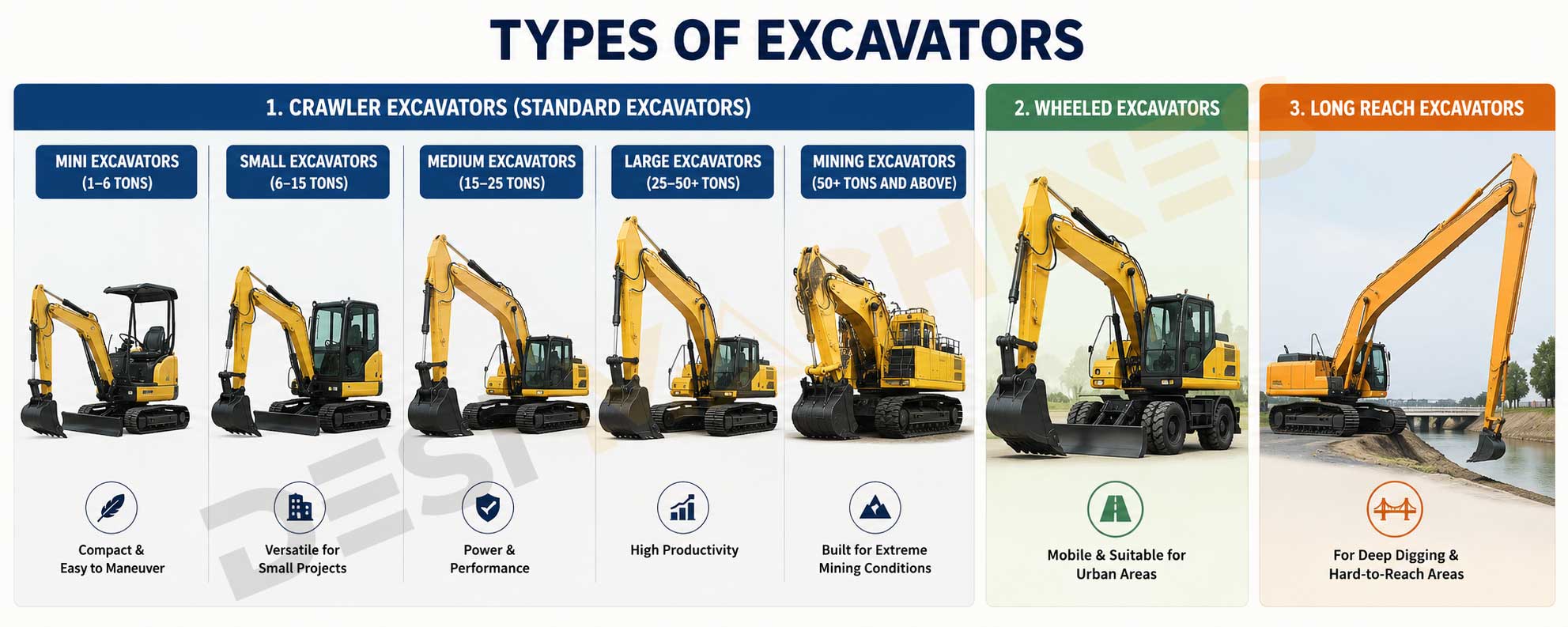
Excavators are classified by three things: operating weight, undercarriage type, and application. A 7 Ton (7,000 kg) machine digging a basement in Pune has nothing in common with a 90 Ton (90,000 kg) excavator loading coal in Jharkhand, except the basic hydraulic principle. Project requirements determine everything. Terrain, space constraints, digging depth, material type, and yes, what’s actually available from sellers within 150 km of your site.
| Type | Best Terrain | Best Use | Main Limitation |
|---|---|---|---|
| Mini Excavator | Tight urban sites | Utility trenching, basement work | Low bucket capacity |
| Crawler Excavator | Soft, uneven, rough ground | Earthmoving, highways, mining | Slow site-to-site travel |
| Wheeled Excavator | Paved and urban surfaces | Municipal, road, drainage work | Lower stability on soft ground |
| Long Reach Excavator | Canal, river, demolition | Deep or long-distance excavation | Reduced lifting force |
1. Standard Excavators (Crawler Excavators)
Crawler excavators, the ones with continuous tracks instead of wheels, are the workhorses of Indian construction. They range from 2 Ton (2,000 kg) compact units to 200+ Ton (200,000+ kg) mining giants. The tracks distribute weight across a larger surface area, which means better stability on uneven terrain and soft ground. Black cotton soil near Nagpur? Waterlogged clay in Bengal during monsoon? Crawlers handle it. Wheeled machines sink. For a closer look at this family, read our crawler excavator guide with size classes and prices.
The trade-off is mobility. Crawlers can’t drive on public roads without a trailer. They’re slower: the crawler machines we list top out between about 2 and 6 km/h. But on site, that stability translates to higher digging force and precision. Every NHAI highway package, every metro rail corridor, every mining operation in India runs on crawler excavators.
Popular crawler excavator models in India (indicative price ranges, as of September 2026):
- JCB NXT 205LC, 21 Ton (21,250 kg), ₹53–58 Lakh
- SANY SY215C-9LC SPARC, 21 Ton (21,400 kg), ₹53–59 Lakh
- Tata Hitachi EX 210LC Prime, 21 Ton (20,600 kg), ₹60–65 Lakh
- Hyundai R215 SMART X Plus, 22 Ton (21,700 kg), ₹64–66 Lakh
Mini excavators (1–6 tons)
The mini excavators weigh between 1 Ton (1,000 kg) and 6 Ton (6,000 kg). They’re built for confined spaces: basement excavations in urban plots, landscaping, utility trenching where a full-size machine simply won’t fit. A JCB 30 Plus at 2,870 kg fits through a standard gate opening. The SANY SY20U at 1,980 kg can work inside existing structures during renovation.
Key specs:
- Digging depth: 2.3–3.8 metres (2,270–3,815 mm) across all 49 mini machines we list
- Bucket capacity: 0.04–0.22 cubic metres
- Engine power: 13.2–48.9 HP (9.9–36.5 kW)
- Price range: ₹20–36 Lakh (indicative, as of September 2026) — 48 of the 49 mini excavators we list carry a published price
Popular models (indicative price ranges, as of September 2026):
- JCB 30 PLUS (₹26–28 Lakh)
- SANY SY35U (₹27–29 Lakh)
- Tata Hitachi NX30 (₹25–27 Lakh)
- Kubota U30-6S (₹26–29 Lakh)
- Bobcat E37 Ultra HD (₹29–31 Lakh)
Small excavators (6–15 tons)
The 7–8 Ton and 13–14 Ton segments are the sweet spot for Indian contractors. Small enough for urban sites, powerful enough for serious earthwork. A 14 Ton (14,000 kg) small excavator handles foundation digging, drainage work, and light demolition without the transport hassles of larger machines.
Key specs:
- Digging depth: 3.1–5.8 metres (3,131–5,827 mm)
- Bucket capacity: 0.09–1.0 cubic metres
- Engine power: 46.7–108 HP (34.8–80 kW)
- Price range: ₹28–54 Lakh (indicative, as of September 2026) — 43 of the 46 machines in this class carry a published price
Popular models (indicative price ranges, as of September 2026):
- JCB NXT 140 (₹42–45 Lakh)
- SANY SY80C-9 PRO (₹30–32 Lakh)
- Tata Hitachi EX 70 Prime (₹33–35 Lakh)
- Hyundai R140L Smart Plus (₹45–48 Lakh)
- Kobelco SK80 (₹35–37 Lakh)
Medium excavators (15–25 tons)
This is the highest-volume segment in India. The 20–23 Ton (20,000–23,000 kg) class dominates NHAI projects, irrigation canal work, and large commercial construction. Why? Because it’s the perfect balance — enough power for serious production, transportable on standard trailers, and fuel-efficient enough to not kill your margins.
When you compare machines in this segment, whether from Tata Hitachi, Komatsu, Volvo, SANY, or Hyundai Construction Equipment, the real difference isn’t just price. It comes down to fuel efficiency, hydraulic performance, digging force, and after-sales support.
For most contractors, this category is where profitability is decided. A well-matched 20-ton excavator can consistently deliver high output with controlled operating costs, making it the go-to choice for long-term projects, especially when you review a detailed 20 ton excavator comparison.
Key specs:
- Digging depth: 5.9–7.0 metres (5,910–6,980 mm)
- Bucket capacity: 0.17–1.85 cubic metres
- Engine power: 114–197 HP (100–147 kW)
- Price range: ₹50–94 Lakh (indicative, as of September 2026) — 62 of the 77 machines in this class carry a published price. One machine tagged to this class publishes a 52,000 kg operating weight, three classes above its own tag; it is left out of these figures while we check the listing
Popular models (indicative price ranges, as of September 2026):
- JCB NXT 215LC (₹56–58 Lakh)
- SANY SY210C-9 (₹51–57 Lakh)
- Tata Hitachi ZAXIS 220LC Ultra (₹69–71 Lakh)
- Hyundai R210 SMART X Plus (₹63–65 Lakh)
- Volvo EC210 (₹62–72 Lakh)
- Komatsu PC210-10M0 (₹65–75 Lakh)
Large excavators (25–50+ tons)
Large excavators, 25 Ton (25,000 kg) to 50 Ton (50,000 kg), are quarry and heavy infrastructure machines. They load dumpers faster, dig deeper, and handle rock that would stall a medium excavator. But they need reinforced trailers for transport, burn far more diesel per hour than a 20-tonner, and require operators with serious experience. No manufacturer we list publishes a litres-per-hour figure for these machines, so build the fuel budget from your own logs on a comparable machine rather than from a number in a brochure.
Key specs:
- Digging depth: 5.9–7.7 metres on a standard arm (5,920–7,720 mm), with one long-arm model reaching 9.9 metres
- Bucket capacity: 0.5–3.1 cubic metres
- Engine power: 170–416 HP (125–310 kW)
- Price range: ₹62 Lakh–₹2.60 Crore (indicative, as of September 2026) — 36 of the 46 machines in this class carry a published price
Popular models (indicative price ranges, as of September 2026):
- JCB 385LC Quarry Master (₹1.25–1.27 Crore)
- SANY SY380C-10HD (₹1.25–1.30 Crore)
- Tata Hitachi ZAXIS 370LCH Ultra (₹1.20–1.30 Crore)
- Hyundai HX380L (₹1.20–1.38 Crore)
- Volvo EC380D (₹1.40–1.80 Crore)
Mining excavators (50+ tons and above)
Mining excavators start at 50 Ton (50,000 kg) and run to several hundred tonnes on the largest machines built anywhere. In India, Coal India operations and private mining companies use the 50–100 Ton class extensively. These are purpose-built for continuous operation: 20+ hours daily, loading dumpers in a handful of passes.
We list 50 machines above 50 tonne and only seven of them carry a published price; those seven run from ₹1.25 Crore to ₹5.0 Crore (indicative, as of September 2026). The rest are price-on-request, which is normal at this end of the market. The specification is built around the mine, so the quote follows the job. The three machines listed below sit at the top of the 25–50 Ton class rather than in the above-50-tonne group.
Key specs:
- Bucket capacity: 1.65–47.5 cubic metres across the 50 machines we list above 50 tonne
- Engine power: 320–1,944 HP on a single engine; six machines run twin engines, the largest a pair of 2,000 HP units
- Reinforced undercarriage for abrasive conditions
Popular models (indicative price ranges, as of September 2026):
- SANY SY500C-10HD, 49.5 Ton (49,500 kg), ₹1.40–1.50 Crore
- Tata Hitachi ZAXIS 470H, 47 Ton (47,100 kg), ₹1.80–1.90 Crore
- XCMG XE520C, 50 Ton (50,000 kg), ₹1.25–1.35 Crore
Compare excavator models side-by-side on Desi Machines: check specs, get transparent pricing, and connect with desimachines.com.
2. Wheeled Excavators
Wheeled excavators have rubber tyres instead of tracks. The advantage? Speed. The one wheeled excavator we list, the SANY SY155W, is rated at 37 km/h on the road, so no trailer is needed for short moves between sites. That changes the economics of urban road construction, utility work, and municipal projects where the machine moves every few hours.
The limitation is stability. Wheels don’t grip soft ground the way tracks do. On sandy riverbeds in Rajasthan or waterlogged sites in coastal areas, a wheeled excavator struggles. And the digging force is lower — you’re trading power for mobility.
When to choose wheels over tracks:
- Urban projects with frequent relocation
- Road widening where the machine moves along the corridor daily
- Municipal drain cleaning
- Sites with paved access where tracks would damage the surface
Currently available in India (indicative price range, as of September 2026):
- SANY SY155W, 13.5 Ton (13,500 kg), ₹90–95 Lakh
This segment is smaller in India compared to Europe, but growing as urban infrastructure projects increase. To understand full performance, features, and cost breakdown, check the detailed wheeled excavator specs and pricing.
3. Long Reach Excavators
Long reach excavators have extended boom and arm assemblies. The twelve long reach machines we list reach 15.0–22.0 metres horizontally, against 9.2–11.0 metres on a standard 15–25 tonne machine. They’re built for specific applications where you can’t position the machine close to the work area, which is why these machines are often discussed under long reach excavator models in project planning.
Applications:
- Dredging: Cleaning canals, rivers, and ponds from the bank — common in irrigation projects across Maharashtra and Karnataka
- Demolition: Bringing down multi-storey structures from a safe distance
- Deep excavation: Reaching the bottom of foundation pits without repositioning
- Slope work: Cutting and shaping embankments on highway projects
The trade-off is lifting capacity. Extended reach means reduced bucket payload: you’re moving less material per cycle. But for the right application, nothing else works.
Popular models (indicative price ranges, as of September 2026):
- JCB NXT 245HD LR, 15.6 m reach, ₹81–83 Lakh
- Tata Hitachi EX 215LC-SLR, 15.6 m reach, ₹79–84 Lakh
- Hyundai R245LR SMART X Plus, 15.3 m reach, ₹78–80 Lakh
Types of Excavation Shoring Systems
Shoring is the temporary support system that prevents trench walls from collapsing during excavation. It’s not optional: it’s the difference between a completed project and a fatality investigation. This is especially important when looking at excavator applications across industries.
Indian regulations under the Building and Other Construction Workers Act require protective systems for excavations deeper than 1.5 metres. But let me back up — even shallow trenches in unstable soil can collapse without warning.
The right shoring system depends on excavation depth, soil type, groundwater conditions, and how long the trench stays open.
1. Timber Shoring
Timber shoring is the traditional method — wooden planks and beams assembled on site to support trench walls. It’s still used across India for shallow excavations (up to 3–4 metres) where soil conditions are stable.
Components:
- Uprights (soldiers): Vertical timber members against the trench wall
- Wales: Horizontal members running along the trench length
- Struts: Cross-braces holding the two walls apart
- Sheeting: Planks covering the soil face between uprights
Advantages: Low material cost. Available everywhere. Can be cut and adjusted on site. Good for irregular trench shapes.
Limitations: Labour-intensive installation. Not reusable across multiple projects. Limited to shallow depths. Requires skilled carpenters who understand load distribution.
2. Aluminum Hydraulic Shoring
Hydraulic shoring uses aluminum or steel frames with hydraulic cylinders that expand to press against trench walls. The pressure is adjustable — tighten it as soil conditions change, release it for removal.
Advantages:
- Fast installation — one crew can shore 20–30 metres of trench per day
- Adjustable pressure for varying soil conditions
- Lightweight aluminum components — easier handling
- Reusable across hundreds of projects
- No skilled carpentry required
Suitable depths: 2–6 metres typically, depending on system rating and soil type.
Cost consideration: Higher upfront equipment cost, but lower per-project cost when amortised across multiple uses. We do not list shoring equipment, so take a written quote from a shoring supplier rather than working off a rule of thumb. Rental options are available in major cities.
3. Steel Sheet Piling
Steel sheet piles are interlocking steel sections driven into the ground before excavation begins. They create a continuous wall that retains soil and can also block groundwater — critical for excavations below the water table.
Applications:
- Deep excavations (6–15+ metres)
- Waterfront construction — ports, jetties, river crossings
- Basement construction in high water table areas
- Permanent retaining walls (sheet piles left in place)
4. Trench Boxes (Trench Shields)
Trench boxes, also called trench shields, are prefabricated steel or aluminum boxes lowered into excavated trenches. They don’t support the soil; they protect workers if the soil collapses.
Advantages:
- Quick deployment — no installation time
- Moves with the work — ideal for linear projects
- No soil disturbance from installation
- Available in various sizes (1.2m to 3.6m+ width)
5. Soldier Pile and Lagging
Soldier pile and lagging is an engineered shoring system for deep excavations. Steel H-beams (soldier piles) are driven or drilled into the ground at regular intervals (1.5–3 metres apart).
Applications:
- Deep basement excavations (8–20+ metres)
- Permanent foundation walls
- Urban construction with adjacent buildings
- Combined with soil nails or tiebacks
Ready to find the right excavator machine for your project? Explore all excavator models and request a quote on Desi Machines.
Whichever type you choose, much of its versatility comes from the tools it carries — see the excavator attachments guide for buckets, breakers and more.
Bucket size scales with the machine class shown above; our excavator bucket types guide explains how to match bucket capacity to your machine’s tonnage.
Whatever type you settle on, it pays to know what sits inside it. Our excavator components guide breaks down the undercarriage, boom assembly and hydraulics, so you can tell a genuine problem from an inflated repair quote.
One older name still causes confusion on site: the rope-operated power shovel and how it differs from a hydraulic excavator is worth reading before you agree to buy anything described simply as a “shovel machine”.
Weight is the other way the family is sorted. Our guide to excavator size classes sets out the mini, small, medium, large and mining bands, and what each one is normally used for in India.
Prices, specifications and features are indicative, vary by variant, location and date, and should always be confirmed with the official OEM or authorised dealer before any purchase decision. DesiMachines is not liable for decisions taken on the basis of information that may have changed after publication.