
 Excavator
294 models
Excavator
294 models  Backhoe Loader
51 models
Backhoe Loader
51 models  Crane
68 models
Crane
68 models  Concrete Mixer
79 models
Concrete Mixer
79 models  Wheel Loader
54 models
Wheel Loader
54 models  Compactor / Roller
45 models
Compactor / Roller
45 models  Motor Grader
42 models
Motor Grader
42 models  Dozer
41 models
Dozer
41 models  Concrete Pump
66 models
Concrete Pump
66 models  Skid Steer Loader
11 models
Skid Steer Loader
11 models  Telehandler
13 models
Telehandler
13 models 


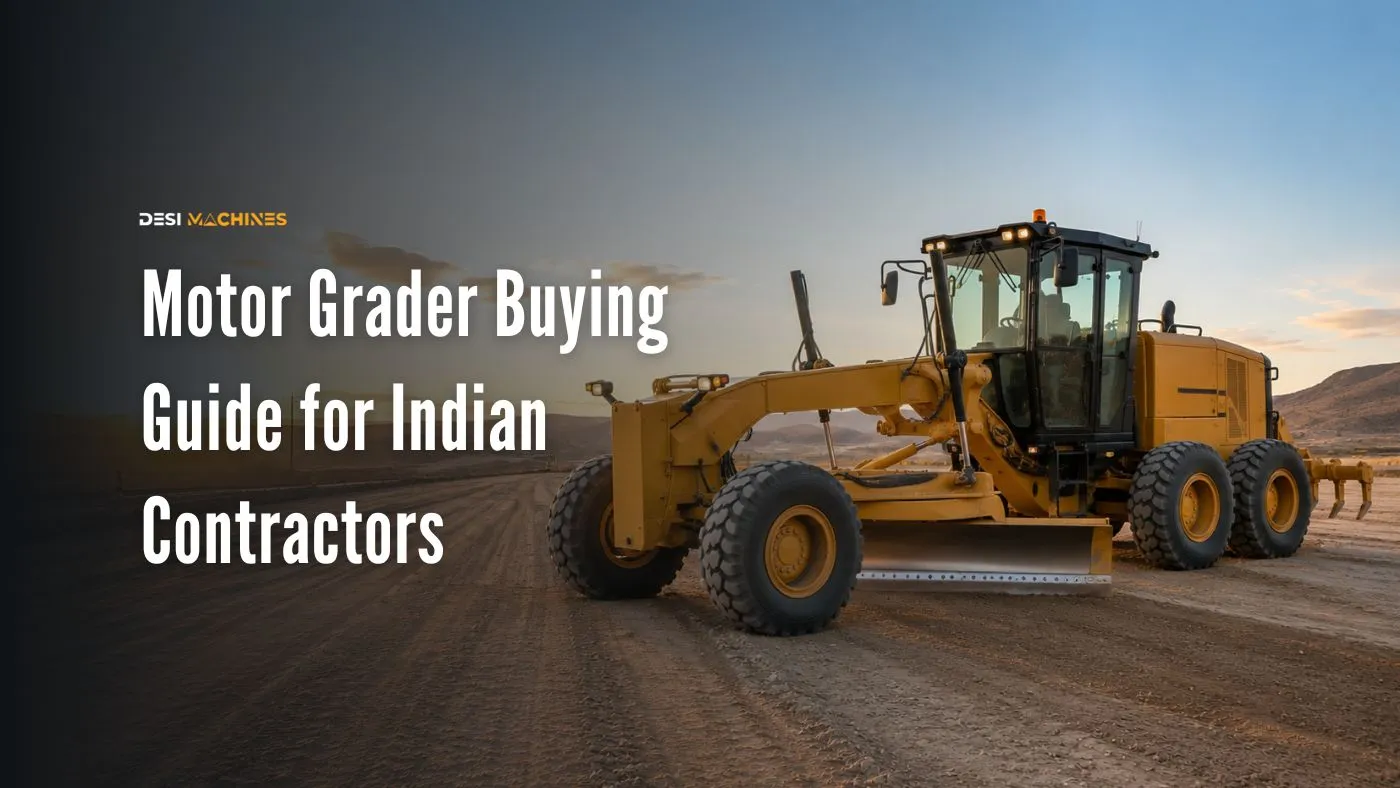
A motor grader is not a machine you buy on impulse. Get it wrong and you are stuck with a machine that cost anything from ₹30–45 Lakh at the bottom of our listings to ₹1.5–1.9 Crore at the top (indicative, as of September 2026), and that is either too small for your highway project or burning fuel on rural roads that needed half the horsepower. Indian contractors make this mistake constantly, buying on brand recognition or dealer proximity instead of matching the machine to the actual job. This motor grader buying guide cuts through the noise. We’ll cover specs that matter, brands worth considering, and the real factors that determine whether your grader earns its keep or sits idle.
Before you buy, it helps to understand the machine: our guide on how motor graders work covers the components and blade controls.
What is a Motor Grader?
A motor grader, sometimes called a road grader or blade, is precision earthmoving equipment designed for one thing: creating flat, even surfaces. The machine’s defining feature is its long, adjustable blade (called a moldboard) mounted between the front and rear axles. This blade can tilt, angle, and rotate to spread material, cut grades, and create slopes with millimetre-level accuracy.
Unlike excavators or loaders that move bulk material, a grader finishes the job. It takes a rough surface and turns it into something you can pave. In India, motor graders are the backbone of NHAI highway projects, PMGSY rural road schemes, and state PWD works. Without them there is no road, just compacted dirt waiting for the first monsoon to wash it away.
Why Motor Graders are Essential for Indian Construction
India’s infrastructure push demands motor graders across multiple applications. Here’s where they earn their keep:
- Road Construction: Creating the sub-base and base layers before asphalt. Every national highway, state highway, and district road starts with a grader pass.
- Road Maintenance: Reshaping gravel roads after monsoon damage, which is critical for rural connectivity in UP, Bihar and Madhya Pradesh.
- Mining Operations: Maintaining haul roads in coal mines across Jharkhand and Chhattisgarh. A poorly graded haul road chews through dumper tyres, and on a mining fleet those tyres are one of the largest consumable bills you carry. We list machines, not tyres, so price them from your own last purchase order.
- Land Leveling: Preparing industrial sites, airport runways, and large housing projects. The Dholera SIR and other smart city projects run graders continuously.
- Drainage Work: Cutting side ditches along roads. Essential in waterlogged areas of Bengal and coastal regions.
The Bharatmala Pariyojana alone targets 34,800 km of highways. That is thousands of graders running double shifts October through May, on every major corridor.
Types of Motor Graders Available in India
Motor graders in India are categorised by operating weight and engine power. The right category depends entirely on your project scale and terrain conditions.
Small Motor Grader (4-12 tons)
Small graders run 74–150 HP and are built for municipal works, rural roads and tight spaces. Across the ten machines in this class, gross vehicle weight runs from 7,160 kg (7.2 Ton) on the Mahindra G75 Smart to 11,500 kg (11.5 Ton) on the BEML BG605I. Note the figure our product pages publish is gross vehicle weight, not the “operating weight” buyers usually ask for; our motor grader weight and dimensions reference explains the difference. Nothing we list sits anywhere near 4 tonnes. These machines offer excellent maneuverability — which matters when you are grading village roads with houses on both sides.
The Mahindra RoadMaster G80/G90/G100 dominates this segment in India. Lower purchase price and reduced fuel consumption make them viable for contractors working PMGSY tenders where margins are thin. The RoadMaster range is listed at ₹29.5 Lakh onwards for the G80 and ₹51 Lakh onwards for the G100 (indicative, as of September 2026). Both product pages quote an onwards starting price rather than a band, so read those as a floor and ask the dealer for the full quote. But don’t expect them to handle rocky terrain or heavy material spreading. That’s not what they’re built for.
Medium Motor Grader (12-20 tons)
The workhorse category, and 24 of the 42 graders we list sit in it. Engines run 148–260 HP and gross vehicle weight runs 12,650–19,300 kg, with blade widths that cover serious ground. Medium graders handle district roads, state highways, and most construction projects without being overkill.
Models like the CAT 120, CASE 845C, Komatsu GD535-6, and SANY STG170C-10 sit in this range. You get balanced power and stability — enough muscle for hard laterite soil in Karnataka but not so heavy that you’re wasting fuel on lighter work. Price range across these four machines: ₹75 Lakh to ₹1.5 Crore (indicative, as of September 2026), the SANY at the floor and the CAT 120 at the ceiling.
Large Motor Grader (Above 20 tons)
For national highways, expressways and mining operations. Across the eight machines in this class, engines run 239–533 HP, gross vehicle weight runs 20,760–65,840 kg and blades run 4,200–7,300 mm (13.8–24 ft) for maximum coverage per pass.
The BEML BG 825, Komatsu GD705, SANY SMG200C-8 are built for this work. These large machines grade faster, handle harder material, and maintain precision even on long stretches. But they cost ₹90 Lakh to ₹1.9 Crore (indicative, as of September 2026), burn more fuel and need skilled operators. Overkill for anything below a state highway project.
Key Specifications to Consider When Buying a Motor Grader
Specs determine whether your grader matches your project or fights it every day. Here’s what actually matters.
Engine Power (Horsepower)
Engine power directly affects grading speed and the machine’s ability to handle hard material. Every one of the 42 graders we list publishes a gross power figure, and they run from 74 HP on the entry-level Mahindra machines to 533 HP on the Cat 24M mining grader. Almost all Indian road work sits between 148 HP and 260 HP.
Match power to workload. A 100 HP grader struggles on rocky terrain in Rajasthan, because the blade skips instead of cutting. A 250 HP grader on soft alluvial soil in Punjab burns diesel every hour for power you never call on. No manufacturer publishes a litres-per-hour figure for a grader and our product pages carry none, so the only honest way to size that waste is to meter your own machine for a week. Most Indian highway projects run efficiently with 150–200 HP machines.
Operating Weight
Gross vehicle weight determines stability during grading. A heavier machine maintains blade contact on uneven surfaces without bouncing. Across the 42 graders listed here the published figure runs from 7,160 kg on the Mahindra G75 Smart to 65,840 kg on the Cat 24M, though almost every machine bought for Indian road work sits between 9,000 kg and 18,000 kg.
But weight isn’t always better. Heavier machines compact the sub-base more — good for highways, problematic for finished surfaces. And transporting a 20+ Ton grader between sites costs more. Consider your typical project distance.
Blade Width & Control
Standard blade widths in India run from 2,600 mm (8.5 ft) on the smallest Mahindra graders to 4,320 mm (14.2 ft) at the top of the mainstream class. The large machines run 4,200–5,489 mm (13.8–18 ft), and the biggest mining grader listed here, the Cat 24M, reaches 7,300 mm (24 ft). Blade width is only one of the figures that decide what the blade can do: motor grader cutting depth and blade reach covers how deep it cuts and how far it swings out past the wheels. Wider blades cover more area per pass — critical on highway projects where daily output targets are aggressive.
But blade width alone doesn’t determine efficiency. Hydraulic blade control matters more. Modern graders offer six-way blade movement: lift, shift, tilt, side-shift, rotation, and articulation. The CAT 120 and SANY models feature joystick controls that let operators make micro-adjustments without stopping. On a 10 km stretch, that precision saves 2–3 days of rework.
Hydraulic System
The hydraulic system powers every blade movement. Advanced graders use load-sensing hydraulics that deliver oil flow only when the blade calls for it, so the pump is not working against a relief valve all day. No published Indian test data puts a percentage on that saving, so treat it as a design advantage rather than a number you can bank.
Check hydraulic pressure ratings. Of the 42 graders listed, 29 publish a maximum system pressure, and it runs from 12.75 MPa (128 bar) on the BEML machines to 27.5 MPa (275 bar) on the Komatsu GD955-7, with most sitting near 20 MPa (200 bar). Higher pressure means the blade holds its position under load instead of drifting. For rocky terrain in Madhya Pradesh or Jharkhand, this isn’t optional — it’s essential.
Articulation Type
Articulated frame graders bend in the middle, allowing the rear wheels to follow a different path than the front. This improves maneuverability in tight spaces and provides better traction on uneven terrain.
Rigid frame graders are simpler and cheaper but struggle on curves and rough ground. In Indian conditions, where you are often grading around existing structures or on hilly terrain in Himachal and Uttarakhand, articulated frames are worth the premium. Most modern graders from CAT, Komatsu, CASE, and SANY are articulated.
Fuel Efficiency & Tank Capacity
Fuel is the largest running cost on a grader over a full year. No manufacturer publishes a litres-per-hour figure for a motor grader and our product pages carry none, so any consumption number you are quoted is the seller’s estimate. Meter it yourself: fill the tank, work a normal shift, refill and divide. Three litres an hour of difference between two machines, over 2,000 working hours a year, is 6,000 litres a year. Put your own diesel rate against that figure before you compare EMIs.
Tank capacity is published for 38 of the 42 graders listed and runs from 100 litres on the Mahindra machines to 1,326 litres on the Cat 24M. A mainstream road grader carries 224 to 416 litres. Larger tanks mean fewer refueling stops — important on remote highway stretches where diesel delivery is unreliable. But a bigger tank also means more weight when full. Balance capacity against your typical shift length and fuel availability.
Factors to Consider Before Buying a Motor Grader in India
Specs tell you what a machine can do. These factors tell you whether it’s right for your specific situation.
Project Type & Application
Match grader size to project scale. Simple as that.
- Rural roads (PMGSY): the small class, 74–150 HP. Lower capital cost, adequate power, easier to transport between scattered village sites.
- District/State highways: the mainstream class, 148–260 HP. Balanced performance, reasonable fuel consumption, handles most Indian soil types.
- National highways/Expressways: the large class, 239–533 HP. Daily output targets demand wider blades and faster grading speeds.
- Mining haul roads: Large graders with reinforced blades. Haul road maintenance is continuous, so the machine runs 10 to 12 hours daily.
Terrain matters too. Black cotton soil near Nagpur expands when wet, so you need a heavier machine to maintain blade contact. Sandy stretches in Rajasthan require less power but more frequent passes. Rocky terrain in Jharkhand demands high hydraulic pressure and reinforced cutting edges.
To pick the grader size for your road, choose road work and the type of road in the finder.
Budget & Total Cost of Ownership
Purchase price is just the beginning. Calculate total cost of ownership over 5 years:
- Initial price: ₹30–45 Lakh at the bottom of our listings to ₹1.5–1.9 Crore at the top, with three Mahindra RoadMaster models quoted at ₹29.5 Lakh onwards instead of a band (indicative, as of September 2026)
- Fuel: your metered litres per hour, times your annual hours, times your diesel rate. We publish no consumption figure because no product page carries one
- Scheduled service: engine oil, filters and hydraulic oil at the intervals below. Price the quantities off our motor grader fuel and oil capacities reference and your dealer’s current rate card
- Wear parts: cutting edges, circle shoes and tyres, quoted per replacement by your dealer. We list machines, not spare parts, so we cannot price these for you
- Operator: a skilled grader operator’s wage in your own state. Ask two contractors locally rather than working off a national figure
EMI and financing options are available through banks and NBFCs. Most dealers offer tie-ups with HDFC, ICICI, and equipment finance companies. Down payment typically 15–25%, tenure 3–5 years. But a lower EMI on a fuel-guzzling machine costs more than a higher EMI on an efficient one. Compare the total, then buy.
Brand Reputation & After-Sales Support
A grader breakdown 200 km from the nearest service centre means 3–5 days idle. Three to five days of zero output, EMIs still running, client still calling. That’s the math.
Before buying, verify:
- Nearest service centre distance from your typical project locations
- Spare parts availability, since some brands stock common parts locally and others import everything
- Service response time commitment in writing
- Availability of trained mechanics in your region
Caterpillar and Komatsu have extensive dealer networks across India. Mahindra’s service reach in Tier 2/3 towns is strong. SANY and XCMG are expanding but verify coverage in your specific operating area.
Operator Comfort & Safety Features
A grader operator works 8–12 hour shifts in Indian summer heat. Operator comfort directly affects productivity and precision.
Look for:
- Air-conditioned cabin: Non-negotiable for sites in Rajasthan, Gujarat, and central India
- Ergonomic controls: Joystick operation reduces fatigue versus lever controls
- Visibility: Large windows and rear-view cameras for safe operation
- Suspension seat: Reduces operator fatigue on rough terrain
- ROPS/FOPS: Rollover and falling object protection, mandatory for mining applications
A comfortable operator maintains precision longer. An exhausted operator makes mistakes that cost rework days.
Technology Features
Modern graders offer technology that improves accuracy and reduces operator skill dependency:
- GPS grade control: Automatic blade adjustment based on design grade, which reduces surveying time and improves accuracy
- Telematics: Remote monitoring of fuel consumption, location, and maintenance alerts
- Digital control panels: Real-time display of blade position, engine parameters, and system status
- Automatic blade leveling: Maintains consistent grade without constant operator adjustment
These features are quoted as options rather than being part of the listed machine price, so ask for each one separately on the proforma. Worth it on large highway projects where precision matters. Overkill for rural road maintenance where a skilled operator achieves the same result manually.
Compare motor grader models side-by-side on Desi Machines — check specs, get transparent pricing
Top Motor Grader Brands in India
Six brands dominate the Indian motor grader market. Each has strengths and limitations.
Caterpillar
Caterpillar (CAT) sets the benchmark for motor grader performance globally. In India, the CAT 120 and CAT 140 GC are the most popular models.
Known for: Powerful engines, exceptional durability, precision hydraulics and strong resale demand. We publish no residual-value data and no reliable Indian index exists for graders, so ask two used-equipment dealers what they would bid for a five-year-old machine before you count resale into the sum.
Limitation: Premium pricing (the three priced CAT graders run ₹1.1–1.7 Crore, indicative, as of September 2026, and the larger 14M3, 16M3 and 24M machines are quoted on request) and higher spare parts costs. But for contractors running 2,000+ hours annually, the reliability justifies the investment.
Komatsu
Komatsu graders are known for fuel efficiency and reliability. The GD535-6, GD705-5, and GD955-7 cover small to large applications.
Known for: A long-standing reputation for fuel economy, smooth hydraulics and strong dealer support through L&T. No published Indian test data backs a percentage, so ask for a demonstration on your own soil rather than accepting a figure. The GD705-5 is particularly popular on NHAI projects.
Limitation: Higher initial cost than Chinese brands. Parts availability can be slower in remote areas.
CASE
CASE offers a strong mid-market option with the 845B, 845C, and 865B models.
Known for: Durability in tough conditions, excellent serviceability (flip-up rear hood for easy maintenance), and competitive pricing. The 845C is a workhorse on state highway projects.
Limitation: Smaller dealer network compared to CAT. Verify service coverage in your operating area before committing.
Mahindra
Mahindra Construction Equipment dominates the small grader segment with the RoadMaster G80, G90, and G100 series.
Known for: Affordability (the six Mahindra graders listed run from ₹29.5 Lakh onwards for the RoadMaster G80 to ₹57–59 Lakh for the G9595, indicative, as of September 2026), strong local service support and parts availability even in Tier 3 towns. Ideal for PMGSY contractors and municipal works.
Limitation: Limited to small and medium applications. Not suitable for heavy highway work or mining.
SANY
SANY has gained significant market share with models like the STG170C-10 and SMG200C-8.
Known for: Value for money, modern features at competitive prices and an improving service network. The price gap is real and measurable from our own listings: the 173 HP SANY STG170C-10 is listed at ₹75–90 Lakh against ₹1.4–1.7 Crore for the 196 HP Cat 140 GC of almost identical weight (both indicative, as of September 2026). Performance is harder to compare honestly, so run both machines on your own ground before deciding.
Limitation: Resale value is lower than established brands. Service network still developing in some regions.
XCMG
XCMG offers the GR1605 and GR1705 with innovative technology at competitive pricing.
Known for: Advanced features, competitive pricing, and improving build quality. Good option for contractors willing to try newer brands.
Limitation: Brand recognition is lower, affecting resale value. Verify service support in your area.
Motor Grader Price Range in India 2026
Motor grader prices in India currently run from ₹29.5 Lakh onwards for the Mahindra RoadMaster G80, the cheapest machine listed, up to ₹1.5–1.9 Crore for the Komatsu GD705-5, the dearest (ex-factory; indicative, as of September 2026). Nine of the 42 graders listed, including the Cat 14M3, 16M3 and 24M and the larger Komatsu units, are quoted on request rather than carrying a listed price.
| Category | Price Range (Ex-Factory, indicative, as of September 2026) | Typical Models |
|---|---|---|
| Entry-Level | ₹30–55 Lakh (three Mahindra models quoted ₹29.5 Lakh onwards) | Mahindra RoadMaster G80, G90, G100; Fine FMG 130; BEML BG405A |
| Mid-Range | ₹65 Lakh – ₹1.05 Crore | XCMG GR1705, ACE AG 176, SANY STG170C-10, Komatsu GD535-6, CASE 845C |
| Premium | ₹1.1–1.9 Crore | CAT 120 GC, CAT 140 GC, BEML BG825, Komatsu GD705-5 |
Each band above runs from the displayed low of the cheapest machine named beside it to the displayed high of the dearest, so the tiers leave gaps: the Mahindra G9595 at ₹57–59 Lakh and the SANY STG140C-10 at ₹55–60 Lakh (both indicative, as of September 2026) sit between the entry and mid tiers. Factors affecting price: brand, engine power, blade width, technology features and attachments. Listed prices are ex-factory. The on-road figure adds transportation, RTO registration, TCS, warranty, insurance and FOC where applicable, and non-standard configurations, attachments and accessories are priced separately. Always get a complete quote before comparing.
If those new prices are beyond the budget for this project, the used motor grader buying guide sets out what to measure on a second-hand machine and how to work a fair price down from the new band for the same class.
Financing and EMI Options for Motor Graders
Most motor grader purchases in India are financed. Options include:
- Bank loans: HDFC, ICICI, SBI, and other banks offer equipment financing at 9–12% interest rates
- NBFC financing: Tata Capital, L&T Finance, Cholamandalam offer faster processing with slightly higher rates
- Dealer financing: Many dealers have tie-ups with finance companies for streamlined approval
Typical terms: 15–25% down payment, 3–5 year tenure, monthly EMIs based on loan amount and interest rate. Documentation required: business registration, ITR for 2–3 years, bank statements, and project contracts (if available).
The financing decision shapes your cash flow for five years, so compare the total interest paid across options rather than the EMI alone. Run the same loan amount at each lender’s rate over three years and over five, and read the difference in the total repaid. On a machine at the top of the mid-range band that difference is routinely larger than any discount you negotiated on the price.
How to Buy a Motor Grader in India
Here’s the process that saves money and avoids regret:
- Define requirements: Project type, terrain, daily output targets, operating hours expected
- Shortlist models: Compare 3–4 models that match your requirements on platforms like Desi Machines
- Check specifications side-by-side: Engine power, blade width, operating weight, fuel tank capacity
- Verify pricing: Get quotes from trusted authorised dealers. Ex-showroom and on-road prices both
- Confirm service support: Distance to nearest service centre, parts availability, response time commitment
- Arrange financing: Compare bank and NBFC options. Factor in processing fees and prepayment charges
- Arrange insurance: Comprehensive coverage for the first 2–3 years minimum
- Inspect before delivery: Check all systems, run the machine, verify accessories match the order
Most contractors skip steps 3 to 5 and regret it within the first year. Ask the hard questions about service response before you sign anything.
Motor Grader Maintenance & After-Sales Service
A motor grader is a precision machine. Neglect maintenance and precision disappears.
Regular maintenance includes:
- Engine oil and filter changes every 250–500 hours
- Hydraulic oil changes every 1,000–2,000 hours
- Blade cutting edge inspection and replacement
- Circle and drawbar inspection for wear
- Tyre pressure and condition checks
- Articulation joint lubrication
Before buying, verify spare parts availability for wear items: cutting edges, circle shoes, tyres, filters. These need replacement regularly. If parts take 3 weeks to arrive, your machine sits idle for 3 weeks.
Operator training matters. A skilled grader operator achieves grade accuracy an untrained operator cannot match, whatever the machine. Brands like Caterpillar, Komatsu, and Mahindra offer operator training programs. Budget for it. It pays back in reduced rework and fuel. Before the first service falls due, check the machine’s fuel and oil capacities so you buy the right quantity of each oil.
Ready to find the right motor grader for your project? Compare live motor grader models and prices and request a quote.
For the published weight, blade width and machine dimensions of every grader listed here, see our reference on motor grader weight and dimensions.
Before you fix on a horsepower figure, check what each class actually carries in motor grader engine power and torque by class, including the machines that publish two different power ratings.
Prices, specifications and features are indicative, vary by variant, location and date, and should always be confirmed with the official OEM or authorised dealer before any purchase decision. DesiMachines is not liable for decisions taken on the basis of information that may have changed after publication. Price figures quoted here are taken from our listings at the time of writing.

