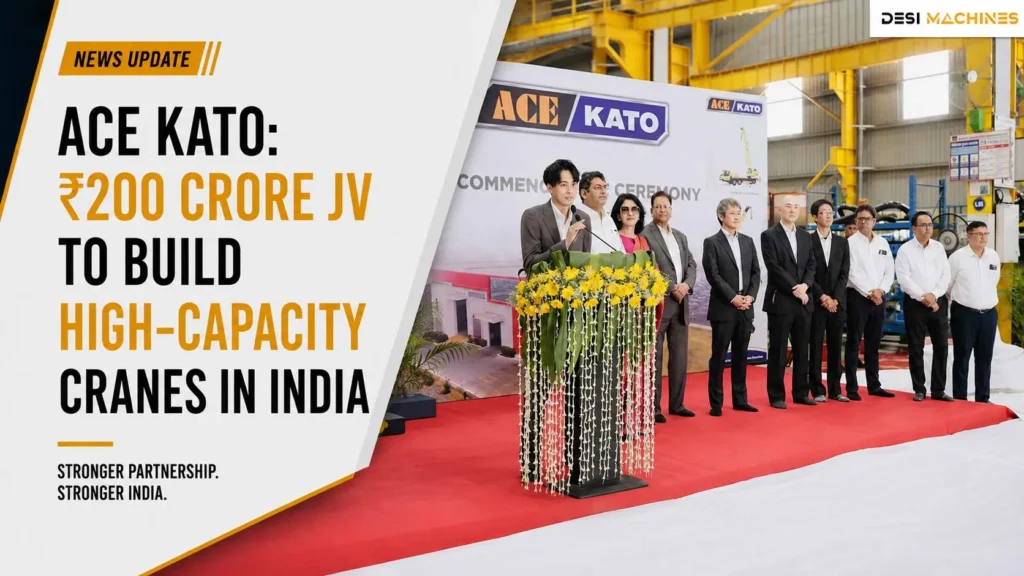
The joint venture is now more than a handshake. ACE and Japan’s KATO have put ₹200 crore and a factory behind ACE KATO, their plan to build high-capacity cranes in India — and for anyone weighing ACE KATO cranes against imports, that’s worth a look.
The quick facts
- Action Construction Equipment (ACE) and Japan’s KATO Works have set up ACE KATO Pvt. Ltd, a 50:50 joint venture to build high-capacity cranes in India. ACE announced the investment on 2 July 2026.
- Planned spend: about ₹200 crore in an 11-acre plant in Haryana, with more to follow in phases.
- The line will cover truck cranes, crawler cranes and rough-terrain cranes for infrastructure, ports, mining, metro rail, energy and industry.
- KATO leads engineering and technology; ACE handles manufacturing, sourcing and step-by-step localisation through its India network.
What ACE and KATO announced
ACE said on 2 July 2026 that its 50:50 JV with KATO Works will build high-capacity cranes in India for both the home market and exports, backed by roughly ₹200 crore and an 11-acre Haryana plant, per Business Standard. The two firms signed the JV back in March; this announcement puts money and a factory behind it. Treat the investment figure and product plans as company-stated until the plant and first models are confirmed.
What local crane manufacturing means for buyers
Today most heavy cranes above the pick-n-carry class — big truck cranes, crawler cranes and rough-terrain machines — reach Indian sites as imports or CKD kits. That usually means long lead times, full exposure to the rupee against the yen or euro, import duty baked into the sticker, and slow, costly spares. A local line aimed at the high-capacity segment could chip away at all four.
If ACE KATO delivers, the clearest wins are faster delivery and easier service. ACE already runs a wide sales-and-service network across India, so parts and support would sit in an existing domestic channel rather than a distant import route. Local build also makes rupee financing simpler — banks and NBFCs are generally happier funding a made-in-India machine, which matters for rental firms and mid-size contractors buying on EMI.
Price is the open question. “Made in India” trims duty and forex, and phased localisation should lower cost over time — but early units off a new line often carry high imported content, so day-one pricing may not undercut established imports by much. Anyone who needs a 100-tonne-plus crawler or rough-terrain crane this year will still weigh Tadano, XCMG, Zoomlion, Kobelco and Liebherr on availability and proven uptime.
Our take: local high-capacity crane manufacturing in Haryana could, over time, trim lead times and landed costs and improve parts and service — but the near-term effect is limited until ACE KATO names models, tonnage classes, prices and delivery dates.
What to watch
- First models, tonnage classes and India pricing from ACE KATO.
- Production-start and delivery timelines from the Haryana plant.
- How fast localisation deepens — it drives both price and lead time.
FAQ
Will ACE KATO cranes be cheaper than imported ones?
Not necessarily on day one. Local build cuts import duty and forex, but early units off a new line often carry high imported content. The clearer near-term wins are shorter lead times and local parts and service; sharper pricing should follow as localisation deepens.
When will the cranes actually be available?
ACE hasn’t named models, tonnage classes or delivery dates yet. Until the Haryana plant is running and the first models are announced, treat availability as company-stated intent, not a firm timeline.
Related on DesiMachines: India construction equipment market — the complete guide →
Source: Business Standard

 Excavator
294 models
Excavator
294 models  Backhoe Loader
51 models
Backhoe Loader
51 models  Crane
68 models
Crane
68 models  Concrete Mixer
79 models
Concrete Mixer
79 models  Wheel Loader
54 models
Wheel Loader
54 models  Compactor / Roller
45 models
Compactor / Roller
45 models  Motor Grader
42 models
Motor Grader
42 models  Dozer
41 models
Dozer
41 models  Concrete Pump
66 models
Concrete Pump
66 models  Skid Steer Loader
11 models
Skid Steer Loader
11 models  Telehandler
13 models
Telehandler
13 models