
 Excavator
294 models
Excavator
294 models  Backhoe Loader
51 models
Backhoe Loader
51 models  Crane
68 models
Crane
68 models  Concrete Mixer
79 models
Concrete Mixer
79 models  Wheel Loader
54 models
Wheel Loader
54 models  Compactor / Roller
45 models
Compactor / Roller
45 models  Motor Grader
42 models
Motor Grader
42 models  Dozer
41 models
Dozer
41 models  Concrete Pump
66 models
Concrete Pump
66 models  Skid Steer Loader
11 models
Skid Steer Loader
11 models  Telehandler
13 models
Telehandler
13 models 


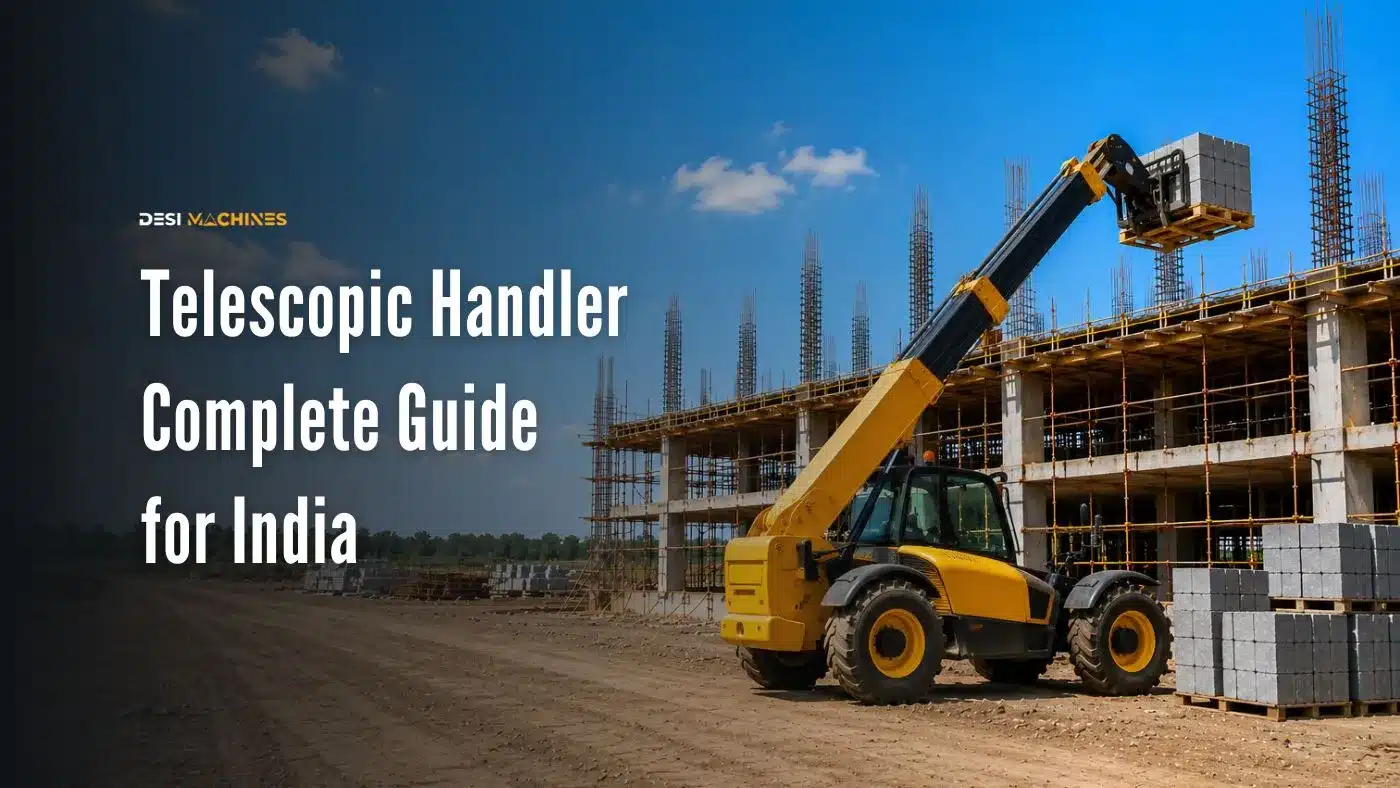
A telescopic handler — telehandler for short — is the machine that does the job of a forklift, a crane, and a loader without being any of them. It’s a wheeled machine with a single extending boom that reaches up and out, lifting loads to heights a forklift can’t touch and into places a crane can’t easily park. On Indian sites building precast, warehousing, and infrastructure, it’s gone from a rarity to a machine buyers now ask for by name.
This guide covers what a telehandler is, how it works, the types sold in India, what the model numbers actually mean, and how to choose one — with the brands and models DesiMachines carries so you can go from understanding to a quote. For a closer look at the jobs it does on site, in farming, and in a godown, see our guide to telehandler applications in Indian construction.
What Is a Telescopic Handler?
A telehandler is a lifting machine built around a telescopic boom — an arm that extends forward and upward like a crane’s, mounted on a wheeled chassis like a loader’s. At the end of the boom you fit an attachment: most often a set of forks (making it a very capable rough-terrain forklift), but also a bucket, a lifting hook, or a work platform.
That combination is the whole point. A forklift lifts straight up and needs level ground. A wheel loader carries material but can’t reach height. A crane reaches high but is slow to set up and move. The telehandler does the middle job better than any of them — lift a pallet of blocks to the third floor of a structure, place a bundle of steel across a trench, load a hopper, or reach over an obstacle — and then drive to the next task on its own wheels.
Globally the machine grew out of the agricultural and European construction markets in the 1980s and became standard kit on building sites there long before India. Here, the rise of precast construction, organised warehousing, and faster infrastructure timelines is what’s pulling it into mainstream use now.
How a Telehandler Works
The boom is hydraulic. It extends and retracts (the telescopic action), raises and lowers, and the attachment at the tip tilts to keep a load level as the boom moves. On most machines the operator also has frame levelling — the ability to tilt the whole chassis a few degrees to stay square on uneven ground before lifting.
The critical thing to understand about any telehandler is the load chart. Unlike a forklift, a telehandler’s safe lifting capacity drops as the boom extends further out. A machine rated to lift 4 tonnes close in might safely handle only a fraction of that at full reach, because the load moves further from the machine’s centre of gravity. Every telehandler carries a load chart in the cab showing safe capacity at each combination of height and reach. Reading it correctly is the core skill of operating one safely — and the same load-chart logic that governs cranes applies here.
Most telehandlers used in Indian construction are 4-wheel drive with multiple steering modes (front-wheel, four-wheel, and crab steer), which is what lets a big machine work on broken site ground and tuck into tight spots.
Types of Telehandlers
Two families cover almost all Indian construction work, split by whether the boom can rotate.
1. Fixed-boom telehandlers
The boom lifts and extends but does not rotate — to move a load to the side, you reposition the whole machine. Fixed-boom machines are simpler, lighter, cheaper, and the mainstay of general construction: loading, placing materials at height, and forklift duties on rough ground. This is the volume segment. DesiMachines lists these under fixed boom telehandlers.
2. Rotating telehandlers (roto telehandlers)
The boom sits on a slewing turntable and rotates a full 360°, like a crane’s superstructure. The operator can place loads all around the machine without moving it — a major advantage on congested sites, and it lets the machine double as a light crane or an access platform. Rotating machines cost significantly more and are specialist kit for precast erection, industrial maintenance, and tight urban work. See rotating telehandlers.
For most contractors, a fixed-boom machine is the right first telehandler. A rotating machine earns its premium only when the work genuinely needs 360° placement or a crane-and-platform in one.
Reading the Model Numbers
Telehandler model names look cryptic but usually encode the two numbers that matter most: lift capacity and lift height. Once you know the pattern, the spec is half-readable at a glance.
Take the JCB Loadall range as the clearest example. A JCB 540-70 lifts roughly 4 tonnes to about 7 metres; a JCB 530-70 handles around 3 tonnes to 7 metres; and a JCB 530-110 trades capacity for reach — about 3 tonnes to 11 metres. Higher second number, taller reach; higher first number, heavier lift.
The pattern isn’t identical across every brand, so always confirm the exact load chart on the product page rather than assuming — but it tells you instantly whether a machine is built more for lift or more for reach.
Telehandler Brands and Models in India
The Indian telehandler market is served by a mix of global specialists and Indian majors. DesiMachines carries the main ranges:
- JCB — the Loadall range (530-70, 540-70, 530-110 and more) is the most familiar telehandler line on Indian sites, backed by JCB’s wide dealer and service network. Browse JCB telehandlers.
- Manitou — the French firm that effectively created the modern telehandler, and still the reference for the rotating (MRT) machines alongside its fixed MXT range. See Manitou telehandlers.
- SANY — the STH series (STH634A, STH844A, STH1056A) brings a competitive, well-supported option into the Indian market. See SANY telehandlers.
- ACE — Indian manufacturer, known for pick-and-carry cranes, with telehandlers such as the AT 30 aimed at the domestic buyer.
A shortlist of “best telehandler brands” is planned as part of this cluster. For now, the honest answer for most buyers is: match the load chart and dealer support to your work, and JCB or SANY fixed-boom machines cover the majority of general construction needs. Manitou leads if you specifically need a rotating machine.
Telehandler vs Forklift vs Wheel Loader
Buyers weighing a telehandler are usually deciding against one of two machines they already know.
- vs a forklift — a forklift is cheaper and fine on hard, level yards. The moment you need to work on rough site ground or lift up and over to height, the telehandler wins outright. A telehandler is a rough-terrain forklift with reach; a warehouse forklift is neither. If the lifting really is on a flat, finished floor, an electric forklift does that work more cheaply and leaves no exhaust inside the shed.
- vs a wheel loader — a wheel loader moves loose material by the bucketful and does it faster and cheaper than a telehandler. But it can’t lift a pallet to a first floor or place a load with precision. If your work is bulk material handling on the ground, buy the loader — see the wheel loader guide. If it’s placing packaged loads at height, buy the telehandler.
The third machine buyers weigh a telehandler against is a pick and carry crane, and the telehandler versus crane comparison sets out where each one stops being the right answer.
Many mixed sites end up with both, because they genuinely do different jobs. The complete loader guide puts the whole loader family — backhoe, wheel, skid steer, telehandler — side by side.
How to Choose a Telehandler in India
Work through four questions in order:
- Maximum lift height — how high do you actually need to place loads? This sets the boom length. Don’t over-buy reach you won’t use; it costs capacity and money.
- Load at that height — read the load chart at your working reach, not the headline maximum. A machine’s rated capacity and its capacity at full extension are very different numbers.
- Fixed or rotating — only pay for a rotating machine if the work needs 360° placement or a crane-platform combination. Otherwise, fixed boom.
- Dealer and service reach — a telehandler is a hydraulic machine that earns only when it’s running. Buy where parts and service are close to your projects.
Cost, financing, and insurance sit on top of all this. Telehandlers are a substantial purchase, and many buyers fund them through equipment finance — the construction equipment finance pages and bank options like SBI cover EMI routes, while equipment insurance protects the asset once it’s on site. Factor those into the real monthly cost, not just the sticker price.
When you’re ready, compare live models, indicative prices, and specifications and get the best current offer on the telehandler category page. Match the load chart to your tallest, heaviest regular lift — paisa vasool comes from a machine sized to the job, not the biggest one on the lot.
Buyers weighing this machine against a digging machine should read the comparison of a telehandler vs a backhoe loader, which sets lift height against dig depth and puts the listed prices side by side.
A telehandler earns its keep by swapping the tool on the boom: the guide on telehandler attachments covers the forks, buckets, work platforms and jibs, and how to fit them safely.
Four brands sell telehandlers in India, and the comparison of the best telehandler brands in India puts all 13 listed machines from JCB, SANY, Manitou and ACE side by side on lift capacity, height and price.
Those headline capacity and height figures are maximums that never apply at the same moment, and the machine’s own chart is what reconciles them: the guide to the telehandler load chart and lift capacity explains how to read it before a lift.
Final specifications, features, and prices should always be confirmed with the official OEM or dealer.
If the budget points second-hand, the used telehandler buying guide covers the boom and fork checks that decide what a second-hand machine is worth, and the papers that must change hands.
Before you plan the site around a telehandler, check what it weighs and how much room it needs: the class figures for operating weight, width, height and turning radius are in telehandler weight and dimensions in India.
Running costs start with what the machine holds: the telehandler fuel tank and oil capacities guide lists the published diesel, engine oil and hydraulic tank figures for every telehandler sold in India.
For what is actually inside the machine, our guide to telehandler parts and components works through the boom wear pads, the wet brakes and the hydraulic figures the 13 telehandlers listed in India publish.
Machines, tenders and news for this industry: Material Handling

