
 Excavator
294 models
Excavator
294 models  Backhoe Loader
51 models
Backhoe Loader
51 models  Crane
68 models
Crane
68 models  Concrete Mixer
79 models
Concrete Mixer
79 models  Wheel Loader
54 models
Wheel Loader
54 models  Compactor / Roller
45 models
Compactor / Roller
45 models  Motor Grader
42 models
Motor Grader
42 models  Dozer
41 models
Dozer
41 models  Concrete Pump
66 models
Concrete Pump
66 models  Skid Steer Loader
11 models
Skid Steer Loader
11 models  Telehandler
13 models
Telehandler
13 models 


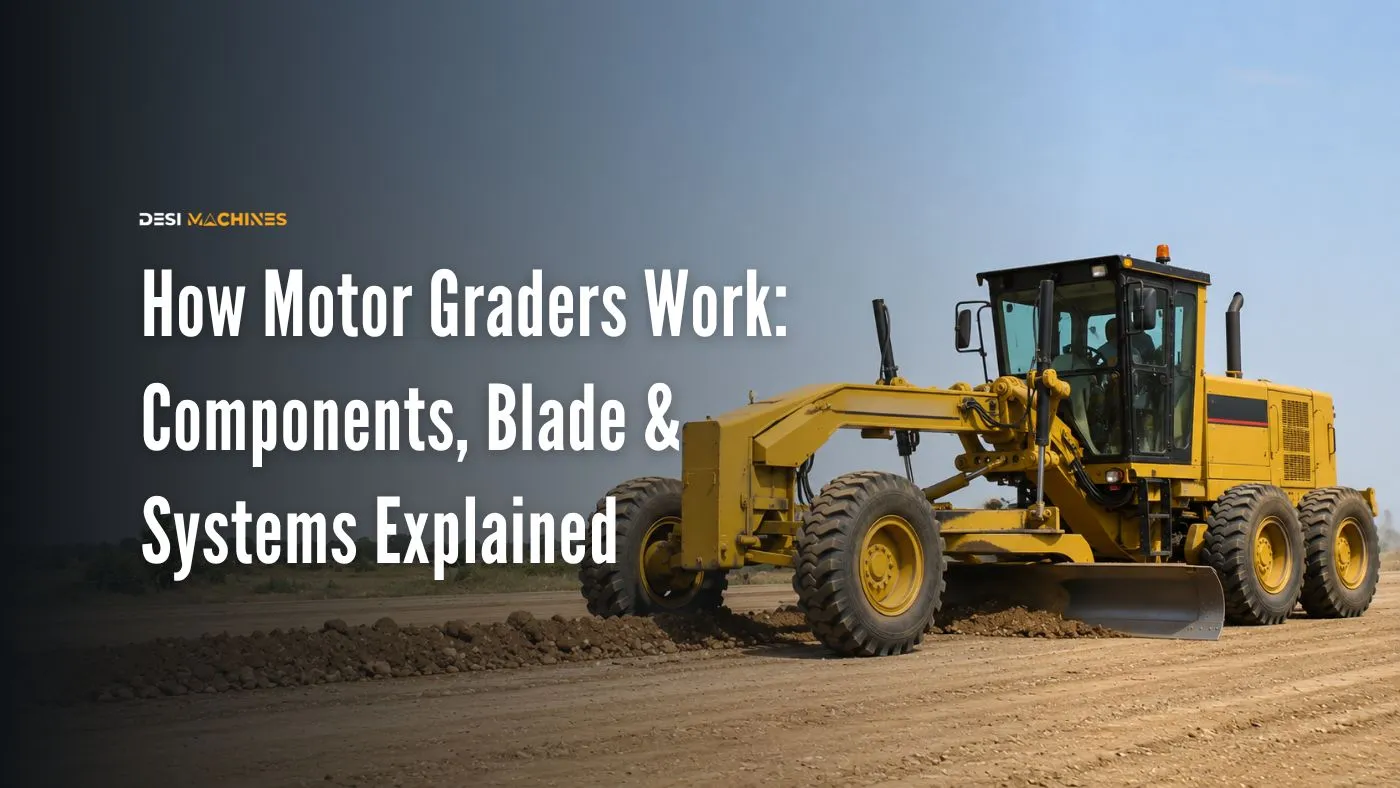
A motor grader is the machine that turns rough, uneven ground into a flat, precisely sloped surface ready to be paved. It is the finishing hand of every road project — the machine that decides whether a highway drains properly and rides smooth, or holds water and breaks up in the first monsoon. What makes it work is a long steel blade, slung between the front and rear wheels, that can be tilted, angled and shifted in ways no other earthmoving machine can manage.
This guide explains how motor graders work — the main components, what the blade can actually do, why the machine is built the length it is, and how the whole thing comes together to cut grade to millimetres. It is written for anyone specifying, buying or running a grader on Indian road and infrastructure work.
The Big Idea: Why a Grader Is Shaped Like That
The first thing people notice about a motor grader is its length — a long wheelbase with the blade (the moldboard) mounted in the middle, not at the front like a dozer. That layout is the whole secret.
By placing the blade far behind the front wheels and well ahead of the rear wheels, the machine’s own frame acts like a long straightedge. The front wheels ride over a bump, but the blade — metres behind them — barely reacts, so it keeps cutting a smooth, even line instead of following every dip. A short machine copies the ground it rolls over; a long grader irons it flat. That is why graders are built long, and why a dozer, for all its power, can never finish a surface the way a grader can.
The Main Components
A motor grader is a system of a few big parts working together:
- Engine — mounted at the rear, over the drive wheels for traction. Indian graders commonly run from around 74 HP on lighter machines to well over 250 HP on heavy highway graders (indicative; varies by model).
- Articulated frame — the machine is hinged in the middle, so the rear (engine) section can swing left or right of the front section. This is what lets a long machine turn tightly and offset its blade (more on that below).
- The moldboard (blade) — the curved steel blade that does the cutting and spreading. Everything else exists to position it.
- Circle and drawbar — the blade hangs from a large toothed ring, the circle, which is carried on a drawbar connected to the front of the machine. The circle rotates the blade a full 360°.
- Tandem rear drive — two driven axles on each side at the rear (four rear wheels), which spreads weight, adds traction, and smooths the ride so the blade cuts evenly.
- Leaning front wheels and a scarifier/ripper — the front wheels tilt to resist side-thrust when the blade is angled, and a toothed ripper breaks up hard ground before grading.
You can see how these translate into real machines across the motor grader range on DesiMachines, from the Mahindra RoadMaster G80 to the CAT 120. Each of these carries a proper parts-counter name, and the ones you will actually reorder are set out in the guide to motor grader parts and components.
What the Blade Can Do: Six Ways to Move It
A dozer blade goes up and down. A grader’s moldboard moves in six independent ways, and that freedom is exactly why a grader can shape a road so precisely. An operator can:
- Raise or lower each end separately — so the blade can cut a cross-slope (camber) into the road for drainage, one side higher than the other.
- Angle the blade across the machine — so material rolls along the blade and off to the side instead of just being pushed ahead.
- Pitch the blade forward or back — changing how aggressively it cuts or mixes.
- Rotate the circle 360° — swinging the blade to any position, including sideways for bank sloping.
- Side-shift the blade — sliding it left or right of the machine to reach beyond the wheels.
Put together, these let one operator cut a precise camber, shape a drain, trim a shoulder and level a subgrade — jobs that would otherwise need several passes of different machines. This control is why the grader is the machine that sets final grade before paving. The specification sheet puts numbers on that movement: across the graders listed here the blade cuts between 300 mm and 787 mm below ground and reaches from 489.5 mm to 3,228 mm out past the wheels, and motor grader cutting depth and blade reach sets out those figures by size class.
Articulation: Grading Where the Wheels Can’t Go
The hinge in the middle of the frame does two valuable things. First, it lets a long machine turn in a far tighter circle than its wheelbase suggests — important on junctions and narrow rural roads.
Second, and more cleverly, it allows crab steering: the rear of the machine offsets to one side so the wheels track on firm road while the blade reaches out over a soft shoulder or into a roadside drain. The operator can grade the edge and the ditch without ever driving the wheels onto the unstable ground they’re shaping. On NHAI highway shoulders and PMGSY rural-road edges, this offset grading is an everyday move, not a trick.
How Modern Graders Hit Grade Automatically
Traditionally, hitting exact grade depended on the operator’s skill and a string line or a surveyor’s level. Today, many graders run GPS and 3D machine-control systems: the design surface is loaded into the machine, sensors track the blade’s position against it, and the hydraulics adjust the blade automatically to hold grade to millimetres, pass after pass.
For Indian highway and airport work, grade control cuts rework, saves material, and lets less-experienced operators produce surveyor-grade results — though on most rural and municipal jobs, a skilled operator with conventional controls still does the bulk of the work. Whether manual or GPS-guided, the underlying machine is the same; automation just moves the precision from the operator’s hands into the control system. Our complete motor grader guide covers types and sizing in more depth.
Where Motor Graders Fit on Indian Projects
Because grading is a finishing job, the grader is one machine in a chain. Excavators and dozers do the bulk earthwork; the grader comes in to shape and level the subgrade and base; then compactors and rollers lock the surface in place, and pavers lay the top. On a highway package that sequence repeats for kilometre after kilometre.
Grader size follows the job. Lighter machines in the small (4–12 ton) class suit rural roads, maintenance and municipal work; heavier machines handle wide highways, airport runways and large embankments. You can browse by size on the small motor grader and medium motor grader listings. If you’re weighing a purchase, our motor grader buying guide walks through the decision, and the top motor grader brands and models in India shows what the market offers.
Once you have seen how a grader works, the next step is knowing every job it does: read our guide to motor grader applications across road, site and mining work. For the volumes each of those systems holds, including the circle housing, see the guide to motor grader fuel and oil capacities.
Three of those six movements are angles, and how to set each one for cutting, casting and finishing is covered in the guide to motor grader blade angles.
For what the blade and circle mean in terms of passes per road and output per hour, see the guide to motor grader productivity and output per hour.
The engine drives all of those systems at once, and how much power and torque each class of machine carries is set out in the guide to motor grader engine power and torque.
A grader spreads the lower layers of a road, and how thick each of those layers goes is covered in the guide to road construction layers.
Choosing a motor grader for a road project? Compare motor grader models, check indicative prices and get the best current offer on DesiMachines. Final specifications, features, and prices should always be confirmed with the official OEM or dealer.