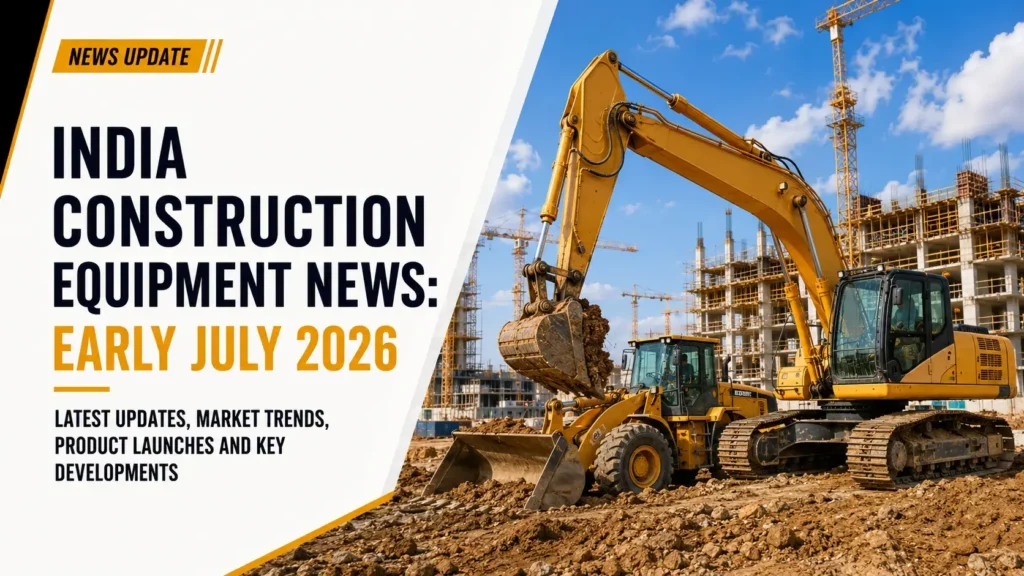
Two threads ran through India’s construction-equipment market this fortnight: a fat public-works pipeline, and a steady push to build more machines at home. Here’s what early July 2026 means if you buy, rent or finance equipment.
The fortnight in brief
- The Cabinet cleared ₹14,114 crore of new NHAI highways: the 117.7 km Kanpur-Kabrai greenfield corridor and a mostly-tunnelled six-lane link in south Delhi.
- ACE and Japan’s KATO put ₹200 crore and a Haryana plant behind a JV to build high-capacity truck, crawler and rough-terrain cranes in India.
- Coal India and BEML began trials of an indigenous 485 HP wheel dozer, another step in localising heavy mining machinery.
- Retail demand stayed soft: construction equipment was the one retail vehicle segment to slip in June (per FADA data), on a high year-ago base.
A strong project pipeline
The headline number is the ₹14,114 crore the Cabinet approved for two NHAI highway projects: the Kanpur-Kabrai greenfield corridor in Bundelkhand and an 8.1 km, mostly-tunnelled six-lane link in south Delhi. Together they point to sustained demand for earthmoving, concrete and tunnelling gear across Uttar Pradesh and Delhi-NCR once the contracts are awarded.
More machines built at home
Two localisation moves stood out. ACE’s ₹200 crore JV with KATO aims to build high-capacity cranes (a segment that today mostly reaches India as imports or CKD kits) at a plant in Haryana. In mining, Coal India began trials of BEML’s indigenous 485 HP wheel dozer. Neither cuts prices tomorrow, but both point the same way: over time, shorter lead times, local parts and service, and easier rupee financing for India-made machines.
What it means for buyers
The demand side looks firm on paper. A big highway pipeline usually feeds excavators, graders, compactors and concrete equipment for a couple of years. But the real work, and the buying, only starts after NHAI awards the contracts and sets appointed dates, so plan for 2026-27, not this quarter.
The nearer-term signal is softer demand: construction equipment was the only retail vehicle segment to decline in June, on a high base a year earlier. When dealers are chasing volume, buyers usually get more room on price, exchange and finance, so if your utilisation is steady, this can be a decent window to negotiate.
Our take: position for the highway pipeline, use any softness in dealer demand to sharpen your deal, and keep an eye on the localisation trend if you buy cranes or mining gear. It should improve availability and service well before it visibly cuts price.
What to watch
- Contract awards and appointed dates on the ₹14,114 crore highway projects, the real start of equipment demand.
- Models, tonnage classes and India pricing from the ACE KATO crane line.
- Whether construction-equipment retail keeps softening through the monsoon, and the ICEMA Q1 FY27 sales print when it lands.
FAQ
Is now a good time to buy construction equipment in India?
If your utilisation is steady, June’s softer demand can work in your favour, because dealers chasing volume tend to offer better price, exchange and finance terms. Weigh that against your own order book before committing.
Why are more cranes and mining machines being built in India?
High-capacity cranes and large mining equipment have mostly been imported. JVs like ACE KATO and trials like Coal India’s indigenous wheel dozer aim to localise them, which over time should mean shorter lead times, local parts and service, and simpler rupee financing.
Related on DesiMachines: India construction equipment market: the complete guide →
Source: PSU Connect

 Excavator
294 models
Excavator
294 models  Backhoe Loader
51 models
Backhoe Loader
51 models  Crane
68 models
Crane
68 models  Concrete Mixer
79 models
Concrete Mixer
79 models  Wheel Loader
54 models
Wheel Loader
54 models  Compactor / Roller
45 models
Compactor / Roller
45 models  Motor Grader
42 models
Motor Grader
42 models  Dozer
41 models
Dozer
41 models  Concrete Pump
66 models
Concrete Pump
66 models  Skid Steer Loader
11 models
Skid Steer Loader
11 models  Telehandler
13 models
Telehandler
13 models