
 Excavator
294 models
Excavator
294 models  Backhoe Loader
51 models
Backhoe Loader
51 models  Crane
68 models
Crane
68 models  Concrete Mixer
79 models
Concrete Mixer
79 models  Wheel Loader
54 models
Wheel Loader
54 models  Compactor / Roller
45 models
Compactor / Roller
45 models  Motor Grader
42 models
Motor Grader
42 models  Dozer
41 models
Dozer
41 models  Concrete Pump
66 models
Concrete Pump
66 models  Skid Steer Loader
11 models
Skid Steer Loader
11 models  Telehandler
13 models
Telehandler
13 models 


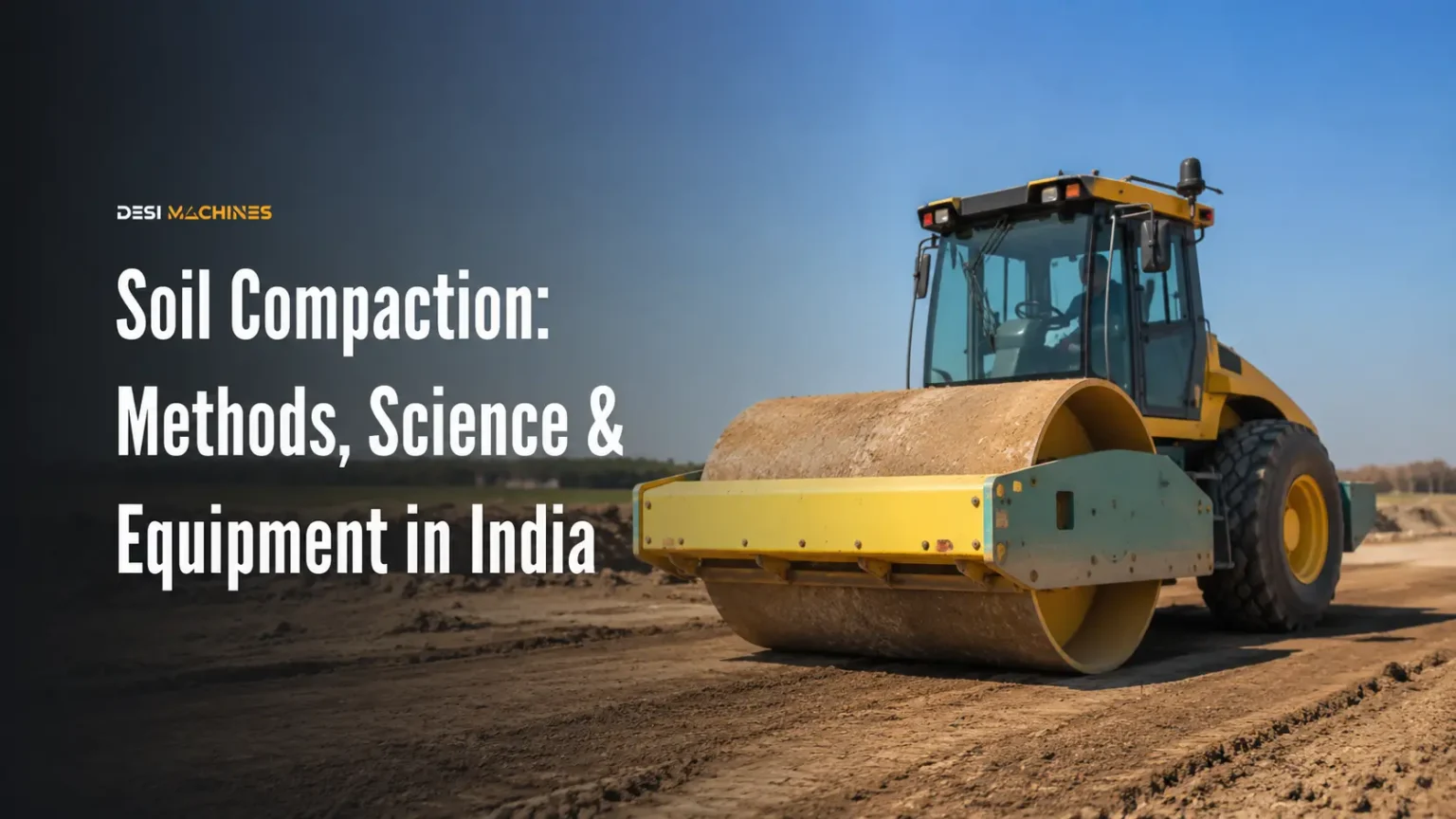
Soil compaction is the step that decides whether a road, foundation, or embankment lasts fifteen years or cracks before the first monsoon. It is the process of pressing soil particles closer together, forcing out the air trapped between them, so the ground becomes denser, stronger, and far less likely to settle later. Every serious project in India — every NHAI highway package, every metro embankment, every building footing — stands or fails on how well the soil under it was compacted.
Skip it or rush it, and the failure shows up later and costs far more: uneven settlement, cracked slabs, potholes, and embankments that slump after heavy rain. This guide explains the science in plain terms, the methods that work for each soil type, and the compaction equipment DesiMachines carries to do the job.
Why Soil Compaction Matters
Loose, natural soil is full of air voids — gaps between the particles. Under the weight of a road or building, those gaps collapse unevenly over time, and the surface above settles and cracks. Compaction removes the voids up front, in a controlled way, so the ground carries load predictably.
Done properly, compaction delivers three things that matter on every site:
- Load-bearing strength — denser soil supports heavier loads without shifting.
- Settlement control — the ground settles now, uniformly, under the roller, instead of later and unevenly under the structure.
- Water resistance — tightly packed soil resists water seeping in, which protects the layers above from monsoon damage and frost.
That last point is why compaction is non-negotiable in Indian conditions. A road base that lets water in during the monsoon will fail from below, no matter how good the asphalt on top. Compaction is the cheapest insurance on the whole project.
The Science: What Actually Happens During Compaction
Compaction works by applying force to rearrange soil particles into a tighter packing. There are four ways to apply that force, and good equipment uses one or more of them:
- Pressure (static weight) — heavy drums pressing down, squeezing particles together.
- Impact — a rapid pounding blow, effective on the surface and in confined areas.
- Vibration — rapid oscillation that shakes granular particles into a denser arrangement, multiplying the effect of weight.
- Kneading — a manipulating action from padded or sheepsfoot drums that works cohesive soils from within.
The single biggest factor you can control is moisture. Every soil has an optimum moisture content — the water level at which it compacts to its maximum density. Too dry, and particles won’t slide into place. Too wet, and water fills the voids you’re trying to close. On site this is why you’ll see water bowsers spraying the subgrade before the roller passes: they’re bringing the soil to its optimum moisture. Laboratory Proctor tests fix the target density and moisture for each layer, and field density tests confirm the roller actually hit it.
Matching the Method to the Soil
Clay behaves nothing like sand, and the compaction method has to match the material. This is where most site problems start — the wrong roller on the wrong soil simply won’t reach density.
- Granular soils (sand, gravel, crushed aggregate): respond best to vibration. The oscillation shakes the particles into a tight pack far faster than weight alone. Vibratory single-drum soil compactors dominate here.
- Cohesive soils (clay, silt): need kneading and impact, not vibration. Sheepsfoot and padfoot rollers push their feet into the layer and work it from within — see our full sheepsfoot roller guide.
- Asphalt and finished surfaces: need smooth-drum static or light vibratory rollers, and pneumatic (rubber-tyred) rollers for a tight, sealed finish.
- Confined areas — trenches, around pipes, near structures: need impact from plate compactors and rammers, where a large roller can’t go.
Get this pairing right and you reach density in fewer passes, which saves fuel, time, and money. Get it wrong and you can roll all day without ever hitting the target.
Soil Compaction Equipment
The right machine depends on the soil, the layer thickness, and the area. Here’s what does the work on Indian sites, from full highway embankments down to a pipe trench. In a pipe trench specifically, the machine is often the excavator that dug it, fitted with a compaction wheel. If this equipment is new to you, start with how a compactor presses air out of a layer, then match a machine to your soil.
1. Soil Compactors (Single-Drum Vibratory Rollers)
The workhorse of earthwork and road building. A single-drum soil compactor has one wide steel drum at the front — vibrating — and rubber tyres at the rear for traction. It’s the standard machine for subgrade and granular base layers on highways, embankments, and large sites. The soil compactor guide covers how the class is sized and how it differs from a tandem roller. Indian models run roughly from 10 Ton (10,000 kg) to 12 Ton and above in operating weight (all figures indicative). Popular options include the SANY SSR110C-10 PRO and machines from Ammann and Dynapac.
2. Sheepsfoot and Padfoot Rollers
For clay and cohesive soils, drums fitted with projecting “feet” knead the layer instead of just pressing it. They compact from the bottom of the layer up, which smooth drums can’t do on clay. Essential where the subgrade is heavy black cotton soil — common across central and western India.
3. Tandem and Pneumatic Rollers
Tandem (double-drum) rollers with steel drums front and rear are the choice for asphalt. Pneumatic rollers use rows of rubber tyres to seal and finish the surface. Both come after the earthwork, on the paving stage.
4. Plate Compactors and Rammers
For trenches, footings, and tight spots, plate compactors (vibrating, for granular soil) and rammers or jumping jacks (impact, for cohesive soil in narrow trenches) do what no roller can reach. Small, but the difference between a pipe trench that holds and one that settles.
For the full family and how they compare, see the types of compactors guide and the road rollers guide.
Getting Compaction Right on Site
Good compaction isn’t just the machine — it’s the method. A few field rules that separate a lasting job from a failing one:
- Compact in layers (lifts). Spread soil in controlled thicknesses — often 200–300 mm — and compact each before the next. One thick dump never compacts through.
- Control moisture. Bring the soil to optimum moisture before rolling. Spray if dry; let it dry if too wet.
- Use the right number of passes. Density comes from the correct passes at the correct speed, confirmed by field tests — not from rolling endlessly.
- Match roller to soil, as covered above. The wrong machine wastes the whole exercise.
Choosing the machine is the first decision, and it depends on your soil and project size. Compare live models, weights, and prices across the compactor category, from single-drum soil compactors to tandem rollers and ask our team for a quote. For choosing between roller types, the guide to choosing the right road roller compactor goes deeper.
Financing Compaction Equipment
A soil compactor is a mid-ticket machine that earns steadily across road and earthwork contracts, which makes it a natural candidate for equipment finance. Loans from SBI and other lenders on the construction equipment finance page let you spread the cost against project cash flow, and cover for the machine is worth comparing on the equipment insurance pages. As with any owned machine, utilisation decides the return — a compactor moving between road packages pays; one parked between contracts doesn’t.
Which machine delivers that energy matters as much as the method. On sand, gravel and murram the shaking drum of a vibratory roller is what carries compaction to full layer depth.
On confined ground like trench backfill, footpaths and paver bedding, where a roller cannot fit, a plate compactor does the same job at small scale.
The density a layer has to reach is not the same all the way up a road, and the target for each one is covered in the guide to road construction layers.
Final specifications, features, and prices should always be confirmed with the official OEM or dealer.
Machines, tenders and news for this industry: Airports · Irrigation and Dams · Pipelines and Water Supply