Excavator
  Backhoe Loader
  Motor Grader
  Wheel Loader
  Crane
Crane  Concrete Mixer
  Compactor
  Skid Steer Loader
  Concrete Pump
  Telehandler


If there’s one machine that earns its keep on every Indian construction site — from NHAI highway packages to PMAY housing projects — it’s the backhoe loader. Ask any contractor what they’d buy first with a limited budget, and nine times out of ten, the answer is a JCB 3DX or something similar. Why? Because this one machine digs trenches, loads trucks, breaks concrete, and moves materials — all in a single shift. That’s not marketing talk. That’s what happens on sites in Nagpur, Lucknow, and Coimbatore every day. The backhoe loader combines an excavator and a wheel loader into one compact, road-legal package. For contractors who need versatility without the cost of a full equipment fleet, nothing else comes close.
Other major machines in this category include the Mahindra EarthMaster SX, Bull SD76, Tata Hitachi Shinrai Prime, CASE 770NX, and Escorts Kubota BLX75 — all popular choices across Indian construction and infrastructure projects.
One of the first choices when buying a backhoe is drive type — our guide on 2WD vs 4WD backhoe loaders explains which one suits your ground.
What is a Backhoe Loader?
A backhoe loader is a construction machine built on a tractor-style chassis with a loader bucket at the front and a backhoe arm (excavator) at the rear. The entire system runs on hydraulics — the engine powers a hydraulic pump, which drives both ends of the machine. It’s essentially two machines in one: a wheel loader for scooping and moving materials, and a mini excavator for digging and trenching. Most Indian contractors simply call it a “JCB” regardless of the brand — that’s how dominant this machine type has become.
Key Components of a Backhoe Loader
Every backhoe loader has four main systems working together. Understanding these helps you spot quality differences between brands and models — and explains why some machines hold up better on Indian sites than others.
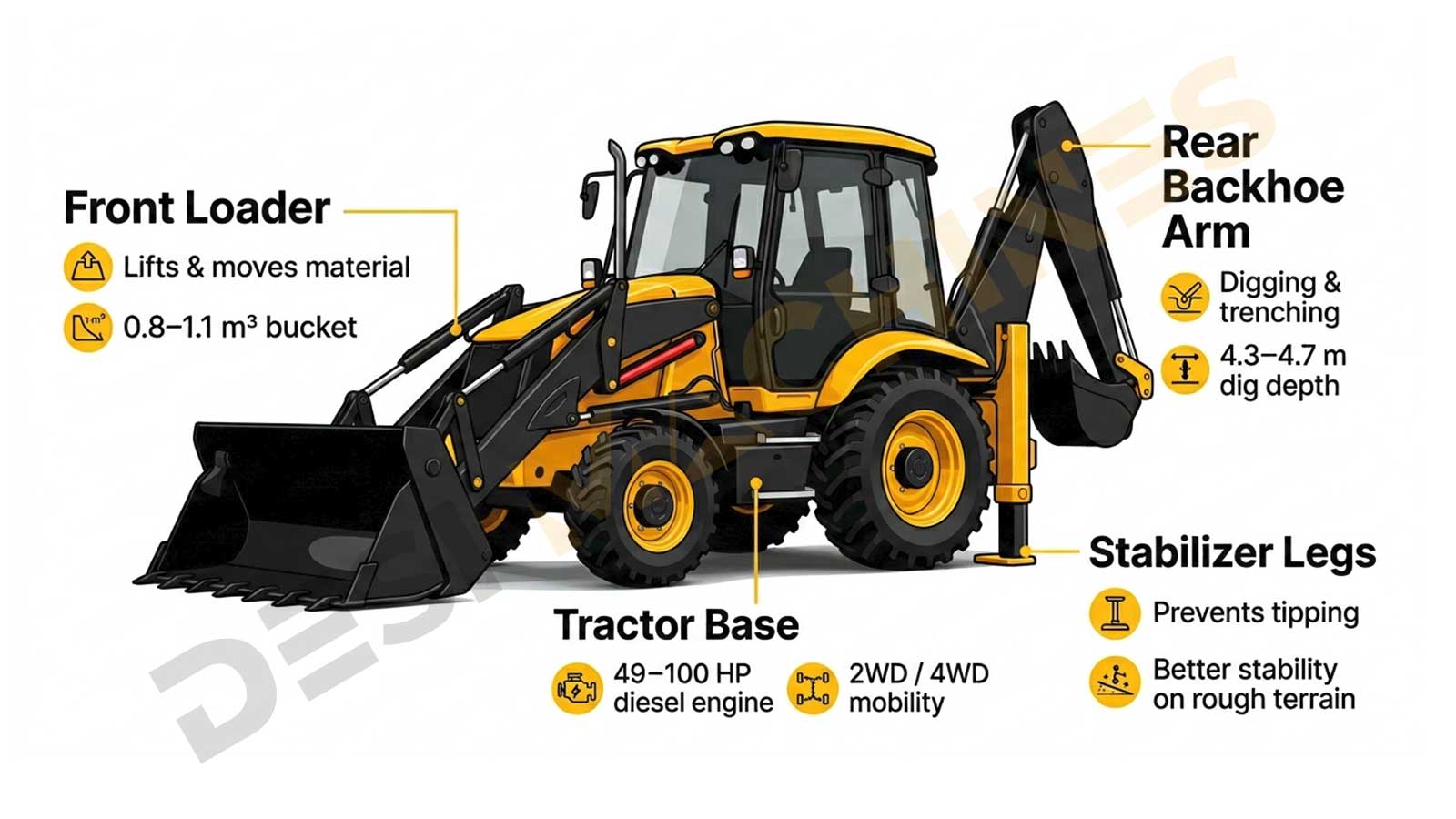
1. Front Loader
The front loader bucket handles lifting and moving materials — soil, gravel, sand, debris, construction waste. It operates through a hydraulic arm system that raises, lowers, and tilts the bucket. Standard bucket capacity on Indian backhoe loaders ranges from 0.8 to 1.1 cubic metres. The loader is what makes this machine useful for site cleanup, material handling, and loading trucks. Without it, you’d need a separate wheel loader on site.
2. Rear Backhoe Arm
The rear arm is where the digging happens. It consists of three main components: the boom (the main arm attached to the machine), the dipper (the secondary arm), and the bucket (the digging attachment). All three move independently through hydraulic cylinders, giving the operator precise control. Standard dig depth on most Indian models is 4.3 to 4.7 metres — enough for foundation work, utility trenches, and drainage lines. The hydraulic system allows smooth, controlled movements even in tight spaces.
3. Tractor Base
The tractor base provides mobility and houses the engine. Most backhoe loaders in India run on 49 HP to 100 HP diesel engines — the JCB 3DX Super, Plus, & Extra uses a 74 HP engine, which has become the industry standard for this segment. On fuel, the 3DX and most full-size backhoe loaders carry a 115 to 160-litre tank; see the model-wise fuel tank capacity guide for the exact figures. Comparable machines like the Mahindra EarthMaster SX, Bull SD76, Tata Hitachi Shinrai Prime, CASE 770NX, and Kubota BLX75 also compete in the same high-demand utility segment. You’ll find both 2WD and 4WD configurations. The wheel-based design means the machine can drive on public roads at 25–40 km/h, moving between sites without a trailer. That’s a major advantage over tracked excavators.
4. Stabilizer Legs
The stabilizer legs (also called outriggers) deploy when you’re using the backhoe arm. They plant firmly into the ground, preventing the machine from tipping during digging operations. This is critical on uneven terrain — and most Indian sites are uneven. Without proper stabilizers, digging on a slope or soft ground becomes dangerous. Good stabilizer design is one of the things that separates premium machines from budget options.
How Does a Backhoe Loader Work?
The hydraulic system is the heart of the machine. The diesel engine drives a hydraulic pump, which sends pressurized fluid through hoses to cylinders at each joint. When the operator moves a joystick or lever, valves direct fluid to the appropriate cylinder, creating movement. Modern backhoe loaders use pilot-operated controls — light joystick movements that reduce operator fatigue during long shifts.
The operator sits in a swivel seat that rotates 180 degrees. Face forward for loader work, spin around for backhoe operations. Simple as that. Most machines have separate control sets for each function — joysticks for the backhoe, levers or a steering wheel for driving and loader operation. An experienced operator can switch between functions in seconds.
Why Backhoe Loaders Are Versatile
Versatility isn’t just a marketing word for backhoe loaders. It’s the core reason this machine dominates Indian construction.
Dual Functionality
One machine does the work of two. The front loader handles material movement — loading trucks, spreading gravel, clearing debris. The rear backhoe handles excavation — digging trenches, foundation work, breaking ground. On a typical residential construction site, you’d otherwise need both a wheel loader and a mini excavator. That’s two EMIs, two operators, two sets of maintenance costs. A backhoe loader eliminates that duplication. Paisa vasool machine hai.
Compact & Maneuverable
Backhoe loaders fit where larger equipment can’t. Urban construction sites in Mumbai, Pune, or Bengaluru often have narrow access roads and limited working space. A standard backhoe loader is about 2.3 metres wide — it can navigate lanes that would stop a 20 Ton excavator. And because it runs on wheels, it drives to the job site. No low-bed trailer required. No transport permits. No waiting for a truck to move your machine 15 km to the next project.
Multiple Attachment Options
The backhoe arm accepts various attachments beyond the standard bucket. Hydraulic breakers for demolition and rock breaking. Augers for drilling post holes and foundation piles. Pallet forks for material handling. Grapples for handling irregular loads. Quick-attach systems let operators swap attachments in minutes. One machine, five different jobs. That’s what keeps utilization rates high and rental income steady.
Compare backhoe loader models side-by-side on Desi Machines — check specs, get transparent pricing, and connect with a local dealer at desimachines.com/backhoe-loader.
Types of Backhoe Loaders
Backhoe loaders come in different configurations to match specific site requirements. The right choice depends on your terrain, project type, and budget.
2WD Backhoe Loaders
Two-wheel drive backhoe loaders send power to the rear wheels only. They work well on flat, stable surfaces — urban construction sites, paved areas, compacted ground. The JCB 3DX at ₹30–32 Lakh (indicative) is a popular entry point. Similar alternatives include the Mahindra EarthMaster SXE and Bull CH76 Challenger, Tata Hitachi Shinrai Prime dedicated 2WD variants. 2WD machines cost less upfront and have simpler drivetrains with fewer parts to maintain. But they struggle on muddy sites, slopes, and loose soil. For contractors working primarily in cities on prepared ground, 2WD makes sense.
4WD Backhoe Loaders
Four-wheel drive machines send power to all four wheels, providing better traction on rough terrain. If your sites include waterlogged clay in Bengal, black cotton soil near Nagpur, or sandy patches in Rajasthan — 4WD is worth the extra cost. The JCB 3DX 4WD at ₹35–39 Lakh (indicative) handles conditions that would leave a 2WD machine spinning its wheels. Competing machines like the Mahindra Earthmaster SX, Bull SD76, Tata Hitachi Shinrai Prime, CASE 770NX, and Kubota BLX75 also offer strong 4WD capability for demanding job sites. 4WD also improves loader performance when pushing into material piles. For heavy-duty construction and challenging terrain, this is the standard choice.
Compact/Mini Backhoe Loaders
Compact backhoe loaders are smaller machines designed for residential projects, landscaping, and tight urban spaces. Dig depth typically ranges from 6 to 8 feet. The JCB 2DX falls into this category. Machines like the Bull Smart Kid S490 are also gaining attention for compact urban utility work. These machines are highly maneuverable and easier to transport. They’re ideal for plumbing contractors, small builders, and municipal maintenance work where a full-size backhoe would be overkill.
Backhoe Loader vs Excavator
This is the question every contractor asks at some point. Here’s the straight answer.
A backhoe loader is versatile, mobile, and handles multiple tasks. It digs to about 4.5 metres, loads trucks, and drives between sites on its own wheels. An excavator is a dedicated digging machine. It digs deeper (up to 6–7 metres for a 20 Ton machine), has a 360-degree rotating cab, and delivers more digging power. But it only digs — no front loader, no material handling capability.
Choose a backhoe when: you need one machine for multiple tasks, your dig depth requirements are under 5 metres, you’re working on smaller sites, or budget is tight. Choose an excavator when: you need deep excavation, high daily output on earthwork, or you’re working on large infrastructure projects where the machine stays in one location for months.
For most Indian contractors starting out, the backhoe loader is the smarter first purchase. It covers more ground.
Backhoe Loader vs Wheel Loader
A wheel loader (payloader) is built for one job: moving bulk materials. Bigger bucket, more lifting capacity, faster cycle times for loading trucks. But it cannot dig. Zero excavation capability.
A backhoe loader does both — digging and loading — though with smaller bucket capacity than a dedicated wheel loader. If your work involves any excavation at all, the backhoe is the better choice. If you’re purely moving aggregate, sand, or finished materials at a quarry or stockyard, a wheel loader makes more sense.
Beyond the standard buckets, a backhoe loader can take many backhoe loader attachments, such as a breaker, an auger or pallet forks, so one machine can handle several different jobs.
Ready to find the right backhoe loader for your project? Explore all models and request a quote on Desi Machines