
 Excavator
294 models
Excavator
294 models  Backhoe Loader
51 models
Backhoe Loader
51 models  Crane
68 models
Crane
68 models  Concrete Mixer
79 models
Concrete Mixer
79 models  Wheel Loader
54 models
Wheel Loader
54 models  Compactor / Roller
45 models
Compactor / Roller
45 models  Motor Grader
42 models
Motor Grader
42 models  Dozer
41 models
Dozer
41 models  Concrete Pump
66 models
Concrete Pump
66 models  Skid Steer Loader
11 models
Skid Steer Loader
11 models  Telehandler
13 models
Telehandler
13 models 


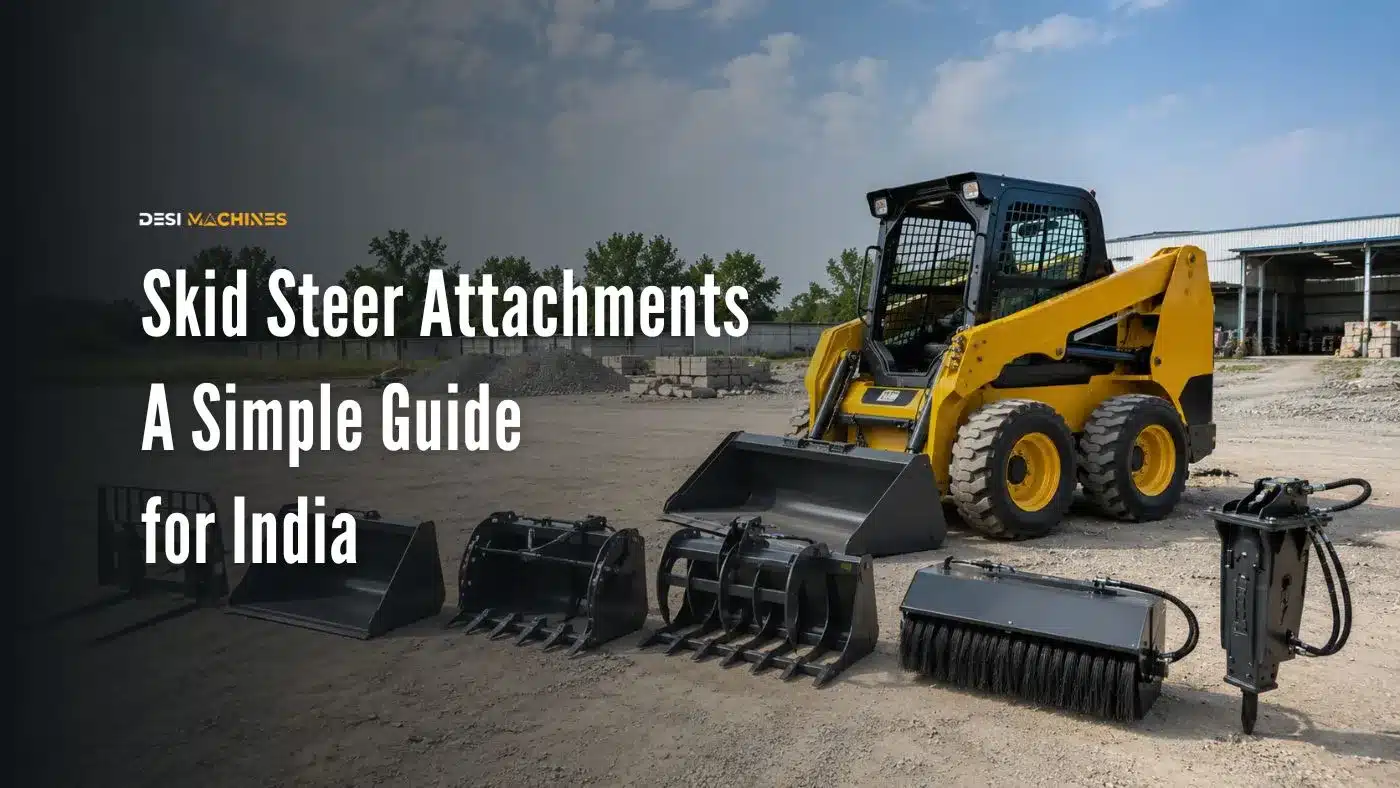
A skid steer loader is one small machine that can do the work of many. The trick is not the machine alone — it is the tool you fix on its front. That tool is called an attachment. Take off the bucket, clip on a breaker, and the same loader that was moving mud a minute ago is now breaking concrete. Swap in a pallet fork and it becomes a small forklift. This one habit — changing the front tool for the job in hand — is what makes a skid steer worth its price on an Indian site.
This guide explains the attachments that actually earn their keep in India, how they lock on to the machine, and how to match a tool to the loader you own or plan to buy. Prices here are for the machines we stock; the attachments themselves are mostly made to order, so we tell you honestly where a number is fixed and where it is on request.
Every machine price below is the range listed for that machine on its own DesiMachines product page.
What is a skid steer attachment?
A skid steer is a compact loader that turns by driving its left and right wheels at different speeds — it “skids” to steer, which is where the name comes from. On the front it has two lift arms and a flat mounting plate. An attachment is any tool that clips on to that plate.
Because the plate is a standard size on almost every skid steer, one loader can carry a long list of tools over its life. You are really buying two things: the machine (the muscle) and a set of attachments (the hands). Most buyers start with a bucket, then add one or two more tools as the work demands. You can read the full machine side of the story in our skid steer loader guide, and see where the skid steer sits in the wider loader family.
The attachments that matter most in India
There are dozens of tools made for skid steers around the world, but only a handful see real work on Indian sites and farms. Here are the ones worth knowing first.
| Attachment | What it does | Where it earns its money in India |
|---|---|---|
| General-purpose bucket | Scoops and carries loose material | Loading sand, soil, gravel, malba (rubble) — the tool most machines come with |
| 4-in-1 (combination) bucket | Digs, doses, grabs and dozes with one bucket that opens like a jaw | Small contractors who want one tool to do most jobs |
| Pallet fork | Two forks to lift stacked loads (also the everyday tool for sacks and bales on a farm, covered in skid steer loaders for agriculture) | Moving cement bags, brick pallets and blocks around a site or godown |
| Hydraulic breaker (hammer) | Breaks concrete, rock and old flooring | Demolition, trench rock, breaking old slabs — the same idea as an excavator breaker, smaller |
| Auger (drill) | Bores holes in the ground | Fence posts, pole footings, tree pits, small foundation holes |
| Grapple | A claw that grips odd-shaped loads | Handling scrap, logs, demolition waste and loose branches |
| Sweeper / broom | Sweeps loose dirt and debris | Cleaning roads, site yards, factory floors and warehouse aprons |
| Trencher | Cuts a narrow, even trench | Laying pipe, cable and water lines |
| Dozer / grading blade | Levels and spreads material | Rough grading of yards, farm roads and plot levelling |
If you also run a digging machine, you will notice the logic is the same for both families — our guide to excavator attachments covers the breaker, auger and grapple from the excavator side.
Buckets: the tool your machine will use every day
Nine out of ten hours on a skid steer are spent with a bucket on the front, so it pays to know the common ones.
The general-purpose bucket is the all-rounder. It scoops soil, sand and gravel and is the bucket most machines are delivered with. A 4-in-1 bucket (also called a combination bucket) has a hinged front that opens like a jaw — so the same bucket can dig, grab, spread and act as a small dozer. It costs more but saves you from buying three separate tools, which is why it is popular with contractors doing mixed work.
For rocky or dirty ground there is the skeleton (rock) bucket, which has gaps in the base so soil falls through and only stones, roots or scrap stay behind — handy for clearing a plot. Choose the bucket by the material you handle most, not by the biggest size available; too wide a bucket will overload a small machine.
How attachments lock on: the quick coupler
The plate at the front of the loader is called the quick coupler (or quick-attach). It is the reason changing tools is a two-minute job instead of an afternoon.
There are two parts to it. First, the mechanical lock — two levers or pins that clamp the attachment on to the plate. On a manual coupler you step out and pull the levers by hand; on a hydraulic (power) coupler you lock and unlock from the driver’s seat. Second, for any tool that moves on its own — a breaker, auger, sweeper or grapple — the machine needs auxiliary hydraulics: a pair of oil lines at the front that carry power to the attachment. A plain bucket or fork does not need them, but a powered tool will not work without them.
So before you buy a powered attachment, check one thing: does your machine have the auxiliary hydraulic lines fitted? Most modern skid steers do, but it is the first question to settle.
Matching the attachment to your machine
Every skid steer has a limit called its rated operating capacity — the safe load it can lift and carry without tipping. A small-frame machine is nimble and cheap to run but lifts less; a big-frame machine lifts more but needs more space and fuel. The attachment has to suit the machine, not the other way round.
Put a heavy rock bucket full of wet earth on a small loader and it will strain, tip forward on slopes and wear out early. The same tool on a bigger machine is comfortable. As a plain rule: pick the attachment first for the job, then make sure your machine’s capacity is enough to carry it loaded. Here are the skid steers we stock, from the light end to the heavy end, to show the spread of machine sizes an Indian buyer can choose from. Read the starting figure of each range for the size ladder; the upper figures overlap because each model is sold in several variants.
| Model | Frame size | Indicative price (as of September 2026) |
|---|---|---|
| Bobcat S70 | Small | ₹13–15 Lakh |
| ACE SS75 | Small–mid | ₹16–23 Lakh |
| JCB SSL 155 | Mid | ₹18–25 Lakh |
| L&T S315R | Mid | ₹19–23 Lakh |
| Bobcat S450 | Mid | ₹21–28 Lakh |
| Bobcat S770 | Large | ₹30–32 Lakh |
Treat these as a starting point, not a final quote. These are ex-factory figures; what still moves the final number is the variant, the attachments you add and the cost of getting the machine to your site. Specifications should always be confirmed with the dealer. See the full range on our skid steer loaders page. If your ground is soft or you work in slush, also look at the tracked cousin — the compact track loader — which takes the same attachments but rides on rubber tracks instead of wheels.
What do skid steer attachments cost in India?
This is the honest part. Attachment prices are not fixed the way machine prices are. A bucket, a fork or a breaker is usually made or supplied to order, so the price depends on the size, the brand and the dealer. For that reason we quote skid steer attachments on request rather than print a number we cannot stand behind.
What we can give you plainly is the machine cost. The skid steers we stock run from about ₹13 Lakh for a small Bobcat S70 up to about ₹32 Lakh for a large Bobcat S770 (indicative segment range, as of September 2026). A common way to think about it: the machine is the big spend, and each attachment is a smaller add-on that widens the range of jobs the machine can take on. If you are working out monthly outgo on the machine, our equipment finance pages walk through loan and EMI options for construction equipment in India.
One buying tip: do not order every attachment on day one. Start with the bucket, add a pallet fork if you handle bagged or palletised loads, and buy a breaker or auger only when a job actually calls for it. Attachments sitting idle in a yard earn nothing.
Looking after your attachments
An attachment is a simple tool, but a little care keeps it working and saves money. Three habits matter most on an Indian site.
First, grease the coupler and any moving pins regularly — dust and grit are the real enemy, and a dry pin wears fast in our conditions. Second, on a working bucket, watch the cutting edge and bucket teeth; worn teeth make the machine dig harder, burn more diesel and slow the job. Teeth are cheap to replace and worth changing before they are fully gone. Third, on any powered tool, check the hydraulic couplings for leaks before each job and wipe the fittings clean before you connect them — a speck of dirt in the oil line does more damage than a hard day’s work.
When a tool is off the machine, park it on flat, firm ground, not propped at an angle where it can slip. These are small things, but they are the difference between an attachment that lasts years and one that gives trouble in a season.
Are skid steer attachments interchangeable between brands?
Mostly, yes — and this is one of the best things about the skid steer. Because the quick-coupler plate follows a common size across brands, a bucket or fork made for one make will usually fit another. So a tool bought for a JCB machine can often go on a Bobcat or an ACE, as long as the mounting plate matches.
Two cautions. Powered tools still need the machine’s auxiliary hydraulics to match up, so check the oil-flow rating before you buy a breaker or auger for a smaller loader. And a very large attachment on a small machine is a bad fit even if it physically clips on — the capacity has to suit. When in doubt, ask the dealer to confirm the tool works with your exact model before you pay.
For lifting loads high rather than wide, a skid steer is not the answer — that is where a telehandler takes over. But for close, mixed groundwork on a tight site, the swap-a-tool skid steer is hard to beat.
If the base machine is still new to you, the guide on how a skid steer loader works covers the steering and controls before you choose attachments.
See skid steer loader models and get a quote →
Prices, specifications and features are indicative, vary by variant, location and date, and should always be confirmed with the official OEM or authorised dealer before any purchase decision. DesiMachines is not liable for decisions taken on the basis of information that may have changed after publication. Price figures are taken from our listings at the time of writing.
Machines, tenders and news for this industry: Demolition · Material Handling · Municipal and Waste