
 Excavator
294 models
Excavator
294 models  Backhoe Loader
51 models
Backhoe Loader
51 models  Crane
68 models
Crane
68 models  Concrete Mixer
79 models
Concrete Mixer
79 models  Wheel Loader
54 models
Wheel Loader
54 models  Compactor / Roller
45 models
Compactor / Roller
45 models  Motor Grader
42 models
Motor Grader
42 models  Dozer
41 models
Dozer
41 models  Concrete Pump
66 models
Concrete Pump
66 models  Skid Steer Loader
11 models
Skid Steer Loader
11 models  Telehandler
13 models
Telehandler
13 models 


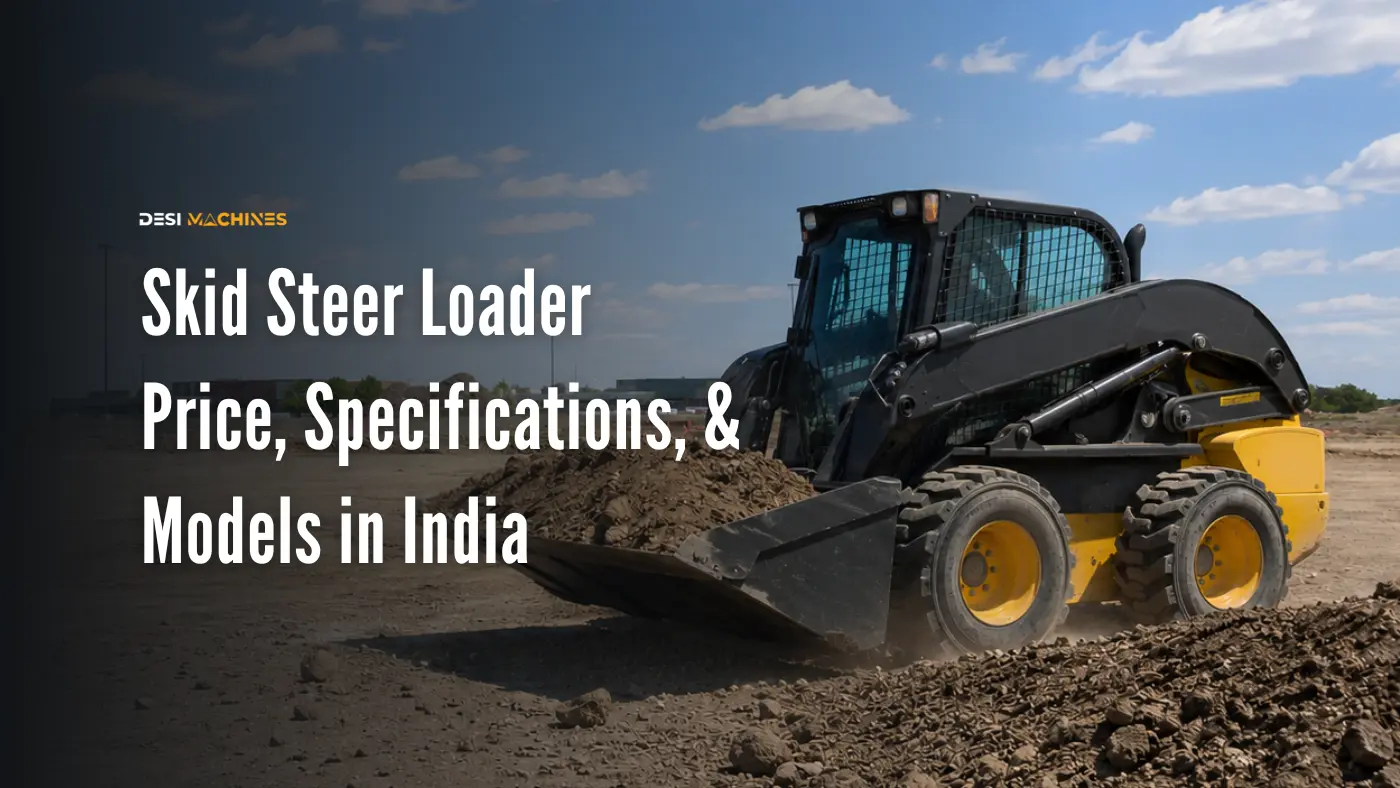
A skid steer loader is a compact, wheeled loader with a rigid frame and two lift arms that swap between buckets, forks, augers and breakers, and it turns inside its own length instead of needing a turning circle. It is also one of the most underrated machines on Indian construction sites. Compact enough to fit through a narrow lane in Chandni Chowk, powerful enough to move 700 kg of debris in a single scoop. And yet most contractors in India still reach for a backhoe when a skid steer would do the job faster, cheaper, and in half the space. Across the eleven machines listed here, the skid steer loader price in India runs from the Bobcat S70 at ₹13–15 Lakh to the Bobcat S770 at ₹30–32 Lakh (both indicative, as of September 2026), depending on brand, capacity and features. If you’re working confined urban sites, warehouses, or agricultural operations where a full-size loader simply won’t fit, this is the machine category worth understanding properly.
Desi Machines is India’s independent comparison platform for heavy construction equipment, not a dealer, not a manufacturer. We help you compare specs, check transparent pricing, and connect with top OEMs and brands. No commissions on your decision. Just the information you need to buy right.
Every price below is the indicative range shown on that machine’s own listing on DesiMachines, quoted as the listing shows it.
What is a Skid Steer Loader?

A skid steer loader is a compact, wheeled machine with a rigid frame and lift arms that can accept dozens of different attachments: buckets, forks, augers, breakers, brooms. What makes it different from a wheel loader or backhoe? Zero turning radius. The machine pivots on its own footprint by driving the left and right wheels at different speeds. That’s the “skid” in skid steer.
In India, skid steers are gaining traction on urban construction sites, inside factories, at warehouses, and on farms where space is tight and versatility matters more than raw digging depth. Most Indian contractors still call any compact loader a “JCB”, but the skid steer is a distinct category with distinct advantages.
How Does a Skid Steer Loader Work?
The skid steering mechanism is simple but effective. Each side of the machine, left wheels and right wheels, is powered independently. Want to turn left? The right wheels spin faster than the left. Want to spin in place? One side goes forward, the other reverses. The wheels literally skid across the ground during turns.
The hydraulic system does the heavy lifting. A diesel engine powers a hydraulic pump, which sends pressurised fluid to the lift arms, the bucket tilt cylinder, and any attachment you’ve connected. Standard flow hydraulics handle buckets and light attachments. High-flow systems power demanding tools like mulchers or cold planers. The operator controls everything from a compact cab: two joysticks, one for drive, one for the loader arms.
Here is why that matters on an Indian site: a skid steer can enter a space, load material, turn 180 degrees, and exit without ever needing to reverse or do a three-point turn. In a congested Pune basement dig or a narrow godown in Ludhiana, that’s not a convenience. That’s the difference between getting the job done and not.
Key Features of Skid Steer Loaders
- Compact Design: Width over the tyres runs from 900 mm on the Bobcat S70 to 1,832 mm on the Bobcat S770, and most of these machines sit between 1.5 and 1.7 metres. Only the smallest, the S70 at under a metre wide, will pass through a standard doorway or into a shipping container, but every one of them works down lanes where a backhoe would get stuck.
- Zero-Turn Radius: The machine rotates within its own footprint. No swing clearance needed. No tail swing to worry about.
- Hydraulic Power: The same hydraulic system that runs the bucket also powers attachments: augers, breakers, sweepers. One machine, multiple jobs.
- Quick-Attach System: Swap attachments in under 5 minutes. A bucket in the morning, pallet forks after lunch, a sweeper before you leave. One machine doing the work of three.
- Operator Cab Safety: ROPS/FOPS certified cabs protect operators from rollovers and falling objects. Side entry doors, good visibility, and climate control on higher-spec models.
Lift Types: Radial vs Vertical
This is where most first-time buyers get confused. And it matters more than you’d think.

Radial lift skid steers have a simpler single-arm design. The lift path curves outward as it rises, like an arc. Better reach at mid-height. Better for ground-level work: grading, backfilling, loading material from piles. If your primary job is pushing and loading at ground level, radial lift is usually the right choice.
Vertical lift skid steers use a more complex linkage that keeps the load closer to the machine as it rises, then pushes it forward at full height. Better for loading trucks, stacking pallets, dumping into high-sided containers. If you’re loading tippers or working in a warehouse with high racking, vertical lift earns its premium.
Which should you pick? Ask yourself: where does the material go? Into a truck bed 2 metres up? Vertical. Into a pile on the ground or a low hopper? Radial.
Whether the machine clears the truck at all is a separate figure, and it is published for every machine listed here: skid steer dump height and reach tables dump height, dump reach and dump angle across all eleven, and explains why reach separates these machines far more than height does.
Our listings do not publish the lift path machine by machine, so ask the dealer to confirm whether the model you are quoted is radial or vertical before you sign anything.
Standard vs High-Flow Hydraulics
Standard flow hydraulics on the machines listed here deliver 37 to 87.1 litres per minute (9.8–23 GPM, or gallons per minute), from the little Bobcat S70 at the bottom of that spread to the Bobcat S770 at the top. Enough for buckets, pallet forks, augers, and most common attachments. This is what skid steers in India come with from the factory.
High-flow hydraulics push past 114 litres per minute (30 GPM). You need this for power-hungry attachments: mulchers, cold planers, forestry cutters, high-capacity trenchers. The attachment spins faster, cuts harder, works quicker. None of the machines listed here ships with high flow as standard, so treat it as a factory option to ask the dealer about, and expect it to cost extra.
Here’s the honest advice: if you’re buying your first skid steer for general construction or material handling, standard flow is enough. Don’t pay for high-flow unless you already own the attachment that needs it. Compare first, then buy.
Top Skid Steer Loader Brands in India
The Indian skid steer market is smaller than excavators or backhoes, but it’s growing. Here are the brands with real dealer networks and parts availability:
- Bobcat: The original skid steer manufacturer. Global leader. Models from the compact S70 through the mid-size S450 and S590 up to the large S770, which is the machine that sets the top of that price range. Prices run from the S70 at ₹13–15 Lakh to the S770 at ₹30–32 Lakh (indicative, as of September 2026). Strong service network in metros, weaker in Tier 3 towns.
- JCB: The most recognised name in Indian construction. SSL 135 and SSL 155 models, both rated 56 HP (42 kW), at 612 kg and 703 kg rated operating capacity. JCB’s dealer network is unmatched — parts available even in smaller towns. That matters when you’re 200 km from the nearest city.
- CAT (Caterpillar): Premium machines, premium price. The CAT skid steer listed in India is the CAT 216B Series 3, at 51 HP (38 kW), 635 kg rated operating capacity, ₹26–30 Lakh (indicative, as of September 2026). Higher resale value, but higher upfront cost. Best for contractors who already run CAT fleets and want standardised service.
- ACE: Indian manufacturer with affordable options. The ACE SS75 is their primary skid steer model, at 50 HP (37.3 kW) and 750 kg rated operating capacity, the joint-highest capacity among the mid-size machines here. Lower price point, decent for light-duty applications. Service network concentrated in North India.
- Manitou: French brand with growing India presence. Known for telehandlers, but the MANITOU 1340R is listed here too, at 49 HP (36 kW), 612 kg rated operating capacity. Limited dealer network currently.
- Bull Machines: Indian brand. The AV490 is their skid steer offering — 655 kg rated operating capacity and 60 L/min hydraulic flow. Budget-friendly option for contractors testing the skid steer category.
- L&T: The S315R is the L&T entry in this class, at 60 HP (44.7 kW) and 750 kg rated operating capacity, the most powerful of the mid-size machines listed here. Worth a look if your site already runs L&T equipment on the same service contract.
Skid Steer Loader Price in India
The skid steer loader price in India starts with the compact Bobcat S70 at ₹13–15 Lakh and runs up to the 93.3 HP Bobcat S770 at ₹30–32 Lakh (both indicative, as of September 2026). That is a wide range. What drives the difference?
- Operating Capacity: A 318 kg capacity machine like the Bobcat S70 costs less than a 750 kg capacity standard model like the ACE SS75 or the L&T S315R. More capacity = bigger frame, bigger engine, higher price.
- Brand: Brand on its own does not decide it, because Bobcat sells both the cheapest and the dearest machine on this list. CAT sits at the top of the order, and the Indian-built machines are not automatically the cheapest: Bull lists above both JCB models. The table below sets out the full order.
- Hydraulic System: High flow is a factory option rather than a standard fit, so ask the dealer to quote it against the base machine, because there is no separately published figure for the option in India.
- Cab vs Canopy: Enclosed cabs with AC cost more than open canopy models.
- Attachments: The base price usually includes a bucket. Forks, augers, breakers are all extra.
Skid Steer Loader Price List in India
| Model | Engine power | Rated operating capacity | Indicative price (as of September 2026) |
|---|---|---|---|
| Bobcat S70 | 23.5 HP (17.5 kW) | 318 kg | ₹13–15 Lakh |
| ACE SS75 | 50 HP (37.3 kW) | 750 kg | ₹16–23 Lakh |
| JCB SSL 135 | 56 HP (42 kW) | 612 kg | ₹17–23 Lakh |
| MANITOU 1340R | 49 HP (36 kW) | 612 kg | ₹17–23 Lakh |
| JCB SSL 155 | 56 HP (42 kW) | 703 kg | ₹18–25 Lakh |
| L&T S315R | 60 HP (44.7 kW) | 750 kg | ₹19–23 Lakh |
| Bull AV490 | 50 HP (36.8 kW) | 655 kg | ₹20–25 Lakh |
| Bobcat S450 | 49 HP (36.4 kW) | 608 kg | ₹21–28 Lakh |
| Bobcat S590 | 69 HP (51.4 kW) | 907 kg | ₹26–30 Lakh |
| CAT 216B Series 3 | 51 HP (38 kW) | 635 kg | ₹26–30 Lakh |
| Bobcat S770 | 93.3 HP (69.7 kW) | 1,520 kg | ₹30–32 Lakh |
Every figure above is taken from that machine’s own listing on DesiMachines. Where a listing shows a range, the range is reproduced as it stands rather than narrowed to a single number, because the price you are quoted moves with variant, attachments, location and the month you buy in.
Compare skid steer loader models side-by-side on Desi Machines — check specs, get transparent pricing.
Applications of Skid Steer Loaders
A skid steer isn’t a one-job machine. That’s the whole point. Here’s where they earn their keep in India:
- Construction — Material Handling: Moving sand, gravel, debris on congested urban sites. Basement excavations in Bangalore and Mumbai where a full-size excavator won’t fit. Site cleanup before handover.
- Construction — Site Preparation: Grading, levelling, backfilling around foundations. With a dozer blade attachment, a skid steer handles light grading work that would otherwise need a motor grader.
- Agriculture: Manure handling on dairy farms in Punjab and Gujarat. Feed distribution in cattle sheds. Cleaning poultry houses. The quick-attach system means one machine handles multiple farm tasks. Our guide to skid steer loaders for agriculture goes into gate widths, lifting capacity and the tractor comparison.
- Infrastructure Projects: Utility trenching with a trencher attachment. Cable laying. Pipe installation in urban areas where road closures need to be minimised.
- Landscaping: Hardscape installation, soil moving, tree planting with auger attachments. Golf courses, resorts, and commercial landscaping projects.
- Warehousing: Pallet handling with fork attachments. Moving goods inside factories and godowns. The compact size means they work in spaces where forklifts struggle.
Popular Skid Steer Loader Models
Here are the models you’ll actually find on Indian sites, with real specs rather than brochure numbers:
Bobcat S70: The smallest skid steer in the market. 23.5 HP (17.5 kW), 318 kg rated operating capacity. Width over the tyres is 900 mm, under a metre. Built for the tightest spaces — inside buildings, through doorways, in residential plots. Price: ₹13–15 Lakh (indicative, as of September 2026).
Bobcat S450: Mid-size workhorse. 49 HP (36.4 kW), 608 kg rated operating capacity, 2,157 mm dump height. Popular in warehouses and on construction sites that need more muscle than the S70. Good balance of size and capability.
JCB SSL 135: 56 HP (42 kW) JCB Diesel by Kohler engine. 612 kg rated operating capacity, 2,320 mm dump height. JCB’s dealer network is the real advantage here — parts and service available across India, not just metros.
JCB SSL 155: The larger JCB option. 56 HP (42 kW), 703 kg rated operating capacity, the same 2,320 mm dump height as the SSL 135. Better for heavier material handling. If you’re already a JCB fleet owner, it runs on the service arrangements you already have.
Bull AV490: Indian-made. 655 kg rated operating capacity, 60 L/min standard hydraulic flow. Budget option for contractors who want to test skid steer applications without the premium brand price. Service network concentrated in North India.
Skid Steer Loader Specifications to Consider
Before you buy, these are the numbers that actually matter:
- Rated Operating Capacity (ROC): The safe working load, typically 50% of tipping load. A 600 kg ROC machine can safely lift and carry 600 kg. Exceed it and you risk tipping. Across the machines listed here ROC runs from 318 kg on the Bobcat S70 to 1,520 kg on the Bobcat S770, and eight of the eleven sit between 608 kg and 750 kg.
- Engine Horsepower: 23.5 HP (17.5 kW) to 93.3 HP (69.7 kW) across the machines listed here. More HP means faster cycle times and ability to power demanding attachments. But more HP also means more fuel. Match the power to your actual work.
- Lift Height: How high can the bucket dump? Dump height runs from 1,882 mm (1.88 m) on the Bobcat S70 to 2,675 mm (2.68 m) on the Bobcat S770. If you’re loading into tippers, measure your truck bed height and add 300mm clearance.
- Bucket Capacity: 0.23–0.63 cubic metres across the machines listed here. Larger buckets move more material per cycle but need more HP to fill and lift.
- Operating Weight: 1,291 kg to 4,225 kg across these machines. Heavier machines are more stable but harder to transport. A 2,500 kg skid steer fits on a standard trailer.
- Fuel Type: Diesel. Every skid steer in the Indian market runs on diesel. Better torque, better fuel efficiency, better durability for heavy-duty work
A skid steer earns its keep by swapping the tool on its front. See our guide to skid steer attachments for the buckets, breakers, augers, forks and grapples that fit these machines in India.
New to these machines? The guide on how skid steer loaders work explains the differential steering, the joystick controls and the wheels-versus-tracks choice in plain language. Fuel tank, engine oil, hydraulic and chain case volumes for each model are listed in the guide to skid steer loader fuel tank and oil capacities.
Buyers cross-shopping the compact class against a digging machine should read skid steer vs backhoe loader, which sets the two classes side by side on weight, digging depth, width, road speed and price.
If a machine you already own will not move, or has started pulling to one side, see the guide to skid steer drive problems before booking a workshop visit.
Buying second-hand instead? The used skid steer loader prices and checks guide sets out what to inspect on a used machine and how to work down from these new price bands.
Prices, specifications and features are indicative, vary by variant, location and date, and should always be confirmed with the official OEM or authorised dealer before any purchase decision. DesiMachines is not liable for decisions taken on the basis of information that may have changed after publication.

