
 Excavator
294 models
Excavator
294 models  Backhoe Loader
51 models
Backhoe Loader
51 models  Crane
68 models
Crane
68 models  Concrete Mixer
79 models
Concrete Mixer
79 models  Wheel Loader
54 models
Wheel Loader
54 models  Compactor / Roller
45 models
Compactor / Roller
45 models  Motor Grader
42 models
Motor Grader
42 models  Dozer
41 models
Dozer
41 models  Concrete Pump
66 models
Concrete Pump
66 models  Skid Steer Loader
11 models
Skid Steer Loader
11 models  Telehandler
13 models
Telehandler
13 models 


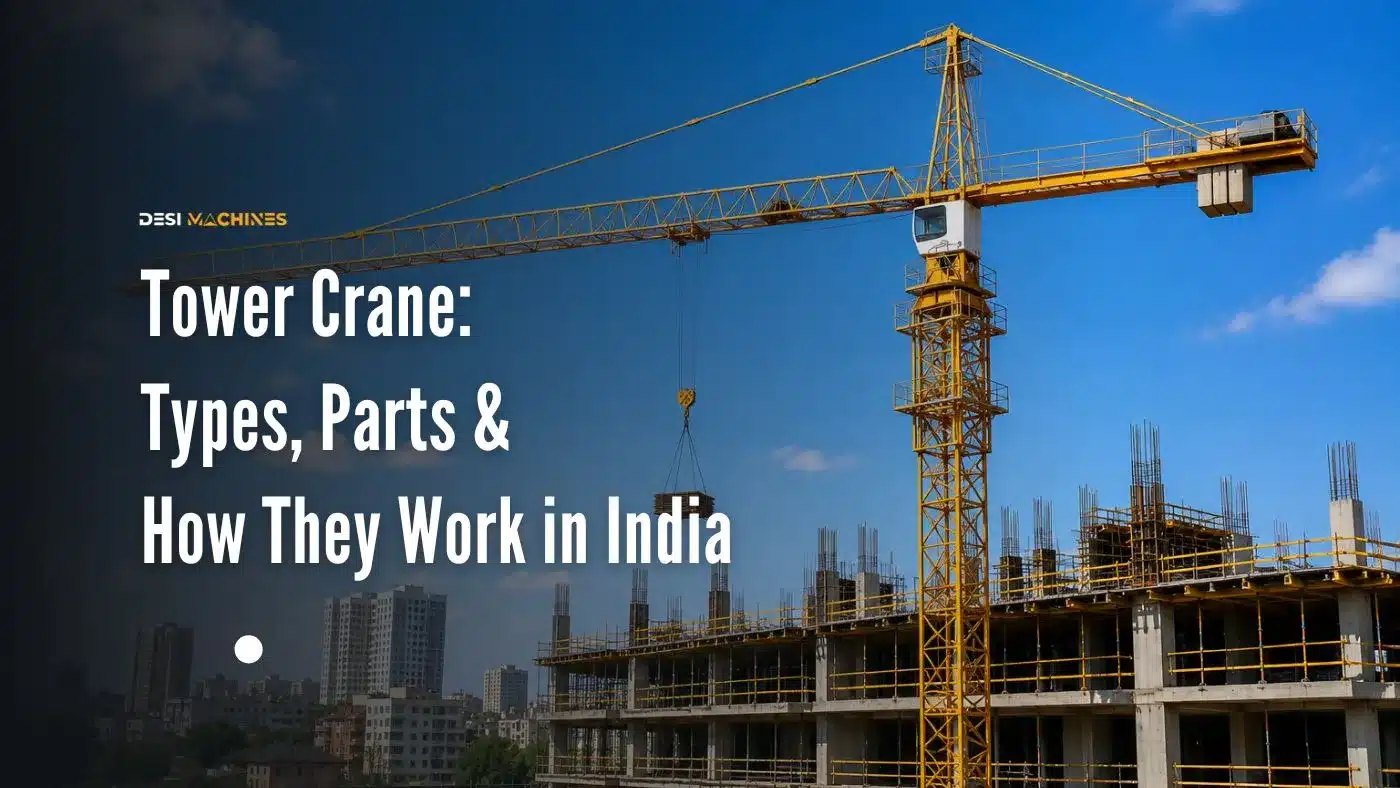
A tower crane is the tall, fixed crane you see rising over every high-rise, metro viaduct, and large commercial site in India. It is the machine that lifts steel, shuttering, and precast segments to heights a mobile crane simply cannot reach — 60, 80, sometimes over 200 metres — and keeps lifting in the same spot for months at a stretch. If you are building anything vertical and serious, the tower crane is the backbone of the site.
Here is the honest part first, because it shapes everything below. Tower cranes are project machines. On most Indian jobs they are rented, erected by the supplier, and dismantled when the structure tops out — very few contractors buy one outright. DesiMachines lists mobile and pick-and-carry cranes — the machines that get bought and moved between sites. So treat this guide as the ground-up explanation of how tower cranes work and when you actually need one, and use the crane pages here to source the mobile lifting you can own.
What is a Tower Crane?
A tower crane is a fixed, vertical crane built up from a steel mast (the tower) with a horizontal or luffing jib at the top. Unlike a mobile crane that drives in, lifts, and leaves, a tower crane is assembled on site, anchored to a foundation or the building itself, and stays put for the length of the job.
The height is the whole point. A tower crane gives you reach over a footprint no wheeled machine can match, and it can lift loads to the top of a 40-storey building without repositioning. That’s not a minor advantage. That’s the reason they exist. On a crowded metro or high-rise plot in Mumbai or Bengaluru, where there is no room to swing a large mobile crane, the tower crane’s small ground footprint and huge working radius are what make the job possible at all.
The trade-off is time and cost. Erecting a tower crane takes a day or more with a support crane, a trained crew, and a proper foundation. You commit to it for the duration. So the machine earns its place only on tall, long-duration structures — not on a two-month warehouse shed.
Main Parts of a Tower Crane
Understanding the components makes the capacity numbers and the safety talk far easier to follow.
- Base and foundation: a heavy concrete footing (often cast into the basement raft) or a ballasted cross-base that anchors the whole machine. Everything above depends on this being right.
- Mast (tower): the vertical lattice column of bolted steel sections. Extra sections are added to raise the crane as the building grows — this is called climbing.
- Slewing unit: the gear and motor just below the jib that let the top of the crane rotate a full 360 degrees.
- Jib (working arm): the long horizontal arm that carries the load. A trolley runs along it to move the hook in and out.
- Counter-jib and counterweights: the shorter arm on the opposite side, loaded with concrete blocks to balance the load on the working jib.
- Operator’s cab: mounted near the slewing unit, high up, giving the operator a clear view of the whole radius.
The counterweight is what keeps the machine from tipping. Every lift is a balancing act between the load on the jib and the ballast on the counter-jib — which is exactly why the load chart, not the operator’s confidence, decides what can be picked.
Types of Tower Cranes
Not every tall site needs the same tower crane. Three types cover almost all Indian work.
1. Hammerhead (Flat-Top / Horizontal Jib) Cranes
The classic tower crane with a horizontal jib and a trolley that moves the load in and out. Simple, stable, and the workhorse of high-rise residential and commercial construction. Flat-top versions drop the tower peak, which makes erection quicker and lets multiple cranes work close together on the same site — common on large township projects.
2. Luffing Jib Cranes
Here the jib raises and lowers instead of using a trolley. That matters on congested city plots: a luffing crane can pull its jib up steeply to avoid a neighbouring building or an adjacent crane’s swing. On tight Mumbai and Delhi sites hemmed in by other structures, the luffing jib is often the only type that fits the airspace restrictions.
3. Self-Erecting (Fast-Erecting) Cranes
Smaller, trailer-mounted cranes that unfold themselves without a support crane. Capacities and heights are modest, but they set up in hours. Useful on low-rise residential, villa projects, and smaller builder work where a full tower crane would be overkill — think of them as the bridge between a big mobile crane and a full high-rise tower crane.
How Much Can a Tower Crane Lift?
This is the question that trips up most first-time buyers, so read it carefully: a tower crane’s capacity depends on the radius. The rated maximum — say 12 Ton (12,000 kg) or 16 Ton (16,000 kg) — applies only close to the mast. Out at the jib tip, the safe load might be a fraction of that.
A typical high-rise hammerhead crane might carry 12–16 Ton near the tower but only 1.5–3 Ton at a 50–60 metre radius. That drop-off is the entire logic of the crane load chart, and it applies to every crane, tower or mobile. Before you plan a lift, you match the heaviest load to the radius it sits at — never to the crane’s headline figure.
For the machinery you can actually own and move between sites, the same rule governs pick-and-carry work. Load chart pehle dekho, phir uthao. Compare capacities and prices on the pick-and-carry (Hydra) crane range and the wider crane category before you commit to any lift plan.
Where Tower Cranes Are Used in India
Tower cranes turn up wherever the work goes high and stays put:
- High-rise residential and commercial towers — the largest single use; lifting rebar, formwork, and concrete buckets floor after floor.
- Metro rail construction — erecting precast viaduct segments and station structures across the Delhi, Mumbai, Bengaluru, and other metro corridors.
- Bridges and flyovers — placing girders and segments where a mobile crane can’t stay parked for months.
- Industrial and power plants — lifting heavy equipment into tall structures during construction.
For horizontal work — road building, earthmoving, material handling across a spread-out site — a tower crane is the wrong tool. There you want mobile lifting and the earthmoving fleet. The construction equipment applications guide maps machines to project types if you’re planning a mixed site.
Tower Crane vs Mobile Crane: Which Do You Need?
Most buyers landing on “tower crane” actually need to decide between a fixed tower crane and a mobile or pick-and-carry crane. The split is simple:
- Building tall and staying put for months (high-rise, metro pier, tall industrial structure) → tower crane, almost always rented.
- Lifting across a spread-out or changing site, moving between jobs, or doing general material handling → a mobile crane or a Hydra/Farana pick-and-carry crane you own.
For the second case — the machinery most Indian contractors actually buy — the crane buying and rental guide walks through owning versus hiring, and the types of cranes classification covers the full family. If you’re weighing the two most popular Indian pick-and-carry options, the Hydra vs Farana comparison lays out models and price bands.
Renting a Tower Crane: What It Costs and Involves
Because tower cranes are rented far more often than bought, the commercial picture looks different from a mobile crane purchase. Rental is usually a monthly charge plus separate erection, dismantling, and transport costs, and the supplier’s operator and rigging crew. Rates vary widely with capacity, height, and how long you need it — treat any single figure as indicative and get a project-specific quote.
If you are buying lifting equipment rather than renting a tower, financing and insurance matter. Equipment loans from SBI and other lenders on the construction equipment finance page can spread the cost, and every owned machine should carry cover — compare providers on the equipment insurance pages. Idle days and finance EMIs are what quietly decide whether a crane makes money, so plan utilisation before you sign anything.
Final specifications, features, and prices should always be confirmed with the official OEM or dealer.
Machines, tenders and news for this industry: Building Construction