Excavator
294 models
Excavator
294 models  Backhoe Loader
51 models
Backhoe Loader
51 models  Crane
68 models
Crane
68 models  Concrete Mixer
79 models
Concrete Mixer
79 models  Wheel Loader
54 models
Wheel Loader
54 models  Compactor / Roller
45 models
Compactor / Roller
45 models  Motor Grader
42 models
Motor Grader
42 models  Concrete Pump
66 models
Concrete Pump
66 models  Skid Steer Loader
11 models
Skid Steer Loader
11 models  Telehandler
13 models
Telehandler
13 models 


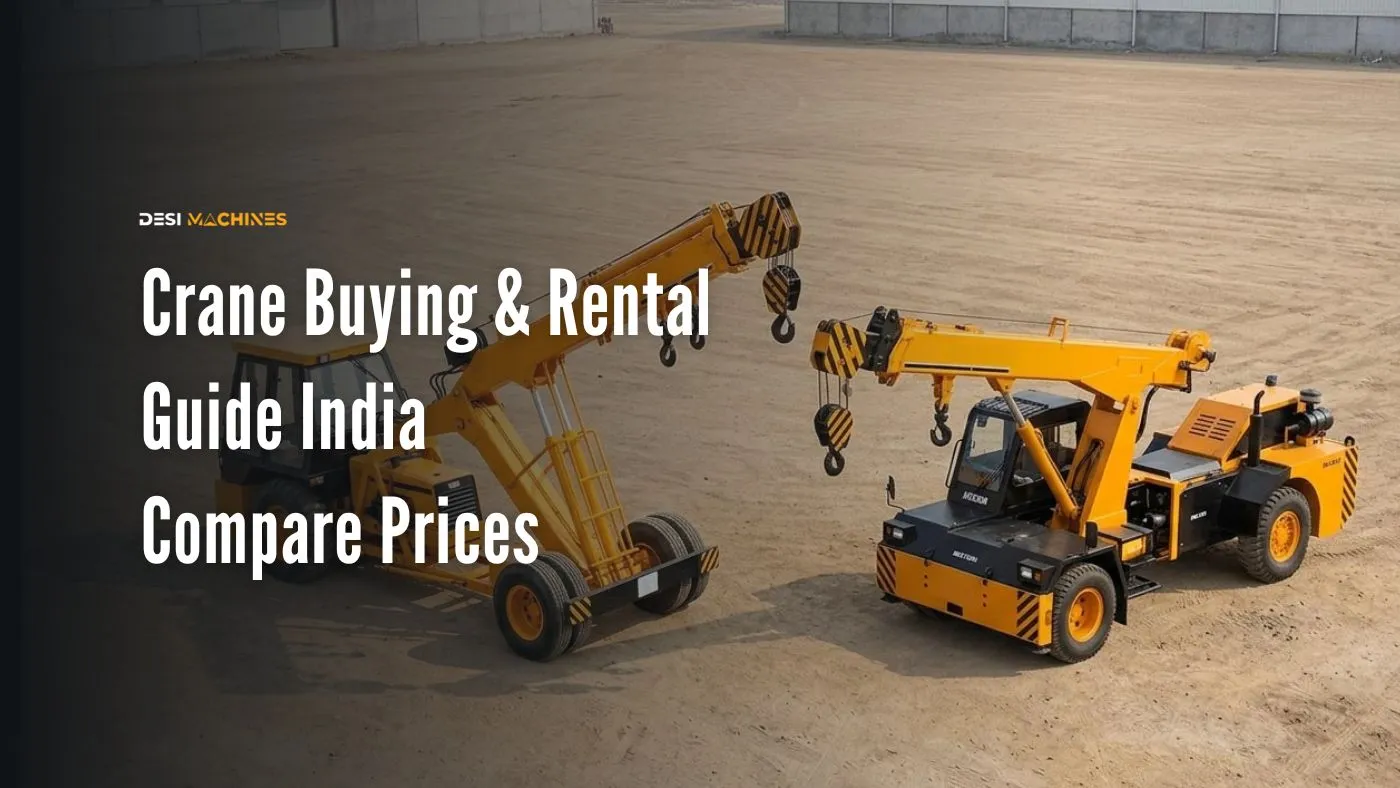
Every contractor in India faces the same question at some point: should I buy a crane or rent one? The answer isn’t straightforward. It depends on your project pipeline, cash flow, storage capacity, and how often you actually need lifting equipment. A wrong decision here costs lakhs — either in idle EMIs or in rental fees that could have funded ownership. This guide covers the crane types available in India (hydra, farana, mobile, crawler, tower), realistic pricing for both buying and renting, and the factors that actually matter when you’re making this call. Every crane price below is the indicative range published on that machine’s own product page, as of September 2026. Compare the machines first, then buy.
What is crane buying?
Crane buying means purchasing new or used crane machinery outright — you own the asset, you maintain it, and you deploy it as needed. For contractors with recurring lifting requirements across multiple projects, fleet owners building rental businesses, and industrial operations with daily material handling needs, buying makes financial sense over time.
Ownership means no waiting for availability during peak season. October to May — the dry season when NHAI highway packages and infrastructure projects run at full capacity — rental cranes get booked months in advance. Owners don’t face that problem. But ownership also means EMIs running whether the crane works or sits idle. That’s the trade-off.
What is crane rental?
Crane rental means hiring a crane on an hourly, daily, or monthly basis without taking ownership. You pay for what you use. The rental company handles maintenance, insurance, and often provides a certified operator. For project-specific needs — a single heavy lift, a 3-month construction phase, or occasional material handling — rental keeps your capital free.
Rental is ideal when your crane requirement varies. One project needs a 14 Ton hydra, the next needs a 23 Ton farana. Buying both doesn’t make sense. Renting gives you flexibility without the storage headache. Cranes in India are hired by the day or by the shift, not by the hour. A 14–16 Ton (14,000–16,000 kg) hydra works out at roughly ₹18,000–₹35,000 a day (indicative, as of July 2026), the figure published in the DesiMachines equipment rental rate card, with longer bookings priced lower per working day.
Crane buying vs rental: Which is right for your business?
This isn’t a theoretical question. It’s a math problem with real numbers. Here’s how the two options compare across the factors that actually affect your bottom line:
| Factor | Buying (figures indicative, as of September 2026) | Renting |
|---|---|---|
| Upfront Cost | ₹12–66 Lakh for pick & carry cranes (indicative segment range, as of September 2026) | Zero capital outlay |
| Ownership | Full ownership, asset on books | No ownership, no depreciation benefit |
| Maintenance | Your responsibility — budget ₹50,000–₹2 Lakh/year | Rental company’s responsibility |
| Availability | Always available when you need it | Subject to market availability |
| Flexibility | Locked into one crane type/capacity | Switch crane types per project |
| Storage | Need yard space, security | No storage required |
| Operator | Hire and train your own | Often included in rental |
| Break-even | Typically 3–5 years of regular use | Never — ongoing expense |
When to buy a crane
Buying makes sense in specific scenarios. Not every contractor needs to own a crane — but some definitely should:
- Long-term projects: If your project runs 12+ months with daily lifting requirements, rental fees will exceed purchase cost. A highway package in Rajasthan running 18 months? Buy.
- Fleet operations: Running a crane rental business yourself? Ownership is the business model.
- Frequent lifting work: Multiple sites requiring cranes 200+ days per year — the math favours ownership.
- In-house maintenance team: If you already have mechanics who can service hydraulic equipment, your running costs drop significantly.
- Resale market access: Brands like ACE, Escorts, and Indo Power hold resale value well in India’s second-hand market.
When to rent a crane
Renting is the smarter choice more often than contractors admit. Here’s when:
- Short-duration projects: A 2-month building construction phase doesn’t justify buying a crane of your own.
- One-time heavy lifts: Installing an industrial chiller, lifting a transformer — rent for the day, return the crane.
- Limited budget: Capital tied up in a crane can’t fund other equipment or working capital needs.
- No storage facility: Cranes need secure yard space. If you don’t have it, renting avoids that problem entirely.
- Varying crane requirements: Different projects need different capacities. Renting lets you match the crane to the job every time.
Factors to consider before buying a crane in India
Buying a crane is a capital decision that affects your business for 10–15 years. The purchase price is just the starting point. Here’s what actually determines whether that crane makes you money or drains it.
Many first-time owners start with a second-hand machine instead, and the checks are different from a new purchase — the used hydra crane buying guide covers the boom, rope and paperwork that decide whether a used pick and carry crane is a bargain or a liability.
1. Crane type and lifting capacity
Match the crane to your actual work — not your aspirations. A 25 Ton crane sitting on a site that only needs 12 Ton lifts is wasted capital. Here’s how crane types map to applications:
- Hydra Crane (9–25 Ton): The workhorse of Indian construction. Compact, manoeuvrable, ideal for urban sites with space constraints. Most popular capacity: 14 Ton.
- Farana Crane (13–35 Ton): Higher capacity pick & carry cranes for heavier industrial lifts. Across the 41 farana-series cranes listed on DesiMachines, 15 Ton is the most common rating (11 machines), followed by 20 Ton (8) and 23 Ton (6), with the ACE FX 250 (25 Ton) and Escorts F17 (17 Ton) also common choices.
- Mobile Crane: Truck-mounted cranes for sites requiring frequent relocation. Good for infrastructure projects spread across large areas.
Tower cranes, crawler cranes, and all-terrain cranes are not currently available on Desi Machines.
Capacity matters, but so does boom length. A 14 Ton crane with a 9-metre boom won’t reach a 4th floor lift. Check both specs against your actual site requirements.
2. Crane price in India
Crane prices in India vary significantly by type, brand, and capacity. Here are realistic 2026 price ranges — all indicative, verify with our team before committing:
- Pick & Carry Cranes (Hydra/Farana): ₹12–66 Lakh depending on capacity (indicative segment range, as of September 2026). At the entry end, a 9 Ton ACE Rhino 90C is listed at ₹12–14 Lakh and a 12 Ton ACE 12XW at ₹16–18 Lakh. A 23 Ton farana like the Escorts F23 is listed at ₹47.15 Lakh onwards — the Escorts pages quote a starting price rather than a band — and the 35 Ton ACE F350 at ₹62–66 Lakh (all indicative, as of September 2026).
Price depends on brand (ACE, Escorts Kubota, Indo Power are the major players for pick & carry), lifting capacity, boom length, and whether you’re buying new or used. A well-maintained 5-year-old crane can cost 40–50% less than new, but verify running hours and service history.
3. Brand reputation and after-sales support
A crane is only as good as the service network behind it. A breakdown 200 km from the nearest service centre means 3–5 days idle. Three to five days of zero output, EMIs still running, client still calling.
Before buying, check:
- Authorized dealer network: How many service centres within 100 km of your primary operating area?
- Spare parts availability: Common wear parts (hydraulic seals, filters, brake pads) should be available locally, not shipped from another state.
- Warranty terms: Most manufacturers offer 1-year warranty on new cranes. Understand what’s covered and what’s not.
- Response time: Ask existing owners in your area — and put the question to the service team, not the sales team.
ACE and Escorts Kubota have the widest service networks in India. Smaller brands may offer lower prices but weaker support in Tier 2/3 towns.
4. Total cost of ownership (TCO)
The purchase price is maybe 60% of what that crane will cost you over its lifetime. The rest, all indicative as of September 2026:
- Fuel costs: No crane maker publishes a litres-per-hour figure, and the burn swings with the lift cycle anyway. Measure your own: fill the tank, note the hour meter, run the machine a fortnight, refill and divide. Multiply that by your local pump rate and you have a fuel cost you can actually budget against.
- Maintenance: Budget ₹50,000–₹2 Lakh annually depending on usage intensity and crane type.
- Operator salary: ₹18,000–₹35,000/month for a skilled crane operator in most Indian cities.
- Insurance: 1.5–2.5% of crane value annually.
- Registration and permits: RTO registration, fitness certificates, periodic inspections.
A “cheap” crane with poor fuel efficiency and frequent breakdowns costs more over 5 years than a premium crane that runs reliably. That’s the math. Shortcuts do not survive a total-cost calculation.
5. Safety compliance and certifications
Indian safety standards for cranes are non-negotiable — especially on government tenders and NHAI projects. Verify:
- BIS compliance: Bureau of Indian Standards certification for structural and operational safety.
- ISO certifications: ISO 9001 for manufacturing quality, ISO 4301 for crane classification.
- Safe Load Indicator (SLI): Mandatory on all cranes — displays load weight, boom angle, and safe working limits.
- Overload protection: Automatic cut-off when load exceeds rated capacity.
- Operator certification: Operators must have valid licenses. Many NHAI contractors now require ITI certification or manufacturer training certificates.
6. Financing and EMI options
Most crane purchases in India are financed. Banks and NBFCs offer equipment loans with these typical terms:
- Down payment: 15–25% of crane value
- Interest rate: 8.5–17% depending on credit profile and lender
- Tenure: 3–7 years (5 years most common)
- Processing fee: 1–2% of loan amount
Platforms like Desi Machines offer EMI calculators to estimate monthly payments before you commit. Take a 16 Ton ACE 16XW, listed at ₹24–26 Lakh (indicative, as of September 2026): with 20% down, at 12% over five years, the instalment works out to roughly ₹42,700–₹46,300 a month. Run the numbers against your expected utilization before signing.
Compare crane models side-by-side on Desi Machines — check specs, get transparent pricing.
Factors to consider when renting a crane in India
Crane rental requires understanding what you’re actually paying for. The headline rate is rarely the full cost. Here’s what to evaluate before signing a rental agreement.
1. Crane rental pricing structure
Rental pricing in India follows three models, and the right one depends on your project duration. The figures below are indicative, as of July 2026, and they move with season and location:
- Daily or per shift: the normal way cranes are billed in India. A 14–16 Ton (14,000–16,000 kg) pick & carry crane (hydra) runs about ₹18,000–₹35,000 a day (indicative, as of July 2026). A shift is usually eight or nine hours, with overtime charged beyond it. Ask what the shift length is before you agree a rate.
- Monthly or project hire: a long deployment moves to a monthly or project rate that works out cheaper per working day than short hire. Operators quote these case by case rather than off a list, so ask for a project rate with your dates and lift count already in hand.
- Larger cranes: crawler and tower cranes are quoted per project rather than off a day rate, because mobilisation, erection and dismantling drive the cost as much as the lifting does.
Monthly hire gives the best value per operating hour — but only if the crane actually works most days. A month’s hire for a machine that works ten days is worse value than paying the day rate for those ten days. Do the sum on working days, not calendar days.
2. Rental duration
Short-term rentals (hourly/daily) suit one-off lifts and emergency requirements. Long-term rentals (monthly/project-based) work for construction phases lasting 2–6 months.
Most rental companies offer discounts for extended commitments:
- 3-month booking: 5–10% discount on monthly rate
- 6-month booking: 10–15% discount
- Bulk requirements (multiple cranes): Negotiable — always ask
Lock in rates before peak season. October–May is when every infrastructure project in India runs at full capacity. Crane availability drops and rates climb 15–25%.
3. Operator inclusion
Clarify upfront: does the rental include a certified operator or not? This single question changes your effective cost significantly.
- With operator: Rental company provides trained, licensed operator. You pay a higher rate but avoid recruitment, training, and liability.
- Without operator: You arrange your own operator. Rates are 15–30% lower, but you’re responsible for certification, insurance, and performance.
For short-term rentals, always take the operator-included option. For long-term rentals where you have in-house operators, bare rental makes sense. But verify your operator has the specific crane certification — a hydra operator isn’t automatically qualified for a larger farana.
4. Transportation and setup costs
The rental rate rarely includes getting the crane to your site. Budget separately for the following, all indicative as of September 2026:
- Mobilization: Transport from rental yard to site — ₹5,000–₹25,000 depending on distance
- Erection/setup: For larger cranes requiring assembly — additional charges apply
- Dismantling: Reverse process at project end
- Return transport: Back to rental yard
Remote locations cost more. A site 150 km from the nearest rental hub might add ₹30,000–₹50,000 (indicative, as of September 2026) to your total rental cost. Factor this into your comparison — sometimes a slightly higher daily rate from a closer provider works out cheaper overall.
5. Location and availability
Crane availability varies dramatically across India. Metro cities — Mumbai, Delhi, Bangalore, Chennai, Hyderabad — have multiple rental providers and good availability year-round. Tier 2 cities like Nagpur, Indore, Jaipur have fewer options. Tier 3 towns and remote project sites? You might wait weeks.
Check local dealer networks before finalizing project timelines. A project in rural Madhya Pradesh assuming easy crane availability will face delays. Plan ahead. Book early. A crane only earns its keep on site if it actually turns up.
And if the job calls for a road-travelling machine rather than a site machine, the truck-mounted crane guide explains its types, load charts and the checks that matter before you hire one.
Ready to find the right crane for your project? Compare all crane models and prices and request a quote.
Prices, specifications and features are indicative, vary by variant, location and date, and should always be confirmed with the official OEM or authorised dealer before any purchase decision. DesiMachines is not liable for decisions taken on the basis of information that may have changed after publication.