Excavator
294 models
Excavator
294 models  Backhoe Loader
51 models
Backhoe Loader
51 models  Crane
68 models
Crane
68 models  Concrete Mixer
79 models
Concrete Mixer
79 models  Wheel Loader
54 models
Wheel Loader
54 models  Compactor / Roller
45 models
Compactor / Roller
45 models  Motor Grader
42 models
Motor Grader
42 models  Dozer
41 models
Dozer
41 models  Concrete Pump
66 models
Concrete Pump
66 models  Skid Steer Loader
11 models
Skid Steer Loader
11 models  Telehandler
13 models
Telehandler
13 models 


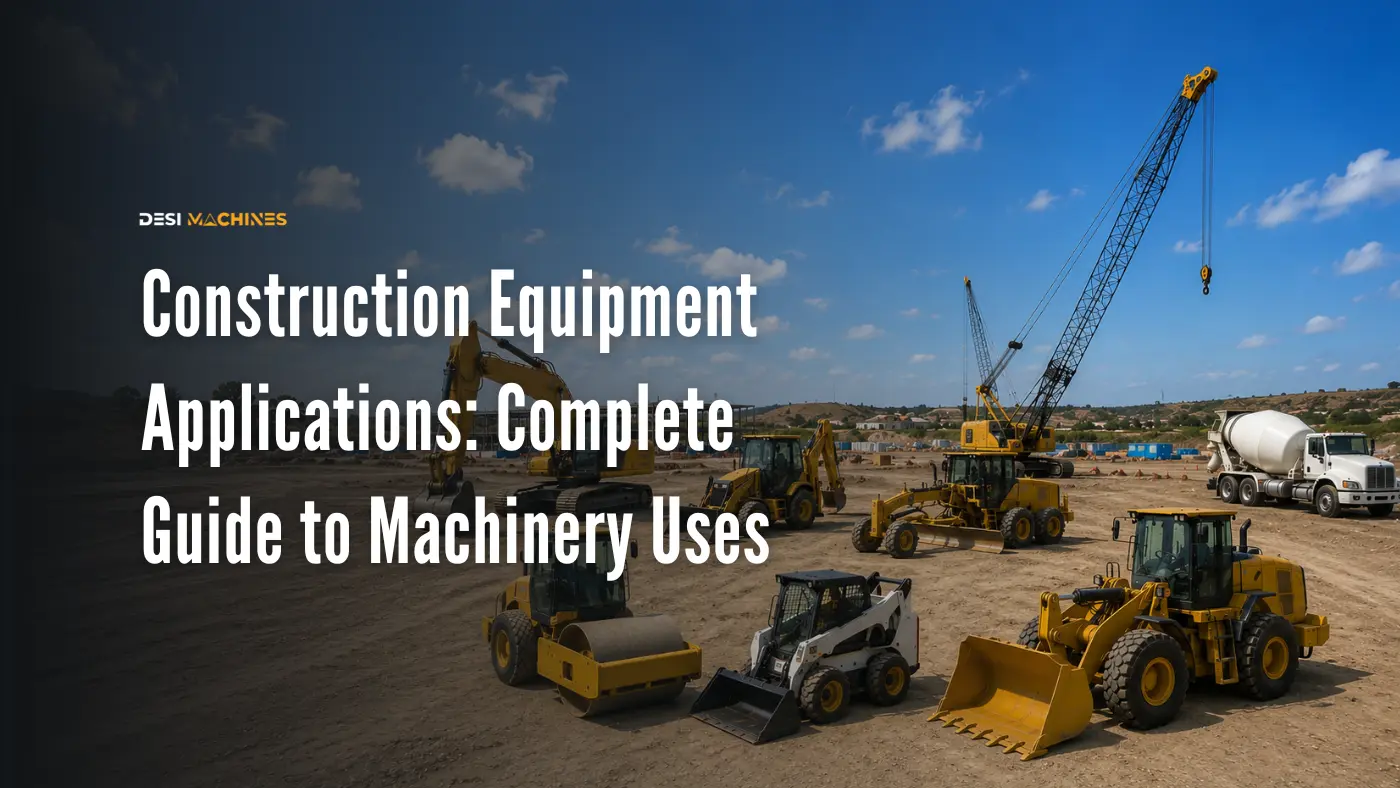
Construction equipment applications determine whether a project finishes on time or bleeds money for months. Pick the wrong machine for black cotton soil near Nagpur, and you’re looking at a stuck excavator, a crane call-out, and three days of zero output. Pick the right one, matched to terrain, project scope, and your actual daily requirements, and the machine pays for itself faster than the EMI schedule suggests.
This guide covers the practical applications of every major equipment category available on Desi Machines: excavators (called “JCB” or “Poclain” across most Indian sites), backhoe loaders, wheel loaders (payloaders), motor graders, cranes, concrete mixers, compactors (road rollers), and skid steer loaders. Each machine exists because it solves a specific problem better than anything else. Understanding those problems, and matching them to your site conditions, is the difference between a contractor who builds wealth and one who just builds.
What are Construction Equipment Applications?
Construction equipment applications refer to the specific tasks and project requirements that each type of heavy machinery is designed to handle. An excavator digs. A crane lifts. A compactor compresses. Simple enough. But the real question is: which excavator, for which soil, at which depth, with which attachment, on which terrain?
Every piece of equipment serves one or more of these five core functions:
- Excavation: Digging foundations, trenches, basements, canals: removing earth from where it shouldn’t be
- Material handling: Moving aggregates, debris, construction materials from point A to point B
- Lifting: Vertical and horizontal movement of heavy loads: structural steel, precast elements, equipment
- Grading: Creating level surfaces, drainage slopes, finished road profiles
- Compacting: Densifying soil, road base, and asphalt to achieve required load-bearing capacity
The application dictates the machine. Not the other way around. A contractor who buys a 20 Ton (20,000 kg) excavator for residential foundation work is overpaying on fuel, transport, and EMI. A contractor who tries to dig a 6-metre basement with a backhoe loader will be there until next monsoon.
Types of Construction Equipment and Their Applications
Eight equipment categories cover 90% of construction work across India, from NHAI highway packages in Rajasthan to metro rail corridors in Bangalore to PMAY housing in Tier 2 towns. Here’s what each one actually does on site.
1. Excavator Applications
Excavators handle the heavy digging that defines most construction projects. Foundation excavation, trenching for utilities, demolition, material handling, landscaping. If earth needs to move in volume, an excavator does it. The machine’s 360-degree rotation means the operator can dig, swing, and dump without repositioning. That’s 150–200 cubic metres per hour on a 20 Ton (20,000 kg) machine in normal soil conditions.
Key applications:
- Foundation digging: Basements, footings, pile caps: depths from 3 to 10+ metres depending on machine size
- Trenching: Water pipelines, sewer lines, electrical conduits, OFC cables
- Demolition: Building teardowns with breaker attachments, common in urban redevelopment
- Material handling: Loading trucks, moving debris, stockpiling aggregates
- Landscaping and canal work: Irrigation projects, pond excavation, land levelling
Track vs wheeled excavators: Track excavators dominate Indian sites. They handle soft soil, uneven terrain, and waterlogged conditions that would sink a wheeled machine. Wheeled excavators (like the SANY SY155W at ₹90–95 Lakh, indicative, as of Sep 2026) work for urban projects where the machine moves frequently between paved locations. But for most Indian terrain, whether laterite in Goa, black cotton soil in Vidarbha or sandy riverbeds in UP, tracks are the only option.
Mini excavators (0–6 Ton) handle residential sites and tight urban spaces. The JCB 30 Plus at 2,870 kg fits through standard gates. Medium excavators (15–25 Ton), the 20–21 Ton class specifically, dominate NHAI and infrastructure work. The SANY SY210C-9 at 20,900 kg runs ₹51–57 Lakh (indicative, as of Sep 2026) and moves 150+ cubic metres per hour in normal conditions.
2. Backhoe Loader Applications
The backhoe loader is India’s most versatile construction machine. Period. A front loader bucket for material handling. A rear excavator arm for digging. Four wheels for mobility between sites. One machine, three functions, one EMI. On the right site it pays for itself.
Primary applications:
- Trench digging: Water lines, sewer connections, electrical conduits: depths up to 4.5 metres
- Backfilling: Refilling trenches after utility installation
- Loading materials: Sand, gravel, debris into trucks and dumpers
- Site preparation: Clearing, levelling, basic grading for small to medium projects
- Utility work: Municipal projects, telecom installations, rural electrification
The JCB 3DX is the default choice. It’s what most Indians mean when they say “JCB.” At ₹30–32 Lakh for the base 2WD model (indicative, as of Sep 2026), it handles 80% of small to medium construction work. The Tata Hitachi Shinrai Prime at ₹33–35 Lakh (indicative, as of Sep 2026) offers better fuel efficiency on longer shifts. For sites with clay-heavy soil and standing water, such as Bengal, coastal Odisha and parts of Kerala, the 4WD variants hold up better.
Here’s the thing most contractors miss: a backhoe loader is not a small excavator. It’s a different machine for different work. Digging depth maxes out around 4.5 metres. Bucket capacity is smaller. But mobility between sites, driving on roads at 30–40 km/h, makes it unbeatable for scattered urban work.
3. Wheel Loader Applications
Wheel loaders (payloaders) move material. That’s their job. Loading trucks, stockpiling aggregates, feeding crushers and batching plants, clearing debris. Wheel loaders don’t dig. They scoop, carry and dump. A 3 cubic metre bucket on a medium wheel loader moves 200+ tonnes per hour in a well-organised quarry.
Core applications:
- Loading trucks: Aggregates, sand and muck: the primary use on most sites
- Stockpiling: Building and maintaining material piles at quarries and ready-mix plants
- Aggregate handling: Feeding crushers, moving processed material between stages
- Snow removal: Northern states, high-altitude projects, attachment-based
- General material transport: Short-distance movement across large sites
Wheel loaders work best on firm, relatively flat surfaces. Rocky outcrops in Jharkhand, compacted quarry floors, concrete yards. That’s where they shine. Soft, waterlogged sites slow them down and increase tyre wear.
4. Motor Grader Applications
Motor graders create finished surfaces. The long blade between the front and rear axles spreads, levels, and shapes material with precision that no other machine matches. Road construction depends on them. So does any project requiring accurate grades and drainage slopes.
Applications:
- Road construction: Spreading base layers, creating camber, finishing sub-grade
- Surface levelling: Airstrips, industrial yards, large parking areas
- Grading: Achieving specified slopes for drainage and load distribution
- Drainage slope creation: Side drains, table drains, cross-fall on road surfaces
- Maintenance: Regrading unpaved roads, removing ruts, redistributing material
NHAI packages specify motor grader work at multiple stages: sub-grade preparation, granular sub-base, wet mix macadam. A skilled operator on a well-maintained grader achieves ±10mm accuracy on finished surfaces. That precision matters, because every millimetre of extra thickness laid over a kilometre of carriageway is bitumen you have paid for and cannot recover.
5. Crane Applications
Cranes lift what humans and smaller machines cannot. Structural steel, precast concrete elements, heavy equipment, formwork: anything that needs to move vertically or horizontally across a site. The application determines the crane type.
Pick & Carry crane applications (Hydra and Farana, currently live on Desi Machines):
- Material handling: Moving steel, precast elements, equipment across sites
- Loading/unloading: Trucks, trailers, storage yards
- Erection work: Structural steel, trusses, pre-engineered building components
- Industrial maintenance: Factory equipment installation and relocation
Hydra cranes (9–25 Ton capacity) dominate Indian construction. The 14 Ton class is most popular: enough capacity for most structural work, compact enough for congested sites. Farana cranes (13–35 Ton) handle heavier lifts: precast girders, heavy industrial equipment.
Rough-terrain, all-terrain, crawler, truck-mounted and telescopic boom crawler cranes are not currently listed on Desi Machines.
Tower cranes, overhead cranes, gantry cranes, and floating cranes are not currently available on Desi Machines.
6. Concrete Mixer Applications
Concrete mixers produce and transport the material that holds everything together. Two types serve different needs: self-loading concrete mixers (SLCM) for on-site production, and transit mixers for ready-mix delivery.
Self-Loading Concrete Mixer applications:
- On-site mixing: Rural roads, canal lining, small bridge works, where batching plants aren’t feasible
- Remote locations: Hill roads, forest areas, sites without ready-mix access
- Small to medium pours: 4–8 cubic metres per hour output
Transit Mixer applications:
- Ready-mix delivery: Transporting concrete from batching plants to pour locations
- High-rise construction: Continuous pours requiring consistent supply
- Large infrastructure: Bridges, flyovers, metro stations: high-volume requirements
SLCMs work where transit mixers can’t reach or where setting up a batching plant doesn’t make sense. A contractor doing 50 km of rural road in Chhattisgarh isn’t getting ready-mix trucks to every pour location. The SLCM goes to the aggregate pile, loads itself, mixes while travelling, and pours at the work face.
7. Compactor Applications
Compactors (road rollers) densify material. Soil, road base and asphalt all require compaction to achieve specified density and load-bearing capacity. Skip this step, and the road fails within two monsoons. Every time.
Soil Compactor (Single Drum) applications:
- Earthwork compaction: Embankments, sub-grade, backfill behind retaining walls
- Road base preparation: Granular sub-base, wet mix macadam layers
- Dam and reservoir work: Core and shell compaction
Tandem Roller (Double Drum) applications:
- Asphalt compaction: Bituminous macadam, dense bituminous concrete, surface courses
- Finish rolling: Achieving smooth, dense surface on completed pavements
Pneumatic Tyre Roller (PTR) applications:
- Intermediate rolling: Between breakdown and finish rolling on asphalt
- Kneading action: Sealing surface, improving aggregate interlock
The Dynapac CA305D CEV-V at ₹34–36 Lakh (indicative, as of Sep 2026) handles most road construction compaction. For asphalt work, the CASE 952NX tandem roller at ₹32–34 Lakh (indicative, as of Sep 2026) delivers the smooth finish NHAI specs demand.
8. Skid Steer Loader Applications
Skid steer loaders work where larger machines cannot fit. Tight urban sites, indoor demolition, landscaping in confined spaces. The compact footprint and zero-turn radius make them essential for specific applications.
Applications:
- Compact jobsite work: Material handling in congested areas, indoor construction
- Landscaping: Grading, material spreading, site preparation for gardens and parks
- Demolition: Interior teardowns, selective demolition with breaker attachments
- Snow removal: Northern states, high-altitude locations
- Attachment versatility: Buckets, forks, augers, trenchers, breakers: one machine, multiple tools
The attachment system is what makes skid steers valuable. A single machine with a bucket, pallet forks, and an auger handles material moving, equipment unloading, and post-hole digging. Three jobs, one machine, one operator. That math works on sites where space is tight and equipment logistics are expensive.
Construction Equipment Applications by Project Type
Different projects demand different equipment combinations. A residential site in Pune needs different machines than an NHAI highway package in Rajasthan. Here’s what actually shows up on each project type.
Residential Construction
Residential projects, from individual houses to housing societies and apartment complexes, typically need smaller, more versatile equipment. Space is limited. Access roads are narrow. Neighbours complain about noise.
Equipment typically used:
- Backhoe loaders: Foundation excavation, utility trenching, material handling. The JCB 3DX handles 70% of residential work
- Mini excavators: Basement digging in tight plots, utility connections. The JCB 30 Plus at 2,870 kg fits through standard gates
- Skid steer loaders: Site preparation, landscaping, material movement in confined spaces
- Concrete mixers: Transit mixers for larger pours, SLCMs for remote residential plots
Most residential contractors in India run on backhoe loaders. One machine handles excavation, loading, and basic grading. For basement work deeper than 4 metres, a mini or small excavator comes in for the dig, then the backhoe handles everything else.
Commercial & High-Rise Projects
Commercial buildings and high-rises require heavier equipment, longer reach, and higher lifting capacity. Deep basements, structural steel erection, continuous concrete pours. The scale changes everything.
Equipment typically used:
- Large excavators: Deep basement excavation using the 25–50 Ton class for basements exceeding 10 metres
- Cranes: Pick & Carry cranes for ground-level material handling; tower cranes (not on Desi Machines) for vertical lifts on high-rises
- Concrete mixers: Transit mixers feeding concrete pumps for continuous pours
- Concrete pumps: Stationary pumps (live on Desi Machines) for high-rise pours
A typical commercial project in a metro city runs 2–3 excavators (one large for basement, one medium for general work), multiple transit mixers on rotation, and cranes sized to the heaviest lift required.
Road & Highway Construction
Road construction is equipment-intensive. Every layer, from sub-grade and sub-base to base course and surface course, requires specific machines. NHAI packages specify equipment requirements in tender documents. Show up without the right fleet, and you’re renting at premium rates or missing deadlines.
Equipment typically used:
- Motor graders: Sub-grade preparation, spreading granular layers, creating camber and cross-fall
- Compactors: Soil compactors for earthwork, tandem rollers for asphalt, PTR rollers for intermediate passes
- Wheel loaders: Feeding pavers, loading trucks, stockpile management
- Excavators: Earthwork, drain excavation, utility crossings
- Asphalt pavers: Laying bituminous layers (not currently on Desi Machines)
A 10 km NHAI package typically runs 3–4 motor graders, 6–8 compactors of various types, 2–3 wheel loaders, and 4–6 excavators. The dry season, October to May, is when 80% of the work happens. Earth or rock, the machine has to suit the material.
Mining & Earthmoving
Mining and large earthmoving projects move volume. Thousands of cubic metres per day. The equipment is bigger, the running hours are longer, and the margins depend on fuel efficiency and uptime.
Equipment typically used:
- Large excavators: 35–50 Ton class for overburden removal and material extraction. The SANY SY500C-10HD at 49,500 kg handles mining-scale work
- Wheel loaders: Large loaders for truck loading, stockpile management
- Articulated dump trucks: Hauling material from pit to processing or dump locations
Mining excavators run 4,000–6,000 hours per year. At that utilisation, a difference of 2–3 litres per hour is 8,000 to 18,000 extra litres of diesel a year. The purchase price matters less than the running cost.
Road building is the sector that uses the widest spread of these machines, and our guide to road construction equipment follows a road job stage by stage.
How to Choose Construction Equipment for Your Application
Choosing equipment is not about finding the “best” machine. It’s about finding the right machine for your specific application, terrain, and budget. An excavator in the ₹50–60 Lakh bracket that sits idle 200 days a year is a worse investment than a ₹30–35 Lakh machine running 280 days.
Six factors determine the right choice:
- Project scope: What work needs to be done? Digging depth, material volume, lift heights, surface area
- Terrain conditions: Soft soil needs tracks. Hard surfaces suit wheels. Slopes require specific stability
- Material type: Rock needs breakers. Clay needs different bucket teeth than sand. Sticky soil clogs standard buckets
- Lifting requirements: Weight, height, reach: cranes are sized to the heaviest single lift
- Space constraints: Tight sites need compact equipment. Road access limits transport options
- Budget: Purchase price, EMI, fuel cost, maintenance, resale value: total cost of ownership, not just sticker price
Most contractors in India make equipment decisions based on what they’ve always used or what the dealer is pushing. That’s not buying. That’s habit. Compare first, then buy: Desi Machines exists precisely because the one-dealer habit leaves money on the table on every major purchase.
Ready to find the right machine for your project? Explore all models and request a quote on Desi Machines.
Prices, specifications and features are indicative, vary by variant, location and date, and should always be confirmed with the official OEM or authorised dealer before any purchase decision. DesiMachines is not liable for decisions taken on the basis of information that may have changed after publication.
Machines, tenders and news for this industry: Building Construction