

 Excavator
  Backhoe Loader
  Motor Grader
  Wheel Loader
  Crane
Crane  Concrete Mixer
  Compactor
  Skid Steer Loader
  Concrete Pump
  Telehandler


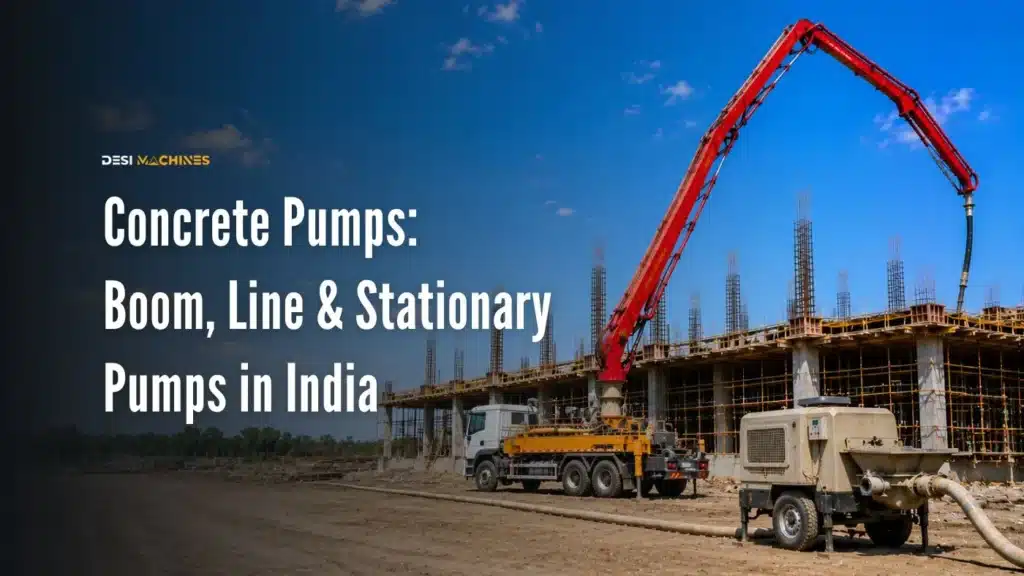
A concrete pump moves fresh concrete from the mixer to exactly where it needs to go — up 30 floors, across a raft foundation, or into a congested column cage a wheelbarrow could never reach. On any site pouring more than a few cubic metres a day, the pump is what keeps the concrete moving fast enough to place it before it starts to set. Get the pump wrong and your pour stalls; get it right and a slab that once took a day goes down in a few hours.
This guide covers how concrete pumps actually work, the main types you’ll deal with in India, and how to match pump capacity to your project — with the models and brands DesiMachines carries so you can move from understanding to a quote.
What is a Concrete Pump and How Does It Work?
A concrete pump is a machine that pushes liquid concrete through a steel or rubber pipeline under pressure. Instead of carrying concrete by wheelbarrow, crane bucket, or chute, you pump it — continuously, at rates from around 8 to over 60 cubic metres per hour (m³/hr) depending on the machine.
The heart of nearly every modern pump is a twin-cylinder hydraulic system. Two pistons work in opposite strokes: as one cylinder draws concrete in from the hopper, the other pushes its charge out into the pipeline. A valve (the S-valve, in most designs) switches back and forth to keep the flow going in one direction. The result is a near-continuous stream of concrete delivered under steady pressure.
That pressure is what lets a pump beat gravity and distance. A powerful pump can push concrete vertically to the top of a high-rise or horizontally across hundreds of metres of pipeline — placing it accurately, with less labour and less wastage than any manual method. On a large raft or a tall structure, that isn’t a convenience. It’s the only practical way to pour.
Types of Concrete Pumps
Three families cover Indian construction, from small builder sites to major infrastructure pours.
1. Boom Pumps (Truck-Mounted)
A boom pump mounts the pump and a folding robotic arm — the placing boom — on a truck. The boom, typically 20 to 60+ metres long, swings the delivery pipe directly over the pour and places concrete precisely, no manual pipe-laying needed. One operator controls it by remote.
Boom pumps are the choice for high-volume, high-reach work: high-rise slabs, large foundations, bridges, and metro decks. They set up fast, pour fast, and move to the next job. The trade-off is cost and the space the truck needs to deploy its outriggers.
2. Line Pumps (Stationary / Trailer Pumps)
A line pump, also called a stationary or trailer pump, is the pump unit on its own — mounted on a trailer or skid, with no boom. Concrete travels through a hose or steel pipeline that the crew lays out by hand to wherever it’s needed.
Line pumps are more affordable, more flexible on tight or oddly shaped sites, and ideal for ground-level slabs, footings, swimming pools, and smaller structural work. The smallest of them, rated 27 to 40 m³/hr, are what buyers call a mini concrete pump, and that guide sets out their sizes, pressure and price bands. They pump slower than boom pumps and need labour to set up and move the line, but for many builders and contractors they are the workhorse — a paisa vasool machine for steady mid-size work.
3. Self-Loading and Combination Units
Some Indian sites use pumps paired with, or built into, mixing equipment for smaller or remote pours. Where a full transit mixer and separate pump aren’t justified, a combined setup keeps concrete moving on modest jobs. For the mixing side of the equation, the concrete mixer types guide covers transit mixers, SLCMs, and where each fits.
Boom Pump vs Line Pump: Which One?
This is the real decision for most buyers. It comes down to volume, reach, and site.
- Pouring high volumes at height or over distance — high-rise slabs, big foundations, bridges → boom pump.
- Pouring at ground level, on tight sites, or on a tighter budget — footings, small slabs, pools, structural infill → line pump.
- Remote or low-volume work where a full boom truck can’t reach or isn’t justified → line pump with laid pipeline, or a combination unit.
A quick rule from site: if you’re regularly pouring above the third or fourth floor at pace, a boom pump pays for itself in labour and time. Below that, or on unpredictable sites, a line pump’s flexibility usually wins. Compare live options across both on the concrete pump category.
Matching Pump Capacity to Your Project
Output is rated in cubic metres per hour, but the headline number is a theoretical maximum — real-world output is usually 60–70% of it once you account for pipeline friction, pauses between mixer loads, and pour height. Size the pump to the concrete supply, not the other way round: a pump that outruns your mixers just sits idle.
A rough field guide (all figures indicative — confirm with our team):
- Small builder / residential: line pumps around 8–20 m³/hr handle most slabs and footings.
- Mid-size structural / commercial: 20–40 m³/hr line or smaller boom pumps.
- High-rise / infrastructure: boom pumps at 40–60+ m³/hr, with the boom length matched to building height.
Popular Indian and global models on DesiMachines run across this range — the Putzmeister BSA 1410 D and heavier BSA 2109 HD stationary pumps, and the CONMAT SCP 7500 — cover typical line-pump duties. Match the model to your peak pour rate and reach. Note that the rate and the reach are set by two separate specifications that do not rise together — see concrete pump output and pressure explained for the m³/hr and bar figures published across the stationary pumps on sale in India.
Concrete Pump Brands in India
The Indian market is served by strong global and domestic names. Schwing Stetter and Putzmeister lead the high-end boom and stationary segment, while AJAX, CONMAT, Aquarius, and Venus offer competitive line pumps and value machines. Each has its own dealer and service reach, which matters as much as the spec sheet — a pump down for want of a spare stops the whole pour.
Browse brand-wise ranges — Schwing Stetter, Putzmeister, AJAX Engg, and CONMAT — or read the wider concrete equipment brands guide for how the makers compare on range and after-sales.
Buying, Financing and Running a Concrete Pump
A concrete pump is a serious capital purchase, and the economics turn on utilisation. A pump that pours 20 days a month earns; one that sits between jobs bleeds EMIs. Before buying, be honest about your pour pipeline.
Equipment finance makes ownership reachable — loans from SBI, HDFC Bank, and other lenders are laid out on the construction equipment finance page, and cover for the machine is worth comparing on the equipment insurance pages. On the ground, the things that decide running cost are wear parts — the S-valve, wear plates, and delivery pipes take a beating from abrasive concrete — so factor spares and cleaning discipline into the budget, not just the sticker price.
To move from research to a real quote, start at the concrete pump category, shortlist by output and reach and ask our team for pricing on your shortlist. For the full placement picture — mixing and pumping together — the concrete equipment guide ties it up.
Pouring high up or across a big raft foundation? A truck-mounted concrete pump truck (boom pump) does the reaching for you — read when to hire one versus owning a line pump.
Final specifications, features, and prices should always be confirmed with the official OEM or dealer.