
 Excavator
294 models
Excavator
294 models  Backhoe Loader
51 models
Backhoe Loader
51 models  Crane
68 models
Crane
68 models  Concrete Mixer
79 models
Concrete Mixer
79 models  Wheel Loader
54 models
Wheel Loader
54 models  Compactor / Roller
45 models
Compactor / Roller
45 models  Motor Grader
42 models
Motor Grader
42 models  Dozer
41 models
Dozer
41 models  Concrete Pump
66 models
Concrete Pump
66 models  Skid Steer Loader
11 models
Skid Steer Loader
11 models  Telehandler
13 models
Telehandler
13 models 


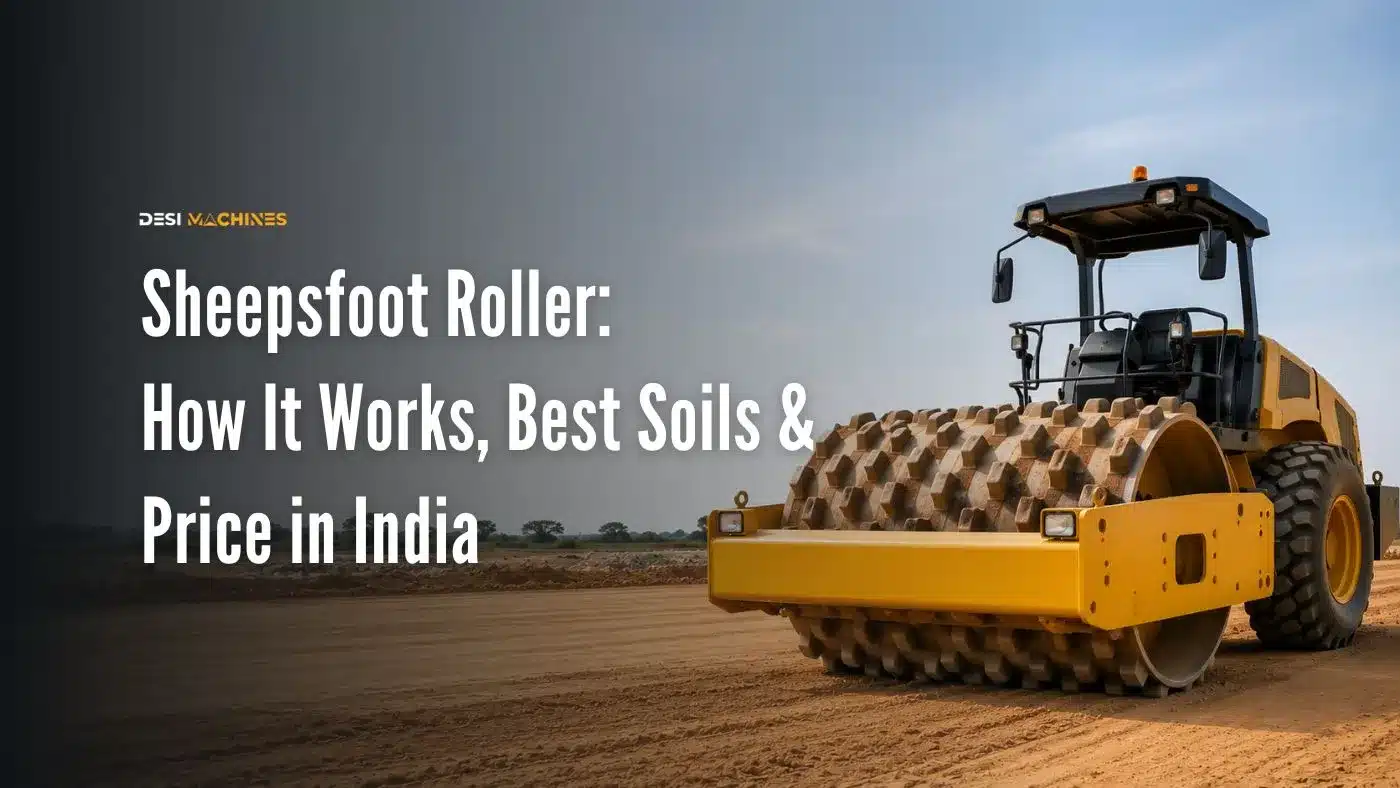
A sheepsfoot roller is a type of soil compactor. Its steel drum is not smooth — it is covered with rows of small, foot-shaped lugs called feet or pads. As the drum rolls, these feet press deep into the soil and knead it (press and squeeze it), packing the layer tightly from the bottom up. That is why it is the best machine for cohesive soils — sticky soils like clay and silt that hold together in a lump when you squeeze them in your hand. On a highway embankment, a canal bank or a dam wall, this is the roller that does the real compaction. It is the wrong roller for loose sand or gravel, which need a smooth drum or a rubber-tyre (pneumatic) roller instead. If compaction is new to you, start with the basics of how a compactor works on soil and asphalt.
Below we explain, in plain words, how it works, the difference between sheepsfoot and padfoot, which soils it suits and which it does not, where these rollers are used across India, and what the machines cost.
What is a sheepsfoot roller?
A sheepsfoot roller is a compaction machine with a heavy steel drum that has many projecting feet welded around it. Each foot is a small metal knob, usually club-shaped or oval, about 60–90 mm (6–9 cm) long. A single drum can carry a hundred or more of these feet.
When the drum rolls over loose soil, the whole weight of the machine is carried on just a few feet at a time. So the pressure under each foot is very high. The feet punch into the soil, squeeze it sideways and downward, and compact it deep inside the layer — not just on the surface. As pass after pass is made, the soil gets firmer, the feet sink less, and finally the drum “walks out” — it rides on top instead of sinking in. That walking-out is the operator’s simple signal that the layer is compacted.
In the field, contractors in India often just call it a padfoot roller or a soil compactor. All three names point to the same idea: a drum with feet, made to pack sticky soil.
Why is it called a “sheepsfoot” roller?
The name comes from the early rollers of the 1900s. The first tamping rollers used narrow, curved lugs that looked like the hoof of a sheep, and as the drum turned it looked like a flock of sheep treading the ground. Farmers had long known that animal hooves pressing over wet clay packed it down hard, and the machine copied that same kneading action. The name stuck, and it is still used a century later.
How a sheepsfoot roller works
The whole trick is foot pressure and kneading. Here is the simple sequence:
- Soil is spread in a thin layer, called a lift, usually 150–300 mm (15–30 cm) thick.
- The roller’s feet sink into this loose lift because the pressure under each foot is high.
- The feet compact the soil from the bottom of the lift upward. This is important — a smooth roller mainly presses the top, but a sheepsfoot works the deep soil first.
- With each pass the soil grows firmer, so the feet sink less and less.
- When the drum stops sinking and rides on the surface, the layer is done. The operator then spreads the next lift on top.
This kneading action does one more useful thing: it presses the loose grains of clay together and pushes out the trapped air and extra water. A well-compacted clay layer holds far less water, so it does not swell in the monsoon or shrink and crack in summer — a real problem with the black-cotton soils of central and western India.
Most modern soil compactors also add vibration (the drum shakes rapidly as it rolls). Vibration plus the tamping feet compacts each lift in fewer passes, which saves diesel and time. We explain the vibratory side in our guide to soil compaction methods and moisture control.
Sheepsfoot vs padfoot roller: is there a difference?
People use the two names for each other, and for buying purposes they do the same job. But there is a small real difference in the shape of the feet:
- Sheepsfoot: many narrow, club or spindle-shaped feet. Very high pressure on a small tip. This is the classic design, often seen on towed (pulled) drums.
- Padfoot (also called tamping foot): fewer, larger rectangular or oval pads with a flat top. The pad spreads the load a little more, so the drum leaves a smoother, more even surface and self-cleans better in wet clay.
Almost every self-propelled soil compactor sold in India today — the single-drum machine you see on highway sites — uses the padfoot style drum. So when an Indian dealer says “padfoot roller” or “sheepsfoot roller”, he almost always means the same modern soil compactor. Do not get stuck on the word; ask about the drum, the weight and the vibration.
Which soils suit a sheepsfoot roller — and which do not
This is the single most important thing to get right. A sheepsfoot roller is made for cohesive soil and is a poor choice for granular (loose) soil.
| Soil type | Sheepsfoot / padfoot roller? |
|---|---|
| Clay, silty clay, black-cotton soil | Best choice. The feet knead sticky soil the way nothing else can. |
| Silt and clayey gravel mixes | Good. Works well on soils that hold together. |
| Clean sand, fine sand | Poor. The feet just push loose grains aside. Use a smooth vibratory drum. |
| Gravel, crushed aggregate (GSB, WMM road base) | Poor. Use a smooth drum roller for the base layers. |
The simple field test: take a handful of the soil, wet it lightly and squeeze it. If it holds together like dough, it is cohesive — a sheepsfoot roller suits it. If it falls apart like beach sand, it is granular — use a different roller.
Sheepsfoot vs smooth drum vs pneumatic roller
On a real road or embankment job you rarely use only one roller. Each one has its own job:
- Sheepsfoot / padfoot roller — deep compaction of clay and cohesive fill. Used first, on the embankment and subgrade layers.
- Smooth drum vibratory roller — for sand, gravel and the granular base (GSB/WMM), and to give a tight top finish. See our guide to road rollers and their types.
- Pneumatic (rubber-tyre) roller — the kneading finish on bituminous (tar) layers and some soils, closing small surface gaps.
A common India sequence for a highway embankment: spread the clayey fill, compact it with a padfoot roller, then run a smooth drum on top to seal the surface before the next lift. For the full picture of every machine, read our complete guide to the types of compactors.
If you are still deciding which roller your work needs, browse all the machines and prices on the compactors page at DesiMachines before you commit.
Where sheepsfoot and padfoot rollers are used in India
Because so much of Indian earthwork is on clay and black-cotton soil, the padfoot roller is a workhorse here. You will find it on:
- Highway and expressway embankments — the raised earth on which NHAI roads sit is compacted layer by layer with padfoot rollers.
- Earthen dams and pond bunds — the clay core of a dam must be watertight, and only deep kneading compaction gives that.
- Canal banks and irrigation bunds — the same watertight-clay need under many state irrigation projects.
- Railway formation and PMGSY rural roads — the sub-base earthwork on cohesive ground.
- Building and factory pads where the site soil is clay and has to carry a heavy floor.
In short, wherever sticky soil has to be packed hard and deep, this is the roller for the job.
Static vs vibratory padfoot rollers
Older sheepsfoot drums were static — they compacted by dead weight alone, and were usually towed behind a tractor or dozer. They still work, but they are slow and need many passes.
The machines sold new today are vibratory single-drum soil compactors: self-propelled (they drive themselves), and the padfoot drum vibrates as it rolls. Vibration shakes the soil grains so they settle tighter, which means fewer passes and better density. For clay work you usually run the vibration on a low-frequency, high-amplitude setting — your dealer or operator will set this to suit the soil. If you are compacting mostly cohesive fill, a vibratory padfoot machine is the sensible buy.
Sheepsfoot and padfoot soil compactors on DesiMachines
On DesiMachines, sheepsfoot and padfoot work is done by single-drum soil compactors. We list machines from L&T, Escorts, Dynapac, HAMM, JCB, SANY, CASE, Volvo, LiuGong, XCMG, ACE and Ammann. Here are a few real examples with our indicative prices:
| Model | Type | Price (indicative, as of September 2026) |
|---|---|---|
| L&T 1190D | Single-drum soil compactor | ₹30–32 Lakh |
| Escorts EC 5250 Plus | Single-drum soil compactor | ₹30–32 Lakh |
| Dynapac CA405PS CEV-V | Padfoot-shell soil compactor | ₹34–36 Lakh |
| JCB VM117 | Single-drum soil compactor | ₹36–38 Lakh |
Two things to know before you read a price:
- Most single-drum soil compactors are sold with a smooth drum as standard. The padfoot / sheepsfoot version uses a padfoot drum, or a bolt-on padfoot shell kit that fits over the smooth drum. Dynapac, for example, lists a padfoot-shell version of its CA405 (the CA405PS). Tell the dealer you need the padfoot configuration.
- Across the range listed on DesiMachines, soil compactors run from about ₹30–40 Lakh (indicative segment range, as of September 2026). The L&T 1190 and Escorts EC 5250 sit at the bottom of that span, the Volvo SD110 at the top. That span is built from the 19 of our 21 soil compactors that carry a listed price — the SANY SSR220C-8H and the Ammann ARS 110.2 are price-on-request, so neither of them sets an end of it. The exact padfoot-drum price for your model is best taken on request, as it depends on the drum and any shell kit.
You can compare brand ranges directly — for instance Dynapac compactors or L&T compactors — or read our roundup of the best compactor brands in India. A machine in this class is a ₹30–40 Lakh decision (indicative, as of September 2026), so if you plan to buy on EMI it is worth checking equipment finance options first.
Price note: all figures above are indicative, dated September 2026 and taken from listings on DesiMachines at the time of writing. They are ex-factory prices. Diesel-price changes, emission-norm variants (CEV Stage IV/V), drum type and dealer offers all move the number. Prices, specifications and features are indicative, vary by variant, location and date, and should always be confirmed with the official OEM or authorised dealer before any purchase decision. DesiMachines is not liable for decisions taken on the basis of information that may have changed after publication.
Buying or renting: what to check
If most of your work is on clay, embankment or dam soil, a padfoot soil compactor earns its keep. Before you decide, check these points:
- Operating weight — heavier drums give deeper compaction. Match the weight to your lift thickness and soil.
- Drum type — confirm you are getting a padfoot drum (or shell kit), not just the smooth version.
- Vibration setting — for clay you want good amplitude at low frequency; ask what the machine offers.
- Dealer and parts — a padfoot drum takes hard knocks; make sure feet, drum and service support are available near your site.
- Buy vs rent — if you only need it for one embankment season, renting or hiring can be cheaper than buying into this class.
When you are ready, compare every padfoot and soil compactor model, with specs and prices, and talk to our team about the machine that fits your soil.