Excavator
294 models
Excavator
294 models  Backhoe Loader
51 models
Backhoe Loader
51 models  Crane
68 models
Crane
68 models  Concrete Mixer
79 models
Concrete Mixer
79 models  Wheel Loader
54 models
Wheel Loader
54 models  Compactor / Roller
45 models
Compactor / Roller
45 models  Motor Grader
42 models
Motor Grader
42 models  Dozer
41 models
Dozer
41 models  Concrete Pump
66 models
Concrete Pump
66 models  Skid Steer Loader
11 models
Skid Steer Loader
11 models  Telehandler
13 models
Telehandler
13 models 


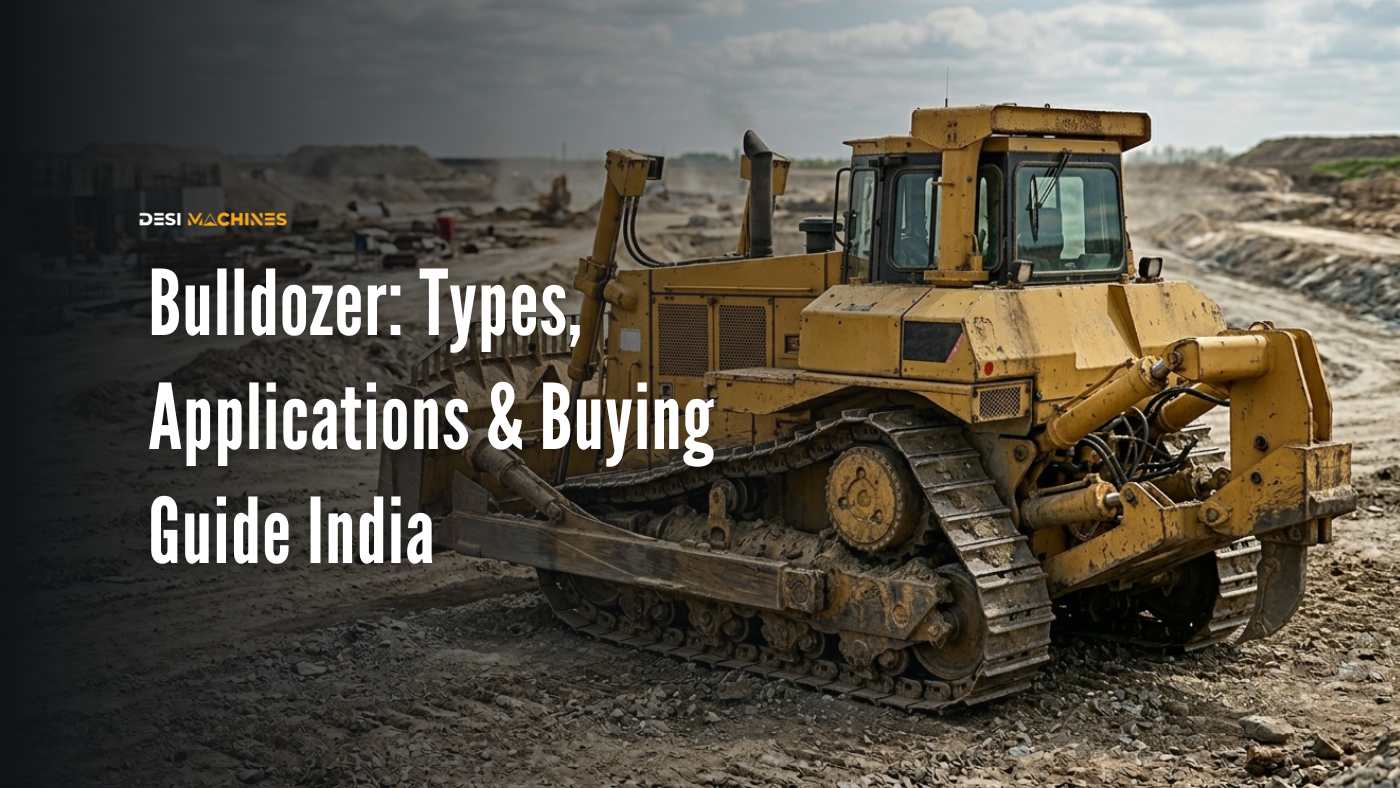
A bulldozer is the machine that moves mountains — sometimes literally. In India’s construction and mining sectors, these track-mounted powerhouses clear land, push overburden, grade terrain, and prepare sites for everything from NHAI highway packages to open-pit coal mines in Jharkhand. Without bulldozers, most large-scale earthmoving projects would take three times longer and cost twice as much.
India’s bulldozer market has grown steadily alongside infrastructure spending. The Bharatmala and Sagarmala projects, Smart City missions, and aggressive mining expansion have pushed demand for dozers across all size categories — from compact machines for agricultural land leveling in Punjab to 50+ Ton mining giants operating in Chhattisgarh’s coalfields. BEML, Komatsu, Caterpillar, and Shantui dominate the Indian market, each with distinct strengths in pricing, service network, and application fit.
This guide covers bulldozer types available in India, blade configurations, applications across industries, and what to consider before buying. Whether you’re a contractor looking at your first dozer or a fleet owner expanding operations — compare first, buy second.
What is a Bulldozer?
A bulldozer — also called a dozer or crawler dozer — is a heavy construction machine built around a simple concept: a powerful tractor with a large metal blade mounted at the front. That blade pushes soil, rocks, sand, rubble, and debris across the ground. The machine’s weight and engine power do the rest.
The basic structure is straightforward. A bulldozer consists of four main components: the blade (front-mounted, hydraulically controlled), the engine (diesel, typically 100–500+ HP depending on size), the undercarriage (tracks or wheels that provide mobility and traction), and often a ripper (rear attachment for breaking hard ground or rock). Most bulldozers in India run on tracks — the continuous metal belts that distribute weight and provide grip on soft or uneven terrain.
Why tracks instead of wheels? Simple. A 20 Ton machine on wheels would sink into the black cotton soil near Nagpur or the waterlogged clay of Bengal. Tracks spread that weight across a larger surface area. That’s the math. Tracks also provide the traction needed to push heavy loads without spinning out — which is the entire point of a bulldozer.
How Does a Bulldozer Work?
The operating principle is deceptively simple. The blade engages the ground, the tracks push forward, and material moves. But the details matter.
A bulldozer’s work cycle has two phases: the productive phase (blade down, digging and pushing material) and the non-productive phase (blade up, reversing to the starting position). Good operators minimize non-productive time. Great operators read the terrain and adjust blade angle, depth, and speed continuously — that’s where experience shows.
The hydraulic system is the brain behind blade movement. Hydraulic cylinders control blade height, tilt, and angle. The operator adjusts these in real-time using joysticks or levers. Modern dozers from Komatsu and CAT include semi-automatic blade control systems that maintain grade automatically — useful for precision work on highway subgrade preparation. But on most Indian sites, especially mining operations, manual control still dominates. On an Indian site the operator’s skill still matters more than the automation.
Track-based movement works through differential steering. Each track can be controlled independently. To turn left, the left track slows or stops while the right track continues. To pivot in place, tracks move in opposite directions. This gives bulldozers surprising maneuverability for their size — a 30 Ton dozer can turn within its own length.
Types of Bulldozers in India
Bulldozers come in multiple configurations designed for specific terrains, project scales, and applications. Choosing the wrong type means either overpaying for capacity you don’t need or struggling with a machine that can’t handle the job. Neither is acceptable when EMIs are running.
| Bulldozer Type | Best For | Main Strength | Main Limitation |
|---|---|---|---|
| Crawler Bulldozer | Mining, rough terrain, land clearing | Maximum traction and push power | Slow travel |
| Wheel Bulldozer | Firm ground and faster relocation | Higher travel speed | Weak in soft terrain |
| Mini Bulldozer | Small sites and agriculture | Lower cost and easier transport | Limited capacity |
| Large Bulldozer | Mining and heavy earthmoving | Maximum production | High acquisition and operating cost |
1. Crawler Bulldozer (Track-Type)
The crawler bulldozer is what most people picture when they hear “bulldozer.” Large continuous tracks instead of wheels. Superior traction on mud, gravel, loose soil, and uneven ground. This is the workhorse of Indian mining and heavy construction.
Features: Wide tracks distribute weight (ground pressure typically 0.5–0.8 kg/cm²), excellent stability on slopes up to 45 degrees, high drawbar pull for pushing heavy loads. Most crawlers in India range from 80 HP to 500+ HP.
Applications: Heavy-duty construction, land clearing in forested areas, mining overburden removal, dam construction, quarry operations. If the terrain is rough, soft, or steep — crawler is the answer.
Popular Models in India: CAT D6R, Komatsu D155A, BEML BD155, Shantui SD16. BEML dominates government and PSU mining projects due to competitive pricing and indigenous manufacturing.
Advantages: Superior stability on difficult terrain, highest pushing power, works in conditions where wheeled machines would fail.
Disadvantages: Slower travel speed (typically 6–12 km/h), higher undercarriage maintenance costs, cannot travel on paved roads without damaging them.
2. Wheel Bulldozer
The wheel bulldozer trades off-road capability for speed and mobility. Large rubber tires instead of tracks. Faster movement between work areas. Better suited for firm, stable surfaces.
Features: Travel speeds up to 35–40 km/h, better fuel efficiency on hard surfaces, easier transportation between sites (can drive on roads).
Applications: Road construction on established subgrade, large landscaping projects, stockpile management in industrial yards, projects requiring frequent relocation.
Advantages: Faster travel, lower operating costs on hard surfaces, easier to transport.
Disadvantages: Poor traction on soft or muddy ground, less stability on slopes, limited use during monsoon season. In India’s conditions, wheel dozers are relatively rare compared to crawlers.
3. Mini Bulldozer
The mini bulldozer — also called a compact dozer — fills the gap where full-size machines can’t fit or aren’t economical. Operating weight typically under 8 Tons, engine power 50–100 HP.
Features: Compact dimensions for tight spaces, lower ground pressure, easier transport on standard trailers.
Applications: Residential construction site preparation, landscaping, small demolition projects, urban construction where space is limited, agricultural land leveling. The BULL Compact Dozer has gained traction in agricultural applications across Punjab and Haryana.
Advantages: Maneuverability in confined areas, lower purchase and operating costs, suitable for small contractors.
Disadvantages: Limited pushing capacity, not suitable for heavy earthmoving or mining. Don’t expect a mini dozer to handle what a D6 does. Not even close.
4. Large/Heavy-Duty Bulldozers
The giants. Operating weight 30–100+ Tons, engine power 300–850 HP, blade capacities measured in cubic metres. These machines exist for one purpose: moving massive volumes of earth in mining and major infrastructure projects.
Features: Enormous pushing power, reinforced undercarriages for abrasive conditions, advanced operator comfort systems for long shifts.
Applications: Large-scale open-pit mining (coal, iron ore, limestone), major dam construction, large quarry operations. In India, you’ll find these primarily at Coal India subsidiaries, NMDC operations, and major private mining companies.
Popular Models: CAT D11 (the largest production dozer globally), Komatsu D475A, BEML BD475. BEML recently unveiled India’s largest indigenous crawler dozer — a significant milestone for domestic manufacturing.
Note: We do not publish a price for the biggest mining dozers. The Cat D11, Komatsu D475A-5E0 and BEML BD475-2 are all price-on-request, so ask for a written quote rather than working off a figure you read somewhere. For a sense of scale, the largest dozer we do price is the Shantui SD32W at ₹1.80 – 2.20 Cr (indicative, as of Sep 2026). At this size the decision is a detailed return-on-investment calculation, not an impulse buy.
Bulldozer Blade Types
The blade is where the work happens. Different blade configurations serve different purposes. Choosing the wrong blade for your application is like using a hammer when you need a screwdriver — technically possible, practically inefficient.
Straight Blade (S-Blade)
The S-Blade is positioned perpendicular to the dozer’s direction of travel. No curvature, no wings. Straight across.
Characteristics: High power per unit blade length, excellent ground penetration, cuts and pushes soil straight forward. Can be fitted with a tilt cylinder for enhanced versatility.
Best for: General-purpose work, fine grading, short-distance pushing. This is the most commonly used blade type across Indian construction sites.
Universal Blade (U-Blade)
The U-Blade is longer than an S-Blade with large curved wings on both sides. Those wings contain material during pushing — less spillage, more volume per pass.
Characteristics: Higher material capacity than S-Blade (typically 20–40% more), side wings prevent material from rolling off the blade edges.
Best for: Moving large volumes of loose material, stockpiling operations, bulk earthmoving where pushing distance is longer. Common in mining applications.
Semi-Universal Blade (S-U Blade)
The S-U Blade combines characteristics of both straight and U-blades. Built-in short wings, but not as pronounced as a full U-Blade.
Characteristics: Higher capacity than S-Blade, can handle greater loads, more versatile than a pure U-Blade.
Best for: Medium to heavy earthmoving where you need more capacity than an S-Blade but more versatility than a U-Blade. A good compromise for contractors handling varied work.
Angle Blade
The Angle Blade can be angled up to 25–30 degrees relative to the direction of travel. Material gets pushed to the side rather than straight ahead.
Characteristics: Usually shorter and wider than other blade types, can be tilted for side-casting material.
Best for: Ditching, grading, side-slope work, spreading material sideways. Useful for road shoulder construction and drainage channel work.
Power-Angle-Tilt (PAT) Blade
The PAT Blade is the most versatile configuration. Hydraulic controls allow the operator to angle, tilt, and adjust pitch — all from the cab, all on the fly.
Characteristics: Maximum flexibility, can handle almost any blade position, ideal for precision work.
Best for: Precision grading, complex earthmoving tasks, professional finishing work where blade position needs constant adjustment.
Note: PAT blades come with higher cost and complexity. More hydraulic lines, more potential failure points. Worth it for precision work, overkill for bulk pushing.
Applications of Bulldozers in India
Bulldozers are versatile machines used across multiple industries in India. Their robust construction and raw pushing power make them indispensable where large volumes of earth need to move.
1. Construction Industry
Every major construction project starts with site preparation. That’s bulldozer territory.
Site Preparation: Clearing land of vegetation, rocks, and debris. Leveling ground for building foundations. A single D6-class dozer can clear and level a 1-acre residential plot in 2–3 days.
Foundation Excavation: Rough excavation for basements and foundations. Bulldozers handle the bulk removal; excavators do the precision work.
Material Movement: Pushing debris from demolition, spreading soil delivered by trucks, moving aggregate for road base preparation.
Rough Grading: Creating level areas before fine grading. Highway subgrade preparation across NHAI packages relies heavily on dozers.
Real-world example: On the Delhi-Mumbai Expressway project, crawler dozers worked alongside excavators and graders — dozers handled initial land clearing and rough grading, preparing the corridor for subsequent layers.
2. Mining Operations
Mining is where bulldozers earn their keep. The work is brutal, the conditions harsh, and the volumes massive.
Overburden Removal: Pushing soil and rock layers above mineral deposits. In open-pit coal mines across Jharkhand and Chhattisgarh, dozers work 16–20 hour shifts during peak season.
Stockpiling: Organizing extracted materials, maintaining coal stockpiles, managing waste dumps.
Haul Road Maintenance: Creating and maintaining access roads within mining areas. Dozers grade haul roads daily to keep dump trucks moving efficiently.
Site Development: Preparing new mining areas, benching operations, maintaining pit walls.
Popular models for Indian mining: BEML BD155 and BD355 dominate Coal India operations. CAT D9 and D10 series for private mining companies. Komatsu D155A for iron ore operations in Odisha and Karnataka.
3. Road Construction
India’s road network expansion — Bharatmala, Pradhan Mantri Gram Sadak Yojana (PMGSY), state highway projects — keeps bulldozers busy year-round.
Land Clearing: Removing obstacles from the road alignment. Trees, boulders, structures — dozers push them aside.
Base Preparation: Leveling and grading terrain before subgrade construction.
Material Spreading: Distributing gravel, aggregate, and soil for road foundation layers.
Cutting and Filling: Cutting high areas, pushing material to fill low areas. Balancing earthwork is where experienced dozer operators save contractors lakhs in hauling costs.
4. Agriculture
Agricultural applications for bulldozers have grown significantly in India, particularly in Punjab, Haryana, and western UP.
Land Leveling: Creating uniform agricultural fields for efficient irrigation. Laser-guided land leveling often uses compact dozers.
Bund Making: Constructing field boundaries and water retention structures.
Pond Construction: Digging farm ponds and water reservoirs for irrigation.
Land Reclamation: Clearing wasteland for agricultural use. Converting ravine land in MP and UP into productive fields.
Compact dozers like the BULL Compact Dozer have found a niche in agricultural land development — powerful enough for the work, small enough to be economical for individual farmers or cooperatives.
5. Forestry
Forestry applications require machines that can handle roots, stumps, and uneven terrain.
Forest Road Construction: Creating access paths for timber extraction and fire management.
Land Clearing: Removing trees, stumps, and boulders. Dozers with rippers are particularly effective for root removal.
Log Movement: Pushing felled timber to collection points.
6. Environmental and Disaster Management
Bulldozers play critical roles in environmental management and disaster response.
Landfill Operations: Spreading and compacting waste at municipal solid waste sites. Daily cover application.
Disaster Relief: Clearing debris after floods, earthquakes, and landslides. During the 2023 Himachal floods, dozers were among the first machines deployed for road clearing.
Flood Control: Creating embankments, clearing drainage channels, emergency bund construction.
Snow Removal: Clearing snow from roads in Himachal, Uttarakhand, and J&K during winter months.
Popular Bulldozer Brands in India
India’s bulldozer market features both international giants and domestic manufacturers. Each brand has distinct strengths — and weaknesses. Understanding these helps you make a decision that fits your application, budget, and service requirements.
1. Caterpillar (CAT)
Overview: The global leader in construction equipment. CAT bulldozers are the benchmark against which others are measured. Premium pricing, premium performance.
Presence in India: Through Gainwell CAT and authorized dealers in major cities and mining regions.
Popular Models: D6R, D7H, D8R, D9T, D10T, D11 series.
Key Features: Advanced control systems, superior build quality, excellent operator comfort, industry-leading resale value. CAT‘s telematics systems provide real-time machine monitoring.
Best For: Large mining operations, major infrastructure projects, buyers who prioritize long-term reliability over initial cost.
Price Range: Premium category. The Cat D6R2 we list is ₹1.20 – 1.45 Cr and the Cat D5R2 is ₹95 Lakh – 1.15 Cr (both indicative, as of Sep 2026). The bigger D8, D10 and D11 machines are price-on-request.
Consideration: Service network is strong in metros and mining belts but can be thin in Tier 3 areas. Parts are expensive. But the machines last.
2. Komatsu
Overview: Japanese manufacturer with a wholly-owned subsidiary in India. Designs dozers from 43 HP to 1150 HP. Known for reliability and fuel efficiency.
Popular Models: D39EX, D65, D85, D155A, D275A, D375A, D475A series.
Key Features: Excellent power-to-weight ratio, advanced blade technology, widespread service network, strong performance in Indian mining conditions.
Best For: Mining, infrastructure, challenging terrains. The D155A is particularly popular in Indian coal and iron ore mining.
Reputation: Known for long-term durability. Komatsu dozers routinely exceed 15,000 running hours with proper maintenance.
3. BEML (Bharat Earth Movers Limited)
Overview: Indian government PSU under the Ministry of Defence, manufacturing earthmoving equipment since 1964. Headquarters in Bengaluru with manufacturing plants at KGF.
Popular Models: BD50, BD65, BD80, BD155, BD355, BD475 series.
Key Features: Robust machines designed for Indian conditions, cost-effective pricing, indigenous manufacturing, strong government project presence.
Best For: Coal India and other PSU mining operations, government infrastructure projects, buyers who prioritize value and local support.
Advantage: Make in India, government backing, competitive pricing (typically 15–25% lower than equivalent CAT/Komatsu models), strong spare parts availability across India.
Recent Development: BEML unveiled India’s largest indigenous crawler dozer — a milestone for domestic heavy equipment manufacturing.
4. Shantui
Overview: Chinese manufacturer known for affordability and durable construction. Growing presence in Indian market.
Popular Models: SD13, SD16, SD22, SD32 series.
Key Features: Cost-effective solutions, good performance for the price, improving service network in India.
Best For: Budget-conscious buyers, medium-scale projects, contractors entering the dozer market.
Consideration: Resale value is lower than established brands. Service network still developing in many regions. But the initial price difference is substantial.
5. LiuGong
Overview: Chinese manufacturer combining efficiency and affordability with increasingly modern features.
Key Features: Good price-to-performance ratio, modern technology, reliable operation.
Growing Presence: Expanding dealer network in India, particularly in southern and western regions.
6. CASE
Overview: Part of CNH Industrial, offers a range of bulldozers with innovative design.
Popular Models: CASE 1150L, 1650L series.
Key Features: Good build quality, modern cab design, competitive in mid-range segment.
Which is the best bulldozer brand in India?
There’s no single “best” — it depends on your application, budget, and service requirements.
For advanced technology and maximum reliability: Caterpillar (CAT). Premium price, premium performance. If uptime is critical and budget is secondary, CAT is the answer.
For high performance and durability: Komatsu. Excellent machines with strong service network. Slightly more accessible pricing than CAT.
For value and government project compatibility: BEML. Indigenous manufacturing, competitive pricing, strong presence in PSU mining. If you’re working on Coal India contracts, BEML machines are often specified.
For budget-conscious entry: Shantui or LiuGong. Lower initial investment, acceptable performance for medium-scale work. Just factor in potentially higher long-term costs and lower resale value.
Match the brand to your site and your work, not to what someone else bought.
What is the difference between crawler and wheel bulldozer?
The difference is fundamental: tracks vs. tires.
Crawler bulldozers use continuous metal tracks. Superior stability on rough, soft, or uneven terrain. Higher pushing power. Slower travel speed (6–12 km/h). Cannot travel on paved roads without damage. Higher undercarriage maintenance costs. This is what 90%+ of Indian bulldozers are.
Wheel bulldozers use large rubber tires. Faster movement (up to 35–40 km/h). Better for firm, smooth surfaces. Can travel on roads. Less stability on soft ground. Limited use in muddy conditions — which rules them out for most Indian sites during monsoon.
For most Indian applications — mining, construction, land clearing — crawler is the default choice. Wheel dozers are niche machines for specific applications where speed and road travel matter more than off-road capability.
How much fuel does a bulldozer consume?
Fuel consumption varies significantly by size, terrain, and operating conditions.
Small dozers (80–120 HP): 8–15 litres/hour
Mid-size dozers (150–250 HP): 15–25 litres/hour
Large dozers (300–500+ HP): 25–40+ litres/hour
Crawler dozers typically consume more than equivalent wheel dozers due to track resistance. Factors affecting consumption include terrain difficulty, operator skill, maintenance quality, blade load, and grade.
Newer models offer improved fuel efficiency. CAT’s D6 XE and Komatsu’s intelligent machine control systems can reduce fuel consumption by 10–15% compared to conventional models. Over 3,000 running hours per year that is roughly ₹3–5 Lakh saved (indicative, as of Sep 2026). That is the math.
What license is required to operate a bulldozer in India?
Operators must hold a valid heavy equipment operator license. Requirements vary by state, but generally include:
- Minimum age 18 years
- Valid driving license (typically LMV or HMV)
- Training certification from recognized institute (ITI, manufacturer training, or approved private training centre)
- Medical fitness certificate
Some states require additional permits for specific work zones. Mining operations often require separate certifications under DGMS (Directorate General of Mines Safety) regulations. Environmental clearances may be needed depending on project type and location.
Reality check: On many Indian sites, operators learn on the job without formal certification. This is changing as safety regulations tighten and insurance requirements become stricter. Proper training and certification protect both the operator and the contractor.
What is the lifespan of a bulldozer?
With proper maintenance, a well-maintained bulldozer can operate for 10–15 years, with some machines exceeding 20 years of service.
Lifespan is typically measured in running hours rather than years:
- Light-duty applications: 15,000–20,000 hours
- Heavy-duty mining: 10,000–15,000 hours before major overhaul
Key factors affecting lifespan:
- Maintenance quality: Regular servicing extends life dramatically
- Operating conditions: Abrasive materials (coal, iron ore) wear components faster
- Operator skill: Poor operating practices accelerate wear
- Component replacement: Tracks, hydraulic systems, and engine components require periodic replacement
A BEML BD155 in a Coal India mine might need major overhaul at 12,000 hours. The same machine doing agricultural work might run 18,000 hours before similar intervention. How you use the machine decides how long it lasts.
Are financing options available for bulldozer purchase?
Yes. Multiple financing options exist for bulldozer purchases in India:
- Equipment loans from banks and NBFCs: Typical tenure 3–7 years, interest rates vary by creditworthiness
- Manufacturer/dealer financing: CAT Financial, Komatsu financing schemes, BEML financing arrangements
- MSME loans: For eligible small and medium enterprises
- Leasing options: Operating lease or finance lease arrangements
Down payment requirements typically range from 15–25% of machine value. Interest rates and terms vary based on credit history, business vintage, and lender policies.
Before committing to financing, calculate total cost of ownership — not just EMI. A lower interest rate with higher processing fees might cost more than a slightly higher rate with minimal fees. Tell the lender exactly what you need, and get every cost in writing before you sign.
What are maintenance costs for bulldozers?
Maintenance costs for bulldozers fall into three categories. The figures below are indicative workshop and market budgets for the class, not prices we list — we do not publish running costs per machine — so treat them as planning numbers and confirm them with your dealer:
Daily consumables: Fuel, grease, filters. Fuel is the largest daily expense — budget ₹15,000–50,000 per day depending on machine size and utilization (indicative, as of Sep 2026).
Periodic services: Oil changes every 250–500 hours, filter replacements, hydraulic fluid changes. Budget ₹50,000–1,50,000 per service depending on machine size (indicative, as of Sep 2026).
Bulldozer parts and components are named one by one in our parts guide, with the figures the 41 dozers listed publish for themselves.
Major component replacements:
- Undercarriage: Represents 40–50% of total maintenance costs. Complete track replacement for a D6-class dozer runs ₹8–12 Lakh (indicative, as of Sep 2026). Track shoes, rollers, idlers, and sprockets wear continuously.
- Hydraulic system: Pump replacement ₹3–5 Lakh, cylinder rebuilds ₹1–2 Lakh each (both indicative, as of Sep 2026)
- Engine overhaul: ₹5–15 Lakh depending on machine size (indicative, as of Sep 2026)
Systematic preventive maintenance reduces costs by up to 70% and prevents 85% of catastrophic failures. A breakdown 200 km from a service centre means 3–5 days idle. Three to five days of zero output, EMIs still running, client still calling. Preventive maintenance isn’t optional — it’s survival.
Where can I buy bulldozers in India?
Multiple channels exist for bulldozer purchase:
- Authorized brand dealers: CAT (Gainwell and other dealers), Komatsu India dealers, BEML regional offices, Shantui/LiuGong dealers
- Online platforms: Desi Machines for comparing models and best deal
- Direct from manufacturers: For bulk orders or government/PSU procurement
- Used equipment marketplaces: HeavyEquipments.in, Machinery Line, dealer used equipment yards
Always verify dealer authorization before purchasing. Compare quotes from multiple sources. For used machines, insist on running hour verification and maintenance records. A cheap machine with hidden problems is the most expensive machine you’ll ever buy.
Note: Dozers are now listed on Desi Machines. There are 41 machines across the mini, construction, mining and wheel dozer classes — browse the range of dozers in India. If you are hiring rather than buying, our guide to taking a dozer on rent in India sets out the class, the blade and the ground-pressure figure to ask a rental yard for.
Prices, specifications and features are indicative, vary by variant, location and date, and should always be confirmed with the official OEM or authorised dealer before any purchase decision. DesiMachines is not liable for decisions taken on the basis of information that may have changed after publication. Machine prices on this page are taken from our own listings at the time of writing; running-cost figures are market estimates.
Machines, tenders and news for this industry: Airports · Irrigation and Dams · Farm and Land Development