
 Excavator
294 models
Excavator
294 models  Backhoe Loader
51 models
Backhoe Loader
51 models  Crane
68 models
Crane
68 models  Concrete Mixer
79 models
Concrete Mixer
79 models  Wheel Loader
54 models
Wheel Loader
54 models  Compactor / Roller
45 models
Compactor / Roller
45 models  Motor Grader
42 models
Motor Grader
42 models  Dozer
41 models
Dozer
41 models  Concrete Pump
66 models
Concrete Pump
66 models  Skid Steer Loader
11 models
Skid Steer Loader
11 models  Telehandler
13 models
Telehandler
13 models 


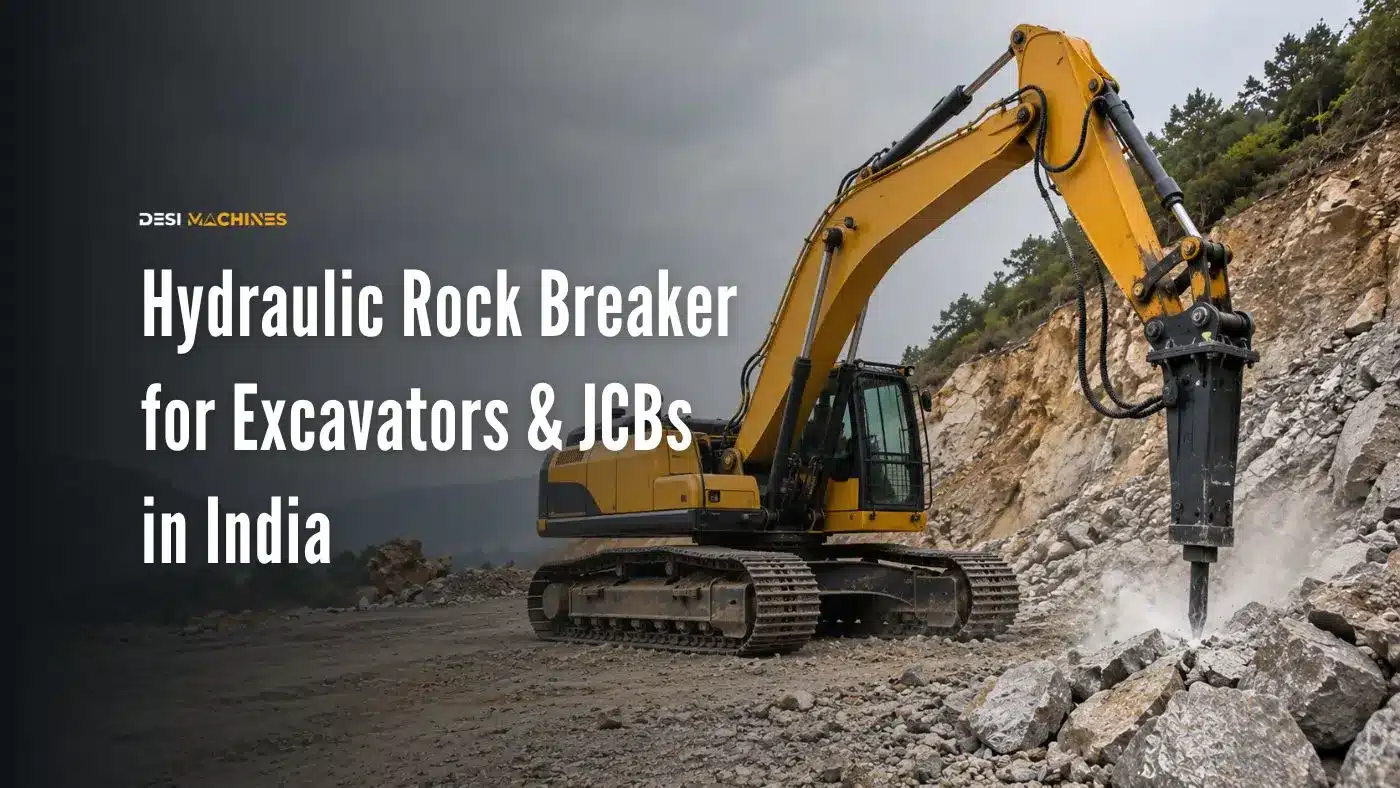
A hydraulic rock breaker is the big hammer you bolt onto the arm of an excavator or backhoe loader to break rock, concrete and hard ground that a normal bucket cannot dig. On most Indian sites people just call it the rock breaker, the breaker machine, or simply the hammer. Breakers are usually fitted to tracked machines, so it is worth knowing how crawler excavators are sized and specced before you buy one. Search for “JCB breaker” or “rock breaker machine” and you will see hundreds of listings, but very little that explains the one thing a first-time buyer actually needs to know: which breaker fits your machine, what work it does, and what it costs.
Every machine price below is the band listed for that model, as of October 2026.
This guide keeps it simple. We explain what a rock breaker is, how it works, how to match one to your excavator or JCB, and the real machines Indian contractors run with a breaker fitted. Prices here come from live listings on DesiMachines, so you know they are grounded and not made up.
What is a hydraulic rock breaker?
A rock breaker is an attachment — a tool that takes the place of the bucket on your excavator or backhoe. Inside it sits a heavy steel piston that hammers up and down very fast onto a thick steel point called the chisel or tool. That pounding is what cracks rock, breaks a concrete slab, or opens a hard road surface.
It runs on the machine’s own hydraulic oil (that is the “hydraulic” part), helped by a charge of nitrogen gas that acts like a spring to push the piston down harder. So the breaker does not have its own engine. It borrows power from the excavator it is mounted on. That is why the machine under it — the carrier — matters as much as the breaker itself.
You will hear it called a hydraulic hammer, a rock breaker or a stone breaker. All the same tool.

How a rock breaker works, in plain words
Think of a hand chisel and hammer, but scaled up and made automatic. When the operator turns the breaker on:
- Hydraulic oil from the excavator pushes the piston up.
- A charge of nitrogen gas at the top gets squeezed, like a spring being loaded.
- That spring releases and slams the piston down onto the chisel.
- The chisel drives into the rock and cracks it.
This happens many hundreds of times a minute, so to the eye it looks like a steady heavy drumming. The operator uses the excavator arm to press the chisel firmly against the rock and let the hammer do the work. Pushing too hard or hammering in one empty spot (this is called blank firing) wears the tool out fast, so a good operator keeps the chisel loaded against solid material.
What people mean by rock breaker, hammer and “JCB breaker”
The words change from site to site, and that confuses buyers. Here is what the common ones mean:
- Rock breaker and breaker machine are the everyday names for the attachment.
- Hydraulic hammer is the same thing; “hammer” describes how it works.
- JCB breaker usually means a breaker fitted on a JCB backhoe loader (the 3DX is the machine most people picture). Buyers search this a lot because the JCB is India’s most common yellow machine.
- Poclain breaker says the same thing, because in many parts of India Poclain is slang for any hydraulic excavator.
So do not get thrown by the name. A rock breaker on a JCB and a rock breaker on a Tata Hitachi are the same kind of tool, sized differently for the machine.
What size breaker fits your machine?
This is the mistake that costs money. A breaker that is too big will strain a small machine, tip it forward and crack the mountings. A breaker that is too small will just bounce off hard rock and get you nowhere.
If you are still deciding whether the job needs a breaker at all, compare the material against the machine’s excavator digging force first; teeth that chatter and skid mean the bucket has run out of push.
The simple rule dealers use: the breaker should weigh roughly one-tenth of the machine’s operating weight. Match the breaker to the carrier weight class like this:
| Carrier machine | Operating weight | Breaker class | Typical work |
|---|---|---|---|
| Mini excavator | 1–5 tonnes (1,000–5,000 kg) | Light breaker | Tiles, thin concrete, small trenches |
| Backhoe loader (e.g. JCB 3DX) | About 7.2 tonnes (7,200 kg) | Medium breaker | Urban demolition, pipe trenching, footpaths |
| 20-tonne excavator (e.g. Tata Hitachi EX 210) | About 20.3 tonnes (20,300 kg) | Heavy breaker | Rock excavation, quarry, foundation, heavy demolition |
If you are still choosing the machine itself, start with our types of excavators guide and the mini excavator guide, then come back to the breaker. For the most common rock-breaker carrier, see our best 20-ton excavator comparison.
If the machine itself is still open, find the right machine for your job first, then size the breaker to it.
Popular machine and breaker setups in India
Most breaker work in India happens on two kinds of machine: a JCB backhoe for lighter city jobs, and a 20-tonne class excavator for serious rock. These are the carriers Indian contractors actually run a breaker on, with indicative prices. The breaker attachment is bought separately from the dealer and is quoted on request, so ask for that price when you enquire.
| Carrier machine | Class | Indicative price | Best for |
|---|---|---|---|
| JCB 3DX | Backhoe loader (7,200 kg) | ₹30–32 Lakh (indicative, as of Oct 2026) | The classic “JCB breaker”: trenching, footpath and light demolition |
| JCB 3DX Super | Backhoe loader (7,880 kg) | ₹35–39 Lakh (indicative, as of Oct 2026) | Same work, higher-spec backhoe |
| Tata Hitachi EX 210 Infra | 20-tonne excavator (20,300 kg) | ₹60–65 Lakh (indicative, as of Oct 2026) | Rock breaking, quarry, foundation work |
| Tata Hitachi ZAXIS 220LC | 20–22 tonne excavator (21,700 kg) | ₹65–67 Lakh (indicative, as of Oct 2026) | Heavy, continuous rock and demolition |
The JCB 3DX is why “JCB breaker” is such a common search. It is affordable, road-legal to shift itself between sites, and a medium breaker on it handles most city demolition and trenching. When the rock gets hard and the days get long, contractors move up to a 20-tonne machine like the Tata Hitachi EX 210, which carries a bigger hammer and takes the pounding better. Browse the full range of excavators and backhoe loaders.
Where a rock breaker earns its money
A breaker is not an everyday-digging tool. You fit it for the jobs a bucket cannot do:
- Rock excavation means cutting foundations, basements and canals through hard rock where blasting is not allowed.
- Demolition work breaks old buildings, bridge piers, concrete floors and RCC slabs.
- Trenching in hard ground opens lines for pipes and cables through murum and rock.
- On roads, a breaker opens old bitumen and concrete pavement before relaying, including PMGSY and highway repair work.
- In quarry and mining work it breaks oversized boulders down to a size the crusher can take.
If your work also needs digging, grabbing or grading, remember the breaker is just one of several tools that fit the same machine. Our excavator attachments guide covers buckets, rippers, augers and more, and the excavator components guide explains the boom and arm the breaker mounts on. For the wider picture of what one machine can do, see our excavator applications guide.
What does a rock breaker cost in India?
Two prices are involved, and buyers often mix them up.
The carrier machine is the bigger cost, and it is a machine you keep using with or without the breaker. A JCB 3DX backhoe runs about ₹30–32 Lakh, and a 20-tonne class Tata Hitachi excavator about ₹60–67 Lakh (both indicative, as of October 2026, taken from our listings at the time of writing). Those listed figures are ex-factory. On a wheeled machine like the backhoe you still pay transport, RTO registration, TCS, warranty and insurance to get it on the road. A tracked excavator is not registered at all, so its landed cost is mainly the trailer that brings it to your site.
The breaker attachment is bought separately and is quoted on request, because the price depends on the breaker class and brand you choose for your machine. We do not list a fixed breaker price, so please ask our team for a current quote rather than trusting a random number online.
Most buyers do not pay for all this in one go. A machine like this is usually bought on a loan with an EMI spread over a few years. Equipment finance in India explains how excavator and backhoe loans work, so you can plan the monthly figure before you commit. If you want to compare machines first, browse live excavator models and prices.
Buying and running a breaker without regrets
A breaker is a hard-working tool that fails early if you treat it carelessly. A few habits keep it healthy:
- Grease the tool often. The chisel needs fresh grease through the shift — most breaker damage comes from a dry, worn tool.
- Do not blank-fire. Keep the chisel pressed on solid rock; hammering into air or a broken piece shakes the whole breaker loose.
- Match the oil flow and pressure. Every breaker needs a certain hydraulic flow. Buy one your machine can actually feed, or it will underperform and overheat.
- Check the nitrogen charge. If the breaker loses hitting power, the nitrogen usually needs topping up — a quick job for the dealer’s service team.
- Buy the carrier from a dealer with service reach. A breaker is only as good as the excavator under it and the support behind it. Buying the machine through a proper channel means spares and service when a job is running.
The tool on the bottom is a wear part with rules of its own. Our guide to rock breaker chisels sets out the four tool shapes, how the size is fixed by the breaker model, and the wear limits that say it is time to change.
New to this side of the machine? The backhoe loader guide and the main excavator guide walk a first-time owner through the basics before you add attachments.
Picking the breaker and the machine under it
A rock breaker turns your excavator or JCB into a machine that eats rock and concrete. Get the size right for your carrier, buy the attachment from a dealer who will service it, and match it to a machine that can feed the oil it needs. For a light city setup, a JCB 3DX with a medium breaker does the job. For serious rock, step up to a 20-tonne excavator like the Tata Hitachi EX 210.
A breaker will not cut steel, however. The chisel bends the section and slides off it, so where the material is steel rather than rock the right tool is an excavator metal shear, sized to the same carrier weight you worked out above.
Ready to pick the machine under the hammer? Compare live excavator models and prices and backhoe loaders, and speak to the team for the breaker quote to suit your work.
A breaker works the oil hard and heats it, so shorten your service intervals accordingly: see hydraulic system maintenance.
For what the breaker itself costs by machine size, see the rock breaker price guide.
Machine prices above are the indicative bands listed for those models in our listings at the time of writing (October 2026); the breaker attachment itself is quoted separately on request. Prices, specifications and features are indicative, vary by variant, location and date, and should always be confirmed with the official OEM or authorised dealer before any purchase decision. DesiMachines is not liable for decisions taken on the basis of information that may have changed after publication.