
 Excavator
294 models
Excavator
294 models  Backhoe Loader
51 models
Backhoe Loader
51 models  Crane
68 models
Crane
68 models  Concrete Mixer
79 models
Concrete Mixer
79 models  Wheel Loader
54 models
Wheel Loader
54 models  Compactor / Roller
45 models
Compactor / Roller
45 models  Motor Grader
42 models
Motor Grader
42 models  Dozer
41 models
Dozer
41 models  Concrete Pump
66 models
Concrete Pump
66 models  Skid Steer Loader
11 models
Skid Steer Loader
11 models  Telehandler
13 models
Telehandler
13 models 


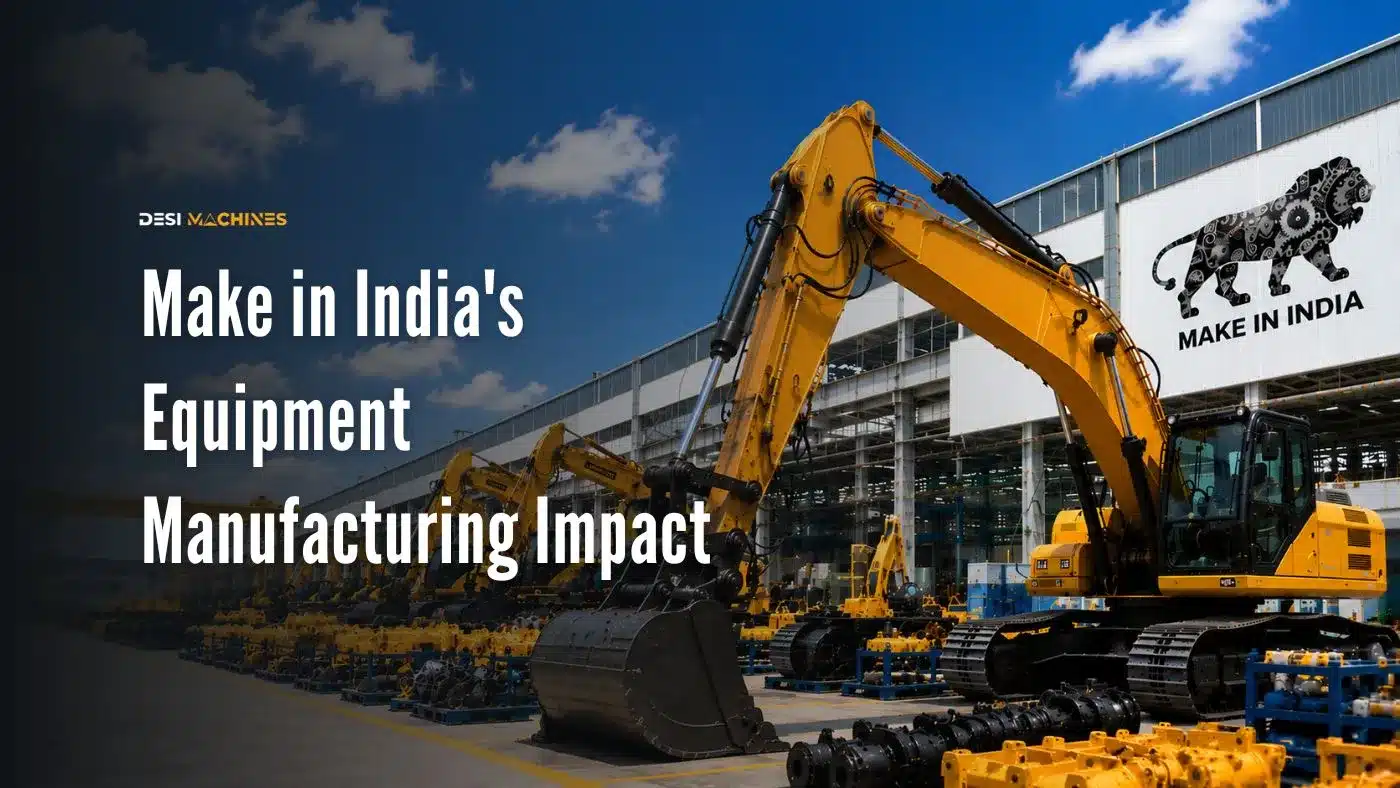
When the government launched Make in India in 2014, construction equipment was exactly the kind of industry it was aimed at: capital-heavy, technology-led, and until then dependent on imports for a lot of what Indian sites ran on. A decade on, the picture has changed. Most of the machines working on Indian highways, metros, and building sites today are built in India — often by global brands that chose to manufacture here rather than ship in. For a buyer, that shift shows up in shorter delivery times, better parts availability, and more competitive prices.
This is an industry explainer, not a policy brochure. It covers what Make in India actually changed for construction equipment, who builds what in India now, and what it means when you’re the one signing the cheque.
What Make in India Set Out to Do
Make in India was a policy push to raise manufacturing’s share of the economy and pull global manufacturers into building their products on Indian soil, rather than importing finished goods. For heavy industries like construction equipment, the levers were familiar ones: import duties that made local assembly more attractive than shipping in complete machines, incentives for setting up plants, and — critically — a pipeline of government demand large enough to justify the investment.
That last part is what made it real for equipment makers. A factory only makes sense if machines will sell in volume for years. India supplied that through sustained public spending on roads (NHAI and the highways programme), railways and metros, ports, and rural infrastructure under the national infrastructure push. Later programmes — the National Infrastructure Pipeline, PM Gati Shakti, and Production Linked Incentive (PLI) schemes for allied components — kept the demand and the manufacturing incentives pointed in the same direction.
The logic is a loop: government builds → machines are needed → makers manufacture here to meet demand → local manufacturing lowers cost and lead time → more building becomes viable.
How It Changed Construction Equipment Manufacturing
The most visible effect is localisation. Global equipment brands went from importing machines to assembling them in India, and then to manufacturing a growing share of components — engines, hydraulics, fabricated structures — locally. That deepening of the supply chain is what separates genuine manufacturing from screwdriver assembly, and it’s where the real cost and capability gains sit.
For the industry, the shift brought a few concrete changes:
- Shorter lead times. A machine built in an Indian plant reaches an Indian site far faster than one shipped from Europe, Japan, or China.
- Better parts and service. Local manufacturing means local parts inventories and service networks — the thing that decides whether a machine actually earns, because a machine waiting for an imported part earns nothing.
- More competitive pricing. Local production and local sourcing cut the landed cost, and competition among makers building here keeps prices keen. Prices remain indicative and cycle with steel and demand, but the structural pressure has been downward.
- Export base. Several makers now use Indian plants to export to Africa, the Middle East, and South Asia — turning India from an import market into a manufacturing hub.
Who Builds Construction Equipment in India
The Indian construction equipment industry is a mix of Indian companies, long-standing joint ventures, and global majors manufacturing locally. A buyer benefits from knowing the difference, because it shapes dealer reach and parts support.
- JCB India — the clear market leader in backhoe loaders and a major manufacturer across excavators and more, built in India across several plants. It’s the reference point for local manufacturing scale in this industry. See JCB.
- Tata Hitachi — a long-running Indian–Japanese joint venture that manufactures excavators in India, from mini machines to large crawlers; see the Tata Hitachi excavator range.
- Global majors manufacturing here — Caterpillar, Volvo, SANY, Hyundai, CASE, Kobelco, Komatsu and others build or assemble a range of machines in India rather than importing them whole.
- Indian manufacturers — ACE (Action Construction Equipment), leaders in the pick-and-carry crane segment that dominates Indian sites, alongside BEML, the public-sector maker, and others.
The construction equipment manufacturers guide maps the full industry and where each brand fits. The industry’s collective voice is ICEMA (the Indian Construction Equipment Manufacturers’ Association), which publishes the sector’s demand and production trends.
What It Means for a Buyer
Policy is abstract; a purchase decision isn’t. Here’s how the Make in India shift actually lands when you’re buying a machine.
You get a locally made machine, backed locally. The single biggest practical gain is service and parts. A machine manufactured in India, sold through an Indian dealer network, means faster support and less downtime than an imported machine ever offered. When you weigh two machines, the depth of the local dealer and parts network is worth as much as the spec sheet — sometimes more.
Pricing is more competitive, but still cyclical. Local manufacturing has structurally lowered costs, but machine prices still move with steel prices, demand cycles, and emission-norm transitions. Treat every quoted figure as indicative and time your purchase where you can.
Financing and ownership are built around the domestic market. Because these are machines sold at scale to Indian buyers, the finance and insurance ecosystem is mature — equipment finance through banks like SBI and NBFCs, and equipment insurance tailored to construction machinery. That matters: for most buyers the machine is bought on EMI, and the total cost of ownership, not the sticker price, is the real number.
Where Indian equipment makers are heading on localisation
The direction of travel is toward deeper localisation and cleaner, smarter machines. Emission norms are tightening — Indian construction equipment engines are moving through stricter Bharat (CEV) stages, pushing makers toward newer engine technology built locally. Electric and hybrid machines, telematics, and operator-assist features that were premium imports a few years ago are arriving in Indian-built ranges. And the government’s infrastructure spending — the demand engine underneath all of it — remains the biggest single factor in where the industry goes next.
For the buyer, none of this changes the fundamentals. Match the machine to the work, buy where service is strong, and read the total cost of ownership. What Make in India changed is that you can now do all three with machines built in India — and that’s a better deal than the market offered a decade ago.
Where those factories send their output has changed as well. Roughly a fifth of Indian construction equipment production now goes abroad, against 2 to 3 per cent five years ago, and what that means for a buyer here is set out in the guide to construction equipment exports from India.
Browse the full range of India-built machines, compare indicative prices and get the best current offer across the excavator, loader, and crane categories on DesiMachines. For the wider market picture, the Indian construction industry growth outlook sets out where demand is headed.
These same policy forces are visible on the machine itself: from January 2025, every new machine must meet the stricter CEV Stage V emission norms, which we explain in plain language for buyers.
Final specifications, features, and prices should always be confirmed with the official OEM or dealer.
Engine supply is one of the clearest places to see this play out. Construction equipment engine brands in India counts how many listed machines run Indian engines against imported ones.