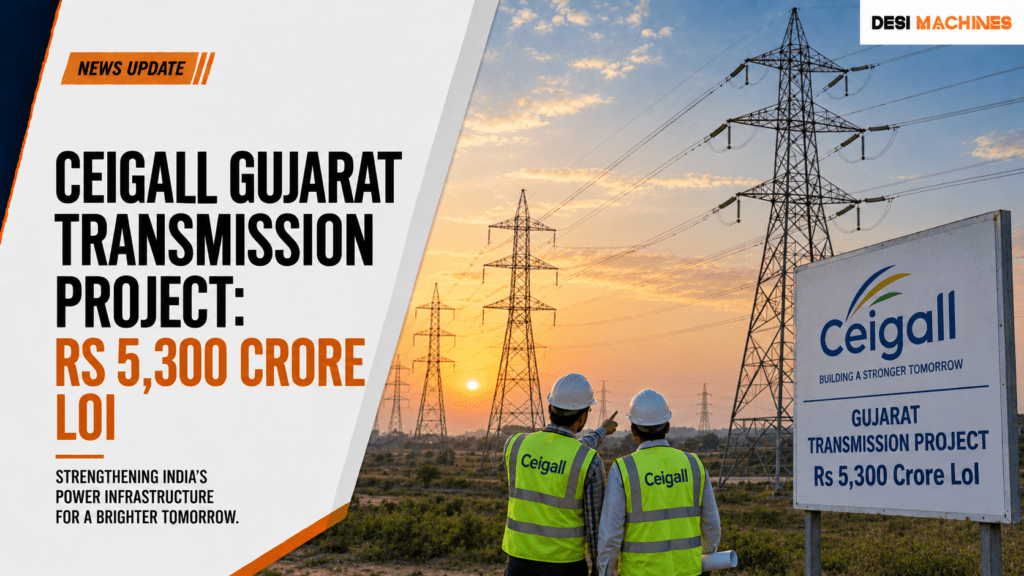
Ceigall India has a letter of intent for a Rs 5,300 crore transmission build in Gujarat, and the figure that travelled furthest this week was the wrong one. Several desks ran Rs 609 crore as the contract value. That is the annual charge the asset earns once it is running, not the money that buys machines. The build budget is roughly nine times larger, and it lands in an already busy corner of Saurashtra.
The quick facts
- REC Power Development and Consultancy Limited issued the letter of intent to Ceigall India on 3 September 2026 for Part-B of the common transmission system evacuating power from Lakadia, Jam Khambhaliya and Jamnagar.
- Project value about Rs 5,300 crore including GST. Scope is one 765/400 kV air-insulated substation plus roughly 300 km of transmission line.
- The system carries 14 GW of renewable capacity: Lakadia Phase-II at 7.5 GW, Jam Khambhaliya Phase-II at 5.5 GW and Jamnagar Phase-I at 1 GW.
- Construction period 36 months, then 35 years of operation at company-stated annual transmission charges of Rs 608.67 crore.
What Ceigall actually won
This is an inter-state project awarded through tariff-based competitive bidding, so the winner builds the asset and then owns it. The specialist transmission desk T and D India reported the letter of intent and named the project company, Jam Khambhaliya Jamnagar Power Transmission Ltd, which sits inside RECPDCL today and transfers to Ceigall. Free Press Journal carried the same figures plus a comment from managing director Ramneek Sehgal about deepening the company’s position in transmission. Ceigall was declared lowest bidder in late August; the letter of intent is the stage that follows.
Separate this from the Jam Khambhaliya scheme Power Grid won earlier. Same renewable zone, different scheme, different winner. Part-A of this procurement went in August to AnantGrid Projects One, in which Bajel Projects holds 26 per cent, for about 270 km of 765 kV double-circuit line and strengthening at three existing substations.
What does this mean for equipment buyers?
Read the scope as two jobs with two different fleets, because that is how it will be sub-contracted.
The substation is the earthwork. A 765/400 kV yard built as air-insulated needs a large graded platform, far larger than a gas-insulated yard at the same voltage, and it has to be cut, filled and compacted to tight tolerance before a single structure goes up. Expect a sustained run of excavators, dozers, graders and soil compactors on one site, then piling, batching and crane work for equipment foundations, gantries and the control building. That machine park stays put for most of the 36 months.
The 300 km of line is the opposite job. Tower foundations are scattered pits along a corridor across Gujarat, so the work is logistics before it is excavation. Backhoe loaders and small crawlers do the digging, and the cost sits in haulage, access tracks and tower erection gear rather than in a concentrated fleet.
Our take: Ceigall is not the buyer here, and that distinction matters. It is a road contractor moving into transmission ownership, and owners of this kind sub-award the civil packages. The machines get bought or hired one level down, by whoever takes the substation civil works and the foundation packages, probably two to three quarters out. The sharper signal is competition for capacity: with Part-A and Part-B both live alongside the Power Grid scheme, Saurashtra now has several large 765 kV builds running at once in a small geography. Piling rigs, crawler cranes and tipper capacity in Kutch, Devbhumi Dwarka and Jamnagar look like they will get tight before they get cheap.
One number we are deliberately not giving you is a rate per kilometre. The Rs 5,300 crore covers a substation and a line together, and Part-A’s value was never disclosed, so there is no clean way to split them. Anyone quoting a per-km figure on this project is guessing.
What to watch
- The transfer of the project SPV from RECPDCL to Ceigall, which starts the 36-month clock.
- Civil and foundation sub-packages going out to tender, especially the substation platform works.
- Whether Part-A and Part-B mobilise in the same season and squeeze hire rates across Saurashtra.
Planning for this pipeline? Compare machines across the classes these packages will pull, and get your finance in place before the mobilisation window opens.
FAQ
Is Rs 5,300 crore the contract value or the annual charge?
It is the project value including GST. The Rs 608.67 crore figure that appeared in several headlines is the company-stated annual transmission charge earned over the 35-year operating period, not the construction budget.
When will equipment demand actually appear on site?
Not immediately. The SPV has to transfer first, then the owner sub-awards civil packages. Realistic mobilisation is two to three quarters away, with the substation platform likely first.
Which machine classes does this project pull hardest?
Earthmoving and compaction on the substation platform, then piling and lifting gear for foundations and structures. The line stretch leans on backhoe loaders, compact crawlers and haulage rather than large excavators.
Related on DesiMachines: Adani Satara Transmission Project: Rs 4,700 Crore Win in Maharashtra
Source: T&D India
Machines, tenders and news for this industry: Power and Renewable Energy

 Excavator
294 models
Excavator
294 models  Backhoe Loader
51 models
Backhoe Loader
51 models  Crane
68 models
Crane
68 models  Concrete Mixer
79 models
Concrete Mixer
79 models  Wheel Loader
54 models
Wheel Loader
54 models  Compactor / Roller
45 models
Compactor / Roller
45 models  Motor Grader
42 models
Motor Grader
42 models  Dozer
41 models
Dozer
41 models  Concrete Pump
66 models
Concrete Pump
66 models  Skid Steer Loader
11 models
Skid Steer Loader
11 models  Telehandler
13 models
Telehandler
13 models