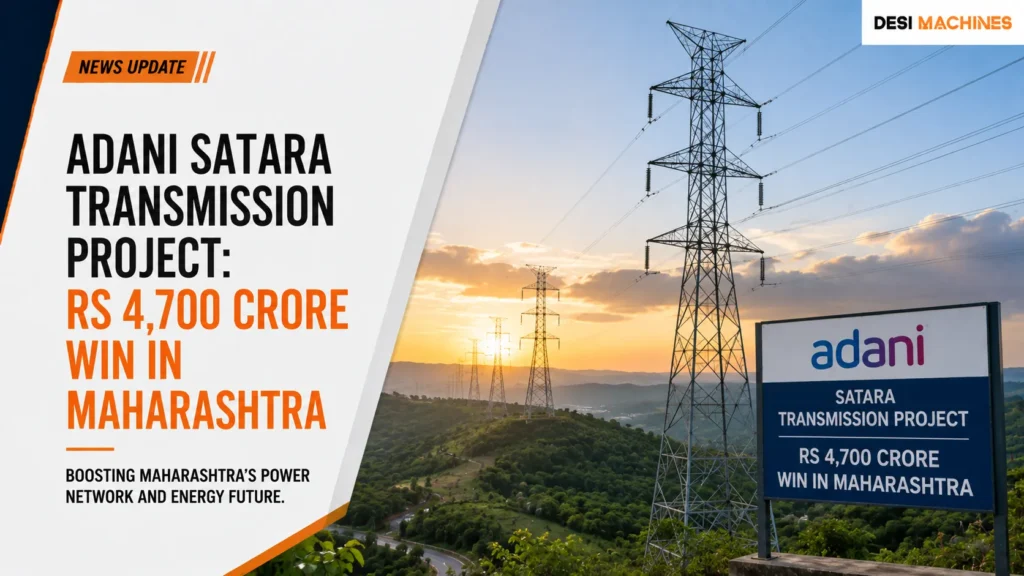
Adani Energy Solutions has won a Rs 4,700 crore transmission build in western Maharashtra. For anyone running earthmoving or lifting plant in the Satara-Kolhapur belt, the useful number is not the headline value. It is the clock: a company-stated 36 months, in a high-rainfall district where the real working year is a good deal shorter than twelve months.
The quick facts
- Adani Energy Solutions Ltd (AESL) has won the Network Expansion Scheme in the Western Region catering to pumped storage potential near Satara, up to 4,500 MW, Part A, through tariff-based competitive bidding as the lowest bidder.
- Company-stated capital expenditure of roughly Rs 4,700 crore, held in a special purpose vehicle called Satara Power Transmission Ltd.
- Scope covers a 765/400 kV substation at Satara, a Kolhapur-Satara 765 kV double-circuit line, and augmentation of the Kolhapur pooling station.
- Adds 562 circuit km of line and 9,000 MVA of transformation capacity, on a company-stated 36-month delivery period.
What Adani Energy Solutions announced
The win was announced on 26 August 2026 and carried the same morning by Business Today and by the IANS wire, both reporting the same scope and the same Rs 4,700 crore figure. Chief executive Kandarp Patel described the job as a transmission backbone for renewable evacuation and energy storage. The corridor is built to move up to 4,500 MW of renewable and stored power out of Karnataka into Maharashtra load centres, including the pumped-storage cluster taking shape around Satara, Pune and the Mumbai Metropolitan Region.
What does a TBCB win actually mean for machine owners?
Less than the headline suggests, and later than you would like. AESL is the concessionaire, not the plant buyer. The excavators, cranes and compaction gear get bought or hired by whoever takes the civil and erection packages that Satara Power Transmission Ltd sub-awards, and those land months after financial closure. This is a demand signal with a date on it, not an order.
Then do the arithmetic. Rs 4,700 crore across 562 circuit km is near Rs 8.4 crore a circuit km, which sounds rich until you remember what sits inside a 765 kV package: transformers, reactors, switchgear and conductor. The civil slice is a genuine minority of that total, and reading the headline value as a construction budget will get your bid wrong.
Split the job in two, because it is two fleets. The Satara substation is one graded platform, and a 765/400 kV switchyard carrying 9,000 MVA needs real land. Built air-insulated rather than gas-insulated, it needs a great deal more. That is months of sustained earthwork: graders and dozers to level, soil and tandem compactors to proof-roll, 20-tonne excavators on cable trenches and equipment foundations, and a batching plant feeding concrete through the term.
The line is the opposite job. Hundreds of separate tower pits scattered across Maharashtra, each small, each reached down a temporary access track. That is backhoe-loader work, the class JCB and Case dominate here, plus 13 to 21 tonne compacts from the likes of Tata Hitachi, piling rigs only where rock cover is deep, and cranes for erection and stringing. Machines mobilise and stay, so spares, housing and diesel haulage sit inside the rate.
Our take: the Ghats edge between Kolhapur and Satara takes a heavy monsoon, so an honest earthwork window runs roughly October to May. A 36-month programme holds about two and a half usable dry seasons, not three. Quote utilisation across that window, not across the contract term.
What to watch
- The civil and tower-erection package awards from Satara Power Transmission Ltd. That is when machine orders and hire contracts are actually placed.
- Whether the Satara substation is specified air-insulated or gas-insulated, which changes the graded footprint and earthwork volume sharply.
- Right-of-way and forest clearance along the Kolhapur-Satara alignment, which decides whether the 36-month clock is realistic.
Sizing a fleet for substation or line work? Put compaction and earthmoving models side by side before you commit, and check the monthly outgo first. Start with our machine comparison tool.
FAQ
Is the Rs 4,700 crore a construction budget?
No. It is company-stated capital expenditure for the whole project, and most of it is electrical equipment: transformers, switchgear, reactors and conductor. Civil works and erection are a minority share, so treat the figure as a scale indicator, not a works value.
When would equipment actually be needed on site?
After AESL closes financing and sub-awards the civil and erection packages. Substation earthwork normally starts before line foundations get going in volume.
Which machine classes does a 765 kV scheme pull hardest?
Graders, dozers and soil compactors for the substation platform, 20-tonne excavators for trenching and foundations, backhoe loaders and compact excavators for tower pits, and cranes for tower erection and stringing.
Related on DesiMachines: Power Grid Wins Jam Khambhaliya Transmission Project: Rs 822.91 Crore a Year
Source: Business Today
Machines, tenders and news for this industry: Power and Renewable Energy

 Excavator
294 models
Excavator
294 models  Backhoe Loader
51 models
Backhoe Loader
51 models  Crane
68 models
Crane
68 models  Concrete Mixer
79 models
Concrete Mixer
79 models  Wheel Loader
54 models
Wheel Loader
54 models  Compactor / Roller
45 models
Compactor / Roller
45 models  Motor Grader
42 models
Motor Grader
42 models  Dozer
41 models
Dozer
41 models  Concrete Pump
66 models
Concrete Pump
66 models  Skid Steer Loader
11 models
Skid Steer Loader
11 models  Telehandler
13 models
Telehandler
13 models