
 Excavator
294 models
Excavator
294 models  Backhoe Loader
51 models
Backhoe Loader
51 models  Crane
68 models
Crane
68 models  Concrete Mixer
79 models
Concrete Mixer
79 models  Wheel Loader
54 models
Wheel Loader
54 models  Compactor / Roller
45 models
Compactor / Roller
45 models  Motor Grader
42 models
Motor Grader
42 models  Dozer
41 models
Dozer
41 models  Concrete Pump
66 models
Concrete Pump
66 models  Skid Steer Loader
11 models
Skid Steer Loader
11 models  Telehandler
13 models
Telehandler
13 models 


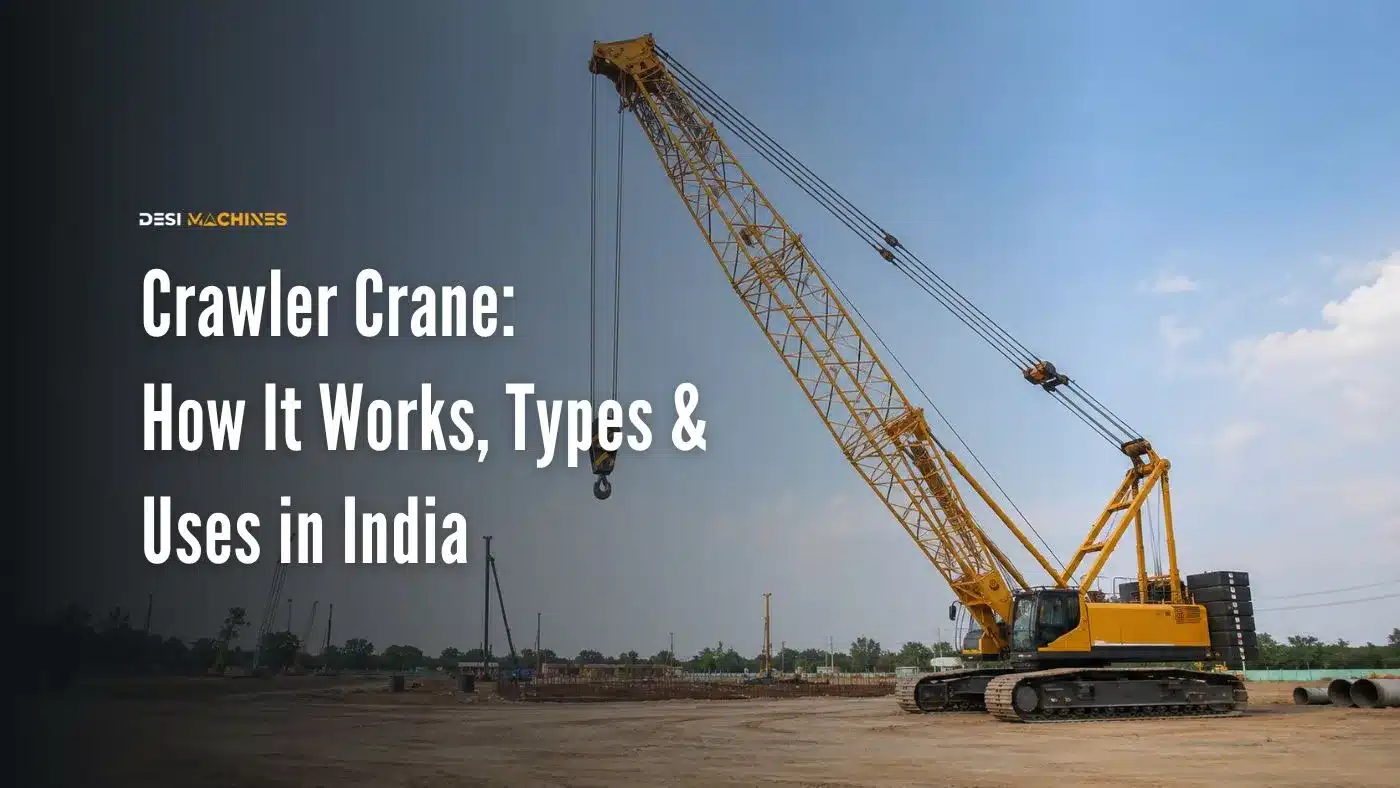
A crawler crane is the giant lifting machine that moves on two wide steel tracks instead of wheels — the kind you see standing over a metro site, a big bridge, a power plant, or a wind farm, picking up loads that would flatten an ordinary crane. It is built for one job: lift very heavy things, very high, on soft or uneven ground, and stay stable while doing it.
Here is the honest part first, because it changes how you should read the rest. Crawler cranes are big-project machines. On most Indian jobs they are hired for the project along with the operating crew, erected, used, and moved out — very few contractors buy one outright. DesiMachines lists the cranes that actually get bought and moved between sites: mobile and pick-and-carry (Hydra) cranes. So treat this guide as a ground-up explanation of how crawler cranes work and when you really need one — and browse the full crane range to source the lifting machine you can own.
What is a Crawler Crane?
A crawler crane is a heavy lifting crane mounted on a crawler track base — the same kind of continuous rubber-and-steel track (like a tank runs on) that you see on a bulldozer or a large excavator. On top of that base sits the crane body, a long lifting arm called the boom, and a set of counterweights that stop it tipping over.
The tracks are the whole idea. Because the machine’s weight is spread over two long, wide tracks instead of four tyres, it presses much less on the ground. That lets a crawler crane work on soft soil, loose fill, or a rough site where a wheeled crane would sink or wobble. It can also move slowly around the site while carrying a load — something a wheeled mobile crane is not allowed to do.
The trade-off is mobility on the road. A crawler crane cannot drive itself from one town to the next. It has to be taken apart, carried on trailers, and rebuilt at the new site with a support crane and a trained crew. That job takes time and money, which is exactly why crawler cranes earn their place only on large, long jobs — not on a quick lift you finish in an afternoon.
Main Parts of a Crawler Crane
Once you know the parts, the capacity numbers and the safety talk become much easier to follow.
- Crawler tracks (the undercarriage): two long tracks that carry the whole machine and spread its weight on the ground. These give the crane its grip (grip on the surface, so it does not slip or sink) and its ability to move while loaded.
- Carbody and counterweights: the heavy base frame plus large steel or concrete blocks at the back. The counterweight balances the load on the boom — like a person leaning back to carry a heavy bucket in front.
- Boom (the lifting arm): usually a lattice boom — a long arm made of criss-cross steel sections, light for its strength. Extra sections bolt on to make it taller. Some smaller crawler cranes use a solid telescopic boom that slides out instead.
- Superstructure and cab: the rotating top section that holds the engine, the winches (the drums that wind the lifting rope), and the operator’s cab. It turns a full 360 degrees.
- Hook block and wire rope: the steel rope and hook that actually pick up the load, running over pulleys for extra lifting power.
The counterweight and the wide track base are what keep the machine standing. Every lift is a balance between the load hanging off the boom and the ballast at the back — which is why the load chart, not the operator’s confidence, decides what can safely be picked up.
Types of Crawler Cranes
Not every heavy job needs the same crawler crane. Three broad kinds cover almost all the work.
1. Lattice-Boom Crawler Cranes
The classic and most common type. The long lattice (criss-cross steel) boom is light for its length, so these cranes reach very high and lift very heavy — from around 40–50 tonnes up to several hundred tonnes on the biggest models. This is the machine used for metro viaducts, bridge girders, and power-plant erection.
2. Telescopic Crawler Cranes
Here the boom slides out like a mobile crane’s instead of being built from sections. Capacities are smaller, but the crane can set up faster and start lifting sooner. Useful where you want crawler-track stability on soft ground but do not need the huge reach of a lattice boom.
3. Heavy-Lift and Ring Cranes
The giants. These very large crawler and ring-mounted cranes lift a thousand tonnes or more and are used on refineries, large power projects, and offshore-module work. In India you will only meet these on the biggest EPC (engineering, procurement and construction) projects, always hired with a specialist crew — never a machine a normal contractor owns.
How Much Can a Crawler Crane Lift?
This is the question that trips up most first-time buyers, so read it slowly: a crawler crane’s capacity depends on the radius — how far out from the machine the load hangs. The rated maximum — say 80 Ton (80,000 kg) or 150 Ton (150,000 kg) — applies only close to the machine, with the boom short and steep. Stretch the load out to the boom tip and the safe weight drops sharply.
A mid-size lattice crawler might carry its full rated load close in, but only a small fraction of that at a long radius with a tall boom. That drop-off is the entire logic of the load chart — the maker’s table that tells you the safe load for every boom length and radius. It applies to every crane, crawler or wheeled. Before you plan a lift, you match the heaviest load to the radius it will sit at — never to the crane’s headline figure.
The same rule governs the machines Indian contractors actually own. Read the load chart first, then lift. If you want to understand this properly, the types of cranes guide covers the full family, and you can compare owned machines on the pick-and-carry crane range.
Where Crawler Cranes Are Used in India
Crawler cranes turn up wherever loads are heavy, the ground is soft or rough, and the job runs for months:
- Metro rail construction — lifting precast viaduct segments and station steel across the Delhi, Mumbai, Bengaluru, Chennai and other metro corridors, often on freshly filled ground.
- Bridges and flyovers — placing heavy girders and segments where the crane must stand on the riverbank or embankment for a long stretch.
- Power plants and refineries — erecting boilers, vessels, and heavy equipment during construction.
- Wind farms — raising turbine towers and nacelles (the machine housing at the top of a wind tower), which sit high and weigh a lot.
- Ports and large industrial sites — handling very heavy modules and structures.
For work that spreads across a site or keeps moving — road building, earthmoving, general material handling — a crawler crane is the wrong tool. There you want mobile or pick-and-carry lifting and the earthmoving fleet. The construction equipment applications guide maps machines to project types if you are planning a mixed site.
Crawler Crane vs Mobile Crane vs Pick-and-Carry Crane
Most buyers who search “crawler crane” actually need to decide between three machines. Here is the plain split.
| Machine | Moves on | Best for | Own or hire? |
|---|---|---|---|
| Crawler crane | Steel tracks | Very heavy lifts, soft/rough ground, long projects (metro, bridges, power) | Almost always hired by the project |
| Mobile crane | Wheels (truck-type) | Heavy lifts across changing sites, road travel between jobs | Hired or owned |
| Pick-and-carry (Hydra) crane | Wheels (compact) | Everyday lifting and shifting on Indian sites, moving load short distances | Usually owned by the contractor |
If you are building tall and heavy on one spot for months, you are hiring a crawler crane. If you move between jobs and do general lifting, you want a mobile crane or a Hydra/Farana pick-and-carry crane you own. For the tall fixed sites, a tower crane may be the answer instead. If you are weighing the two most popular Indian pick-and-carry options, the Hydra vs Farana comparison lays out models and price bands, and the rising demand for Hydra cranes explains why they dominate small-contractor sites here.
Buying or Renting a Crawler Crane in India
Because crawler cranes are hired far more often than bought, the money picture looks different from a normal crane purchase. These are high-capital machines — the large ones run into crores — and they come with transport, erection, dismantling, and a specialist crew on top of the rental. Rates change a lot with capacity, boom height, ground conditions, and how long you need it, so treat any single figure as indicative and get a project-specific quote. Never plan a budget around a headline number you read online.
For most Indian contractors the practical machine to own is a pick-and-carry crane, and here real prices help. One thing catches out most first-time buyers: with these cranes the series matters more than the tonnage. The compact end of the class starts below the 12 Tonne mark: the 9 Tonne (9,000 kg) ACE Rhino 90C is listed at ₹12–14 Lakh, and 12 Tonne (12,000 kg) is the size most everyday site work settles on. The Indo Power 12AV is listed at ₹15–18 Lakh, while the Escorts Hydra 12 is quoted as a starting price of ₹18.0 Lakh onwards rather than as a band. From there the class climbs to the 25 Tonne (25,000 kg) ACE 25XW at ₹30–34 Lakh. The Escorts HYDRA 1565 sits in the middle, again quoted as a floor, from ₹22.6 Lakh onwards. Step up to the bigger road-going F and FX series and the same 25 Tonne rating costs far more: the ACE F250 is listed at ₹50–54 Lakh and the ACE FX 250 at ₹50–52 Lakh. So a 25 tonne rating on its own tells you very little about the price until you know which series the crane belongs to. If your work is closer to piling and heavy foundation lifting, the 20 Tonne (20,000 kg) four-wheel-drive ACE FP 210 Piling Crane is listed at ₹42–44 Lakh. All figures indicative, as of September 2026. Full crawler lifting cranes are not sold as everyday machines, and where no price is listed it is price on request, so ask for a quote rather than trusting an internet range.
Whether you buy or hire, financing and insurance decide whether a machine makes money. Equipment loans on the construction equipment finance page can spread the cost over the machine’s earning life, and every owned crane should carry cover — compare providers on the equipment insurance pages. Idle days and EMIs are what quietly turn a lifting job into a loss, so plan utilisation before you sign anything. When you are ready to shortlist a machine you can own, start with the crane buying and rental guide and the full crane range.
Prices, specifications and features are indicative, vary by variant, location and date, and should always be confirmed with the official OEM or authorised dealer before any purchase decision. DesiMachines is not liable for decisions taken on the basis of information that may have changed after publication.
Before you plan any heavy lift, learn to read the capacity table itself in our crane load charts guide.
Machines, tenders and news for this industry: Bridges and Tunnels