Excavator
294 models
Excavator
294 models  Backhoe Loader
51 models
Backhoe Loader
51 models  Crane
68 models
Crane
68 models  Concrete Mixer
79 models
Concrete Mixer
79 models  Wheel Loader
54 models
Wheel Loader
54 models  Compactor / Roller
45 models
Compactor / Roller
45 models  Motor Grader
42 models
Motor Grader
42 models  Dozer
41 models
Dozer
41 models  Concrete Pump
66 models
Concrete Pump
66 models  Skid Steer Loader
11 models
Skid Steer Loader
11 models  Telehandler
13 models
Telehandler
13 models 


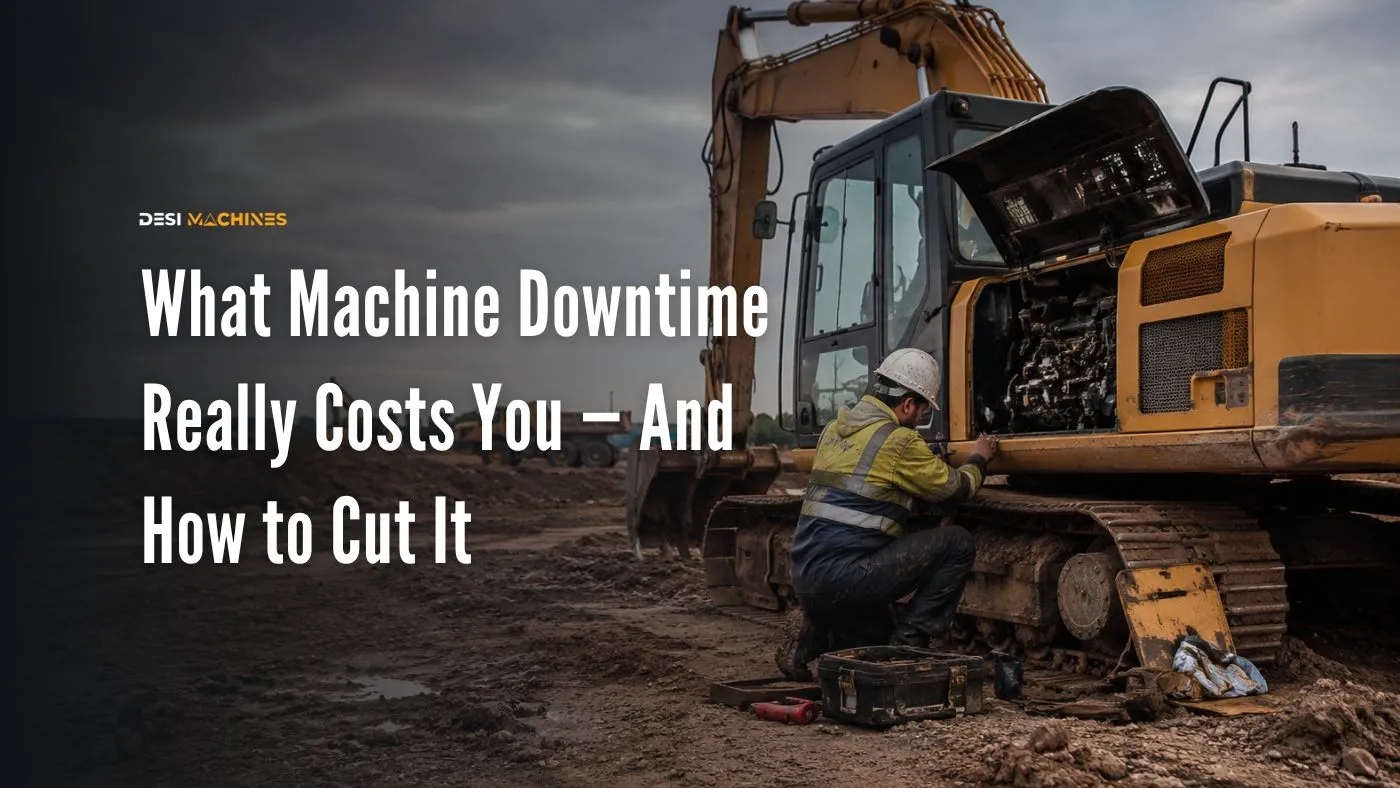
The equipment downtime cost that hurts an owner is rarely the repair bill — it’s the money the machine bleeds every day it can’t work. On a financed 20-tonne excavator, the EMI keeps running, the operator still gets paid, and the hire or project revenue simply stops. Add those up and a single idle day can cost ₹16,000–25,000 (indicative, as of Jul 2026), often several times the value of the part that caused it. This is why uptime, not the spare-parts price, is where the real money in ownership is won or lost.
The all-in idle-day floor was re-derived from this page’s own cost rows on this date.
Ask most owners what a breakdown cost them and they’ll quote the invoice from the workshop. That’s the visible number. The bigger one — the money the machine didn’t earn while it stood — never shows up on any bill, so it gets ignored. Over a year, for a machine that’s financed and meant to be billing every working day, that invisible cost usually dwarfs the repair spend.
This piece puts a rupee figure on an idle day so you can see it, and then lays out the moves that actually cut it. Every number here is indicative — your machine, your EMI and your hire rate decide the real one.
Equipment downtime cost: the four things you pay for while a machine sits
When a machine is down, four costs run whether it works or not. Three of them are money going out; the fourth is money not coming in, which is the one owners underestimate.
| Cost of an idle day | Indicative range (20-tonne excavator) | Why it still runs |
|---|---|---|
| Daily share of EMI | ₹5,000–8,300 | The loan doesn’t pause for a breakdown |
| Operator wage | ₹700–1,200 | You keep the operator; letting him go loses you a trained hand |
| Fixed overheads (insurance, parking, admin) | ₹500–1,500 | Annual costs spread across every day |
| Lost hire / project revenue | ₹10,000–14,000 | The machine would have billed 6–8 working hours |
| All-in idle day | ≈ ₹16,000–25,000 | Before the repair bill |
Figures are indicative (as of Jul 2026) for a mid-size crawler excavator on a typical loan. A backhoe loader or a smaller machine will land lower; a large excavator or a crane on a metro job will land much higher, because the lost billing scales with the machine. The EMI share assumes roughly ₹1.5–2.5 Lakh a month spread over ~30 days; you can pull your own per-hour running numbers from our excavator cost-per-hour method and swap them in.
Why the repair bill is the wrong number to watch
Here’s the trap. A hydraulic sensor fails. The part is ₹6,000. But the exact sensor isn’t in the dealer’s stock, so it comes in three days later. In those three days the machine is parked on a running site.
The invoice says ₹6,000 plus labour. The real damage is three idle days — call it ₹48,000–75,000 in EMI, wages, overhead and missed billing (indicative). The spare was 10% of the loss. The other 90% was waiting.
This is the single most useful shift in how you think about running a machine: a cheap part that parks the machine is expensive; an expensive part that keeps it working is cheap. Owners who understand this keep fast-moving spares on the shelf even when the accountant grumbles, because a ₹20,000 stock of filters and common sensors can save several times that in a single avoided breakdown week.
When an idle day hurts most
Not every idle day costs the same. A breakdown in a slow week, when the machine had no work anyway, costs you the EMI and wages but no lost revenue. A breakdown during peak demand — road season, a tight project deadline, a rate that’s temporarily high — costs you the full amount plus, sometimes, a penalty clause or a lost repeat customer.
That’s why the same repair can be a shrug in July and a disaster in October. Seasonal demand is real in Indian construction, and the weeks where rates and utilisation peak are exactly the weeks you cannot afford to be down. If you’re weighing whether to even own the machine through the lean months, the trade-off is worth reading properly — our guide on buy versus rent, and renting your machine out works through when ownership pays and when it doesn’t.
How much downtime is “normal”?
There’s no single figure, and anyone who quotes you one for “all machines” is guessing. What matters is your own machine’s availability — the hours it actually worked divided by the hours it was meant to work. A machine on planned servicing and a decent operator will lose only a small slice of its hours to unplanned stoppages. A neglected machine, run to failure, can lose a large chunk and you won’t even notice, because the losses are spread across the year in ones and twos.
Start writing down two numbers each month: hours the machine was booked or available to work, and hours it actually ran. The gap is your downtime. Once you can see it, you can manage it. Diesel, servicing and repair spend all tie back to the same running-cost picture — the full breakdown sits in our 5-year cost of owning an excavator, and fuel alone often surprises owners once they check it against our fuel-consumption-per-hour figures.
Five ways owners actually cut downtime
None of these are exotic. They’re the habits that separate a machine earning 25 days a month from one earning 18.
1. Service by the hour-meter, not by the breakdown. Planned oil and filter changes cost a known amount on a day you choose. A seized component costs an unknown amount on a day the site chooses for you. Servicing on schedule is the cheapest downtime insurance there is.
2. Stock the fast-movers. Filters, belts, common hoses, the sensors your machine model is known to eat — keep them on the shelf. The cost of the stock is small next to one avoided idle week.
3. Act on small warnings. A weeping seal, a warning lamp, a temperature creeping up — these are cheap on Monday and a tow-off on Friday. Train the operator to report them, and reward him for it rather than blaming him. On a newer machine a warning lamp often points at the electronics, and a cheap earth or connector fault is easily mistaken for a dead controller; how a JCB ECU repair should be diagnosed is worth reading before anyone quotes a new unit.
4. Keep the operator. A good operator prevents more downtime than any spare part: gentler on the machine, quicker to spot trouble, and available the moment it’s fixed. Losing him during a slow spell to save a month’s wage often costs far more later.
5. Have a peak-season backup. For the weeks you truly cannot be down, a standby arrangement — a machine you can hire in, or a nearby owner you swap with — turns a catastrophic idle day into a manageable one.
Why one idle day costs more than the repair
Stop measuring breakdowns by the repair invoice. The number that decides whether your machine makes money is uptime, and a single idle day on a financed machine can quietly cost you ₹16,000–25,000 (indicative) — several times the part that caused it. Track your availability, service on schedule, stock the fast-movers, and protect the peak weeks. That discipline is worth more to your bottom line than any single deal on price.
And if the EMI share is the line that’s really squeezing you on idle days, the fix may be the loan structure rather than the machine. Compare equipment finance options, rates and tenures before your next purchase or refinance — a lower monthly outgo softens every idle day for the life of the loan. You can also browse the live range of excavators and backhoe loaders to see where the numbers land for the machine you’re eyeing.
Prices, specifications and features are indicative, vary by variant, location and date, and should always be confirmed with the official OEM or authorised dealer before any purchase decision. DesiMachines is not liable for decisions taken on the basis of information that may have changed after publication.