Excavator
294 models
Excavator
294 models  Backhoe Loader
51 models
Backhoe Loader
51 models  Crane
68 models
Crane
68 models  Concrete Mixer
79 models
Concrete Mixer
79 models  Wheel Loader
54 models
Wheel Loader
54 models  Compactor / Roller
45 models
Compactor / Roller
45 models  Motor Grader
42 models
Motor Grader
42 models  Dozer
41 models
Dozer
41 models  Concrete Pump
66 models
Concrete Pump
66 models  Skid Steer Loader
11 models
Skid Steer Loader
11 models  Telehandler
13 models
Telehandler
13 models 


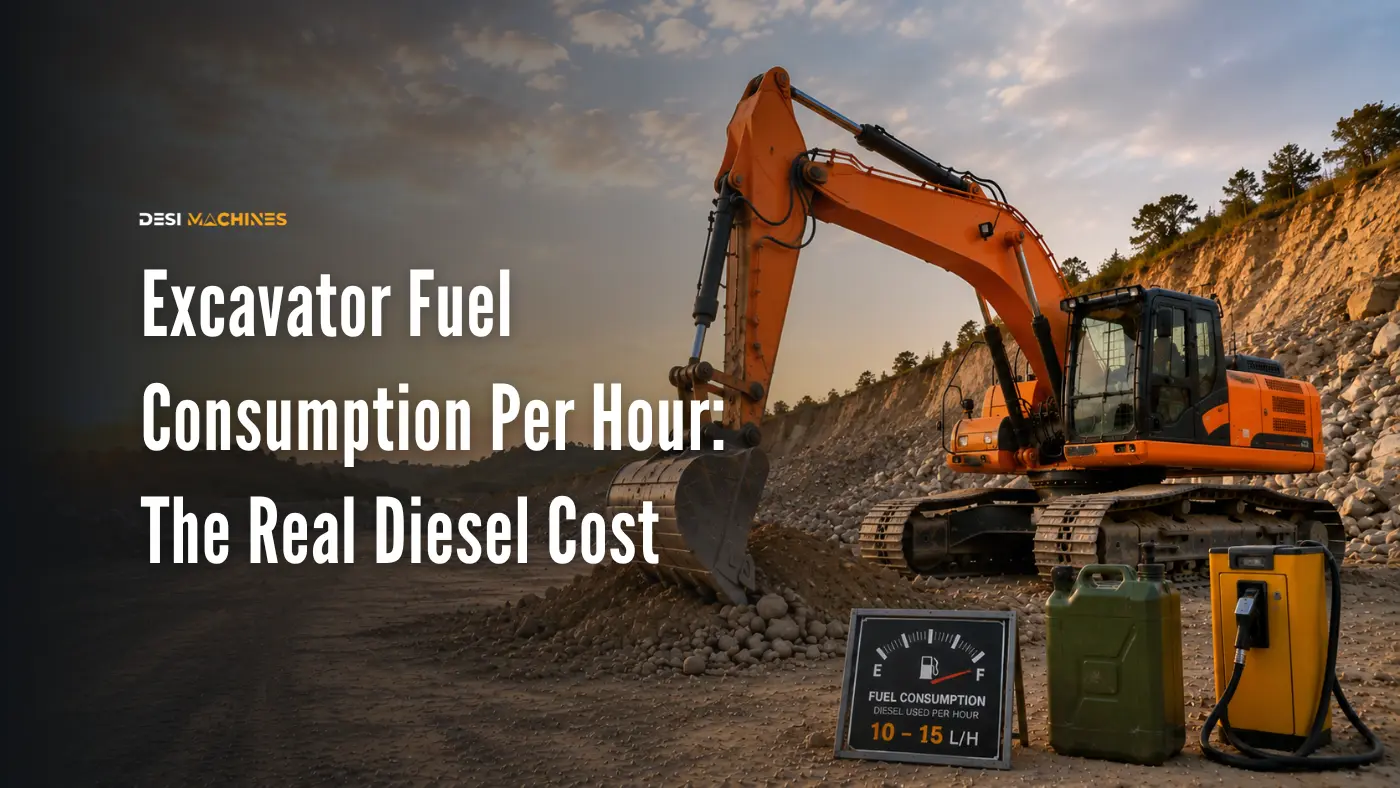
There is no single honest answer to excavator fuel consumption per hour — it moves with machine size, load, idling and the operator. The number that matters is your own, and you get it by dividing the litres your machine drinks by the hours it works. Then the money is simple arithmetic: litres per hour x your pump rate. With diesel at roughly Rs 95-104 a litre across the big cities (indicative, as of July 2026), every single litre/hour of burn costs you about Rs 800 a day on an 8-hour shift and about Rs 20,000 a month at 200 hours. A machine drinking 12 litres/hour is therefore a Rs 2.4 lakh a month diesel bill (indicative).
Diesel rates and fuel figures are indicative and move with city and machine — confirm the current pump rate locally and your own litres/hour against your hour meter.
Ask ten owners what their machine burns per hour and you will get ten confident answers, most of them guesses. Ask for the tank slips and the hour meter and the room goes quiet. Diesel is usually the largest cheque you write on a working machine, month after month, and most owners are managing it on memory.
This is not about the brochure figure. It is about the number your machine actually produces on your sites, with your operator, on your material — and what to do once you know it.
Why the brochure number will not help you
Manufacturers test in controlled conditions. Your machine works in dust, on gradients, with a bucket that may or may not suit the material, driven by an operator who may be brilliant or may keep the revs pinned all day. Two identical machines on two sites can differ enough to matter to your bank balance.
Load is the biggest mover. An excavator trenching soft soil and the same machine breaking hard murram are not the same machine as far as the fuel tank is concerned. Idling matters too, and so does the number of times a truck is late and the engine keeps turning anyway.
So treat any published figure as a starting reference, and your own measurement as the truth.
So what does an excavator burn per hour, in litres?
Since the point of a starting reference is to have one, here is ours, and the caveat comes with it rather than after it. Working from the fuel line in our own five-year cost of owning an excavator, a 20-tonne class crawler excavator in steady digging work runs at roughly 13-16 litres an hour (indicative), and the worked example in excavator cost per hour is built on about 14 litres an hour, which sits inside that band.
Put that through the same arithmetic as the table below, at the round Rs 100 a litre used there:
- Per hour: 13-16 litres, about Rs 1,300-1,600
- Per 8-hour day: 104-128 litres, about Rs 10,400-12,800
- Per month at 200 hours: 2,600-3,200 litres, about Rs 2.6-3.2 lakh
Two honest limits on that band. It is a 20-tonne class figure: a mini machine on light work sits far below it and a 30-tonne machine above it, so do not read it as “an excavator”. And it is a class band from a cost model, not a specification — for what a particular model burns, the only figures worth quoting are the ones the machine gives you on your own hour meter, which is what the next section is for.
That is also why this page does not print a litres-per-hour figure against individual model names. A number attached to a model reads like a specification, and fuel burn is not one.
How to measure your excavator fuel consumption per hour
The top-up method (works on any machine)
You need nothing except a pump and a notebook.
- Fill the tank to the brim. Note the hour-meter reading.
- Work the machine normally for a full day or two. No special behaviour, or you will measure a fantasy.
- Fill it to the brim again. Note the litres it took and the new hour reading.
- Divide the litres by the hours worked. That is your litres per hour.
Do this across two or three tankfuls on typical work. One tankful on an unusual day tells you nothing. Keep the readings — the trend over months is worth more than any single number.
The telematics method (if your machine has it)
Most newer machines report fuel use and hours to an app. That gives you litres per hour without the pump ritual, and it usually splits working hours from idle hours, which is the split that actually tells you where your money is going. What each maker calls it and what each system reports is set out in LiveLink, CareTrack, KOMTRAX and other machine telematics. If you have the box, read the report monthly.
Know your tank size
Your tank capacity is the sanity check on every fuel entry. A JCB 3DX Plus, for instance, carries a 128-litre fuel tank as per its current July 2026 specification. If a diesel entry says 150 litres went into that machine in one fill, either the tank was not empty at the start or the diesel did not all reach the tank. Both are worth knowing about.
What diesel actually costs you per hour
Once you have your litres per hour, the money is arithmetic. Find your row. The table uses a round Rs 100 a litre to keep the sums readable — swap in the rate at your pump. If you buy under a supply contract instead, check how the bulk diesel price in India is set first, because it can sit above the pump rate.
| Fuel burn | Cost per hour | Per 8-hour day | Per month (200 hours) | Diesel per 8-hour day |
|---|---|---|---|---|
| 3 litres/hour | Rs 300 | Rs 2,400 | Rs 60,000 | 24 litres |
| 5 litres/hour | Rs 500 | Rs 4,000 | Rs 1,00,000 | 40 litres |
| 8 litres/hour | Rs 800 | Rs 6,400 | Rs 1,60,000 | 64 litres |
| 12 litres/hour | Rs 1,200 | Rs 9,600 | Rs 2,40,000 | 96 litres |
| 16 litres/hour | Rs 1,600 | Rs 12,800 | Rs 3,20,000 | 128 litres |
| 20 litres/hour | Rs 2,000 | Rs 16,000 | Rs 4,00,000 | 160 litres |
Figures are indicative, at Rs 100/litre and 200 working hours a month, and are there to show the shape of the bill — not to predict your invoice.
Read that table once and the point lands: 2 litres/hour is roughly Rs 40,000 a month (indicative). Every small habit that shaves fuel is not small. This is also why fuel belongs in your rate before you quote a job, not after — the full picture of what a machine costs you sits in the real 5-year cost of owning an excavator, and the hourly version of the same sum is in how to calculate your excavator cost per hour.
If you are still choosing a machine, fuel behaviour is worth comparing before you sign, not after the first month’s diesel bill. Browse the current range of excavators and check the working modes and engine spec on the models you are shortlisting, then ask the dealer what each one burns on work like yours.
Ten ways to cut the fuel bill
Start where the money leaks for nothing
1. Kill the idling. A machine idling through every truck delay and tea break burns diesel and clocks engine hours for zero output. Idling alone runs at roughly 3-5 litres an hour, which on the table above is Rs 60,000 to Rs 1,00,000 a month of diesel bought for nothing at all. Those hours pull your next service forward and sit on the meter when you sell. If your machine has auto idle or auto stop, use it. If it does not, the shutdown decision belongs to the operator, and that is a conversation, not a setting.
2. Lock down theft. Diesel walks. Tank locks, a fuel log signed at every fill, and reconciling litres against hours will tell you quickly whether your consumption problem is mechanical or human. An unexplained jump in litres per hour with no change in work is a red flag, not a mystery.
3. Use the working modes. Machines with Eco, Standard and Plus style modes are asking you to spend less fuel on light work. Many operators leave them on the most aggressive setting all day out of habit. Light work does not need full power.
The operator moves the needle more than owners expect
4. Train for smooth cycles. Jerky slewing, over-revving between cycles, dragging the bucket and full throttle for everything are all paid for in litres. A steady operator on the same machine and the same job simply spends less.
5. Match the bucket to the material. An oversized bucket in hard material stalls the cycle and burns fuel while achieving less. The right bucket for the job moves more per litre.
6. Plan the site. Every extra metre of travel, every double handling of the same heap, every badly placed truck is fuel. The cheapest litre is the one you never needed to burn.
Keep the machine in a state where it can be efficient
7. Clean air and fuel filters. A choked air filter makes the engine work harder for the same output. Filters are cheap. Fuel is not.
8. Fix hydraulic leaks and use the right oil. A tired or leaking hydraulic system wastes engine power before it ever reaches the bucket. The right grade matters as much as the level — worth reading up on engine oil, hydraulic oil and grease if you have not thought about it lately.
9. Service on schedule. Deferred service does not save money, it moves it to the diesel line and then to the repair line.
10. Measure every month. Litres per hour, tracked monthly, is the only way to know whether any of the above worked. What you do not measure, you cannot manage — and you will go back to guessing.
Do the newer engines actually help?
Manufacturers do publish savings claims, and they are worth reading with your eyes open. JCB claims up to 12% lower fuel consumption on the 3DX Plus, whose 74 HP Stage V engine offers Eco, Standard and Plus modes along with auto idle and stop (as per its current July 2026 specification). That is the manufacturer’s claim under their conditions, not a promise about your site. One thing to budget for alongside the diesel: a Stage V machine with aftertreatment also consumes AdBlue (DEF), which is a separate running cost and a separate tank to keep filled.
Still, the direction is real: selectable modes and auto idle exist precisely because idle and over-powered light work are where fuel disappears. Whether a new machine pays for itself on fuel alone is a different sum — one that belongs in a full ownership calculation, and often answers itself when you compare it against buying versus renting the machine.
If your litres per hour have drifted and you cannot tell whether the cause is the machine, the operator or something leaving the tank, the diagnostic — and what the loss costs a month — is in how to stop diesel theft.
Measure real diesel use with a simple tank test
Stop quoting the brochure. Fill the tank, note the hours, fill it again, and divide. That one number turns your diesel from a monthly shock into a line you can price into every job and attack with specific habits. Idling and theft are free to fix and usually the biggest wins. The operator is the next one. Everything after that is maintenance discipline.
Once you know your litres per hour, you know your true hourly cost — and that is the number that decides whether a rate is worth taking. If the machine you are running is not earning what it should, or you are weighing a newer and thriftier one, look at your equipment finance options with the full running cost in front of you, not just the EMI.
Backhoe loaders are counted the same way but burn less than a 20-tonne excavator; if that is the machine you run, see JCB mileage and backhoe loader fuel consumption.
Rates, schemes, specifications and prices change — confirm current terms with the OEM, bank or insurer before deciding. Fuel figures here are indicative and for illustration; your actual consumption depends on your machine, load, site and operator.
Work it out for your machine: the diesel cost calculator turns litres per hour into rupees per hour, day and month, and shows what one litre an hour saved is worth over a year.