Excavator
294 models
Excavator
294 models  Backhoe Loader
51 models
Backhoe Loader
51 models  Crane
68 models
Crane
68 models  Concrete Mixer
79 models
Concrete Mixer
79 models  Wheel Loader
54 models
Wheel Loader
54 models  Compactor / Roller
45 models
Compactor / Roller
45 models  Motor Grader
42 models
Motor Grader
42 models  Dozer
41 models
Dozer
41 models  Concrete Pump
66 models
Concrete Pump
66 models  Skid Steer Loader
11 models
Skid Steer Loader
11 models  Telehandler
13 models
Telehandler
13 models 


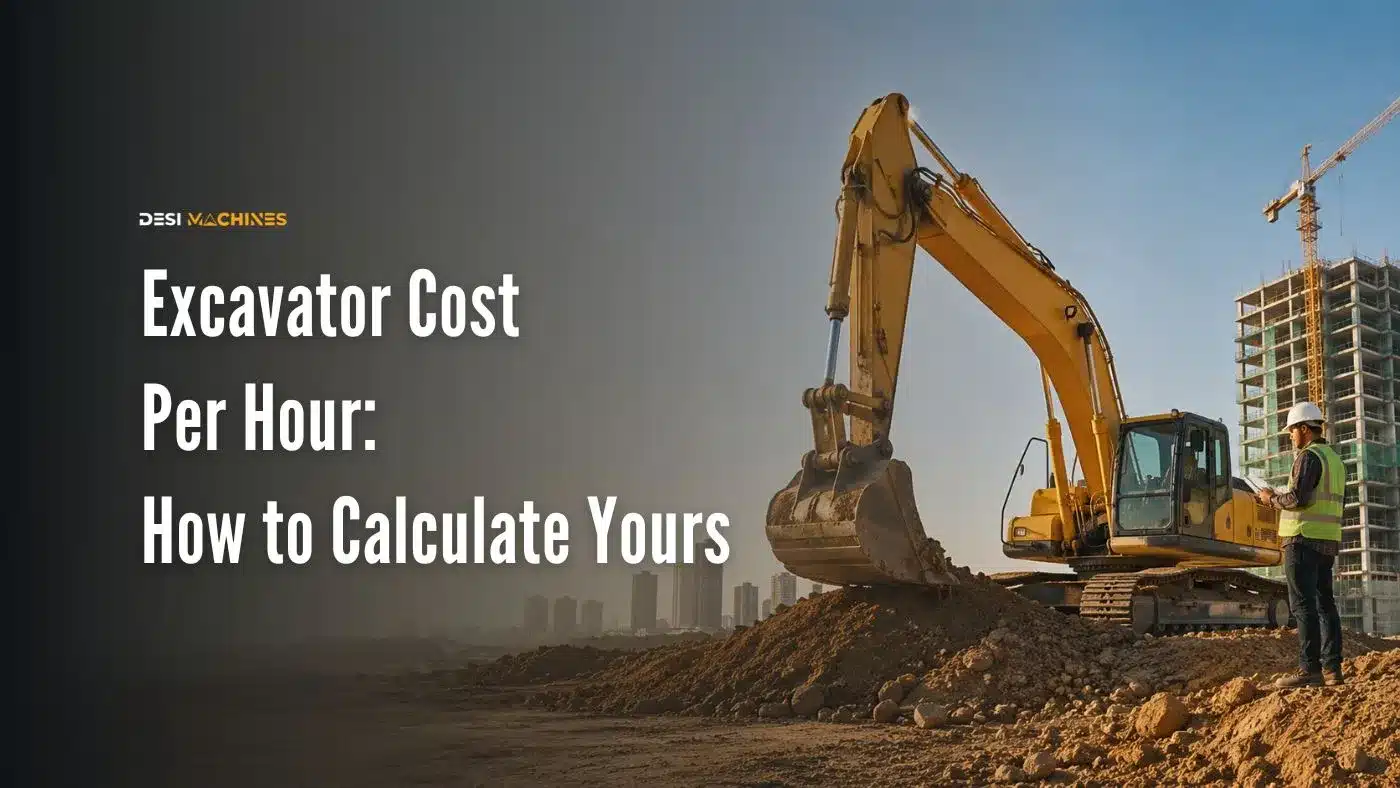
Your real excavator cost per hour is every rupee the machine costs you in a year — fuel, maintenance, wear parts, operator, finance and insurance — divided by the hours you actually run it. For a 20-ton class machine that lands in an indicative ₹1,800-3,000 per hour (as of Jul 2026), with fuel the biggest single slice. The number that moves it most is not the diesel price — it is your utilisation. Work the machine more, and every hour costs less.
Ask three excavator owners what their machine costs to run for an hour and you will get three shrugs and one confident guess that is probably wrong. Yet it is the most useful number an owner can know. It sets the rate you should charge, the utilisation you need to break even, and whether the machine is earning or quietly losing money. Here is how to work out the real excavator cost per hour for your machine, not a magazine average.
The excavator cost per hour formula
The idea is simple. Take everything the machine costs you in a year and divide it by the hours you run it:
Cost per hour = (fixed annual costs + variable annual costs) ÷ annual operating hours
The two halves behave very differently, and understanding that is the whole game.
- Fixed costs stay the same whether the machine works 1,000 hours or 2,500. The loan EMI, the insurance premium and the operator’s monthly retainer are owed regardless. Spread them over more hours and the per-hour figure drops.
- Variable costs rise with use. Fuel, wear parts and much of the maintenance only happen when the machine works, so they stay roughly steady per hour no matter how much you run it.
That split is why utilisation is the master lever. A machine sitting idle still burns fixed cost every day, so low hours mean a punishing per-hour number, while a busy machine spreads those same fixed costs thin.
What goes into each half
Gather your own figures for a full year. If you do not have them yet, start logging — a machine you cannot cost is a machine you cannot price.
| Fixed (per year) | Variable (per hour or per year) |
|---|---|
| Loan EMI or capital recovery | Diesel |
| Insurance premium | Engine oil, filters, greasing |
| Operator retainer / base wage | Undercarriage and wear parts |
| Permits, parking, fixed overhead | Repairs and downtime cost |
One judgement call: the operator. If you pay a fixed monthly wage, treat it as fixed. If you hire per shift or the operator only earns when the machine works, it behaves as a variable cost. Put it wherever it truly sits for you — the total is what matters.
A worked example (20-ton class, indicative)
Take a 20-ton excavator bought at ₹70 Lakh on a loan, run 2,000 hours a year. All figures are indicative and only there to show the method — plug in your own.
| Cost item (per year, indicative) | Amount |
|---|---|
| Fuel (≈14 L/hr × ₹90 × 2,000 hrs) | ₹25.2 Lakh |
| Maintenance + wear parts | ₹6 Lakh |
| Operator wages | ₹3.6 Lakh |
| Insurance | ₹1.2 Lakh |
| Finance interest (year’s share) | ₹3 Lakh |
| Total for the year | ≈ ₹39 Lakh |
| Divided by 2,000 hours | ≈ ₹1,950 per hour |
So this machine costs an indicative ₹1,950 an hour to run. Notice fuel alone is about ₹1,260 of that — roughly two-thirds. That is why fuel efficiency and idle time matter more to your per-hour cost than almost anything else.
Why the same machine has two very different numbers
Now watch what utilisation does. Hold the fixed costs steady at ₹7.8 Lakh a year (operator ₹3.6 L + insurance ₹1.2 L + finance ₹3 L) and the variable costs at ₹1,560 an hour (fuel plus maintenance, from the example above), then change only the hours worked:
| Hours run per year | Indicative cost per hour |
|---|---|
| 1,200 hours (under-used) | ≈ ₹2,210 |
| 2,000 hours (steady) | ≈ ₹1,950 |
| 2,600 hours (busy) | ≈ ₹1,860 |
Same machine, same diesel price, same operator — and the cost per hour moves by about ₹350, close to a fifth, purely on how much you work it. Across a year that gap is worth roughly ₹4 Lakh on the same machine. The fixed costs do not shrink when the machine sits idle; they just get shared across fewer earning hours. This is the single most important thing an owner can understand about running cost: idle days are expensive even when nothing breaks.
What to do with your number
Once you know your true cost per hour, it works for you in three ways:
- Price your work above it. Whatever you charge for hire or contract work has to clear this floor and leave a margin. Quoting below your cost per hour means paying the customer to use your machine.
- Set a utilisation target. If your break-even needs 1,600 hours a year, you know the minimum work the machine must find. Anything less and you are subsidising it from elsewhere.
- Decide own versus rent. If you cannot keep the machine busy enough to get the per-hour cost below the market hire rate, renting when you need a digger may beat owning one. We weigh that up in our guide to renting versus buying an excavator.
Cost per hour is one slice of the bigger ownership picture. For the full five-year view — purchase, finance, depreciation and resale on top of the running cost — read our pillar on the real cost of owning an excavator in India.
If your work is measured and paid by volume rather than by the hour, this same number converts straight into a quote — the conversion is worked through in our guide to the excavation rate per cubic meter.
Work out your own excavator cost per hour
Your excavator cost per hour is not a number to look up — it is one to calculate, from your own fuel, maintenance, operator, finance and insurance, divided by the hours you genuinely work. Do it once and you will price better, chase utilisation harder, and know at a glance whether the machine is earning its keep. The rule of thumb is a starting point; your own figure is the one that pays the bills.
The two levers in that table are the only ones you control: find more hours, or cut the variable cost per hour. Most owners have more room on the first than they think. When you are ready to act on it, compare machines and their running costs on our excavator range, and if a loan is part of the plan, work out the funding on the equipment finance page before you commit.
Fuel rates, wages, maintenance costs, interest and premiums are indicative, change constantly and vary by machine, hours, location and date. Confirm current figures with our team, the OEM, bank or insurer before making any decision. DesiMachines is not liable for decisions taken on information that may have changed after publication.