Excavator
294 models
Excavator
294 models  Backhoe Loader
51 models
Backhoe Loader
51 models  Crane
68 models
Crane
68 models  Concrete Mixer
79 models
Concrete Mixer
79 models  Wheel Loader
54 models
Wheel Loader
54 models  Compactor / Roller
45 models
Compactor / Roller
45 models  Motor Grader
42 models
Motor Grader
42 models  Dozer
41 models
Dozer
41 models  Concrete Pump
66 models
Concrete Pump
66 models  Skid Steer Loader
11 models
Skid Steer Loader
11 models  Telehandler
13 models
Telehandler
13 models 


The real excavator cost of ownership in India is far bigger than the sticker price. Buy a 20-ton machine for roughly ₹55-90 Lakh (indicative, as of Jul 2026) and, run at about 2,000 hours a year, it can cost you well over three times that across a five-year life once diesel, maintenance, the operator, insurance and finance are counted. Fuel is the single biggest slice. The lesson for an owner is simple: judge a machine by what it costs to run, not just to buy.
Figures below are indicative ranges for a 20-ton class crawler excavator in typical Indian use; your numbers will move with brand, hours, diesel price and site conditions.
Most buyers spend weeks comparing purchase prices and about five minutes thinking about running cost. That is backwards. The price you pay the dealer is the smallest part of what the machine takes out of your pocket. Over five hard years the fuel bill, the service schedule, the operator’s wage and the value the machine quietly loses will together dwarf the loan you took to buy it.
This guide lays out the full cost of owning an excavator in India, item by item, and then puts them together in an indicative five-year example so you can see where the money actually goes. Once you can see it, you can cut it — and you can compare two machines properly instead of picking the cheaper sticker.
Excavator cost of ownership: the six buckets
Total cost of ownership is just every rupee the machine costs you from the day you buy it to the day you sell it, minus what you get back at the end. It falls into six buckets. Two are one-time, four repeat every year you own the machine.
| Cost bucket | When it hits | Roughly how big |
|---|---|---|
| Purchase price | One-time, upfront | Large, but a minority of the total |
| Finance cost (interest) | Every month you have a loan | Moderate |
| Fuel | Every working hour | The biggest running cost |
| Maintenance and wear parts | Ongoing, rising with age | Large over five years |
| Operator and insurance | Every month | Steady and predictable |
| Depreciation | Silent, felt at resale | Around half the price over five years |
Notice that only the first two have anything to do with the price on the quotation. The rest are what separate a machine that makes money from one that slowly bleeds it. Let us take them in turn.
The purchase price is only the start
A 20-ton class crawler excavator from a mainstream brand lands somewhere around ₹55-90 Lakh (indicative, as of Jul 2026) ex-showroom, depending on brand, engine, boom configuration and dealer. On-road with GST, registration and insurance it is higher. That is the number everyone fixates on, and it matters, but it is a one-time cost you can spread over years with a loan.
How you fund it changes the total. Pay cash and you tie up capital that could have earned elsewhere; take a loan and you add interest. On a typical five-year equipment loan the interest you pay over the tenure can add a meaningful slice to the machine’s cost. Whether to borrow, lease or pay cash is its own decision, and we have walked through it in full in our guide to loan versus lease versus cash for construction equipment. If you plan to finance, the interest is a genuine cost of ownership and belongs in this sum — you can line up a lender on our equipment finance page.
Fuel: the cost that dwarfs the rest
Here is the number that surprises most first-time owners. A 20-ton excavator in steady digging work burns roughly 13-16 litres of diesel an hour (indicative). At around ₹90 a litre (indicative, as of Jul 2026) that is about ₹1,200-1,600 an hour just in fuel. Run the machine 2,000 hours in a year and you are spending in the region of ₹24-32 Lakh a year on diesel alone. Over five years that single line can cross ₹1 crore (indicative) — more than the machine cost to buy.
Because fuel is so large, it is also where the biggest savings hide. Idle running, a clogged filter, worn hydraulics or an operator who feathers the throttle badly can quietly add 10-15% to the bill. The controllable levers are worth real money:
- Cut idle time. An excavator idling still burns three to five litres an hour for nothing. Auto-idle and a habit of shutting down on long waits add up fast.
- Keep it serviced. Dirty air and fuel filters and tired hydraulics make the engine work harder for the same output.
- Train the operator. A skilled operator digs the same trench in fewer engine hours. Fuel per truck loaded, not fuel per day, is the number to watch.
Maintenance, wear parts and the undercarriage
Servicing is predictable; wear is not. Routine service — oils, filters, greasing, hydraulic checks — for a 20-ton machine in regular use runs an indicative ₹4-8 Lakh a year, and it climbs as the machine ages. Two big-ticket items sit on top of that schedule and catch owners out:
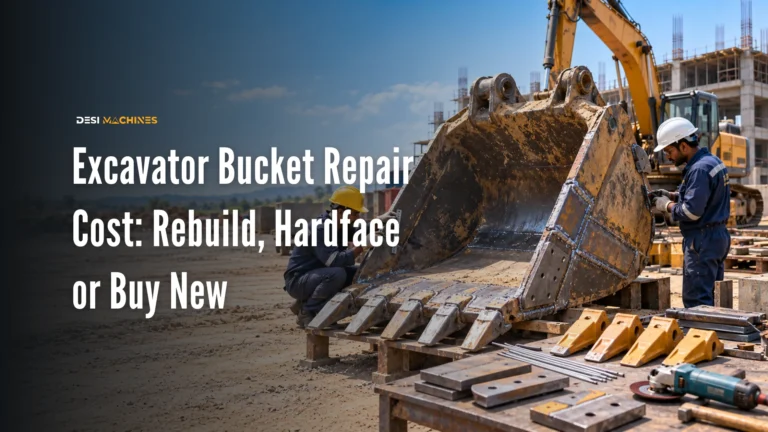
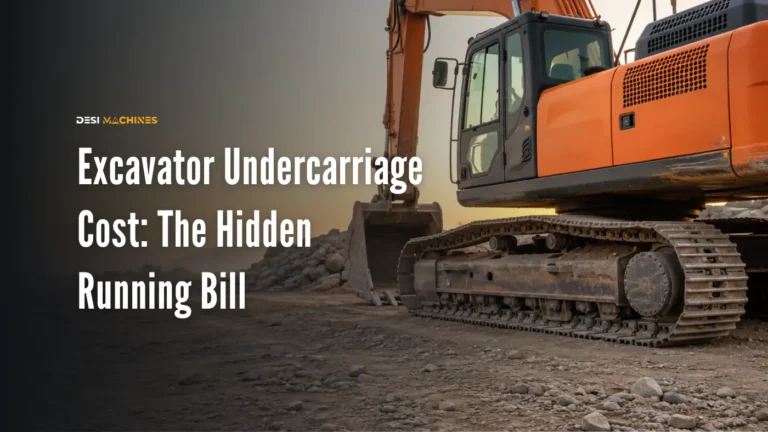
- The undercarriage. Track chains, rollers, idlers and sprockets wear out on abrasive or rocky sites and a full set can run ₹3-6 Lakh (indicative) when it is due, typically somewhere around 4,000-5,000 hours depending on ground conditions. Rocky, sandy work eats undercarriage far faster than soft soil.
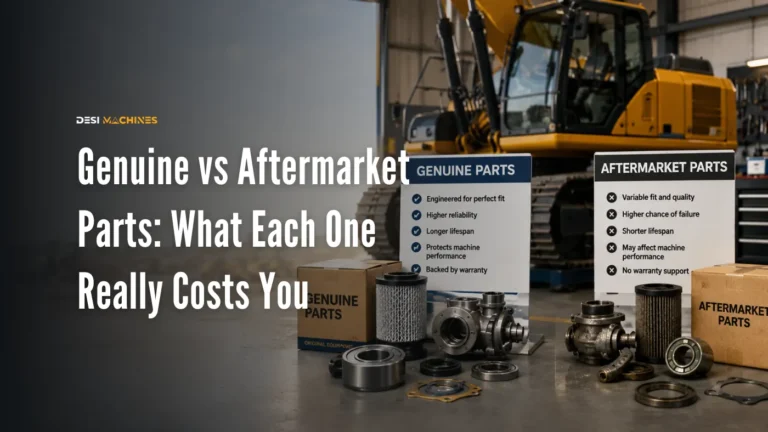
- Hydraulics and the bucket. Pumps, hoses, cylinders and ground-engaging tools all wear. Parts that meet the maker’s specification can cost more per item but usually last longer and fail less, which matters when a breakdown stops the whole site — and the real cost of that downtime is usually far bigger than the repair bill.
The temptation with an ageing machine is to defer service and fit the cheapest parts. It saves cash this month and costs more over the year, because the real maintenance expense is not the part — it is the downtime. An idle machine still owes you its EMI, its operator’s wage and the job it was booked for. On a busy contract a day lost to a breakdown can cost more than the repair itself.
Operator, insurance and the costs owners forget
These are the steady monthly costs that are easy to underestimate because no single one is dramatic.
- Operator wages. A skilled excavator operator earns an indicative ₹20,000-35,000 a month, more in high-demand regions or for a specialist. A good one pays for the extra wage through faster, cleaner work and less machine abuse. For how pay varies, see our operator salary guide.
- Insurance. A comprehensive machinery policy typically costs an indicative 1-2% of the insured value a year, so a few tens of thousands to over a lakh depending on the machine and cover. It is not optional on a financed machine, and a rejected claim after an accident can wipe out a year’s profit.
- Diesel pilferage and site costs. Fuel theft, transport between sites, minor repairs and consumables are small individually and add up over a year. Many owners never track them and are surprised by the gap between what the machine earned and what reached their pocket.
Depreciation: the cost with no bill
The sneakiest cost of all is the value the machine loses while you own it. No invoice ever arrives for it, but it is real money you feel the day you sell. A well-kept excavator holds roughly 40-55% of its purchase price after five years (indicative) — so it sheds close to half its value. On a ₹70 Lakh machine that is the better part of ₹35 Lakh gone, quietly, over five years.
What you can control is how fast it falls. A strong brand with a deep resale market, clean and complete service records, moderate hours and honest maintenance holds value far better than a hard-run machine with a patchy history. That is why resale value should shape the machine you buy, not just the one you sell — the brand that costs a little more upfront can be the cheaper machine to own once you count what it fetches at the end. Our note on the best resale value used excavators in India shows which names tend to hold up.
Excavator depreciation rate, year by year
“Holds 40-55% after five years” is the destination; owners usually want the path, because that is
what decides the right year to sell. Read as a reducing balance, that residual implies a market
depreciation rate of roughly 11-17% a year. On the ₹70 Lakh machine used above,
the curve looks like this.
| Age | Indicative market value | Share of new price |
|---|---|---|
| End of year 1 | ₹58-62 Lakh | 83-89% |
| End of year 2 | ₹49-55 Lakh | 69-79% |
| End of year 3 | ₹40-49 Lakh | 58-70% |
| End of year 4 | ₹34-43 Lakh | 48-62% |
| End of year 5 | ₹28-38 Lakh | 40-55% |
Two things follow from the shape of that curve. The steepest fall is in year one,
which is the strongest argument for buying a low-hour used machine and the weakest moment to sell
a new one. And because the rupee loss shrinks each year while maintenance climbs, most owners find
the sensible exit somewhere in years four to six — late enough that the worst
depreciation is behind them, early enough that the big undercarriage and hydraulic bills are not
yet routine.
One distinction worth keeping straight: this is market depreciation, what a buyer will
pay you. The tax depreciation you claim on the machine is a separate calculation with its
own prescribed rate and method under the Income Tax Act, and it does not track resale value.
Confirm the rate that applies to your business with your chartered accountant before you rely on
it for planning.
What the Income-tax Act 2025 actually fixes on that side, and what it leaves to the Rules, is a separate question worth reading before you build either figure into a projection: the block of assets, the 180-day restriction on a newly commissioned machine, and why no percentage appears in the Act at all are set out in depreciation rate on construction machinery.
Putting it together: an indicative five-year picture
None of these numbers means much alone. Together they tell the real story. Here is an indicative five-year cost of ownership for a 20-ton class excavator bought at ₹70 Lakh and run 2,000 hours a year. Treat every figure as a broad indicative range, not a quote.
| Cost over 5 years (indicative) | Rough amount |
|---|---|
| Purchase price | ₹70 Lakh |
| Finance interest (if borrowed) | ₹12-18 Lakh |
| Fuel (≈10,000 hrs total) | ₹1.2-1.5 crore |
| Maintenance + wear parts | ₹25-40 Lakh |
| Operator wages | ₹15-20 Lakh |
| Insurance | ₹4-8 Lakh |
| Less: resale at year 5 | (₹28-38 Lakh back) |
Read the table and the point jumps out: the ₹70 Lakh you obsessed over at the dealer is a small part of the total, and fuel is bigger than the machine itself. The costs you can move most — fuel efficiency, downtime, resale — are the running ones, not the purchase price. A machine that costs ₹5 Lakh more but burns less diesel and holds its value can be far cheaper to own across five years than the one with the tempting sticker.
How to bring your cost of ownership down
You cannot change the price of diesel, but you have more control over the total than it looks:
- Buy for running cost, not sticker. Compare fuel burn, service intervals and resale between shortlisted machines, not just the ex-showroom price. Our machine comparison tool lets you put models side by side before you commit.
- Chase utilisation. The fixed costs — EMI, insurance, the operator’s retainer — are the same whether the machine works 1,200 hours a year or 2,400. The more productive hours you get, the lower every cost looks per hour — to turn that into a single figure you can quote against, learn how to calculate your excavator cost per hour. Idle days are the enemy of ownership economics.
- Service on schedule with parts that meet the maker’s specification. It costs more per visit and less per year, because it buys you uptime.
- Track the small stuff. Log fuel, repairs and site costs per machine. What you measure, you can cut.
If, after running these numbers, you conclude your work does not justify owning at all, that is a valid answer — renting can be cheaper below a certain utilisation. We compare the two paths in our guide to renting versus buying an excavator.
And when the machine finally goes, the tax on the sale rarely works the way owners expect: because you have been claiming depreciation on it, any gain is treated as short-term however long you owned it, and it is worked out across your whole block of assets rather than on that one machine. We cover the computation in capital gain on sale of machinery.
Why fuel outweighs the machine over five years
An excavator’s price tag is the question every buyer asks and the wrong one to fixate on. The real cost of ownership is a five-year sum in which fuel outweighs the machine, maintenance and downtime punish neglect, and depreciation quietly takes back half the price. Judge a machine by what it costs to run and what it fetches at the end, keep it busy and serviced, and the economics work. Fixate on the cheapest sticker and you can end up owning the most expensive machine on the site. And if your work cannot keep a machine busy, owning may not be the right call at all. Weigh it against renting in our buy vs rent construction equipment guide.
When you are ready to turn these numbers into a decision, compare shortlisted machines on our excavator range, work out the funding on the equipment finance page, and buy the machine that costs the least to own — not just to buy.
Prices, diesel rates, wages, insurance premiums and resale values are indicative, move constantly and vary by brand, variant, hours, location and date. Confirm current figures with our team, the OEM, bank or insurer before making any purchase decision. DesiMachines is not liable for decisions taken on information that may have changed after publication.