Excavator
294 models
Excavator
294 models  Backhoe Loader
51 models
Backhoe Loader
51 models  Crane
68 models
Crane
68 models  Concrete Mixer
79 models
Concrete Mixer
79 models  Wheel Loader
54 models
Wheel Loader
54 models  Compactor / Roller
45 models
Compactor / Roller
45 models  Motor Grader
42 models
Motor Grader
42 models  Dozer
41 models
Dozer
41 models  Concrete Pump
66 models
Concrete Pump
66 models  Skid Steer Loader
11 models
Skid Steer Loader
11 models  Telehandler
13 models
Telehandler
13 models 


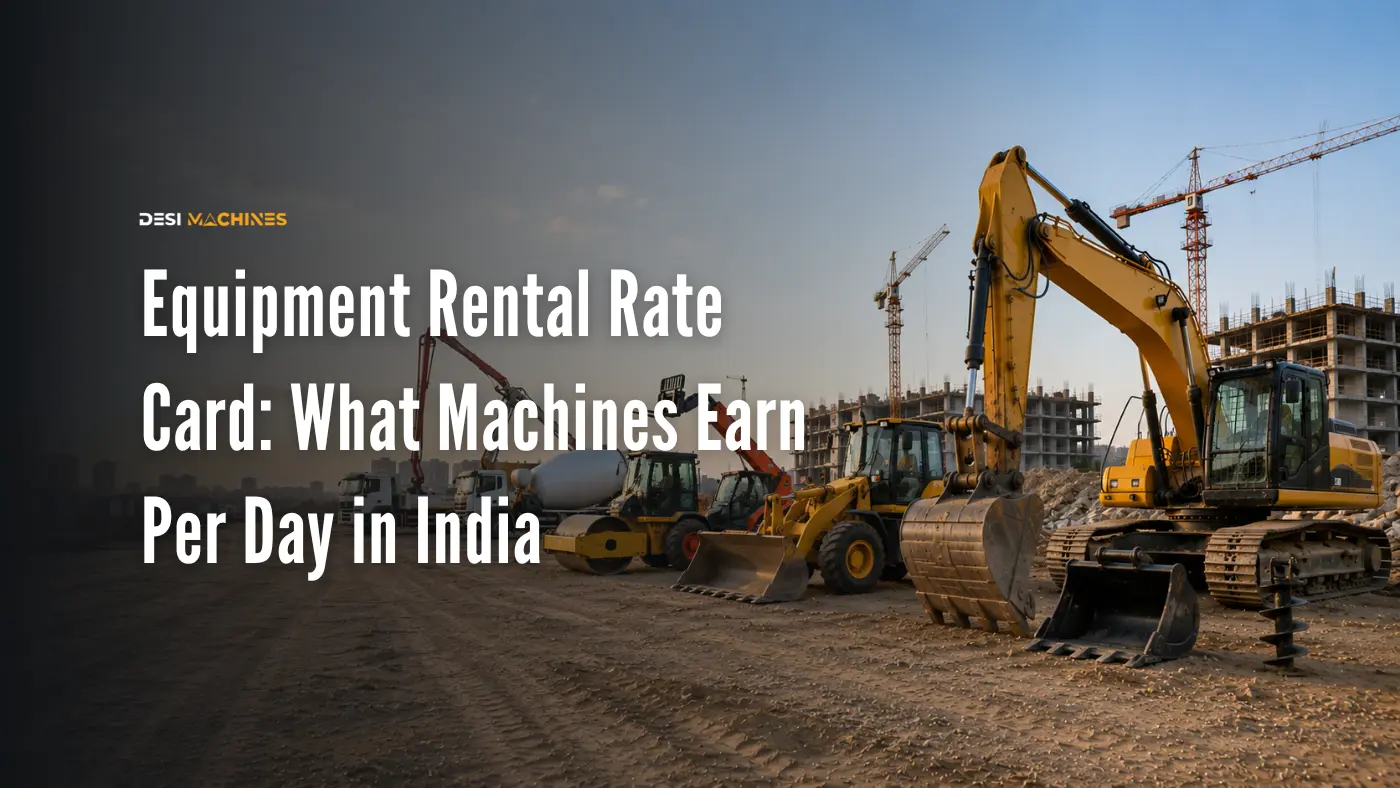
A JCB-class backhoe loader typically rents for about ₹550-900 an hour on dry hire — roughly ₹5,000-9,000 a day or ₹90,000-1,40,000 a month (indicative, Jul 2026). That is the headline jcb rent per day figure, but every machine, and every hire, is different. A 20-tonne excavator on wet hire runs ₹1,400-2,200 an hour; a Hydra crane ₹18,000-35,000 a day. Below is an indicative rental rate card for the machines Indian owners hire most, plus the handful of things that decide the number you pay — or the number you earn.
Every ₹ figure below is an indicative range for typical Indian conditions and moves with machine, region, season, condition and whether an operator and diesel are included. Confirm current rates with a local rental operator or dealer before you plan a job or count on any income.
Rental rates are the one piece of data every machine owner and hirer wants and almost nobody publishes honestly, because the honest answer is “it depends”. It depends on your city, the season, the machine’s age, and above all on whether the quote includes an operator and fuel. This page gives you realistic starting ranges to check against, and then explains what actually moves them — so you can read a quote, or set your own, without getting caught out.
JCB rent per day: what a backhoe loader costs to hire
The backhoe loader — a JCB 3DX or its rivals — is the machine most people mean when they ask about rental. It is the workhorse of Indian sites, so demand and supply are both deep, and rates are more standardised than for bigger machines. Here is the indicative picture.
| Basis | Indicative rate (Jul 2026) | What it usually includes |
|---|---|---|
| Per hour (dry) | ₹550-900 | Machine only; hirer brings operator + diesel |
| Per day (8 hours, dry) | ₹5,000-9,000 | Machine only; daily minimum common |
| Per month (dry hire) | ₹90,000-1,40,000 | Machine only; long deployment |
| Per hour (wet) | ₹900-1,300 | Machine + operator (+ often diesel) |
Two backhoe quotes can look ₹300-400 an hour apart and both be fair — one is dry, one is wet. Before you compare, pin down what is included. To see the machines and their on-road prices behind these rentals, browse the JCB backhoe loader range and the wider backhoe loader line-up.
Equipment rental rate card: what each machine earns
Beyond the backhoe, here is an indicative rate card for the machines Indian owners hire and hire out most. Treat these as a starting point to check locally, not fixed prices — the spread within each row is real, and peak-season rates sit at the top of it.
| Machine | Indicative hire rate (Jul 2026) | Common basis |
|---|---|---|
| Backhoe loader (JCB 3DX class) | ₹550-900 / hr dry · ₹90,000-1,40,000 / month | Hour or month |
| Mini excavator (2-3 tonne) | ₹500-900 / hr | Hour, daily minimum |
| 20-tonne excavator | ₹1,400-2,200 / hr (wet) | Hour or month |
| 30-tonne-plus excavator | ₹2,200-3,500 / hr (wet) | Project / month |
| Wheel loader | ₹1,000-1,600 / hr | Hour or shift |
| Pick-n-carry crane (Hydra 14-16T) | ₹18,000-35,000 / day | Day or shift |
| Soil compactor / road roller | ₹800-1,500 / hr or ₹15,000-25,000 / day | Hour or day |
| Self-loading concrete mixer | ₹1,200-2,000 / hr | Hour or day |
The pattern is worth noticing: smaller, common machines are billed by the hour with a daily minimum; cranes go by the day or shift; and anything on a long project deployment shifts to a monthly rate that works out cheaper per hour than short hire. Browse live machines and indicative prices across the excavator and crane ranges to match a rental against buying one outright.
What decides the rate you pay — or the rate you get
Whether you are hiring a machine in or hiring yours out, the same handful of factors move the number. Understand them and you can read a quote, or defend your own, with confidence.
Dry hire vs wet hire
This is the biggest single swing. Dry hire means you get only the machine; the hirer arranges the operator and diesel. Wet hire means the owner supplies the machine, an operator and usually the fuel, at a higher rate. A wet backhoe can cost ₹300-400 an hour more than a dry one — not because anyone is overcharging, but because the wage and diesel are baked in. Always establish which one a quote is before you compare it to another.
Machine size and type
Bigger machines command higher hourly rates but often a lower cost per unit of work, because they move more per hour. A 30-tonne excavator costs far more an hour than a 20-tonne, yet on a large earthwork job it can be cheaper overall. Match the machine to the task rather than chasing the lowest hourly rate.
Region and season
Rates are local. A backhoe in a busy metro corridor with heavy infrastructure work hires for more than the same machine in a quiet district. And season matters: the pre-monsoon and post-monsoon construction rush tightens supply and pushes rates to the top of the range, while the peak monsoon months soften them. If you are hiring out, this seasonality is exactly why utilization — days actually worked — decides your income more than the headline rate.
Hours, diesel and shifting
Read the fine print. Many hires carry a daily minimum (say 8 hours) whether or not you use them; overtime hours may cost more. Diesel is often the hirer’s cost on dry hire and can quietly double the effective rate. And shifting — transporting the machine to and from your site — is usually charged on top, sometimes a significant sum for a heavy machine over distance.
Condition, age and attachments
A newer, well-maintained machine with the right attachment earns more and breaks down less. An older machine hires cheaper but carries a real risk of downtime mid-job, which for the hirer is far more expensive than the rate saved. If a machine comes with a breaker, ripper or other attachment the job needs, that commands a premium too.
Per hour, per day or per month — how rental is billed
The billing basis changes the effective rate more than most people realise. As a rule, the longer you commit, the cheaper each hour becomes, because the owner values a guaranteed booking over a string of uncertain days.
That is why the two backhoe figures above are not a simple multiplication, and it is worth doing the sum before you accept a quote. ₹550-900 an hour is the dry-hire rate on an hourly or longer booking. The ₹5,000-9,000 day rate is for eight hours, which works out at roughly ₹625-1,125 an hour — dearer, because a single day carries the daily minimum and the shifting charge with nothing to spread them over. If the job runs several days, ask for an hourly or weekly rate rather than stacking day rates, and if it runs several weeks ask for the monthly one.
- Per hour suits short, defined jobs — a day of trenching, a few hours of loading. Watch for the daily minimum.
- Per day / per shift is the norm for cranes and for machines booked for a stretch of work.
- Per month is for project deployments; the per-hour cost drops sharply, but you carry the machine whether the work flows or not.
If you are the one hiring out, offering a monthly rate to a contractor with steady work trades a slightly lower rate for the certainty of a booked machine — often a good deal when the alternative is idle days.
Whichever basis you bill on, the number that tells you if the machine is actually paying is your equipment utilisation rate — earned hours against available hours, which is a very different figure from the hours on the meter.
Cranes are worth separating out from this. They are billed by the day or the shift rather than by the hour, and they carry periodic statutory testing that can stop the machine earning until a certificate is current. The owner-side arithmetic for that is in crane rental business profit.
Reading these rates as an owner who wants to rent out
If you own a machine, this rate card is not just a cost — it is potential income. But a rate on a page is not profit. What you actually earn is the rate multiplied by the days the machine is hired, minus your running cost. That month-by-month arithmetic — hire income against EMI, maintenance and idle days — is worked through in what a machine business actually earns. That is why the real decision for an owner is never the rate alone.
Budget for the deduction as well. A client paying you hire charges will usually cut tax at source before the money lands, and the rate turns on whether the deal is a bare machine hire or a contract for work — see TDS on machinery hire charges for the rates and the limits.
Work out your own machine cost per hour first, then compare it to the hire rate above. The gap between the two, across a realistic number of hired days a month, is your margin. And before you count on any hire income, read our full buy vs rent construction equipment guide — it walks through the utilization math that decides whether owning and renting out actually pays. To fund the machine in the first place, compare what you can borrow and at what rate through equipment finance.
What decides the rent you pay or earn
The jcb rent per day figure most people are chasing — roughly ₹5,000-9,000 a day dry, or ₹550-900 an hour — is a fair starting point, but it is only ever a starting point. The rate you actually pay, or earn, is decided by dry versus wet hire, machine size, your region and season, and what is quietly charged on top for diesel and shifting. Read every quote for what it includes before you compare it to the next one.
If you are weighing whether to hire a machine or buy and hire yours out, get the full picture: run your own cost per hour, read the buy vs rent decision guide, and check where machine demand is opening up in live equipment work and tenders. Those three together turn a rate card into a plan.
If you are on the hiring side of these rates, our guide to how to rent construction equipment in India explains the process, the paperwork and how per-hour and per-day billing is actually counted.
Rental rates, charges and prices change constantly and vary by machine, region, condition, season and date. The figures here are indicative ranges as of July 2026 and must not be treated as quotes or guaranteed income. Confirm current terms with a local rental operator, bank or insurer before making any decision. DesiMachines is not liable for decisions taken on information that may have changed after publication.
Rates reviewed against our live listings on 7 August 2026. Every figure here is an indicative range for typical Indian conditions and moves with machine, region, season, condition and whether an operator and diesel are included — confirm the current rate with a local supplier before you budget.
Work it out for your machine: the running cost and break-even calculator shows how many billed hours a month a machine needs at your rate, EMI and diesel.