Excavator
294 models
Excavator
294 models  Backhoe Loader
51 models
Backhoe Loader
51 models  Crane
68 models
Crane
68 models  Concrete Mixer
79 models
Concrete Mixer
79 models  Wheel Loader
54 models
Wheel Loader
54 models  Compactor / Roller
45 models
Compactor / Roller
45 models  Motor Grader
42 models
Motor Grader
42 models  Dozer
41 models
Dozer
41 models  Concrete Pump
66 models
Concrete Pump
66 models  Skid Steer Loader
11 models
Skid Steer Loader
11 models  Telehandler
13 models
Telehandler
13 models 


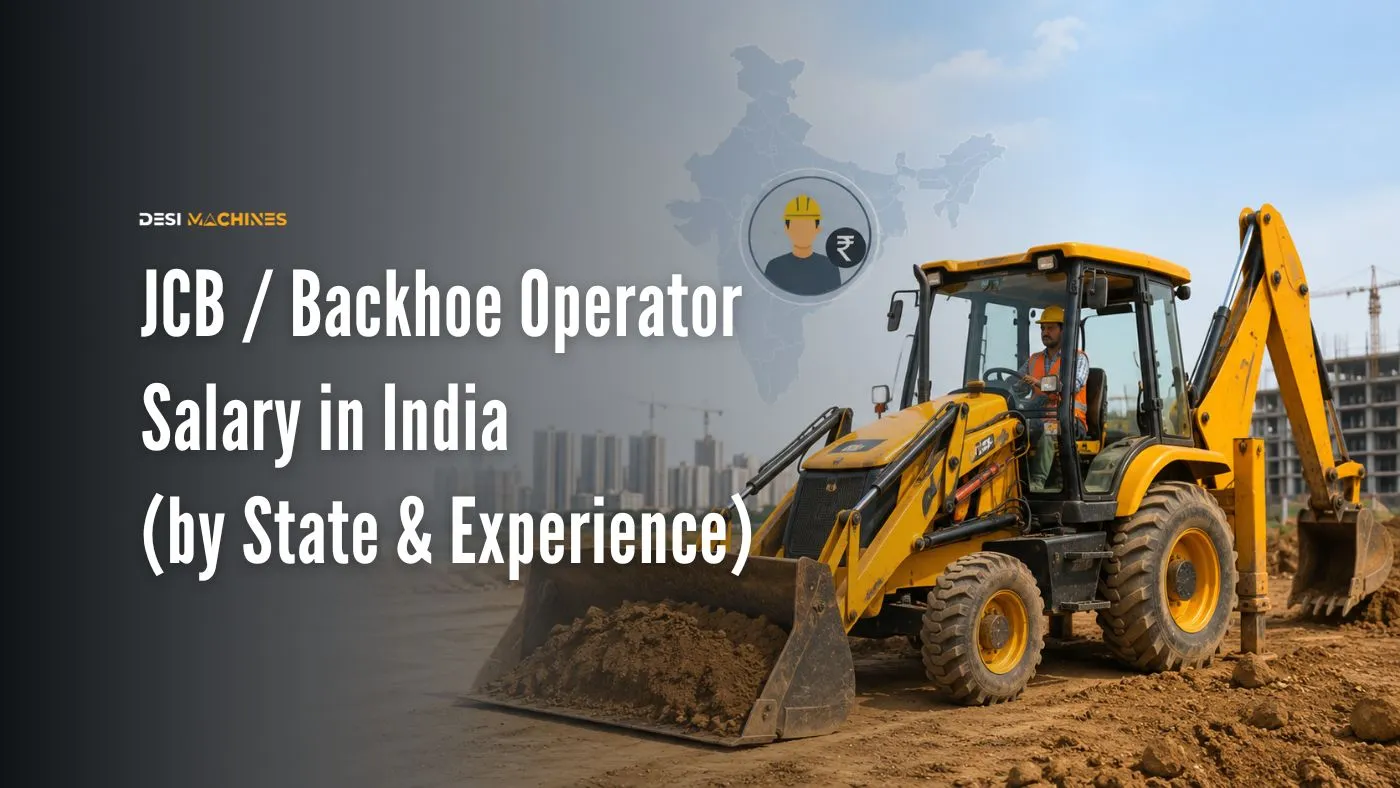
The JCB operator salary in India runs from about 12,000-18,000 a month for a fresher to 28,000-45,000 for a skilled senior operator, before overtime. Metro and industrial states pay the most, skill and a clean record push you up fastest, and the real jump comes when you stop drawing wages and own the machine. Figures are indicative and vary by employer and site.
Pay figures are indicative ranges and move with state, employer and site — confirm current pay with the employer or contractor before you count on it.
Ask ten operators what they make and you will get ten answers, because the JCB operator salary in India depends on where you work, what you can handle, and who signs your cheque. A fresher loading a tipper in a small town and a senior man running a backhoe on a Mumbai metro site are doing the “same” job for very different money.
Here are the honest, indicative ranges, and the things that actually move them.
JCB operator salary in India: the honest ranges
These are typical monthly figures seen in hiring listings and on-site pay. Treat them as indicative; real pay swings with the employer and the work.
| Experience | Indicative Monthly Pay | Notes |
|---|---|---|
| Fresher / trainee (0-1 yr) | 12,000-18,000 | Learning on the job, simple digging and loading |
| Operator (2-5 yrs) | 18,000-28,000 | Independent on most site work |
| Skilled / senior (5+ yrs) | 28,000-45,000 | Precision, mining, long-reach, trusted on tough sites |
| Specialist / lead operator | 45,000+ | Rare skills, imported machines, or supervising a crew |
On top of the base, most site jobs add overtime, a food or stay allowance, and sometimes a bonus tied to hours. For many operators the overtime is where the real money sits, and a busy season can lift take-home well above the base band.
What a JCB operator salary works out to per day
Most pay in this trade is quoted by the month, but a lot of site work is offered and accepted by the day, and the two numbers are easy to talk past each other. Taking the monthly bands above against the 26 paid days a monthly-rated worker is normally counted for, the same pay looks like this:
| Experience | Indicative monthly pay | Same pay per day (26-day month) |
|---|---|---|
| Fresher / trainee (0-1 yr) | ₹12,000–18,000 | ₹460–690 |
| Operator (2-5 yrs) | ₹18,000–28,000 | ₹690–1,080 |
| Skilled / senior (5+ yrs) | ₹28,000–45,000 | ₹1,080–1,730 |
Those day figures are the monthly bands divided out, not a separate market rate, and the difference matters when you are negotiating. A pure daily-wage hire is normally quoted above the line, because you are only paid on the days the machine runs and nobody pays you for a rained-off week or a gap between jobs. A monthly salary buys those idle days back. So a day rate that merely matches the table is a pay cut in disguise once you count the days you will not work, and the honest comparison is your realistic working days in a month, not 26. Per hour, the same bands run roughly ₹58–216 across an eight-hour day, before any overtime premium. Confirm the actual rate, and whether it is per day or per month, with the employer or contractor before you take the job.
What actually lands in your hand
The base figure and the take-home are two different numbers, and it pays to know the difference before you accept a job.
- Overtime. Most sites run past eight hours, and overtime is often paid at a higher hourly rate. On a deadline job it can add 20-40% to a month’s pay.
- Allowances. Food, stay, and travel are sometimes paid on top, sometimes bundled into the figure quoted to you. Always ask which, because a “25,000” job with free food and stay beats a “28,000” job where you pay for both.
- Deductions. On proper company payroll, PF and ESI come out of the figure but buy you a safety net. On daily-wage or cash jobs there is nothing deducted and nothing to fall back on.
- Cash versus bank. A lot of site pay is still cash. A salary paid into a bank account, with a payslip, is worth more than the number suggests, because it is what a lender looks at the day you want to finance your own machine.
How pay changes by state
Where you work matters almost as much as how well you work.
| Region | Indicative level | Why |
|---|---|---|
| Maharashtra, Gujarat, Delhi-NCR, Karnataka | Highest | Dense construction, metros, industrial demand |
| Tamil Nadu, Telangana, Haryana, Punjab | Upper-Middle | Active project pipelines, ports, industry |
| MP, Rajasthan, UP project corridors | Middle | Highway and irrigation work pulls pay up locally |
| Bihar, eastern and smaller states | Lower | Fewer large sites, more seasonal work |
A skilled operator willing to travel to where the big projects are, a metro corridor, a port, a large highway package, can earn noticeably more than the same person staying in a home town with little work. That willingness to move is itself one of the biggest levers on pay.
Does the machine change the pay?
The JCB backhoe is where most operators start, and it sits in the middle of the pay range. The machine you can run changes the ceiling.
- Backhoe loader (JCB and similar): the broad base of the market. Steady demand, middle pay.
- Excavator, especially large, long-reach or mining: usually pays more, because the machines are costlier and the work is less forgiving. A good excavator operator on a mining or infra site is a step above a general backhoe hand.
- Cranes, including hydra and pick-and-carry: among the better-paid seats, and often the ones that most want a certificate, because a lifting mistake is expensive and dangerous. The crane segment rewards a clean record.
- Concrete pumps, transit mixers and specialised rigs: narrower, but a trained hand on a scarce machine can command a premium.
Learning a second, higher-value machine is one of the clearest ways to move your pay up without waiting years for seniority alone. This page stays on the backhoe seat because that is where most operators start; for what the other seats actually pay — excavator, wheel loader, crane and the rest, side by side — see heavy equipment operator salary in India.
What pushes an operator’s pay up
The difference between a 20,000 operator and a 40,000 one is rarely years alone. It is what they can be trusted with.
- Precision and finishing. An operator who can grade to level, trench cleanly, and work close to services without breaking them is worth more than one who only digs.
- Tough-site skills. Mining, long-reach, slope work, and demolition attachments all command a premium.
- A clean record. No damaged services, no site accidents, no wrecked undercarriage. Contractors pay to avoid trouble.
- Basic maintenance sense. An operator who greases the machine, spots a problem early, and keeps downtime low saves the owner money and gets paid to stay.
- Overtime and night shifts. The willingness to run long hours or nights on a deadline job adds up fast.
If you operate a backhoe, the guide to operating a backhoe safely covers the habits that keep both the machine and your record clean.
Payroll, daily wage, or owning your machine
There is a ladder here, and the rungs are worth understanding.
- Company payroll. Steady monthly salary, PF in the better firms, less risk. The ceiling is the senior-operator band.
- Daily wage / contract. Higher headline rate on busy days, nothing on idle ones. Good in a strong season, hard in a slow one.
- Owning the machine. The real jump. An owner-operator stops earning a salary and starts earning the machine’s hire income.
That last step is worth a hard look, because the numbers change shape. A backhoe on hire might gross well over a lakh a month on steady work, but out of that comes the loan EMI (often 45,000 or more), diesel, maintenance, and every idle day when the machine sits without work. Gross is not income, and the gap between the two is the whole question — we work it through properly in what a JCB actually earns as a business, which is the number to look at before you read a hire figure as a salary. In a good month an owner clears far more than a salary; in a slow one, the EMI still arrives. If that is your plan, study the JCB backhoe range and the equipment finance behind it before you take the step, and go in knowing it is a business, not a bigger pay cheque.
Some of the work is not in India at all. Gulf sites recruit Indian machine operators steadily, and the route that protects you is a government one: if your passport is ECR and the destination is a designated ECR country, a JCB operator job abroad needs emigration clearance through the eMigrate portal, compulsory insurance, and a recruiting agent who appears on the official register.
Where the work is
Demand is the reason this career holds up. India is building roads, metros, ports and industrial parks at a pace that keeps machines busy, and skilled operators are genuinely short. A dependable operator with a clean record rarely stays idle for long, especially one willing to follow the big project corridors. That shortage is what gives a good operator the standing to ask for more, and to get it. It helps to know what the man paying you screens for: the owner-side playbook on how to hire a JCB operator sets out the checks and the on-site trial most owners run before they hand over the keys.
How to become a JCB operator
The path is short but the practice is long. Get trained, either through a recognised operator course or a proper apprenticeship under a senior operator, then build real seat hours, because sites hire on how well you actually run the machine. The national course lengths, entry rules and the schools that run them are listed in the guide to JCB operator training in India. For road movement of a wheeled machine you need a valid driving licence for that class. Which class, and what happens on a private site, is set out in what a JCB licence actually requires. If you are new to the machine itself, our explainer on what a backhoe loader does is a sensible place to start, and the backhoe loader range shows the machines you will actually be running.
Not every route up stays on the machine. The site-supervision and engineering rungs are paid on a different scale again, and what a site engineer earns is the honest benchmark for anyone weighing a ticket against more seat hours.
Some operators eventually stop taking the seat and start filling it, putting crews and operators on other people’s sites instead. That is a licensed business with its own threshold and its own paperwork, and how to become a labour contractor sets out the licence, the liability and the margin before you try it.
How an operator can raise his pay step by step
Pay in this field is rising with the country’s road, metro and construction work, and skilled operators are genuinely short. Start on wages, learn the machine cold, add a second higher-value machine, keep a clean record, and the money follows, all the way up to owning your own.
Pay varies by employer, site and region, and changes over time. Treat the ranges here as indicative and confirm current pay with the employer or contractor before you count on a number.