Excavator
294 models
Excavator
294 models  Backhoe Loader
51 models
Backhoe Loader
51 models  Crane
68 models
Crane
68 models  Concrete Mixer
79 models
Concrete Mixer
79 models  Wheel Loader
54 models
Wheel Loader
54 models  Compactor / Roller
45 models
Compactor / Roller
45 models  Motor Grader
42 models
Motor Grader
42 models  Dozer
41 models
Dozer
41 models  Concrete Pump
66 models
Concrete Pump
66 models  Skid Steer Loader
11 models
Skid Steer Loader
11 models  Telehandler
13 models
Telehandler
13 models 


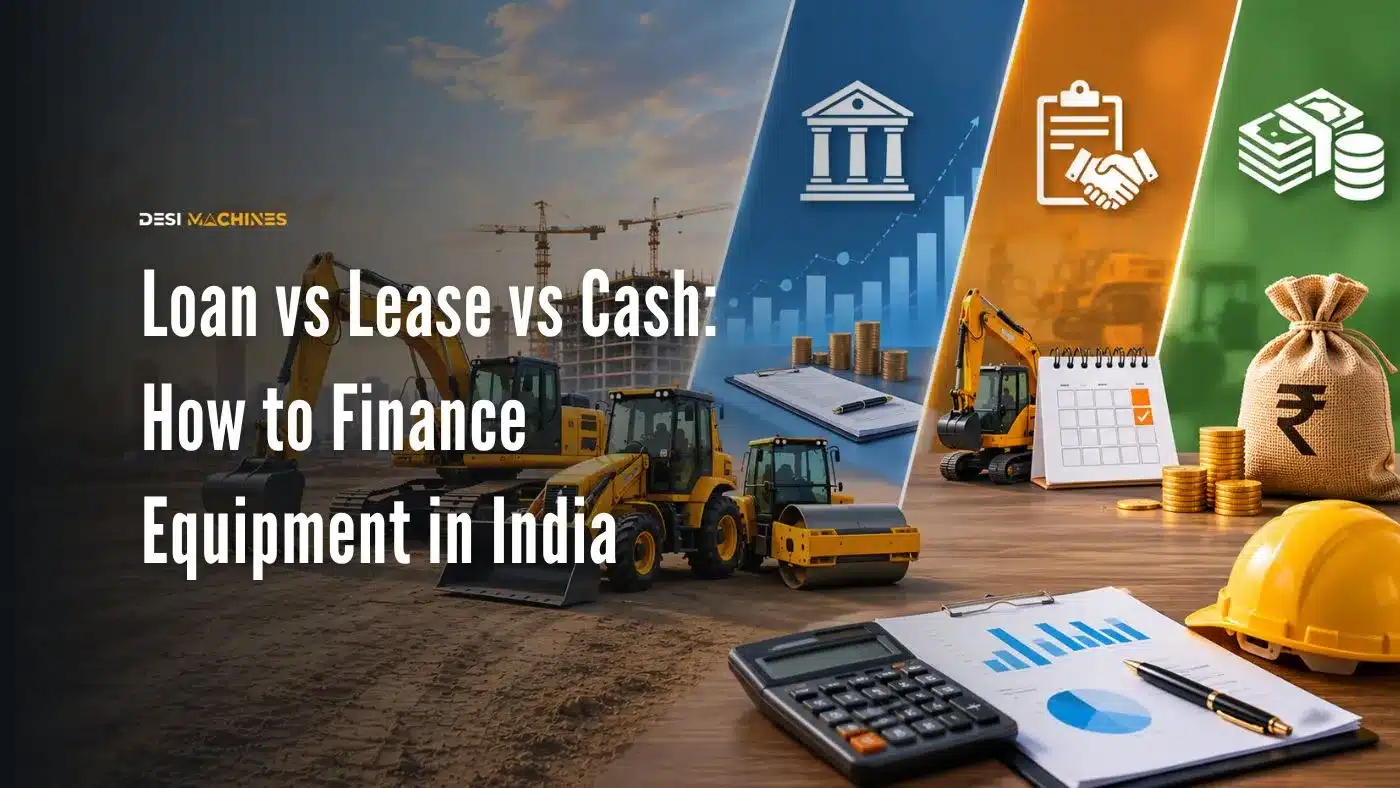
Construction equipment finance comes down to three routes. A loan means you own the machine and its resale value, and it suits anyone keeping the machine for years. A lease keeps the upfront outlay low and can be tax-efficient, but you do not own the machine until the end (if at all). Cash is the cheapest route overall, but only if the machine earns more than that money would working elsewhere in your business. For most Indian buyers a loan wins; lease suits tax planning and short cycles; pay cash only when the maths clearly favours it.
Every machine purchase starts with the same question, and most buyers answer it out of habit rather than maths: how do I pay for this? Get it right and the machine funds itself out of the work it does. Get it wrong and a good machine becomes a monthly weight that a slow season turns into a real problem.
This is a plain guide to construction equipment finance in India, the three routes you actually have, what each costs, how the tax works, and how to pick the one that fits your business. The numbers are indicative; treat them as a way to think, not a quote.
Construction equipment finance: the three ways to fund a machine
Strip away the jargon and you have three choices:
- Loan — you borrow most of the price, put in a margin, and own the machine (with the lender’s hypothecation on it) while you repay an EMI.
- Lease — a leasing company buys the machine and lets you use it for a monthly rental. Depending on the type of lease, ownership either transfers to you at the end or stays with the lessor.
- Cash — you pay the full price upfront from your own funds and own the machine outright, with nothing owed to anyone.
None of these is “the smart one” in the abstract. The right route depends on how long you will keep the machine, how tight your cash flow is, how steady the work is, and how your tax position looks. Take them one at a time.
Route 1: Buying with a loan
This is how most Indian machines are bought, and for good reason. You fund a margin, the bank or NBFC funds the rest, and you own the asset from day one. The lender holds a hypothecation charge until the loan closes, then it is fully yours.
Indicatively, banks fund up to 75-80% of the machine and NBFCs up to 85-90%, so your margin runs roughly 10-25% plus the on-road extras. Tenures usually run three to five years. The rate depends on your profile and your lender; our guide to bank versus NBFC interest rates breaks down what a fair rate looks like and where each type of lender helps, and your CIBIL score decides the rate you are offered, and it is worth checking the loan eligibility and document checklist before you apply so the file goes in complete. Deciding your down payment or margin money is the single biggest lever on what the loan costs.
A loan fits when you will keep the machine for years, you want to build an asset and its resale value, and the work is steady enough to cover the EMI through a slow month. The main risk is the fixed EMI: it arrives whether the machine worked that month or not, so size the tenure to what your worst month can carry, not your best.
Route 2: Leasing the machine
Leasing is less common in India for owner-operators but worth understanding, because in the right situation it is the cleanest option. A leasing company owns the machine; you pay a monthly rental to use it. There are two shapes, and the difference matters:
- Finance lease. Effectively a purchase in instalments. You carry the machine like an owner for the whole term, usually claim depreciation on it, and buy it for a token amount at the end. In substance it is close to a loan.
- Operating lease. Closer to a long rental. The lessor keeps ownership and the residual risk, you expense the rentals, and at the end you hand the machine back or renew. Your outlay is lowest here, and the machine never sits on your books as an asset.
A lease fits when you want the lowest possible upfront outlay, you use a machine for a defined project or a short cycle rather than forever, or your tax plan is built around deductible rentals (more on that below). The trade-off is ownership: on an operating lease you build no resale value, and over a long life a lease often costs more in total than a loan.
Route 3: Paying cash
If you have the money, paying cash is the cheapest route on paper, because you avoid every rupee of interest and lease charges. Own it outright, no EMI, no lender, no hypothecation to clear when you sell.
The catch is not the price, it is the opportunity cost. That same capital could fund a second machine, cover the working capital a growing business eats, or simply stay as the buffer that carries you through a bad quarter. The honest test: will the machine, bought with cash, earn you more than that money would earn deployed elsewhere in the business? For a small machine or a cash-rich buyer, cash often wins. For a contractor who is one slow season away from a squeeze, keeping the cash and taking a loan can be the safer, and sometimes the more profitable, call.
Loan vs lease vs cash: the side-by-side
Here is the comparison in one place. Figures and treatments are indicative and depend on your lender, the lease structure, and current tax law.
| Factor | Loan | Lease | Cash |
|---|---|---|---|
| Upfront outlay | margin ~10-25% | lowest (deposit/rentals) | full price |
| Ownership | yours (hypothecated) | lessor’s till end | yours, clear |
| Monthly cost | EMI | lease rental | none |
| Total cost | machine + interest | often highest | lowest |
| Builds resale value | yes | operating lease: no | yes |
| Protects cash flow | yes | most | no |
| Best for | long-term owners | tax plans, short cycles | cash-rich buyers |
The tax angle, and why it often decides it
This is where the routes really separate, and where a lot of buyers leave money on the table. The broad principles, in plain terms:
- When you own the machine (cash or loan), you can generally claim depreciation on it under the Income Tax Act, which lowers your taxable profit for years. On a loan, the interest you pay is also a deductible business expense. And on the purchase you can usually claim GST input tax credit, set against the GST you collect, provided the machine is used for your business and the usual conditions are met. For exactly when the credit applies, when Section 17(5) blocks it, and the paperwork, see GST input credit on construction equipment.
- On an operating lease, you do not own the machine, so you do not claim depreciation. Instead the full lease rental is a deductible expense, and GST on the rentals is generally available as input credit. For a profitable business, expensing the whole rental can be more useful in the early years than spreading depreciation.
- On a finance lease, the treatment usually mirrors ownership: the substance is a purchase, so depreciation typically sits with you.
The practical upshot: a buyer with strong taxable profits sometimes prefers a lease or a loan precisely for the deductions, while the raw lowest-cost route (cash) can be the least tax-efficient. This is genuinely case-by-case, and the rules shift with each Budget, so run your specific numbers with a tax professional before you decide on tax grounds. The point here is only to make sure tax is in the decision at all, not an afterthought.
Which route fits your business
- First-time buyer, one machine, steady work: a loan. It owns you an asset, keeps your cash, and the EMI is predictable. Put in as much margin as you comfortably can, and if this is your first machine, our roadmap for your first machine walks the whole decision.
- Growing fleet, profitable, tax to manage: weigh a lease or a loan for the deductions, and keep cash free to fund the next machine rather than sinking it into this one.
- Project-specific or short-cycle use: an operating lease, or even renting, can beat owning a machine you will not need in two years. See our note on construction equipment loans for the paperwork side if you go the loan route.
- Cash-rich, small machine, no better use for the money: pay cash and skip the finance charges entirely.
A simple way to decide
When the choice is not obvious, work through it in this order:
- How long will you keep it? Years, and you want the resale value → loan or cash. A defined short stint → lease or rent.
- How tight is your cash flow? Tight → protect the cash: loan or lease, not cash. Comfortable → cash is on the table.
- What does your tax position want? Big taxable profits → the deductions from a loan or lease matter. Modest profits → the raw cheapest route wins.
- Can your worst month carry the commitment? Size the EMI or rental to a slow month, then compare the all-in cost of each route, not the monthly figure.
Once you have a route, you can shortlist the machine and the lender together on our equipment finance page, and browse what fits the work on the backhoe loader and excavator ranges.
A worked example: the same machine, three ways
Numbers make the trade-off concrete. Take a ₹30 lakh backhoe loader — the going band for a mainstream machine such as the JCB 3DX (₹30-32 lakh indicative) — and fund it three ways over five years. These are indicative, meant to show the shape of the decision, not a quote.
| Over 5 years (₹30 lakh machine) | Loan (20% margin, ~12%) | Operating lease | Cash |
|---|---|---|---|
| Upfront outlay | ~₹6 lakh | ~₹1.5-2.5 lakh | ₹30 lakh |
| Paid over the term | ~₹32 lakh (EMIs of ~₹53,400) | ~₹40-47 lakh (rentals) | nil |
| Finance cost | ~₹8 lakh interest | highest | nil |
| Own it at the end | yes, with resale value | no (or pay residual) | yes |
| All-in cost | ~₹38 lakh | ~₹40-47 lakh | ₹30 lakh |
Read down the last row and the pattern is clear: cash costs the least in rupees, the loan sits in the middle and leaves you owning an asset, and the operating lease costs the most in total but asks for the least upfront while keeping the rentals fully deductible. Now read the first row: cash asks for the full ₹30 lakh you may need elsewhere, while the lease frees almost all of it. The cheapest route and the easiest-on-cash-flow route sit at opposite ends of the same table, which is exactly why the answer depends on your business, not on the numbers alone.
Hidden costs and common mistakes
The headline rate or rental is never the whole bill. Before you sign, price in the extras and sidestep the usual traps.
Costs that hide in the fine print:
- Processing and documentation fees of 1-3% on a loan, paid upfront.
- Foreclosure charges if you prepay a loan early from a good season, often 2-4%.
- Lease-end conditions on an operating lease: return standards, excess-usage charges, or the residual you pay to keep the machine.
- Bundled insurance folded into the finance, sometimes fair value, sometimes padding. Ask for it as a separate number.
Mistakes that cost the most:
- Chasing the lowest EMI by stretching the tenure. A longer loan feels easier and quietly costs far more interest. Pick the shortest term your worst month can carry.
- Leaving tax out of the decision until the return is due, instead of choosing the route that suits your profits.
- Taking the dealer’s finance on the spot without one independent quote to hold it against.
- Forgetting the on-road extras (insurance, registration, first service) when you size the margin, so the loan falls short of what the machine actually costs to put to work.
Loan, lease or cash for your next machine?
There is no universally right way to fund a machine, only the right way for your keep-time, your cash flow, and your tax. As a rule of thumb: buy on a loan if you will run the machine for years, lease if the cycle is short or the tax plan calls for it, and pay cash only when the money has no better job in your business. Whatever you choose, count the total cost and the tax, not just the monthly number, and connect with a lender through our equipment finance page before you commit.
Rates, lease terms and tax rules change with the market and each Budget, and every business is different. Treat the figures and tax notes here as indicative and confirm the current position with your lender and a tax professional before you decide.
Figures above are indicative as of 18 August 2026 and vary by variant, state levies, hours, site conditions and date. Confirm the current machine price, interest rate and lease terms with the dealer, bank or NBFC before you commit.