Excavator
294 models
Excavator
294 models  Backhoe Loader
51 models
Backhoe Loader
51 models  Crane
68 models
Crane
68 models  Concrete Mixer
79 models
Concrete Mixer
79 models  Wheel Loader
54 models
Wheel Loader
54 models  Compactor / Roller
45 models
Compactor / Roller
45 models  Motor Grader
42 models
Motor Grader
42 models  Dozer
41 models
Dozer
41 models  Concrete Pump
66 models
Concrete Pump
66 models  Skid Steer Loader
11 models
Skid Steer Loader
11 models  Telehandler
13 models
Telehandler
13 models 


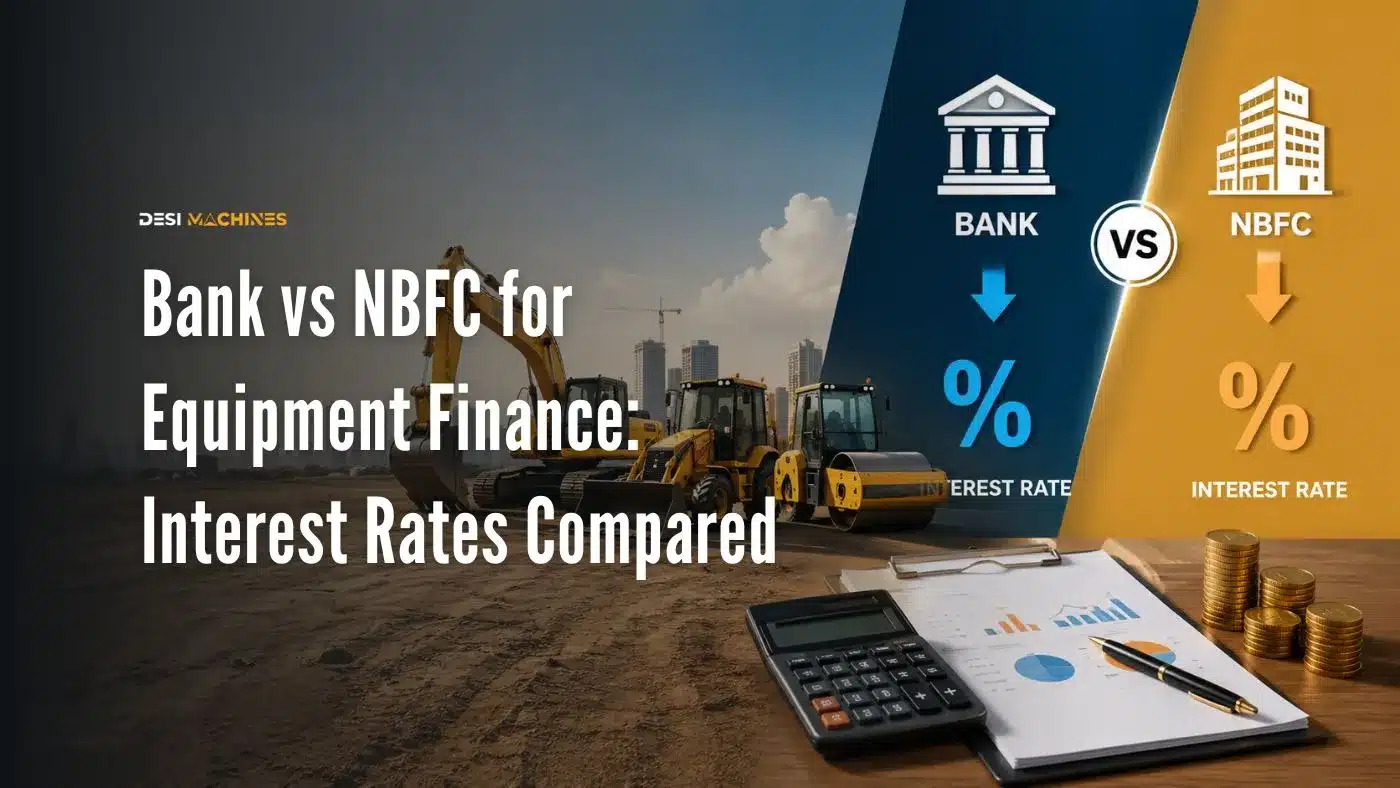
The construction equipment loan interest rate you get is the biggest lever on what a machine really costs. Public-sector banks are cheapest (around 9-12%, indicative) but slow; NBFCs are dearer (around 13-18%) but fast and will fund used machines. Choose a bank if your file is strong and you can wait, an NBFC if you need speed or are buying used, and always count the processing fee, tenure and foreclosure charge, not just the headline rate.
Two buyers, the same 25 lakh backhoe loader. One signs at around 9.5% with a public-sector bank. The other, in a hurry, takes 15% from a financier who cleared the file in a day. The construction equipment loan interest rate each of them was offered looks like a small difference on paper. Over a five-year loan it is worth more than 3 lakh, enough to have bought a decent used compactor.
That gap is the reason this decision matters. Below is a plain comparison of banks and NBFCs for a machine loan, with indicative numbers, so you can walk into the conversation knowing what a fair rate looks like and where each type of lender earns its keep.
What construction equipment loan interest rate to expect
Rates move with the market and with your profile, so treat these as indicative bands, not quotes.
| Lender type | Rate p.a. (indicative) | Processing fee | Funding | Approval speed |
|---|---|---|---|---|
| Public-sector banks | ~9-12% | 0.5-1% | up to ~75-80% | slow (1-3 weeks) |
| Private banks | ~10-13% | 1-2% | up to ~80% | moderate |
| NBFCs / financiers | ~13-18% | 1-3% | up to ~85-90% | fast (1-3 days) |
Read the table as a trade-off, not a ranking. Banks give you the cheapest money and take the longest to say yes. NBFCs give you a fast yes and fund more of the machine, and you pay for both in the rate.
Your own number inside these bands is set by a few things: your CIBIL score and repayment history, how liquid the machine is (a JCB backhoe or a Tata Hitachi excavator resells easily, so it is safer collateral than an odd import), the margin you put in, the tenure you pick, and whether the lender already knows you. Two buyers standing at the same counter rarely get the same rate.
The lenders you will actually choose between
In practice the market splits into three camps, and most of them sit on our equipment finance page.
- Public-sector banks such as SBI, Bank of Baroda, Canara Bank and PNB. Cheapest rates, most paperwork, slowest to move.
- Private banks such as HDFC, ICICI, Axis and Kotak. A little dearer than public banks, usually quicker, stricter on the profile they like.
- NBFCs and equipment financiers such as Sundaram Finance, Cholamandalam, Mahindra Finance, Shriram, Tata Capital and Hinduja Leyland Finance. Dearer on rate, but they understand machines, fund used equipment, and approve files a bank would return.
The names matter less than the category. Know which camp you belong in before you start asking for quotes, and you will not waste a fortnight chasing a bank that was never going to fund your used machine.
Why NBFCs charge more, and when they earn it
An NBFC borrows the money it lends to you, often at a higher cost than a bank pays on its deposits. That cost passes through to your rate. They also take on files a bank turns away, so their book carries more risk, and the pricing reflects it.
None of that makes them the wrong choice. An NBFC is often the right call when:
- You are a first-time buyer with a thin credit history and no machine to show as a track record.
- You are buying a used machine, which many banks quietly avoid.
- You need the money this week because the work has already been awarded.
- You can only manage a small margin and need the lender to fund 85-90% of the cost.
The honest way to use an NBFC is to treat the higher rate as the price of getting started or moving fast, then refinance to a cheaper bank loan once you have a clean repayment record. A good repayment history on a first NBFC loan is what makes the second loan cheap.
Why banks are cheaper, and where they slow you down
Banks price on low-cost deposits, so their rates start lower. If your CIBIL is healthy, your GST returns and bank statements are in order, and you can put in a proper margin, a public-sector or private bank will usually give you the best number in the market.
The catch is the process. Bank files move through more hands, ask for more documents, and can take one to three weeks. On a machine you need on site now, that delay has its own cost. If the work is waiting, the few extra percent from an NBFC can be cheaper than the idle days you spend waiting for a bank to sanction. Run that math before you assume the lowest rate is the cheapest option.
For the paperwork side of a bank file, our guide to a construction equipment loan walks through what to keep ready.
The rate is only half the cost
Buyers fixate on the interest rate and miss the rest of the bill. Three things quietly change what you actually pay:
- Processing fee. One to three percent of the loan, paid upfront. On a 20 lakh loan that is 20,000 to 60,000 before the first EMI.
- Bundled insurance and add-ons. Some lenders fold the first-year premium or a “loan protection” cover into the loan. Sometimes it is fair value, sometimes it is padding. Ask for the number separately.
- Foreclosure charges. If you plan to prepay from a good season’s earnings, a 2-4% foreclosure fee can wipe out the saving. Banks are often gentler here than NBFCs.
Here is the rate difference in rupees. On a 20 lakh loan (after a 20% margin on a 25 lakh machine) over five years, at 10% the EMI is about 42,500 and total interest about 5.5 lakh; at 15% the EMI is about 47,600 and total interest about 8.55 lakh (indicative). That is roughly 3 lakh of extra interest for the same machine, before you count the higher processing fee. Deciding how much down payment or margin money you can manage is what pulls that number down, because a bigger margin means a smaller loan and often a better rate.
How loan tenure changes what you pay
The rate gets all the attention, but the length of the loan quietly decides how much interest you hand over. A longer tenure lowers the monthly EMI, which feels easier, and raises the total interest, which is what actually leaves your pocket. On the same 20 lakh loan at 12% (indicative):
| Tenure | EMI (approx) | Total Interest (approx) |
|---|---|---|
| 3 years | 66,400 | 3.9 lakh |
| 5 years | 44,500 | 6.7 lakh |
| 7 years | 35,300 | 9.65 lakh |
Stretching from three years to seven nearly halves the EMI but more than doubles the interest. The right tenure is the shortest one whose EMI your worst month can still cover. Match the loan to how steadily the machine will earn, not to the lowest EMI on the sheet.
The dealer-finance trap
Most dealers will offer to arrange your loan on the spot, usually through one NBFC they are tied to. It is convenient, the file moves fast, and the machine leaves the yard the same week. It is also, often, not the cheapest money on the table, because the dealer earns a commission on that tie-up.
Take the offer seriously, but treat it as one quote, not the only one. Before you sign, get at least one independent quote of your own, from your bank or from an NBFC you approached directly. If the dealer’s rate matches, fine. If it is a percent or two higher, you now have the number to negotiate with, or to walk to.
How to bring your rate down
You have more room to negotiate than the first quote suggests.
- Fix your CIBIL before you apply. Clear overdues, keep old accounts open, and check the report for errors. A score above 750 moves you into the best band a lender offers.
- Put in more margin. Funding 70% of the machine instead of 90% signals lower risk and earns a lower rate.
- Get quotes in writing. Two or three quotes let you tell each lender what the others offered. This alone is worth a percent or more.
- Use your existing relationship. The bank that holds your current account and sees your daily balances already trusts you. Start there.
- Show a track record. A clean repayment record on an earlier machine is the single strongest thing you can put on the table.
Which lender fits your situation
- First machine, thin file, work already awarded: an NBFC. Take the fast money, keep the record clean, refinance later.
- Established owner, strong CIBIL, buying new: a bank. You have earned the cheapest rate; make them compete for you.
- Buying a used machine: likely an NBFC, since many banks avoid it. Weigh the higher rate against the lower price of the machine, and read our note on new versus used financing, and how a used construction equipment loan is valued and priced, before you decide.
- Buying a backhoe to put straight to work: match the lender to how fast you need it, then pick the machine on our backhoe loader range.
Why the lowest rate may not be the cheapest loan
The lowest rate is not automatically the cheapest loan. Count the processing fee, the tenure, the foreclosure terms, and the cost of any idle days you spend waiting for approval, then decide. If your file is strong and the work can wait, a bank saves you the most. If you need speed or you are buying used, an NBFC earns its higher rate. Either way, get two or three written quotes and compare lenders on our equipment finance page before you sign.
Rates, fees, and schemes change often, and every lender reads a file differently. Treat the numbers here as indicative and confirm the current rate and terms with the bank or NBFC before you sign.
Comparing headline rates only takes you so far. The lender must also hand you a key facts statement carrying the all-in APR, which is the number that actually settles which offer is cheaper.
Rates and fees move with the market. Confirm the current rate, processing fee and foreclosure terms with the bank or NBFC before you sign.