Key Facts
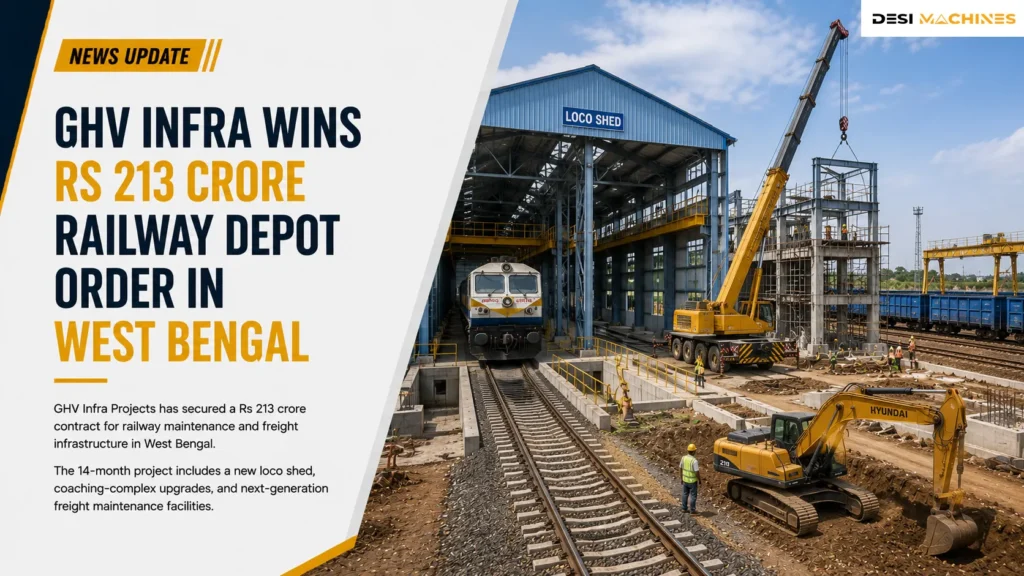
- GHV Infra Projects has won a roughly Rs 213 crore order for railway maintenance and freight infrastructure in West Bengal, disclosed in a stock-exchange filing on 22 June 2026 (reported by Free Press Journal).
- Scope: a new loco shed, upgraded maintenance infrastructure at a coaching complex, and next-generation freight maintenance facilities — bundled as composite civil, electrical, mechanical and signal & telecom (S&T) work.
- Build period: 14 months from the date work officially starts.
- The contract is a related-party deal — the awarder, GHV (India) Pvt Ltd, is promoter-linked to GHV Infra — disclosed as carried out on an arm’s-length basis.
What Happened
GHV Infra Projects told the exchanges on 22 June 2026 that it has bagged a roughly Rs 213 crore order to build and upgrade railway maintenance and freight facilities in West Bengal (reported by Free Press Journal). The work covers three pieces: a new loco shed, maintenance infrastructure at a coaching complex, and next-generation freight maintenance facilities, packaged as composite civil, electrical, mechanical and S&T construction. GHV has 14 months to deliver from the day work starts. The company flagged the order as a related-party transaction — the client, GHV (India) Pvt Ltd, is promoter-linked — carried out, it said, on an arm’s-length basis.
What does a railway-depot order mean for equipment buyers?
A railway-depot package is a different machine job from a highway or a stockyard. Loco sheds, coaching maintenance bays and freight maintenance facilities are building-and-yard work, not bulk earthmoving. The early phase still needs ground preparation — clearing, levelling and compaction for shed floors, inspection pits and approach sidings — so expect a short, sharp pull on mid-size hydraulic excavators, a grader or two and soil compactors, rather than a large fleet. The money sits in the civil and structural phase that follows: deep RCC inspection pits, heavy floors that have to carry locomotives, and long-span steel sheds. That points to concrete equipment — batching plants, transit mixers and concrete pumps — plus mobile and crawler cranes and telehandlers to erect steel and set heavy components. Track-laying and shed crane installation come last and lean on rail-mounted and mobile lifting gear.
The number that matters here is the 14-month clock, not the crore figure. Fourteen months for composite civil-plus-structural-plus-S&T work is a tight, single-site schedule, and tight single-site schedules usually mean contractors hire for the peak rather than buy. That favours rental yards in and around West Bengal that can keep concrete kit, compactors and a crane on near-continuous deployment for a year-plus. For owners, depot work is the kind of steady, weather-protected, milestone-paid job a financed excavator or mixer fleet can be anchored against without chasing work across districts.
DesiMachines view: one Rs 213 crore depot package will not move machine prices, but a fast-track, single-location rail job likely keeps concrete, compaction and crane demand firm locally, and it is a useful read on where railway spending is flowing — into maintenance and freight-handling capacity, not only new lines. Treat the related-party label as a reason to watch execution, not dismiss it: the work is real, but it is an intra-group award, so the actual sub-contracting and mobilisation timeline is what turns it into machine hire.
What to watch:
- Sub-contracting and mobilisation — depot earthwork and civil packages are usually sublet, and that is where machines actually get hired.
- The official start date, which sets the 14-month clock and the earthmoving window.
- Whether GHV’s run of rail orders this year hardens into a steady depot/freight-shed pipeline that rental fleets can plan around.

 Excavator
294 models
Excavator
294 models  Backhoe Loader
51 models
Backhoe Loader
51 models  Crane
68 models
Crane
68 models  Concrete Mixer
79 models
Concrete Mixer
79 models  Wheel Loader
54 models
Wheel Loader
54 models  Compactor / Roller
45 models
Compactor / Roller
45 models  Motor Grader
42 models
Motor Grader
42 models  Concrete Pump
66 models
Concrete Pump
66 models  Skid Steer Loader
11 models
Skid Steer Loader
11 models  Telehandler
13 models
Telehandler
13 models  Dozer
Dozer