Excavator
294 models
Excavator
294 models  Backhoe Loader
51 models
Backhoe Loader
51 models  Crane
68 models
Crane
68 models  Concrete Mixer
79 models
Concrete Mixer
79 models  Wheel Loader
54 models
Wheel Loader
54 models  Compactor / Roller
45 models
Compactor / Roller
45 models  Motor Grader
42 models
Motor Grader
42 models  Concrete Pump
66 models
Concrete Pump
66 models  Skid Steer Loader
11 models
Skid Steer Loader
11 models  Telehandler
13 models
Telehandler
13 models 


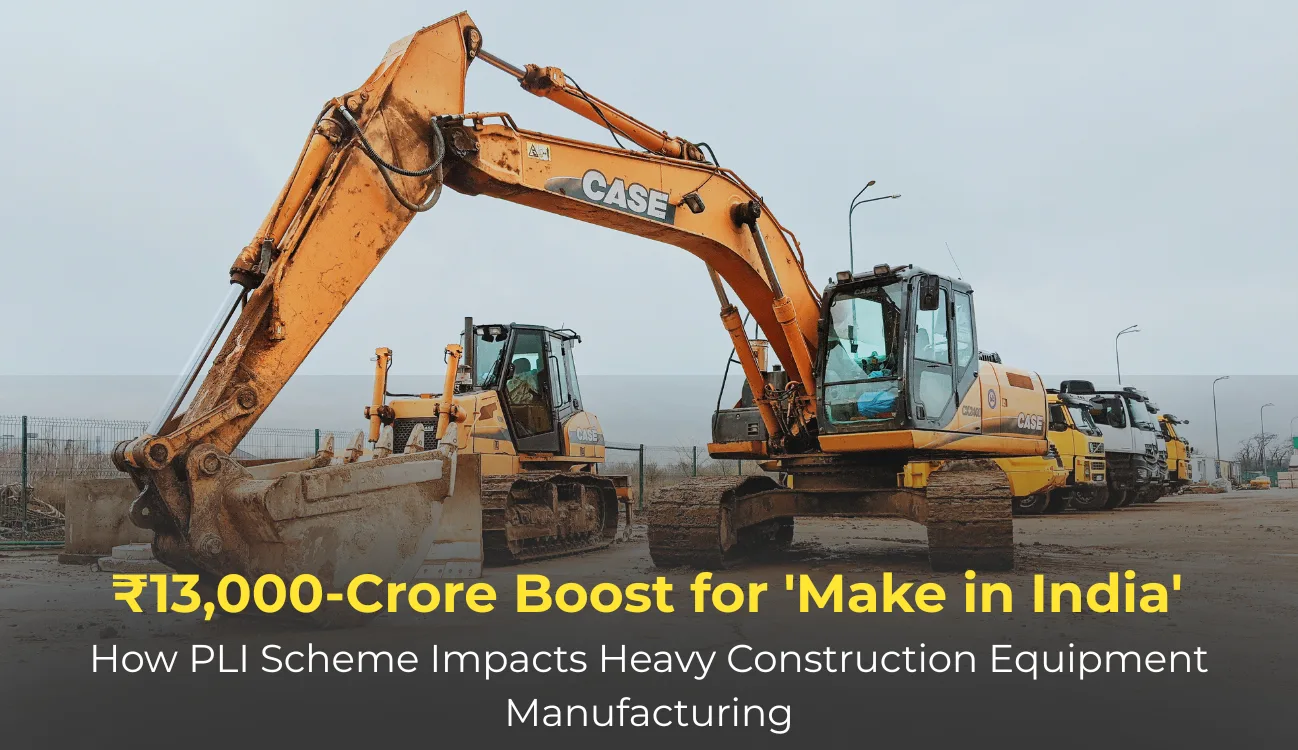
The Indian government is preparing a ₹13,000-crore incentive plan under the PLI scheme to strengthen heavy construction equipment manufacturing. Covering key machinery like tunnel boring machines, cranes, backhoe loaders, and engines, the policy targets 50% domestic value addition to reduce import dependence. Beneficiaries include manufacturers, SMEs, contractors, and fleet owners, with benefits like lower costs, faster availability, and stronger servicing. Supported by Desi Machines, this initiative aligns infrastructure growth, self-reliance, and global competitiveness.
New Delhi: The Indian government will announce a ₹13,000 crore incentive package for the heavy construction equipment sector, a move that will help lessen the nation’s dependence on imported equipment, boost indigenous production, and support the nation’s ambitious agenda for the development of the nation’s infrastructure.
The programme under the Ministry of Heavy Industries (MHI) has been devised and is under inter-ministerial consultations with the ministries of Mines, Commerce & Industry, Finance, NITI Aayog, and the Ministry of New & Renewable Energy. Upon its clearance by the Union Cabinet, it shall be one of the largest policy pushes for the indigenous construction equipment sector ecosystem.
Focus on Critical Machinery
According to Financial Express, the incentive package will cover the high-value segments of equipment, which, though indispensable for the development projects of the country but are now very import-intensive. They include tunnel boring machines (TBMs), ropeway systems, backhoe loaders, tower and crawler cranes, engines, and transmission systems.
It is a performance-linked incentive (PLI) programme wherein manufacturers are remunerated for incremental production and output. The condition of the programme shall be domestic value addition (DVA) of up to 50%, i.e., manufacturers develop a healthy Indian supply system and are not over-dependent on imported parts like engines, control systems, specialty steel, and sensors.
Why the Scheme Matters
The Indian construction equipment market, currently estimated at USD 9.5 billion, is expected to nearly triple by 2030 with the upswing of infrastructure development under initiatives such as Bharatmala, Sagarmala, Gati Shakti, and the National Infrastructure Pipeline.
Nonetheless, excessive dependency on imported materials and parts remains a thorn for manufacturers and contractors, just like their Chinese counterparts. For instance, sophisticated tunnel boring machines and special-purpose cranes are imported at hefty prices, escalating project costs and prolonging timelines.
The proposed ₹13,000-crore package aims to:
- Reduce dependency on imports through encouraging indigenous development and manufacturing of parts.
- Help indigenous players like JCB India, Tata Hitachi, Ashok Leyland, ACE (Action Construction Equipment), and Cummins India increase their capacities.
- Improve cost competitiveness through reduced logistics costs, duties on imports, and risk of foreign exchange.
- Encourage innovations for the sustainability and energy efficiency of heavy construction equipment.
Know More: Global Heavy Construction Equipment Market to Trends
Expected Impact on Stakeholders
Industry executives think the program can trigger a multiplier effect across the overall system from manufacturers, through the contractors, to the fleet owners.
- Manufacturers: They will receive incentives for increasing their manufacturing capacity, investing more in R&D, and indigenising the components.
- Component suppliers: The need for 50% value addition for the country will create SME opportunities for sensors, hydraulic, and steel alloy sectors.
- Fleet owners and contractors: Purchase and maintenance costs will decline with increased accessibility within the region, and the servicing networks will be strengthened.
- Infrastructure projects: Rapid accessibility of heavy construction machinery like TBMs and cranes will accelerate project completion and shorten delays.
Industry Reaction
Industry leaders have welcomed the proposal, noting that it comes at a crucial time when demand for heavy equipment is surging in India’s fast-growing construction sector. Companies with significant domestic operations are expected to benefit the most, while multinational OEMs may need to deepen their localisation strategies to qualify for incentives.
According to Financial Express, government officials expect that by strengthening local manufacturing, India can emerge as a global hub for construction equipment exports over the next decade.
Key Issues to Watch
The scheme could reshape domestic manufacturing, but the trade is watching several things closely:
- Cabinet Approval & Implementation: The Cabinet’s final decision on eligibility, timelines, and incentive slabs will determine industry uptake.
- Measuring Domestic Value Addition: Clear guidelines on calculating the 50% local content will be essential to ensure transparency and compliance.
- Supply Chain Development: Success depends on whether local suppliers can quickly scale up to meet demand for high-quality components.
- Infrastructure for Testing & Standards: Establishing R&D and testing facilities will be vital to ensure machines meet international quality and safety benchmarks.
Role of Desi Machines
For contractors, builders, and fleet owners, such policy changes sound complex. That is where Desi Machines enters the scenario.
As India’s trusted platform for heavy construction equipment, we provide:
- Comprehensive comparisons of excavators, cranes, loaders, and other machinery.
- Transparent insights into specifications, prices, applications, and prospects of ROI.
- Guidance on the availability of models in India, including whether they fall under incentive-eligible categories.
- Financing and insurance provider access for the purposes of facilitating investment decisions through the end-to-end solutions.
With over a decade of expertise in the sector, Desi Machines is uniquely positioned to guide contractors through this new era where domestic policy and heavy equipment procurement intersect.
Conclusion
The government’s proposed ₹13,000-crore incentive plan for the construction equipment industry is a strategic step to align India’s infrastructure growth with domestic manufacturing capabilities. By focusing on localisation, reducing import dependence, and incentivising production, the scheme is expected to accelerate the country’s journey towards self-reliance in heavy construction equipment.
For buyers, the practical read is that nothing changes at the counter yet: the scheme is at proposal stage, the machinery lists and value-addition thresholds are not notified, and no dealer can price a PLI benefit into a quotation today. What it does signal is the direction of travel on locally built backhoe loaders, excavators and cranes over the next few years.
When the policy framework emerges, the fleet owners, builders, and contractors will need to evolve into new procurement and operational opportunities. At Desi Machines, we are committed to clarity, comparisons, and insights with the help of which every purchase of heavy equipment is future-proof, compliant, and profitable.
The PLI scheme for construction equipment remains at proposal stage; figures below are as reported and are not yet notified policy.
Scheme coverage, incentive rates and eligibility are not finalised. Confirm the current status and any applicable benefit with the dealer, OEM or the official source before you factor it into a purchase.