Excavator
294 models
Excavator
294 models  Backhoe Loader
51 models
Backhoe Loader
51 models  Crane
68 models
Crane
68 models  Concrete Mixer
79 models
Concrete Mixer
79 models  Wheel Loader
54 models
Wheel Loader
54 models  Compactor / Roller
45 models
Compactor / Roller
45 models  Motor Grader
42 models
Motor Grader
42 models  Dozer
41 models
Dozer
41 models  Concrete Pump
66 models
Concrete Pump
66 models  Skid Steer Loader
11 models
Skid Steer Loader
11 models  Telehandler
13 models
Telehandler
13 models 


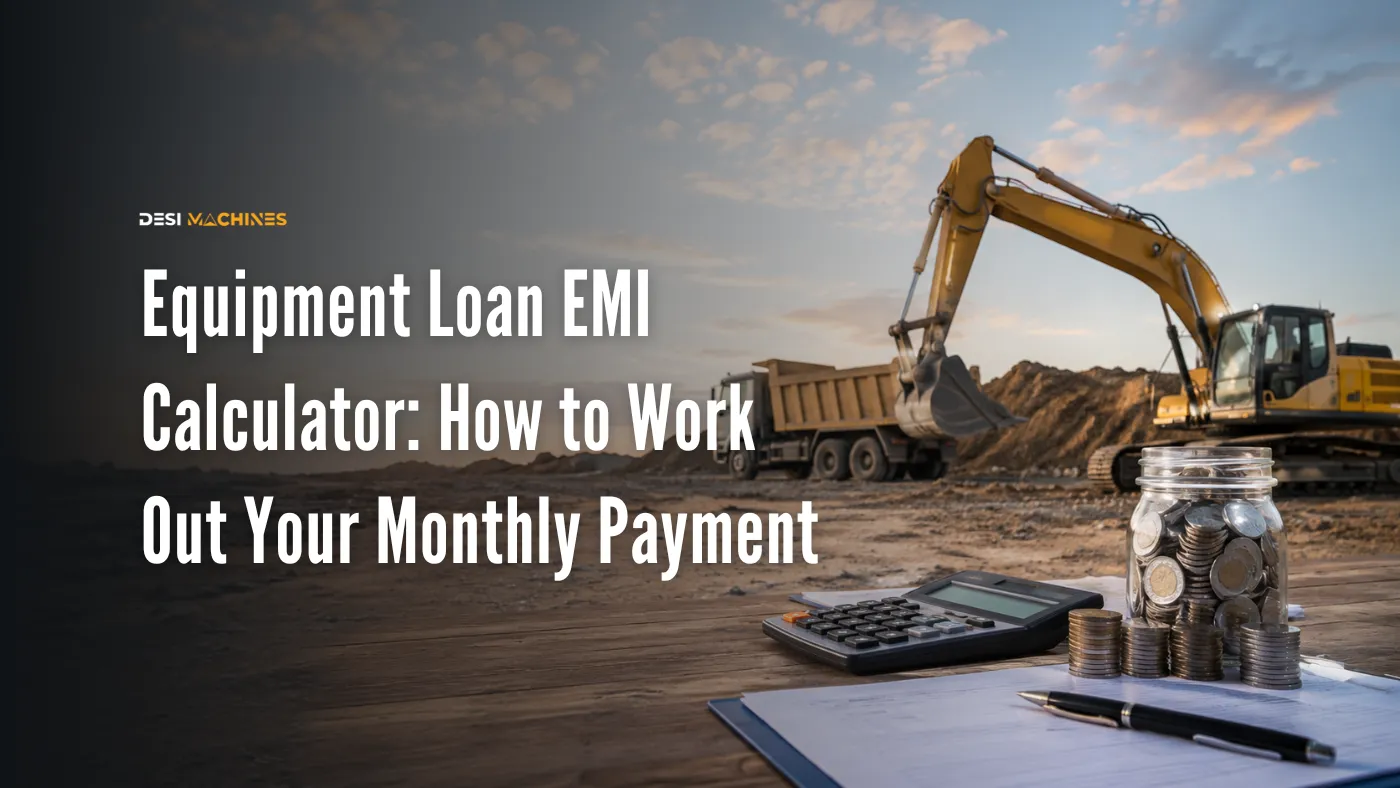
You do not need an equipment loan EMI calculator to sanity-check a dealer’s figure — you need one number. At 12% reducing over 5 years, every 1 lakh you borrow costs about Rs 2,224 a month (indicative, as of July 2026). So a 25 lakh machinery loan is roughly 25 x 2,224 = about Rs 55,600 a month. This guide gives you the formula, a ready per-lakh table for 10-14% and 3-7 years, worked JCB and excavator examples, and the two traps — flat-rate quotes and over-long tenures — that make an EMI look cheaper than it really is.
Every figure in the tables below was re-derived from the reducing-balance formula on this date.
When you sit at a dealer’s finance desk, the monthly EMI is the number everyone talks about — and the one that is easiest to dress up. A longer tenure or a “flat” rate can make a big loan feel affordable, right up until you add the total you actually repay. Knowing how to calculate an equipment loan EMI yourself, in your head or on a phone, means the finance desk can no longer set the terms for you. Here is the whole method.
How an equipment loan EMI calculator actually works
Every equipment loan EMI calculator runs the same reducing-balance formula:
EMI = P × r × (1+r)^n ÷ ((1+r)^n − 1)
Here P is the loan amount, r is the monthly interest rate (the annual rate divided by 12, then by 100), and n is the number of monthly instalments. On a 20 lakh loan at 12% for 5 years, r is 0.01 and n is 60, and the formula gives about Rs 44,500 a month. You will rarely do this by hand — but understanding it tells you exactly which three levers move your EMI: the amount you borrow, the interest rate, and the tenure.
The one number to remember: EMI per lakh
The fastest way to check any quote is the EMI per 1 lakh borrowed. Find your rate and tenure in the table, then multiply by the number of lakhs in your loan. These are indicative figures as of July 2026 for a reducing-balance loan:
| Interest rate (reducing) | 3 years | 5 years | 7 years |
|---|---|---|---|
| 10% | Rs 3,227 | Rs 2,125 | Rs 1,660 |
| 12% | Rs 3,321 | Rs 2,224 | Rs 1,765 |
| 14% | Rs 3,418 | Rs 2,327 | Rs 1,874 |
So a 25 lakh loan at 12% over 5 years is 25 × Rs 2,224 = about Rs 55,600 a month. A 40 lakh loan at 12% over 7 years is 40 × Rs 1,765 = about Rs 70,600 a month. Keep this table on your phone and no dealer’s monthly figure can surprise you.
Worked example: financing a backhoe loader
Say you finance a backhoe loader and, after your margin money, borrow 25 lakh (indicative). Here is how the same loan looks across three tenures at 12%:
| Tenure | Monthly EMI | Total interest paid |
|---|---|---|
| 3 years | Rs 83,025 | ~Rs 4.9 Lakh |
| 5 years | Rs 55,600 | ~Rs 8.4 Lakh |
| 7 years | Rs 44,125 | ~Rs 12.1 Lakh |
The 7-year loan saves you about Rs 11,500 a month against the 5-year one — real breathing room for a first machine — but it costs roughly Rs 3.7 Lakh more in interest over the loan. There is no free lunch: a lower EMI almost always means more total interest. Match the tenure to how fast the machine will actually earn, not to the smallest monthly figure. Our breakdown of the real cost of owning a machine shows why the EMI is only one line in the monthly bill.
Worked example: financing a 20-tonne excavator
The same arithmetic scales straight up to a bigger machine. A 20-tonne class crawler excavator lists on our catalogue at roughly ₹52 Lakh to ₹88 Lakh depending on brand and variant (indicative, as of 19 August 2026), so a buyer putting down about a quarter of the cost is commonly borrowing around ₹50 Lakh. Run that through the same per-lakh table at 12%:
- 5 years: 50 × ₹2,224 = about ₹1,11,200 a month, with roughly ₹16.7 Lakh of total interest.
- 7 years: 50 × ₹1,765 = about ₹88,250 a month, with roughly ₹24.1 Lakh of total interest.
The pattern is identical to the backhoe loader above, just with a bigger number on every line: the longer tenure takes about ₹23,000 a month off the EMI and adds roughly ₹7.4 Lakh to what you finally repay. That is why the tenure question gets harder, not easier, as the machine gets bigger — and why it is worth checking the full cost of owning an excavator before you fix it, since the EMI is only one line in the monthly bill.
Trap one: a “flat” rate is not what it looks like
A dealer may quote a “flat” rate that sounds far lower than the bank’s — 7% instead of 12%. A flat rate charges interest on the full loan amount for the entire tenure, while a reducing-balance rate charges only on the amount still outstanding, which falls every month. They are not the same thing. As a rough rule for a 5-year loan, a flat rate works out close to 1.8 times the equivalent reducing rate — so a 7% flat quote is really around a 13% reducing loan. Always ask for the reducing-balance rate and the total amount payable, and compare those, never the flat headline. Our comparison of bank versus NBFC equipment finance rates shows the going reducing rates so you have a benchmark.
Trap two: the EMI you can afford is not the loan you can afford
It is tempting to pick the tenure that fits the EMI into your monthly budget. But an equipment loan runs alongside diesel, operator wages, maintenance and the gaps when a client pays late. A safe habit is to keep the EMI within a share of the machine’s earning that still leaves you covered through a slow month. Before you fix the tenure, be sure the machine’s realistic monthly earning comfortably clears the EMI plus running costs — the whole point of the loan versus lease versus cash decision is to protect your cash flow, not just to own the asset.
What decides the rate you are actually offered
The table assumes a rate, but the rate you get depends on you. The main levers are your CIBIL score, your margin money, the lender (banks are usually cheaper than NBFCs but stricter), whether the machine is new or used, and your existing relationship with the bank. A stronger CIBIL score for a machinery loan and a larger down payment together can shift your rate by a couple of points — which, on a 25 lakh loan, is worth more than any haggle over the machine price. If you are getting your file ready, the documents and eligibility checklist and the guidance on how much down payment you need are the next two things to read, alongside working out how much total capital your first machine needs.
Price any EMI quote with the per-lakh number
You do not need an app to check an equipment loan EMI — you need the per-lakh number and two habits. Remember that at 12% over 5 years each 1 lakh borrowed costs about Rs 2,224 a month, multiply by your loan in lakhs, and you can price any quote on the spot. Then insist on the reducing-balance rate over the flat one, and choose the tenure that matches how fast the machine earns rather than the one with the smallest EMI. The monthly figure is where dealers dress up a loan, so it is the number worth calculating yourself.
Ready to line up the real numbers? Compare current equipment finance rates and terms, check the live prices on a backhoe loader like the JCB 3DX Plus, and walk into the dealership knowing your EMI before they tell you theirs.
Interest rates, EMIs, schemes and prices are indicative, change constantly, and vary by lender, profile, variant and date. The figures here are indicative as of July 2026 and are illustrative arithmetic, not an offer — always confirm the exact rate, EMI and total payable with the bank or NBFC before any borrowing decision. DesiMachines is not liable for decisions taken on the basis of information that may have changed after publication.