Excavator
294 models
Excavator
294 models  Backhoe Loader
51 models
Backhoe Loader
51 models  Crane
68 models
Crane
68 models  Concrete Mixer
79 models
Concrete Mixer
79 models  Wheel Loader
54 models
Wheel Loader
54 models  Compactor / Roller
45 models
Compactor / Roller
45 models  Motor Grader
42 models
Motor Grader
42 models  Dozer
41 models
Dozer
41 models  Concrete Pump
66 models
Concrete Pump
66 models  Skid Steer Loader
11 models
Skid Steer Loader
11 models  Telehandler
13 models
Telehandler
13 models 


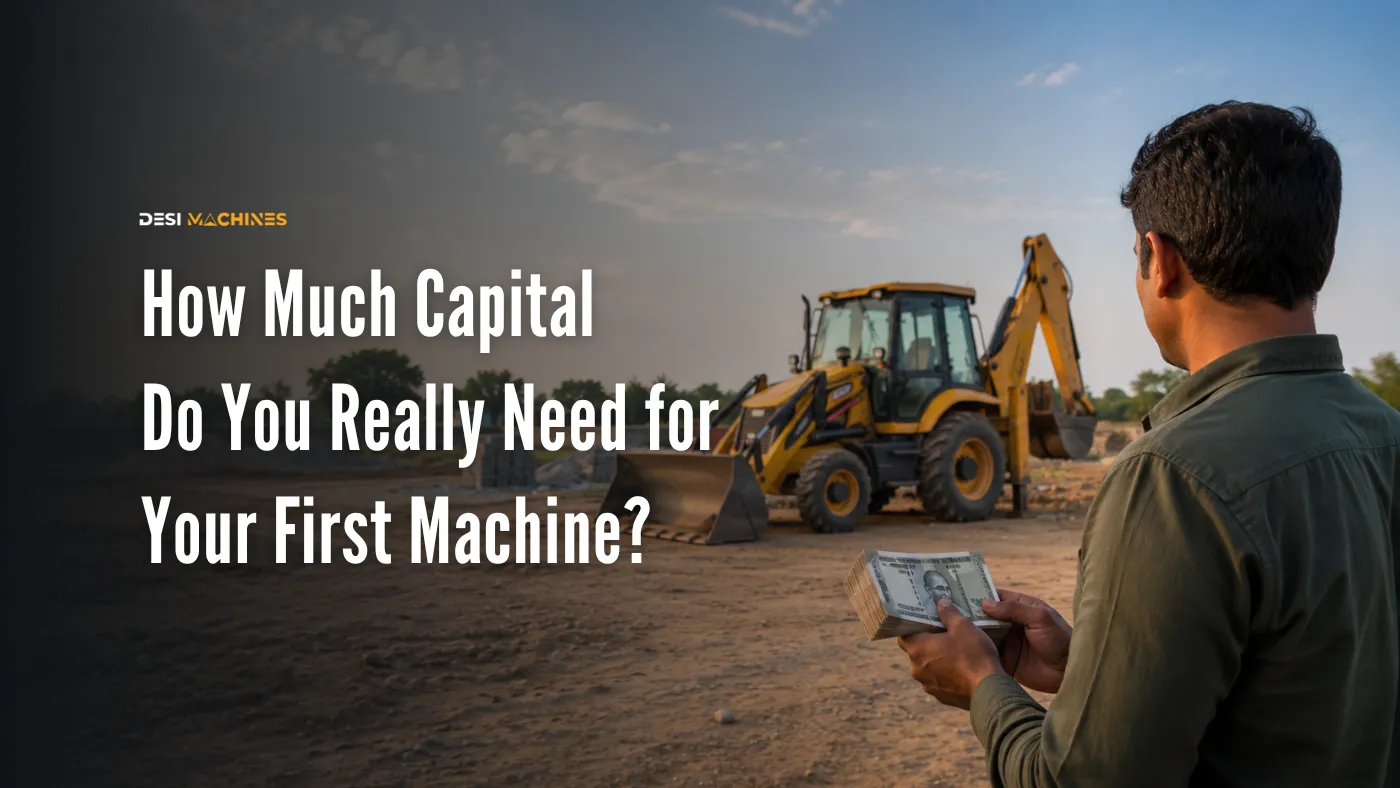
The capital to buy JCB or excavator machines for your first job is far more than the down payment. On an indicative 30-35 Lakh on-road backhoe loader (as of July 2026), the margin money alone is about 5-8 Lakh — but once you add first-year insurance, registration, transport and, most importantly, a working-capital buffer of 2-4 Lakh for the months before clients pay, the honest upfront cash need is closer to an indicative 8-13 Lakh. Budget for the buffer, not just the down payment, and your first machine will not stall for want of cash.
Watch: what a first machine really costs you, in two minutes
Key moments: 0:15 meet Aman, who decided with care · 0:31 which machine to start with · 1:06 the EMI cushion · 1:27 three checks before you buy.
Most first-time buyers ask one question: how much is the down payment? It is the wrong first question. If you are working out the capital to buy JCB or excavator machines for the first time, the number that decides whether you survive the first year is not the margin money — it is everything you need after it, while the machine is working but the payments have not yet come in. Here is the full picture, in the order the cash actually leaves your account.
The capital to buy JCB machines is more than the down payment
Equipment lenders typically fund 70-85% of a machine’s value, so you arrange the rest as margin money. On an indicative 30-35 Lakh on-road backhoe loader, that is about 5-8 Lakh upfront before the loan is even released. A bigger margin lowers your EMI and your total interest, so fund as much as you sensibly can — the detail is in our guide to how much down payment you need. But treat the margin as the start of the budget, not the whole of it.
The on-road extras most quotes bury
Between the ex-showroom price and a working machine sit several charges that are easy to forget when you are focused on the EMI:
| Cost | Indicative amount (Jul 2026) | Notes |
|---|---|---|
| Margin money (15-30%) | Rs 5-8 Lakh | Paid before the loan is released |
| First-year insurance | Rs 40,000-80,000 | Comprehensive cover; varies by machine and location |
| Registration / RTO (where applicable) | Varies | Depends on the machine class and state |
| Transport / delivery | Rs 15,000-50,000 | Distance from dealer yard to your site |
| Early spares / contingency | Rs 50,000-1 Lakh | First consumables and a small repair cushion |
None of these are optional in practice, and together they add an indicative 1.5-2.5 Lakh on top of the margin money. Getting an itemised quotation, and knowing which lines can be trimmed, is exactly what our guide to reading and negotiating a dealer quotation is for.
The working-capital buffer: the part that sinks first-timers
This is the number nobody quotes you, and the one that matters most. Your machine starts working, but in Indian construction and hire work, clients pay 30-90 days late, and a slice of the bill is often held back as retention. Meanwhile diesel, operator wages, routine maintenance and — critically — your first EMIs all fall due on time. If the earnings have not arrived and you have no cushion, you are paying EMIs on a machine that is working but has not yet paid you back.
A safe habit is to set aside enough to cover 2-3 months of EMI plus running costs before any money comes in. On a first backhoe with an EMI of around Rs 55,000-58,000 (learn to calculate your equipment loan EMI) plus diesel, operator and upkeep, that is an indicative 2-4 Lakh kept completely separate from your down payment. Understanding the full monthly bill — not just the EMI — is why the real cost of owning a machine is worth reading before you sign.
Adding it up: the honest first-machine number
Put the three parts together for an indicative 30-35 Lakh backhoe loader, and the upfront capital looks like this:
| Part of the budget | Indicative cash need |
|---|---|
| Margin money | Rs 5-8 Lakh |
| On-road extras (insurance, transport, spares) | Rs 1.5-2.5 Lakh |
| Working-capital buffer | Rs 2-4 Lakh |
| Total upfront capital | ~Rs 8-13 Lakh |
So the real capital to buy a first machine is roughly double the margin money — an indicative 8-13 Lakh, not the 5-8 Lakh a dealer’s EMI pitch implies. This is why so many well-financed first-timers still stall: they arranged the down payment and nothing behind it.
How to fund it without over-borrowing
You have three levers, and the goal is to enter with enough cushion to survive the first slow month. Structure the loan so the loan, lease or cash choice protects your cash flow; check the live on-road price so your margin estimate is real — the JCB 3DX Plus and similar backhoes are a useful reference point; and get your machine insurance quote early so it is in the budget, not a surprise. First-time buyers should walk through the whole journey once in our first machine buyer’s roadmap before committing any capital.
Size your first machine on total capital, not down payment
Do not size your first machine on the down payment. The capital you actually need is the margin money, plus the on-road extras, plus a working-capital buffer big enough to carry the EMIs and running costs through the months before clients pay — an indicative 8-13 Lakh on a 30-35 Lakh backhoe, as of July 2026. The buffer is not caution for its own sake; it is what keeps a working machine from becoming a monthly loss while you wait to be paid. Budget for it first, and everything else in the purchase becomes easier.
Ready to put real numbers to it? Line up your equipment finance options, check the live price of a backhoe like the JCB 3DX Plus, and plan your buffer before you sign — so your first machine earns from day one instead of draining you.
Prices, costs, insurance and finance terms are indicative, change constantly, and vary by machine, variant, location and date. The figures here are indicative as of July 2026 and are illustrative estimates, not quotes — always confirm current prices and terms with our team, lender or insurer before any purchase decision. DesiMachines is not liable for decisions taken on the basis of information that may have changed after publication.
What “a 30-35 Lakh backhoe” actually means on our catalogue
The bands above are deliberately generic. These are the machines behind them, with indicative ex-showroom prices from our own listings — on-road cost sits above these once insurance, registration and transport are added.
| Machine | Indicative ex-showroom | Indicative margin money (15-30%) |
|---|---|---|
| JCB 3DX | Rs 30-32 lakh | Rs 4.5-9.6 lakh |
| JCB 3DX Plus | Rs 35-39 lakh | Rs 5.3-11.7 lakh |
| JCB 4DX | Rs 36-40 lakh | Rs 5.4-12 lakh |
| CASE 770 NX | Rs 33-36 lakh | Rs 5-10.8 lakh |
Compare the shortlist in the comparison tool, see the full backhoe loader range, or size the EMI on the equipment finance page.
Prices above are indicative ex-showroom ranges as of 16 August 2026 and vary by variant, state levies, attachments and dealer. Confirm the current on-road price, margin money and loan terms with the dealer or OEM before you buy.