Excavator
294 models
Excavator
294 models  Backhoe Loader
51 models
Backhoe Loader
51 models  Crane
68 models
Crane
68 models  Concrete Mixer
79 models
Concrete Mixer
79 models  Wheel Loader
54 models
Wheel Loader
54 models  Compactor / Roller
45 models
Compactor / Roller
45 models  Motor Grader
42 models
Motor Grader
42 models  Dozer
41 models
Dozer
41 models  Concrete Pump
66 models
Concrete Pump
66 models  Skid Steer Loader
11 models
Skid Steer Loader
11 models  Telehandler
13 models
Telehandler
13 models 


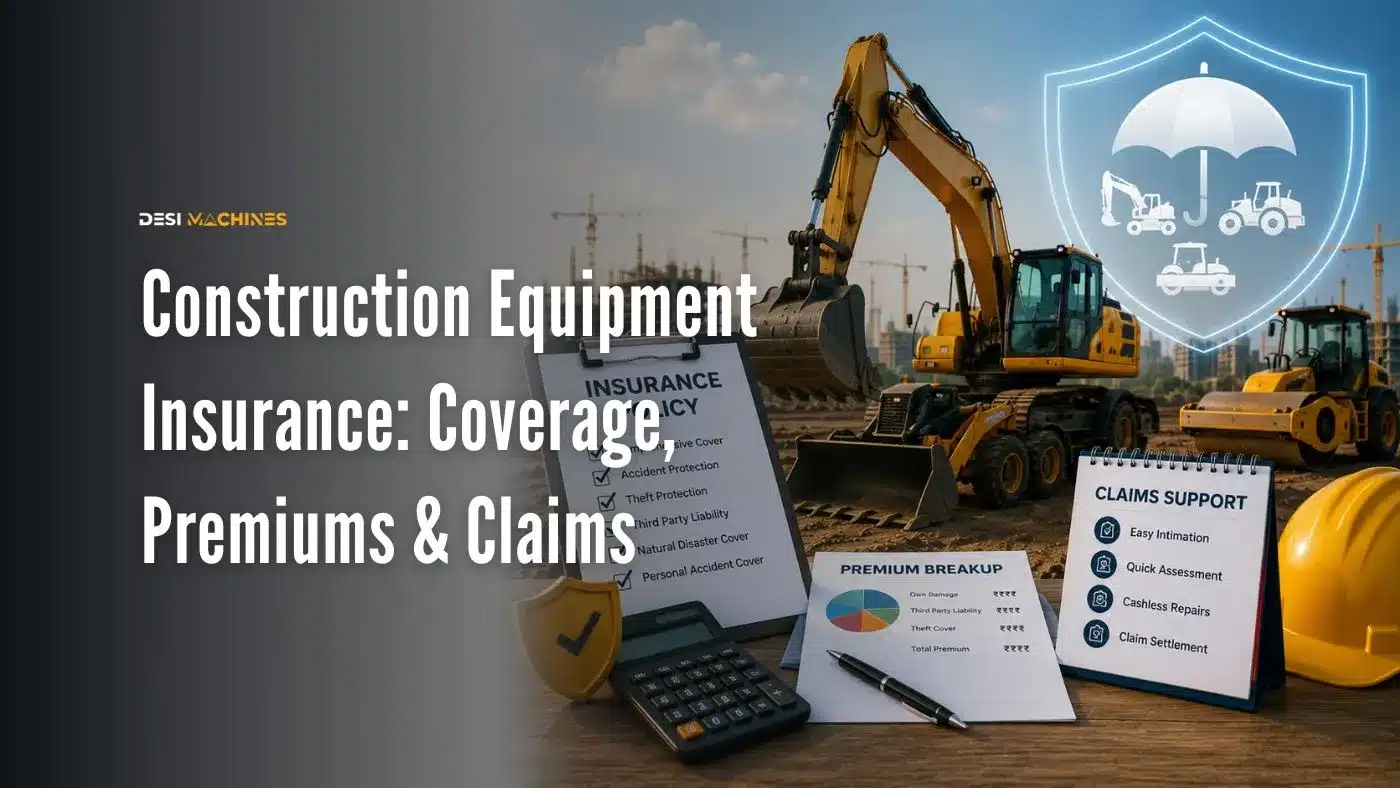
The core of construction equipment insurance in India is a Contractors Plant and Machinery (CPM) policy that pays for accidental damage, fire, theft and natural events to your own machine. A road-registered machine also needs motor third-party cover by law. Premiums run from a fraction of a percent up to around 2% of the machine’s insured value a year for general construction use, and towards 3% on mining, quarry and flood-prone deployments (indicative), and most claims that get rejected fail on avoidable gaps, not on the insurer being difficult. Insure for the right value, read the exclusions, and report any incident the same day.
Premium bands on this page and on our construction equipment insurance premium guide were reconciled on this date so both quote the same range.
A machine is the single biggest asset most contractors own, and it works in the roughest conditions any asset can: mud, dust, night shifts, rented operators, sites far from home. One overturn, one site fire, one theft off a compound wall, and the machine that funds the business becomes a liability with an EMI still running against it. Insurance is the line between a bad week and a ruined year.
Yet insurance is where owners spend the least time. The policy gets bought because the bank asked for it, filed away, and never read until a claim goes wrong. This guide takes the owner’s view: which cover your machine actually needs, what you are paying for, what decides the premium, and how to get a claim paid instead of rejected. Every figure here is indicative and varies by insurer, so treat it as a way to judge a quote, not a fixed price.
What construction equipment insurance actually covers
There is no single “machine policy”. What owners loosely call construction equipment insurance is usually a bundle of covers, and knowing which one does what is how you avoid paying for overlap or leaving a real gap open. These are the ones that matter to a machine owner.
| Cover | What it protects | Who needs it |
|---|---|---|
| CPM (Contractors Plant & Machinery) | Your own machine: accident, fire, theft, flood, storm, in use or at rest, in transit | Every owner |
| Motor insurance | A road-registered machine on public roads: third-party liability (mandatory) and optional own-damage | Road-going machines |
| CAR / EAR (Contractors / Erection All Risk) | A whole construction or erection project, material damage plus third party | Project contractors |
| Third-party liability add-on | Injury or property damage the machine causes to others on site | Most owners |
| Transit / marine cover | The machine while being moved on a trailer between sites | Owners who relocate machines |
| Workmen’s Compensation | Your operator and site staff for injury on the job | Owners with employees |
For most single-machine owners the workhorse is CPM. It follows the machine through its working life: on the job, parked at site overnight, under service, and in transit within the geographical limits named in the policy. Add a third-party liability section and, if the machine drives on public roads, a motor policy, and you have covered the situations that actually bankrupt owners. CAR and EAR are project-level policies a main contractor buys, not something a machine owner needs unless you are running the project yourself.
CPM vs CAR: the difference owners get wrong
This trips up first-time buyers, so it is worth being plain. A CPM policy insures the machine as an asset, no matter which site it works on this month. A CAR policy insures a specific construction project, the building or road being built, for its duration. If you own an excavator and hire it out across three sites in a year, you want CPM, because it moves with the machine. If you are the contractor building a single flyover, CAR covers that job. Owning a machine and running a project are two different exposures, and buying the wrong one leaves the real risk uninsured.
The related trap is thinking your machine is covered under the main contractor’s project policy. Sometimes a hired-in machine is named on the contractor’s CAR policy, often it is not, and even when it is, the cover may end the day your machine leaves that site. Never assume. If a contractor says “you’re covered under our policy”, get it in writing with the machine listed, or keep your own CPM running regardless.
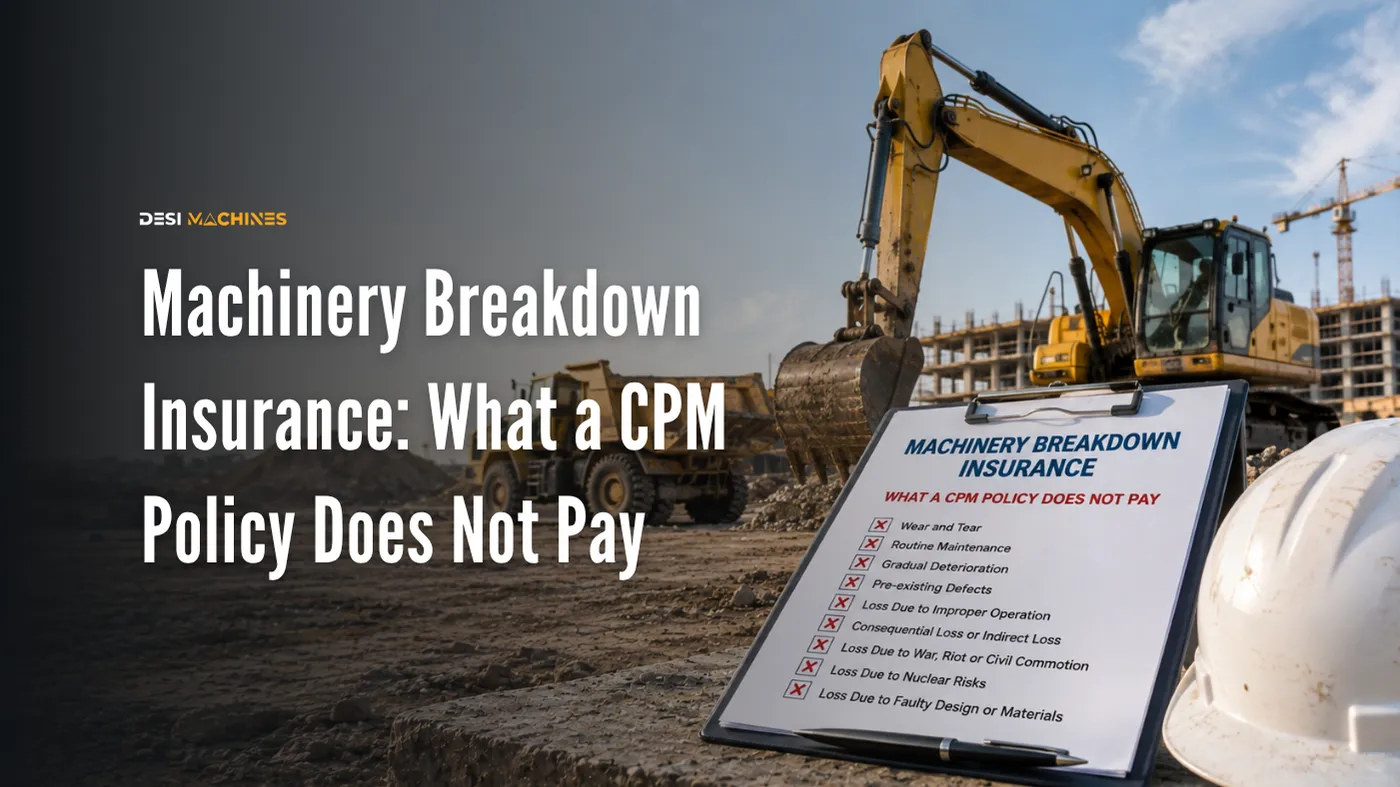
One gap is worth naming before you read further: a CPM policy excludes internal mechanical and electrical breakdown, which is a separate cover. What each policy will and will not pay is set out in machinery breakdown insurance.
What decides your premium
The premium on a machinery policy is a percentage of the Insured Declared Value (IDV), the agreed current value of the machine. As an indicative range it sits anywhere from a fraction of a percent to around 2% of IDV a year for general construction work, rising towards 3% where the machine works mining, quarry, heavy-rock or flood-prone ground. On a machine insured for ₹30 Lakh (indicative), that is roughly ₹15,000 to ₹60,000 a year on ordinary sites, and up to about ₹90,000 a year at the top of the risk band. Where you land inside that range is driven by a handful of factors, and several of them you control.
- Machine type and age. A new excavator on a settled site is cheaper to insure than an old, hard-run one. Age and depreciation push the rate up as the machine gets riskier.
- Where and how it works. Mining, tunnelling, coastal and flood-prone sites carry higher rates than general urban construction. The insurer prices the ground the machine stands on.
- IDV you declare. A higher insured value means a higher premium, but under-declaring to save money leaves you short at claim time. For every lever that moves the number and how to lower it safely, see what decides your construction equipment insurance premium. Match the IDV to the honest market value.
- Add-ons chosen. Third-party liability, transit cover, and cover for the machine while in actual operation each add to the base premium. Buy the ones your exposure needs, skip the ones it does not.
- Claims history and voluntary excess. A clean record earns a better rate. Agreeing to bear a bigger share of each claim (a higher voluntary excess) lowers the premium, which suits owners who can absorb small losses themselves.
The lever most owners ignore is the excess. If you can comfortably pay the first slice of any claim, a higher voluntary excess trims the yearly premium and keeps you out of the habit of filing tiny claims that spoil your record for the loss that really matters.
How to get a claim paid, not rejected
Owners rarely complain about the premium. They complain about the claim, and almost always the story is the same: the machine was insured, something happened, and the insurer said no. Dig into most rejections and they come down to a small set of avoidable gaps.
- Used outside the policy terms. The machine worked outside the geographical area named, or was put to a use the policy did not cover. The cover is written for specific conditions; step outside them and it lapses for that event.
- Unlicensed or unauthorised operator. If a rented or untrained operator was at the controls when the machine is meant to be run by a licensed one, the insurer can decline.
- Late reporting. Most policies require you to inform the insurer within a set window, often 24 to 48 hours. A theft reported a week later, after you tried to trace the machine yourself, is a common reason for a “no”.
- Pre-existing damage or wear and tear. CPM covers sudden accidents, not the slow decay of a neglected machine. A failure that was building for months reads as maintenance, not an insured event.
- An exclusion you never read. Every policy lists what it will not pay for. The rejection was written into the wording on day one; the owner just never looked.
The habits that keep a claim payable are unglamorous. Insure for the correct IDV. Use licensed operators and keep their records. Service the machine and keep the log. The moment anything happens, an accident, a fire, a theft, tell the insurer that day and file an FIR for theft before you do anything else. Photograph the damage at the scene. A clean, prompt, documented claim is very hard for an insurer to turn down. For the detail on this, our guide to reading the numbers behind a machine loan shows how the same discipline of keeping clean records pays off across the whole ownership, not just at claim time.
Reading IDV, excess and exclusions before you sign
Three lines in the policy schedule decide whether the cover is real or hollow, and they are the three most owners skip.
IDV is what the insurer pays if the machine is stolen or written off. It is the current market value, not your purchase price, and it falls every year as the machine depreciates. Set it too low to shave the premium and you are quietly underinsured, so a total loss pays out less than a replacement costs. Set it too high and you still only get the market value, having paid extra for nothing. Declare the honest value.
Excess (or deductible) is the share of every claim you bear yourself. There is usually a compulsory excess you cannot avoid and a voluntary one you can raise to cut the premium. Know both, because a “cheap” policy sometimes hides a heavy compulsory excess that makes small claims not worth filing.
Exclusions are the list of what the policy will not pay for, common ones being mechanical or electrical breakdown, wear and tear, war and nuclear risks, and consequential loss such as the income you lose while the machine is off the road. You cannot remove exclusions, but you can know them, and sometimes buy an add-on that fills a gap that matters, like cover while the machine is in actual operation.
Bundling finance and insurance
When you finance a machine, the lender will require it stays insured for the loan tenure, and will often offer to arrange the policy with the loan. Bundling is convenient, one signature instead of two, but convenience has a cost: a lender-arranged policy is not always the cheapest or the best-fit cover, and you may be paying for it inside the EMI without ever comparing it. It is worth getting one independent quote of your own before you accept the bundled one, then choosing on merit. If you are still deciding how to fund the machine, our guide to loan versus lease versus cash covers where insurance fits into each route, and you can line up a lender directly on our equipment finance page.
Cover a machine needs beyond the bank checklist
Construction equipment insurance is not one product to tick off a bank’s checklist. It is a CPM policy at the core, a motor policy if the machine goes on the road, a third-party section, and transit cover if you relocate, sized to how your machine actually works. Insure for the right value, read the excess and exclusions before you sign, use licensed operators, and report any incident the same day. Do that and the policy does its job on the worst day of your working year. To match cover to your machine and compare what insurers offer, start on our construction equipment insurance page, and if you are buying your first machine, read our first machine buyer’s roadmap so insurance is planned in from day one rather than bolted on after. You can browse the machines this cover protects across the excavator and backhoe loader ranges.
Policy terms, premiums, IDV, exclusions and claim rules change between insurers and over time, and every claim is judged on its own facts. Treat the figures here as indicative and confirm the current cover, premium and conditions with your insurer or a licensed insurance advisor before you decide.