Excavator
316 models
 Backhoe Loader
54 models
 Crane
68 models
 Concrete Mixer
79 models
 Wheel Loader
54 models
 Compactor / Roller
45 models
 Motor Grader
42 models

 Concrete Pump
66 models
 Skid Steer Loader
11 models


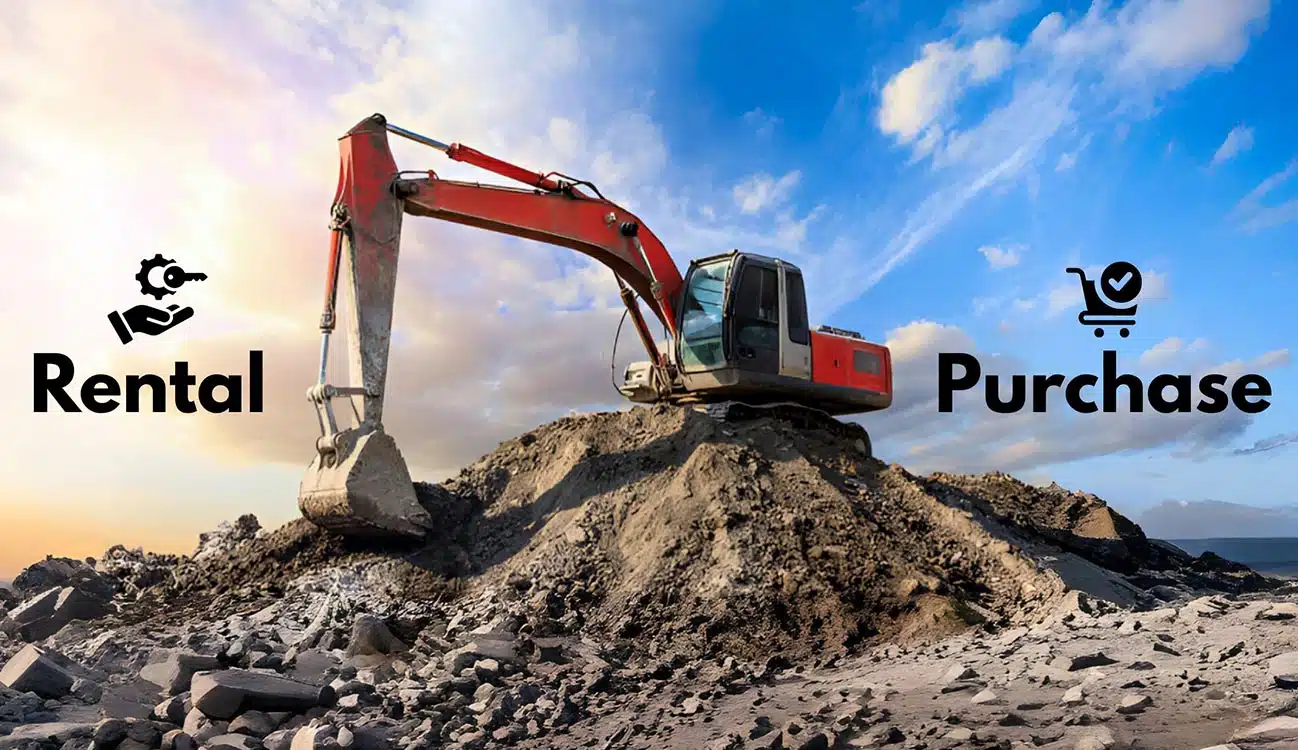
Excavator rental vs. purchase comes down to hours: rent if you need the machine for less than roughly 800–1,000 hours a year or for a single fixed-term contract; buy it if the machine will work steadily across projects. Renting runs about ₹4,000–₹28,000 for an eight-hour day depending on tonnage, city and contract length (indicative July 2026 hire rates) and keeps the cost off your balance sheet. Buying costs roughly ₹20 lakh for the smallest mini excavator to well over ₹1 crore for a 30-tonne-plus machine (as of October 2026), but it stops being an expense once the machine is paid off, and it holds resale value.
The construction industry is in a growth stage, and construction equipment is the most crucial component in this sector. These types of equipment are used to do heavy-duty work like digging, lifting, moving materials from one place to another, etc. Among these heavy machines, the excavator is much more popular and more in demand for its multifunctional use. Excavators are essential in both the mining and construction industries. Excavators are heavy industrial equipment, and the acquisition of one involves high investments. Large firms that have been in this industry for a long time can afford to purchase new excavators if the need arises, but for small and medium-scale firms, it is very difficult to invest so much compared to the scope and scale of work. To cater to this problem, the alternative of purchasing, i.e., a rental system, arises. The decision will have significant impacts on finance, project efficiency, and long-term success.
There is a continuous debate between rental and purchase. No single option is suitable for all types of businesses. There are various factors that should be looked upon when deciding the acquisition option. The sections below take each factor in turn, then put numbers on the choice for a mini excavator.
What is Excavator Rental?
Excavator rental means renting an excavator for a certain period. It does not involve full ownership of the machine. Buying the same machine outright costs roughly ₹20 lakh to well over ₹1 crore depending on model and size (as of October 2026), which is the number renting is measured against. Renting itself runs about ₹4,000 to ₹28,000 for an eight-hour day, again depending on tonnage, the city you are working in and how long you book the machine for: the equipment rental rate card puts a 2–3 tonne mini excavator at ₹500–900 an hour and a 30-tonne-plus machine with operator at ₹2,200–3,500 an hour (indicative, July 2026). Renting an excavator involves many considerations to make. It could be the budget, cash flow of the firm, or the scope of work. There are advantages and disadvantages of renting an excavator, and the hire terms themselves are set out in the excavator rental guide.
Advantages of Excavator Rentals
Renting an excavator involves many advantages.
- The most important benefit of renting equipment is that no upfront costs are required. This is very useful for small-scale and medium-scale businesses that cannot afford to pay so much upfront cost.
- A single project may require multiple machine requirements. So, renting a machine according to need instead of purchasing is a good solution.
- The rental company in most cases looks after the maintenance. So, it reduces repair costs, downtime, and breakdowns.
- Renting reduces the risk of depreciation, and you need not have to worry about the equipment losing value over time.
Disadvantages of Excavator Rentals
Renting an excavator also involves certain disadvantages.
- If the excavator’s requirement is long-term, then renting can be more expensive.
- As the ownership is with the rental company, the business cannot modify or customize the excavator.
- Another disadvantage is the availability of the desired excavator when and where it is required. For example, if the requirement is in a city where no dealer offers a rented excavator, then there is a problem.
What is an Excavator Purchase?
Purchasing an excavator means buying the excavator by paying in full upfront or through financing. It means getting the ownership of the excavator. A mini- to mid-size excavator can cost between ₹20 lakh and ₹94 lakh (a mini excavator ₹20–36 lakh, a 20-tonne-class machine mostly ₹50–94 lakh), while a large excavator starts around ₹62 lakh and passes ₹1 crore in the 30-tonne-plus sizes, and an extra-large excavator for mining runs from about ₹1.25 crore to ₹5 crore. All are listed prices as of October 2026. Normally big firms that have long-term projects going on usually purchase equipment. It reduces the overall cost of the machine. Purchasing an excavator also involves certain advantages and disadvantages.
Advantages of purchasing excavator
Purchasing an excavator involves certain advantages.
- Purchasing involves no repeat payments, like renting; once an upfront amount is taken, there are no rental fees.
- For the businesses that require an excavator for a long time, purchasing an excavator is cost-effective.
- Businesses can modify or customize the excavator according to the requirements. Often an excavator comes with various attachments and customization. Owning allows you to customize the excavator.
Disadvantages of purchasing excavator
- In the case of purchasing an excavator, a huge initial cost is required with no deferred payment. Most of the businesses are unable to bear this investment.
- The responsibility of maintenance and repairs falls on the businesses.
- The machine experiences depreciation, which lowers the resale price.
Comparing the Financial Implications of Renting vs. Buying
Renting and purchasing both have their implications. Financial implication is the key factor to keep in mind while choosing to hire or purchase. In the case of purchasing, there is a huge upfront cost required, while in the case of renting, deferred payment is required according to the usage period. In the case of businesses that require the excavator for a long period and have working capital, it is suitable to purchase the machine. But when businesses are small and do not require the excavator for a long term, then renting is an ideal choice. In the case of renting a machine, the businesses save huge working capital, whereas in the case of purchasing a machine, the need of a huge upfront cost arises.
In the case of renting a machine, the repair and maintenance cost is generally on the renting company, whereas, in the case of purchasing, the business needs to take care of it. Maintenance and repair are essential for this type of machine, as it incurs huge costs, downtime, and breakdowns.
Another important factor is identifying the period of usage. Analysis of the length of the project and frequency of use is vital when choosing to purchase or rent. If it is high, then purchasing the machine is an ideal choice, whereas if it is low, then going for rental is suitable.
Mini excavator hire vs buying: a worked example
Take a JCB 30 PLUS, listed at ₹26–28 lakh as of October 2026 (a Tata Hitachi TMX 20 Neo is ₹22–24 lakh). Call it ₹27 lakh, put 20% (₹5.4 lakh) down and borrow ₹21.6 lakh at 12% over five years. The instalment is about ₹48,000 a month, or roughly ₹5.77 lakh a year.
Hiring the same class of machine dry costs ₹500–900 an hour on the rate card. So the year’s instalments alone buy about 640 hours of hire at ₹900 an hour, or about 1,150 hours at ₹500. At eight hours a day that is roughly 80 to 145 working days.
Below that line, renting is cheaper. Above it, buying wins, and by more than these figures show, because part of every instalment pays off a machine you can later sell. Insurance and routine servicing push the line up a little, since you pay them as an owner. That is where the 800 to 1,000 hours in the answer at the top comes from. The interest rate is an assumption: the spread between lenders is set out in bank vs NBFC equipment loan rates.
What elements should guide your decision?
Project Duration and Frequency of Use
When the excavator will be used for a single project and for a short tenure, then renting is ideal. But when the project is for the long term and the excavator will be used for multiple purposes, then purchasing the machine should be opted for. Long-term renting would eventually surpass the purchasing cost.
Budget availability
When the business has a huge working capital, then purchasing is ideal, but when the business lacks working capital and is unable to afford huge upfront costs, then renting is suitable.
Business Growth
When a business has future plans for expansion, then it will require the excavator for future purposes too. In this case, purchasing the machine should be ideal. It will save a lot of capital and will be useful in the long term. But when there is no requirement for the future and the excavator will be used for a very short term, then renting is ideal. It will not be ideal to invest so much for such a short period.
Should you rent or buy an excavator?
Start with the hours. Estimate how many hours the machine will work this year and next, then price both routes on the same model: the listed prices on each machine page against the hire rate for that size. If the hours clear the line in the worked example above, buying is usually the cheaper route; if they do not, rent. Nowadays there are schemes available like Hybrid Rental, which involves the concept of renting with an option to buy later. This is useful for businesses that are unsure about buying at an initial stage. Moreover, a business can test the machine before use and buy it later. Desi Machines lists the machines, prices and finance options for both routes.
Rental rates and purchase prices are indicative ranges for planning, not quotations, and vary by tonnage, city, season and contract length. Confirm current specifications, prices and terms in writing with the dealer, rental company or OEM before you commit.