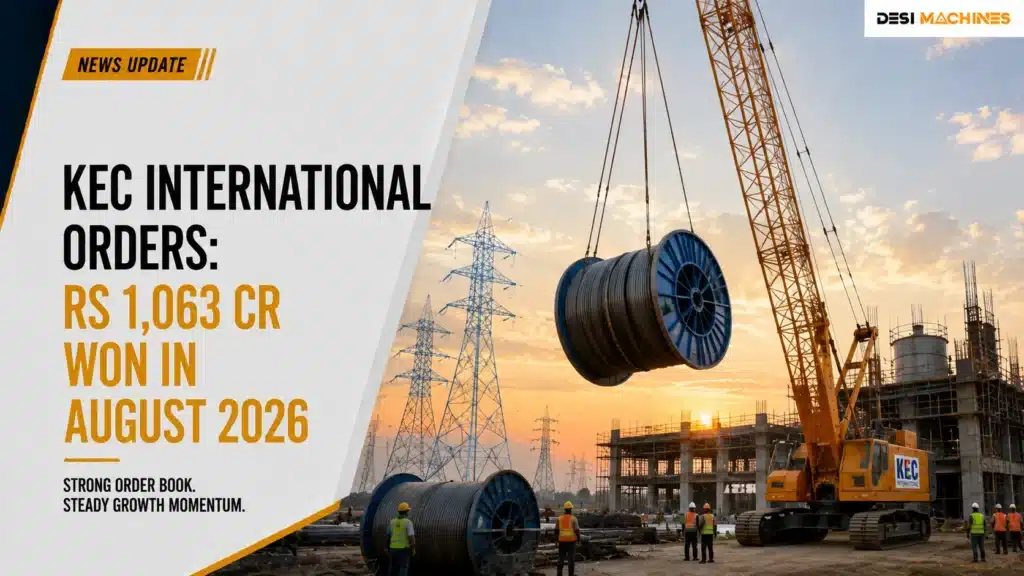
KEC International has booked Rs 1,063 crore of fresh orders, and the useful question for anyone running iron is not the headline number but where the work sits. Four business lines are behind it. Two of them are export supply that never leaves a factory gate in India. The other two put concrete and steel on Indian ground, and they pull two completely different fleets.
The quick facts
- New orders worth Rs 1,063 crore, announced by KEC International on 4 August 2026, spread across its Civil, Transmission & Distribution, Renewables and Cables & Conductors businesses.
- Civil: a high-rise residential project for a real-estate developer covering 24 lakh sq ft of built-up area plus associated facilities.
- Renewables: a 50-plus MW wind EPC job from an existing private developer in western India.
- T&D: a 400 kV line in Africa and supply of towers, hardware and poles into the Americas. Year-to-date FY27 intake is now above Rs 6,300 crore (company-stated).
What KEC announced
The new KEC International orders were disclosed through the company’s own press release on 4 August, carried the same day by Electrical Mirror and the capital-market desks. Managing Director and CEO Vimal Kejriwal framed it around diversification in the international T&D book. KEC has not split the Rs 1,063 crore between the four businesses, has not named the real-estate client, and has not named the wind developer or the site, so nobody outside the company can size the Indian share of this intake precisely.
Which machines does this order actually pull?
Split it the way a fleet owner would. The Africa line and the Americas supply are order book, not site work here. They keep KEC’s tower and conductor plants loaded, which matters to steel fabricators, not to anyone bidding out machines.
The high-rise job is a vertical-build fleet, and it looks nothing like a highway package. Roughly 24 lakh sq ft of residential towers means tower cranes and material hoists as the spine, a captive batching plant with transit mixers and placing booms feeding it, and a piling rig burst at the front end. Earthmoving is a few weeks of basement excavation, then it’s over. Rental economics follow that shape: the tower crane and hoists usually go on a long hire tied to the build cycle, while the batching plant is only worth owning if the site runs long enough to beat ready-mix rates.
The wind EPC in western India is the one to watch, because it is a crane job with a civil job hiding under it. Turbine erection at current hub heights needs the largest crawler and lattice classes, and that pool in India is thin and booked in seasonal blocks. What usually gets subcontracted locally is everything before the crane arrives: access roads wide enough for blade trailers, hardstands, foundation excavation and backfill. That is grader, compactor and excavator work, and it is where a regional fleet gets in on a job whose headline belongs to somebody else.
Our take: a contractor best known for transmission lines keeps adding buildings and renewables, and neither of those pulls the tower-line fleet. If your machines are sized for stringing and tower foundations, this order is not your demand. If you run cranes, batching or the grader-and-compactor set in Maharashtra or Gujarat, it probably is. We would not bet a purchase on it either way while the value split stays undisclosed.
What to watch
- Whether KEC or the developer names the wind site. Once the state and district are public, the access-road and foundation subcontracts are the first packages out.
- The pace of the FY27 book. Above Rs 6,300 crore inside roughly four months sets a run rate that decides whether hiring stays tight into the festive quarter.
- Any follow-on civil order. One high-rise is a single-site fleet; a second one in the same city changes what is worth owning rather than hiring.
Bidding on work like this? Compare crane, batching and compaction options on DesiMachines before you commit a hire rate, and check what finance is costing this month. Start with our crane listings and the equipment finance hub.
FAQ
How much of the Rs 1,063 crore is Indian site work?
KEC has not disclosed the split. Of the four businesses named, the Civil high-rise and the western India wind EPC are executed on Indian sites; the 400 kV line is in Africa and the tower and pole orders are supply into the Americas.
What equipment does a 50 MW wind EPC contract need?
Large crawler or lattice cranes for turbine erection, and before that a civil scope of access roads, hardstands and foundations that runs on excavators, compactors and graders, with transit mixers feeding the foundation pours.
When would subcontract packages typically open?
KEC has given no schedule. On comparable EPC awards, enabling civil packages tend to move first because the crane cannot mobilise until roads and hardstands exist, but treat that as a pattern, not a date.
Related on DesiMachines: NCC books Rs 1,053 crore of orders in July, none of it roads
Source: Electrical Mirror

 Excavator
294 models
Excavator
294 models  Backhoe Loader
51 models
Backhoe Loader
51 models  Crane
68 models
Crane
68 models  Concrete Mixer
79 models
Concrete Mixer
79 models  Wheel Loader
54 models
Wheel Loader
54 models  Compactor / Roller
45 models
Compactor / Roller
45 models  Motor Grader
42 models
Motor Grader
42 models  Concrete Pump
66 models
Concrete Pump
66 models  Skid Steer Loader
11 models
Skid Steer Loader
11 models  Telehandler
13 models
Telehandler
13 models