Excavator
294 models
Excavator
294 models  Backhoe Loader
51 models
Backhoe Loader
51 models  Crane
68 models
Crane
68 models  Concrete Mixer
79 models
Concrete Mixer
79 models  Wheel Loader
54 models
Wheel Loader
54 models  Compactor / Roller
45 models
Compactor / Roller
45 models  Motor Grader
42 models
Motor Grader
42 models  Dozer
41 models
Dozer
41 models  Concrete Pump
66 models
Concrete Pump
66 models  Skid Steer Loader
11 models
Skid Steer Loader
11 models  Telehandler
13 models
Telehandler
13 models 


This first construction equipment buying guide is about the money and the decisions, not the specs. Start from the work that will pay for the machine, then budget for the full picture: margin money of roughly 10-25% (indicative), the on-road extras, and a cash buffer for slow months. Decide new versus used on your risk appetite, line up financing and insurance before you sign, and read the dealer quote line by line. Get the money right and the machine funds itself; get it wrong and a good machine becomes a monthly weight.
Watch: your first machine, four decisions in two minutes
Key moments: 0:15 meet Aman, who decided with care · 0:31 which machine to start with · 1:06 the EMI cushion · 1:27 three checks before you buy.
Buying your first machine is a bigger moment than buying your tenth. You are not just choosing equipment, you are committing to an EMI, an operator, diesel, insurance and the discipline of keeping all of it earning. Plenty of capable contractors have taken on a good machine and still struggled, because the machine was fine and the plan around it was not.
So this first construction equipment buying guide walks the decision the way an owner should: work first, money second, machine last. For the specifications side (which model, what bucket, how many horsepower), we link you to the detailed machine guides as we go. Here we stay on what most first-timers get wrong, the money and the sequence.
Start with the work, not the machine
The most expensive mistake is buying the machine you like and then looking for work to justify it. Reverse that. Before you shortlist anything, answer three questions honestly:
- What work do you already have? Confirmed jobs, an EPC subcontract, municipal work, a rental tie-up. Not “there is a lot of construction around”, but work you can name.
- How many hours a month will it realistically run? A machine earns by the hour. Be conservative: a first machine that runs 120-150 hours a month in its early months is doing well, not 250.
- What does that work pay? Per-hour or per-day rates in your area, minus diesel and operator, is your real margin. That margin has to cover the EMI and leave something over.
Only once the work is clear does the machine choice make sense. A backhoe loader stays busy across mixed civil, municipal and small-site work, which is why so many owners start there. Digging-heavy work points to an excavator. For the machine-selection detail, our equipment buying guide and the model pages go deep on which machine suits which job; use them once you know the work.
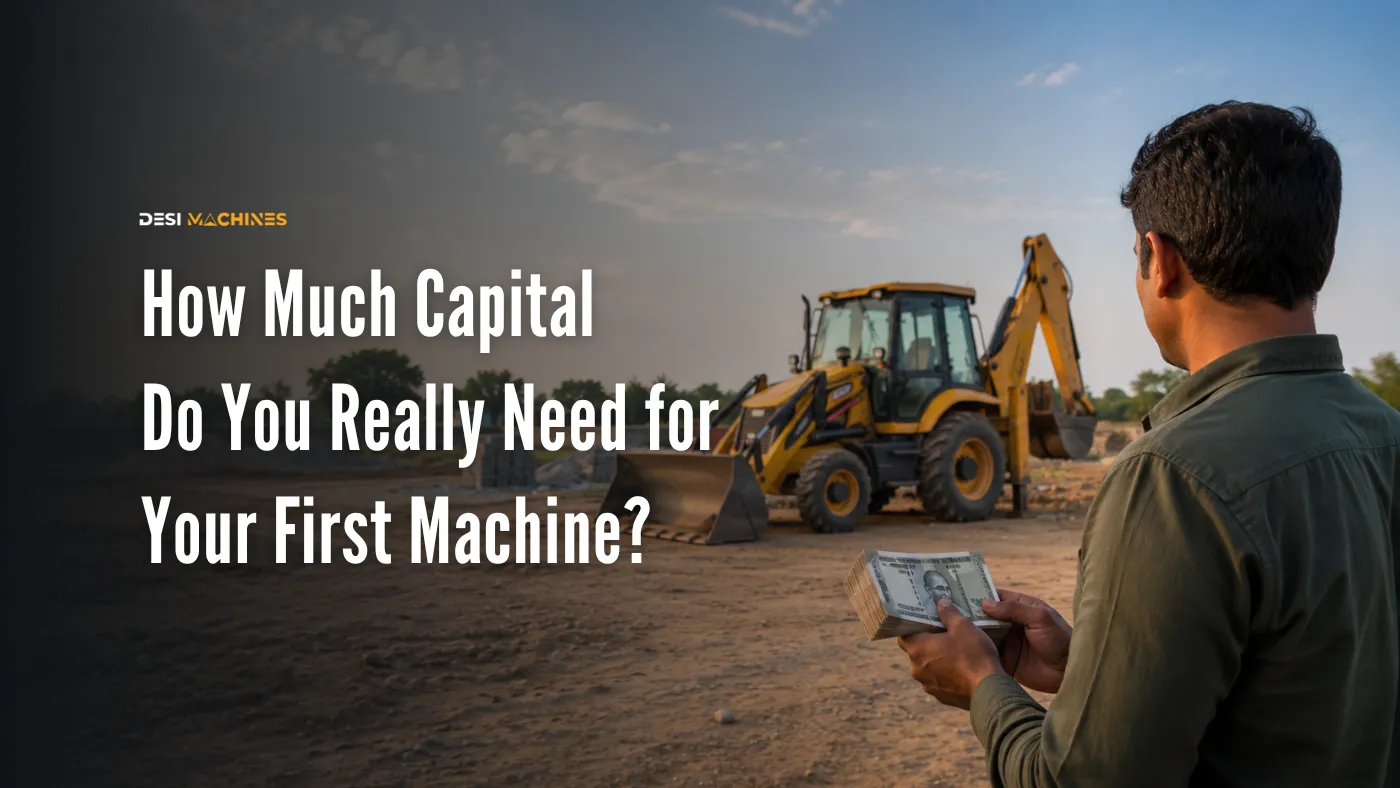
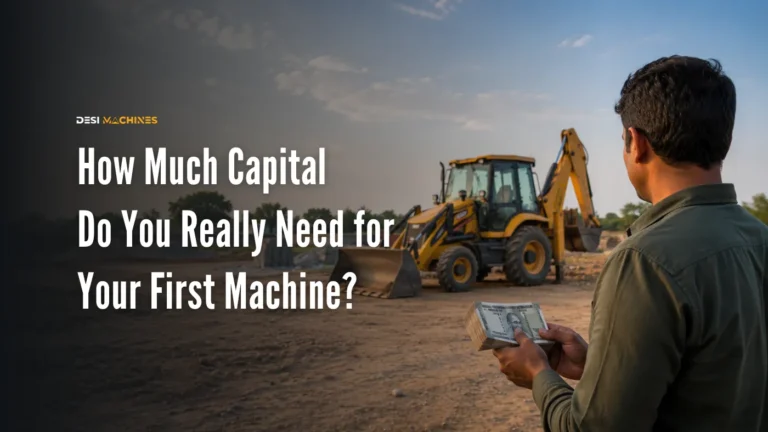
How much capital do you really need?
Here is where first-timers under-budget, because they plan for the down payment and forget everything around it. Your first machine needs money in four buckets, not one.
| Cost bucket | What it covers (indicative) |
|---|---|
| Margin money | 10-25% of the machine, your down payment on the loan |
| On-road extras | GST, registration, first insurance, transport to site |
| Setup costs | First consumables, minor tools, operator advance |
| Working-capital buffer | 2-3 months of EMI, diesel and wages held in reserve |
That last bucket is the one people skip, and it is the one that saves the business. Payments in this trade run late, seasons go slow, and a breakdown can idle the machine for a week. If your entire savings goes into the margin money, the first slow month puts the EMI at risk, which puts the machine at risk. Keep a buffer even if it means a slightly smaller machine to start. Our note on how much down payment you need covers the margin bucket in detail.
What a first machine actually costs
Budgets are easier to build against real numbers, so here is what the three usual first machines
cost on our own catalogue today. These are indicative ex-showroom bands across the models we list,
not a quote for any one variant.
| First machine | Indicative price band (Aug 2026) | Margin money at 10-25% |
|---|---|---|
| Backhoe loader the common first machine |
₹23-40 lakh | ₹2.3-10 lakh |
| Small excavator 6-15 tonne class |
₹28-54 lakh | ₹2.8-13.5 lakh |
| 20-tonne class excavator 15-25 tonne class |
₹52-88 lakh | ₹5.2-22 lakh |
Read the third column before the second. The machine price is what you compare; the margin money
is what you actually have to find on the day, and the working-capital buffer sits on top of it.
A contractor with ₹8 lakh in hand is comfortably placed for a backhoe loader and stretched for a
20-tonne excavator, even though both look affordable on an EMI table.
New or used for your first machine?
Both are valid first machines; the right one depends on your appetite for risk and your access to repair support.
- New gives you warranty, predictable running costs, full dealer support and the easiest finance. You pay for it with a higher price and a steeper first-year depreciation. For an owner without a trusted mechanic, that predictability is worth a lot.
- Used lowers the entry price and softens the depreciation hit, so your capital stretches further. The trade is condition risk: an older machine can carry hidden wear and costs more to run. Buy used only with a proper inspection and a clear service history.
For a first-time owner, a new machine or a certified low-hour used one is usually the safer start; a cheap high-hour machine is a false economy if it spends its life in the workshop. If you are weighing it seriously, our comparison on how to finance the machine and the model-by-model detail on the compare pages help you judge total cost, not just sticker price.
The running costs you are signing up for
The EMI is the cost everyone sees. The running costs are the ones that decide whether the machine actually makes money, and a first-time owner needs them in view before signing, not after. Every hour the machine works, it burns diesel and operator time; every month, it needs service, insurance and the odd repair whether it worked twenty days or ten.
| Monthly running cost | What drives it |
|---|---|
| Diesel | Hours run and the machine’s fuel burn per hour |
| Operator wages | Skill, shift pattern, whether you also feed and house them |
| Service and parts | Scheduled maintenance plus wear items and repairs |
| Insurance | The annual premium, spread across the year |
Add these to the EMI and you have the machine’s real monthly cost, the number your work has to clear before you earn a rupee. Diesel is usually the biggest of them, and it is also the one that quietly leaks through idling and theft, so it deserves the closest eye. Work this out before you buy, using conservative hours, and you will size the machine and the loan to what the work truly supports.
Financing your first machine
Very few first machines are bought with cash, and that is usually the right call, because keeping some capital free matters more than saving the interest. The financing decision has three parts, and it is worth settling all three before you walk into a dealership.
First, the route: loan, lease or cash. For most first-time owners a loan wins, because you own the asset and its resale value while the EMI stays predictable. Our guide to equipment finance lays out when each route fits.
Second, the lender: a bank usually offers a lower rate, an NBFC a faster and more flexible approval. Compare both rather than taking the dealer’s default financier on the spot.
Third, your credit: the lender checks your CIBIL score before anything else, so know it in advance. A score of 750 or above (indicative) gets the best terms; below that you may need a bigger margin or a co-applicant. Sort this out early rather than discovering a weak score at the finance desk.
On-road versus ex-showroom: what is really in the price
The number in the brochure is the ex-showroom price, and it is not what you pay. The on-road price adds GST, registration, the first insurance premium, and any dealer handling or transport to your site. That gap can be a meaningful chunk of the total, and it is real money you must budget for. Our guide to construction equipment insurance covers what that first premium buys and how the cover is priced.
Two rules protect you here. Size your loan and your savings against the on-road figure, never the ex-showroom one, or your margin money will fall short. And ask for the on-road price broken into line items, so you can see what is a genuine cost and what is padding you can question. One line that is not padding is the 1 per cent collected at source once the consideration crosses ₹10 lakh — our piece on TCS on purchase of machinery explains which machines it applies to and why the money comes back to you.
Insurance and registration before the machine runs
A new machine should not turn a wheel on site without cover and papers in order, and both belong in the buying plan, not as an afterthought once the machine arrives. At a minimum you want the machine insured against damage, theft and third-party liability from day one, and registered where the law requires it for road movement.
Get insurance as a separate, comparable number rather than a figure bundled silently into the finance, so you know what you are paying for the cover. Our construction equipment insurance page explains the policies and what they cover, so you can buy the right protection instead of the first one offered.
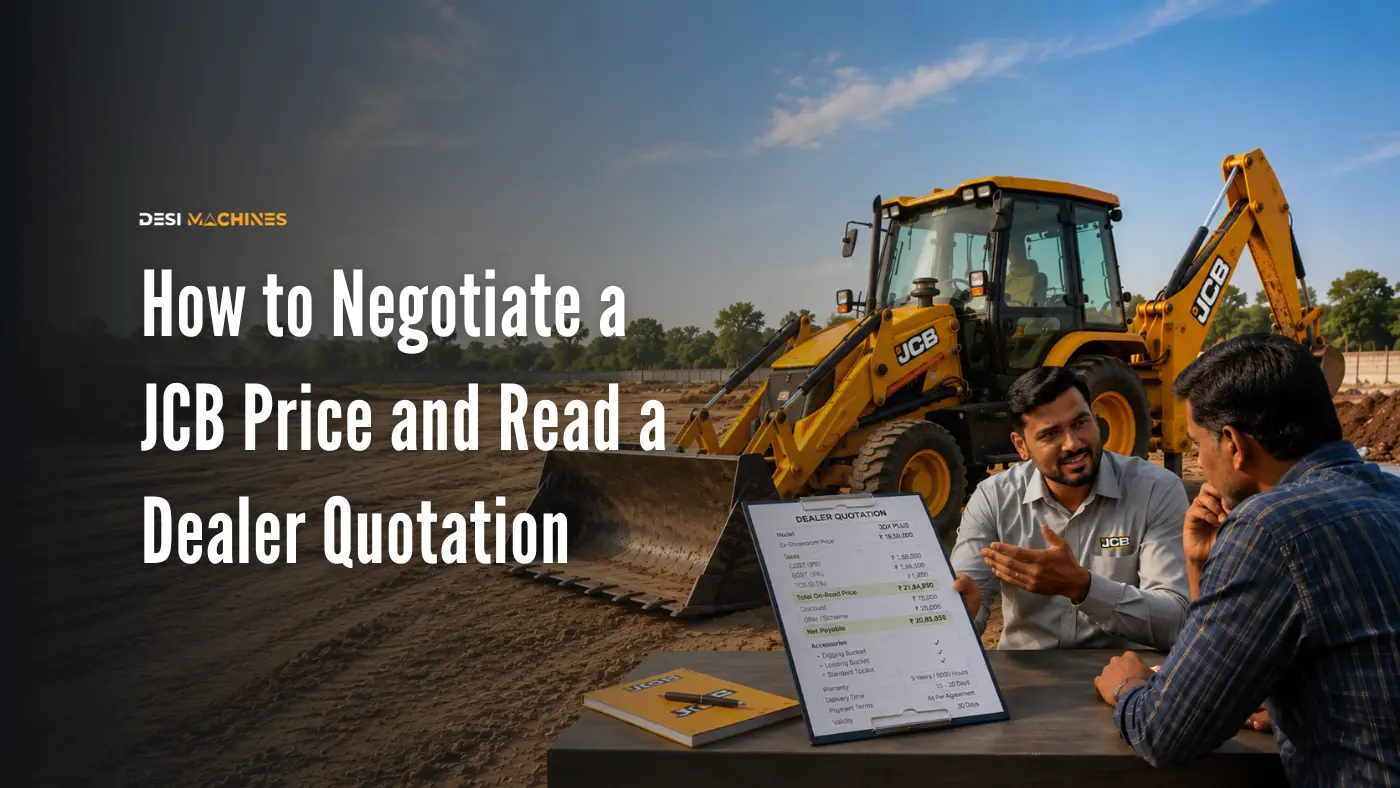
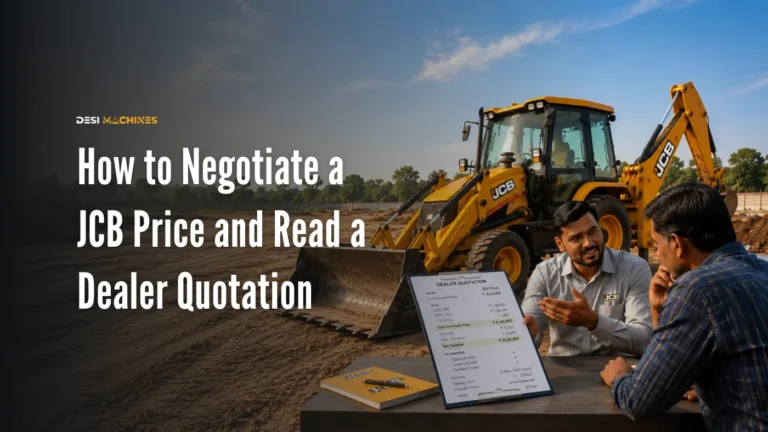
Reading and negotiating the dealer quotation
The quotation is where a prepared buyer saves the most, and where an unprepared one overpays quietly. A few habits make the difference:
- Get it itemised. Machine price, GST, registration, insurance, accessories, handling, transport. A single lump sum hides where the money goes.
- Hold one independent quote against it. Even a rough second quote gives you a reference and room to negotiate.
- Separate the machine from the finance and insurance. Judge each on its own; a keen machine price can hide an expensive bundled loan.
- Do not decide on the EMI alone. A low EMI can mean a long tenure and far more interest. Compare the all-in cost.
- Ask what is included after delivery. First service, warranty terms, operator training, spares support. These have real value and are negotiable.
Walking in with your financing already arranged is the single strongest position you can hold. It turns the conversation from “what can I afford per month” into “what is your best price on the machine”, which is exactly where you want it.
Delivery, PDI and the first 90 days
The deal is not done at signing; it is done when the machine is working reliably and earning. At delivery, do a proper pre-delivery inspection (PDI): check the machine matches the spec you paid for, all fluids and functions are right, the hour meter reads near zero on a new machine, and every document (invoice, insurance, registration, warranty) is in hand.
In the first 90 days, keep the first service on schedule, log hours and diesel from day one so you know your real running cost, and settle your operator and site routine. This is also when you learn the machine’s true earning rhythm, which tells you when a second machine makes sense. Get these early habits right and the machine repays the plan you built around it.
The mistakes that trip up first-time buyers
Most first-machine regrets trace back to a handful of avoidable errors. If you sidestep these, you have already done better than most:
- Buying the machine before the work. Falling for a model and then hunting for jobs to justify the EMI. Let the confirmed work choose the machine.
- Spending the whole cushion on the down payment. No buffer means the first late payment or slow month puts the EMI, and the machine, at risk.
- Judging the deal on the EMI alone. A comfortable monthly figure often hides a long tenure and heavy total interest. Compare the all-in cost.
- Skipping the inspection on a used machine to save a day or a small fee, then paying for hidden wear for years.
- Taking the dealer’s finance and insurance on trust without a second quote to hold against them.
- Underestimating running costs, especially diesel and repairs, so the machine earns less than the plan assumed.
None of these is about being clever; they are about being deliberate. A first-time buyer who slows down, budgets honestly and arranges the money first avoids nearly all of them.
Plan the money before you pick your first machine
A first machine succeeds or fails on the plan around it, not the badge on the bonnet. Work first, then the money: budget all four cost buckets including the buffer, choose new or used on your real risk appetite, arrange financing and insurance before you sign, and read the quote line by line against the on-road price. Do that and your first machine becomes the foundation of a business rather than a monthly worry. When you are ready to move, line up the money on our equipment finance page and shortlist the machine on the backhoe loader and excavator ranges.
Prices, loan terms, insurance premiums, taxes and registration rules change with the market and by state, and every purchase is different. Treat the figures here as indicative and confirm current terms with our team, the OEM, bank or insurer before you decide.
Figures above are indicative as of 18 August 2026 and vary by variant, state levies, hours, site conditions and date. Confirm the current ex-showroom and on-road price for the exact variant with the dealer or OEM before you commit.