
 Excavator
294 models
Excavator
294 models  Backhoe Loader
51 models
Backhoe Loader
51 models  Crane
68 models
Crane
68 models  Concrete Mixer
79 models
Concrete Mixer
79 models  Wheel Loader
54 models
Wheel Loader
54 models  Compactor / Roller
45 models
Compactor / Roller
45 models  Motor Grader
42 models
Motor Grader
42 models  Dozer
41 models
Dozer
41 models  Concrete Pump
66 models
Concrete Pump
66 models  Skid Steer Loader
11 models
Skid Steer Loader
11 models  Telehandler
13 models
Telehandler
13 models 


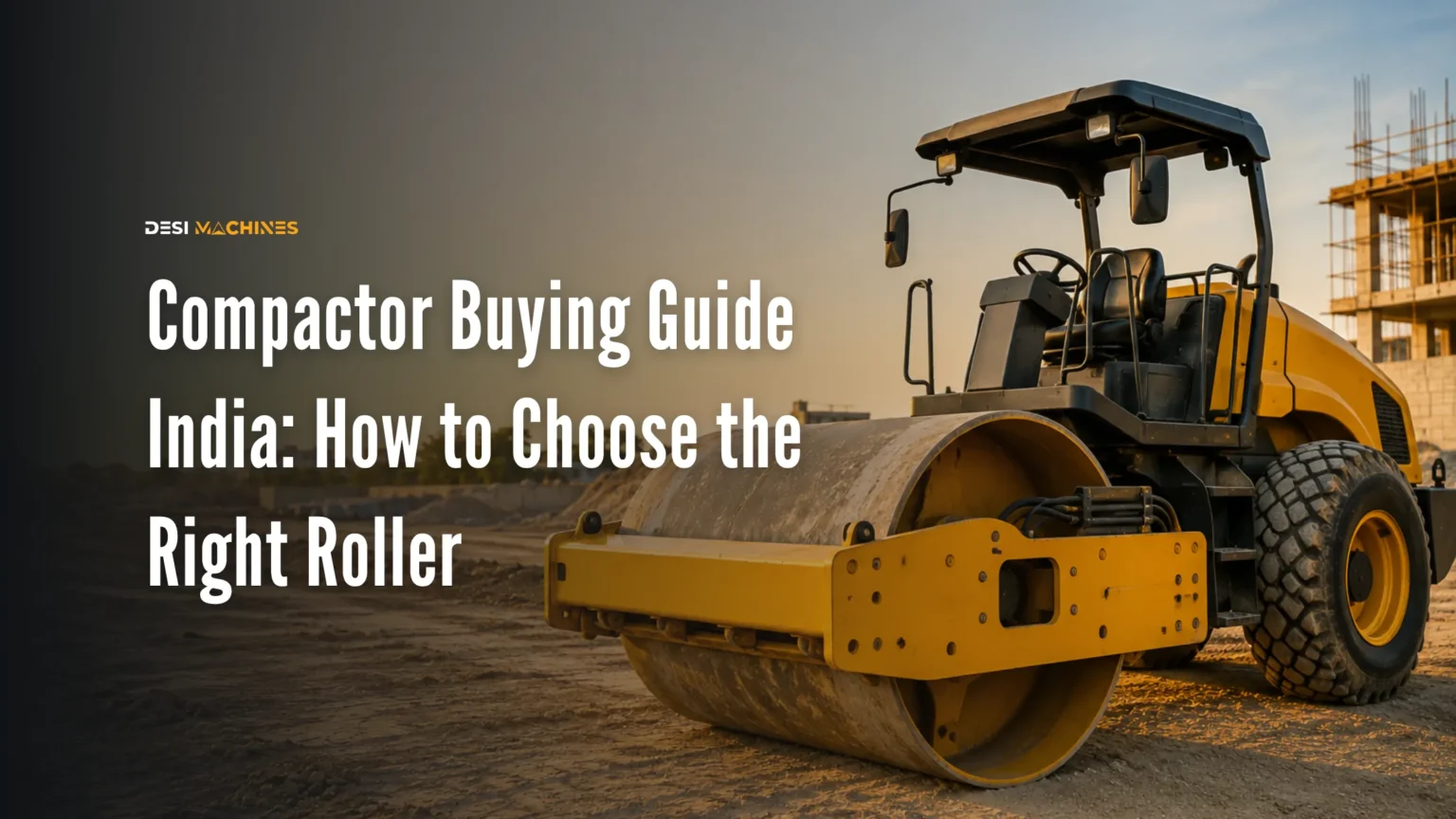
The machines listed in India cover a wide spread: from roughly ₹12 – ₹16 Lakh for a light tandem roller up to ₹42 – ₹44 Lakh for a full-size one (indicative, as of Aug 2026). This guide works through which type your job needs, what size, and what each one actually costs.
Which compactor should you buy for your work?
Start with the material, not the budget. A machine built for soil will not finish asphalt properly, and an asphalt roller will not compact a road embankment however many passes you make. The four types in use in India divide up like this:
| Type | What it compacts | Typical job | Weight range listed | Price (indicative, Aug 2026) |
|---|---|---|---|---|
| Single drum soil compactor | Soil, gravel, sub-base, embankments | Road formation, canal banks, plot levelling, dam work | 9,700 – 14,760 kg | ₹30 – ₹40 Lakh |
| Tandem roller (light) | Thin asphalt, patches, footpaths | Village roads, repairs, colony lanes, parking | 1,665 – 3,535 kg | ₹12 – ₹20 Lakh |
| Tandem roller (full size) | Asphalt breakdown and finishing | State highways, city roads, airport work | 9,100 – 9,600 kg | ₹32 – ₹44 Lakh |
| Pneumatic tyre roller | Asphalt sealing, intermediate rolling | Highway surface course behind a tandem | 12,800 – 18,000 kg | ₹25 – ₹40 Lakh |
Most first-time buyers in India are choosing between the first two rows. If your work is earth and sub-base, a single drum soil compactor is the machine. If it is small-scale asphalt, a light tandem roller costs a third as much and is far easier to move between sites.
To understand what the vibration is actually doing before you spend, read the guide to soil compaction methods, and the comparison of a static and a vibratory roller.
What does a soil compactor cost, and who needs one?
A single drum soil compactor is the workhorse of Indian road building, and the listed machines sit in a surprisingly tight band: roughly ₹30 – ₹40 Lakh (indicative, as of Aug 2026) across every brand. Nineteen machines are listed, and almost all of them are in the 10 to 12 tonne class with a drum about 2,100 mm wide.
- Escorts EC 5250: 10,350 kg, 2,130 mm drum. ₹30 – ₹32 Lakh.
- L&T 1190: 11,050 kg, 2,100 mm drum. ₹30 – ₹32 Lakh.
- SANY SSR110C-10 PRO: 11,200 kg, 2,130 mm drum. ₹31 – ₹33 Lakh.
- ACE ASD 115: 11,000 kg, 2,130 mm drum. ₹32 – ₹34 Lakh.
- JCB VM117: 11,525 kg, 2,100 mm drum. ₹36 – ₹38 Lakh.
- Volvo SD110: 11,150 kg, 2,134 mm drum. ₹38 – ₹40 Lakh.
All figures indicative, as of Aug 2026. The important thing about that list is what it does not show: a big jump in capability. The Volvo weighs about the same as the Escorts and runs a drum 4 mm wider, yet costs around ₹8 Lakh more at the entry end. You are buying build quality, cab comfort, resale and dealer cover, not more compaction.
The heavier machines are the exception worth knowing. The Dynapac CA405PS CEV-V weighs 14,760 kg against 9,700 kg for the lightest Dynapac in the same range, at ₹34 – ₹36 Lakh (indicative, as of Aug 2026). On deep fill layers and heavy clay that extra 5 tonnes is real compaction, and it is nearly free in price terms. If your work is embankments rather than plot levelling, look at weight before you look at badge.
Compare all soil compactor models and prices before you shortlist, and read the single drum roller guide for how the sizes are used on site.
Why do tandem rollers split into two price classes?
The tandem roller category has a gap in the middle that catches buyers out. Of the 18 machines listed, there is a light group and a full-size group, and nothing between them. The light machines weigh 1,665 to 3,535 kg with drums 800 to 1,250 mm wide, and sell at ₹12 – ₹20 Lakh. The full-size machines weigh 9,100 to 9,600 kg with drums 1,675 to 1,750 mm wide, and sell at ₹32 – ₹44 Lakh (both indicative, as of Aug 2026).
A tandem roller has two steel drums, one at each end, and both of them vibrate. That is what makes it an asphalt machine: the surface stays smooth because there is no rubber tyre marking it and no single heavy drum digging in. The tandem roller guide goes through both size classes machine by machine, with drum widths, water tank sizes and where each one earns its money.
The light group, sometimes called a mini roller or baby roller:
- Escorts EC 3664: 1,200 mm drum, 47 HP (35 kW). ₹12 – ₹16 Lakh.
- Dynapac CC800: 1,665 kg, 800 mm drum, 24 HP (18 kW). ₹13 – ₹17 Lakh.
- JCB VMT330: 3,450 kg, 1,250 mm drum, 45 HP (33 kW). ₹15 – ₹20 Lakh.
And the full-size group:
- SANY STR90C-10 PRO: 9,200 kg, 1,680 mm drum, 74 HP (54.6 kW). ₹32 – ₹34 Lakh.
- L&T 990HFi: 9,575 kg, 1,680 mm drum, 74.8 HP (55.7 kW). ₹35 – ₹37 Lakh.
- Volvo DD90: 9,100 kg, 1,676 mm drum, 74 HP (55 kW). ₹42 – ₹44 Lakh.
All figures indicative, as of Aug 2026. The practical rule: drum width has to cover your paving width in a sensible number of passes. A 1,200 mm drum on a 3.5 metre village road is three passes per layer. A 1,680 mm drum on the same road is two. On a 7 metre highway carriageway the light machine is simply the wrong tool, and buying one to save ₹20 Lakh costs more in time than it saves in capital.
The mini roller guide covers the small end in detail, including where a walk-behind machine beats a ride-on one.
When do you need a pneumatic tyre roller?
A pneumatic tyre roller (PTR) runs on rows of smooth rubber tyres instead of steel drums, and it is a specialist third machine rather than an alternative to the first two. The tyres knead the asphalt rather than pressing it flat, which closes the surface and seals it against water.
Three are listed, from 12,800 kg to 18,000 kg:
- Dynapac CP275: 14,000 kg, 125 HP (93 kW). ₹25 – ₹30 Lakh.
- SANY SPR260C-10 PRO: 18,000 kg, 131 HP (98 kW). ₹30 – ₹40 Lakh.
- L&T 2490 HD: 12,800 kg, 102 HP (76 kW). ₹35 – ₹37 Lakh.
All figures indicative, as of Aug 2026. Buy one only if you are laying full-depth bituminous surfacing on highway or airport contracts, where the specification calls for an intermediate rolling pass. On any smaller job the PTR sits idle, and a contractor is better off hiring one for the few weeks it is needed. The pneumatic tyre roller guide explains how the passes are sequenced, and you can compare pneumatic roller models and prices directly.
How do you match compactor size to the job?
Two numbers decide it: operating weight and drum width. Weight sets how deep the compaction reaches. Drum width sets how fast you cover ground.
- Layer thickness. A 10 to 12 tonne single drum machine handles the 200 to 300 mm soil layers that most Indian road specifications call for. Thicker fill layers want the 13 to 15 tonne machines.
- Paving width. Divide your working width by the drum width and round up. That is your pass count, and it decides your daily output more than engine power does.
- Access. A 2,130 mm drum will not enter a colony lane or a trench. That is what the 800 to 1,250 mm machines and the plate compactors are for.
- Soil type. Clay and cohesive soils compact better under a padfoot or sheepsfoot roller; sand and gravel respond to smooth-drum vibration. Getting this wrong wastes passes.
For the smallest work, a plate compactor is often the honest answer instead of any roller. The plate compactor guide covers trench backfill, paver blocks and footings, where even a mini roller cannot reach.
Ready to compare? Browse the full range of compactors and prices and connect with a dealer for a quote on your shortlist.
Not sure between a soil compactor and a tandem roller? See which roller your job needs by choosing the material and where you are rolling.
What to check before you buy a compactor
The machine is the easy part. These five checks decide whether it pays for itself:
- Confirm the compaction specification you have to meet. Government road contracts state a required density and often a machine class. Buying below it means the work gets rejected, whatever the roller cost.
- Check the drum, not the hours. A worn or dented drum is expensive to replace and shows up as a poor surface finish. Run your hand along it and sight down its length. This matters most on a second-hand machine, and the used road roller buying guide works through the full drum inspection.
- Ask about the vibration system. The eccentric shaft and bearings inside the drum are the part that fails, and the repair needs the drum opened. Ask the dealer what that costs and how long it takes locally.
- Work out transport. A 12 tonne soil compactor needs a trailer for every site move. A 1,665 kg mini roller goes on a tractor trolley. Over a year of small jobs that difference is real money.
- Plan the finance before the model. A ₹10 Lakh price difference is a meaningful change in your monthly instalment. The equipment finance options page sets out how tenure and down payment move the EMI.
These are ex-factory prices. A compactor is a wheeled, registrable machine, so on-road cost additionally includes transportation, RTO registration, TCS, warranty, insurance and FOC charges where applicable. Budget above the listed band.
Still deciding on the type? The types of compactors guide maps the full family, the road rollers guide covers specifications in depth, and the compactor guide hub lists every piece in this series.
Prices, specifications and features are indicative, vary by variant, location and date, and should always be confirmed with the official OEM or authorised dealer before any purchase decision. DesiMachines is not liable for decisions taken on the basis of information that may have changed after publication. Prices and specifications are taken from our listings at the time of writing.