Excavator
  Backhoe Loader
  Motor Grader
  Wheel Loader
  Crane
Crane  Concrete Mixer
  Compactor
  Skid Steer Loader
  Concrete Pump
  Telehandler


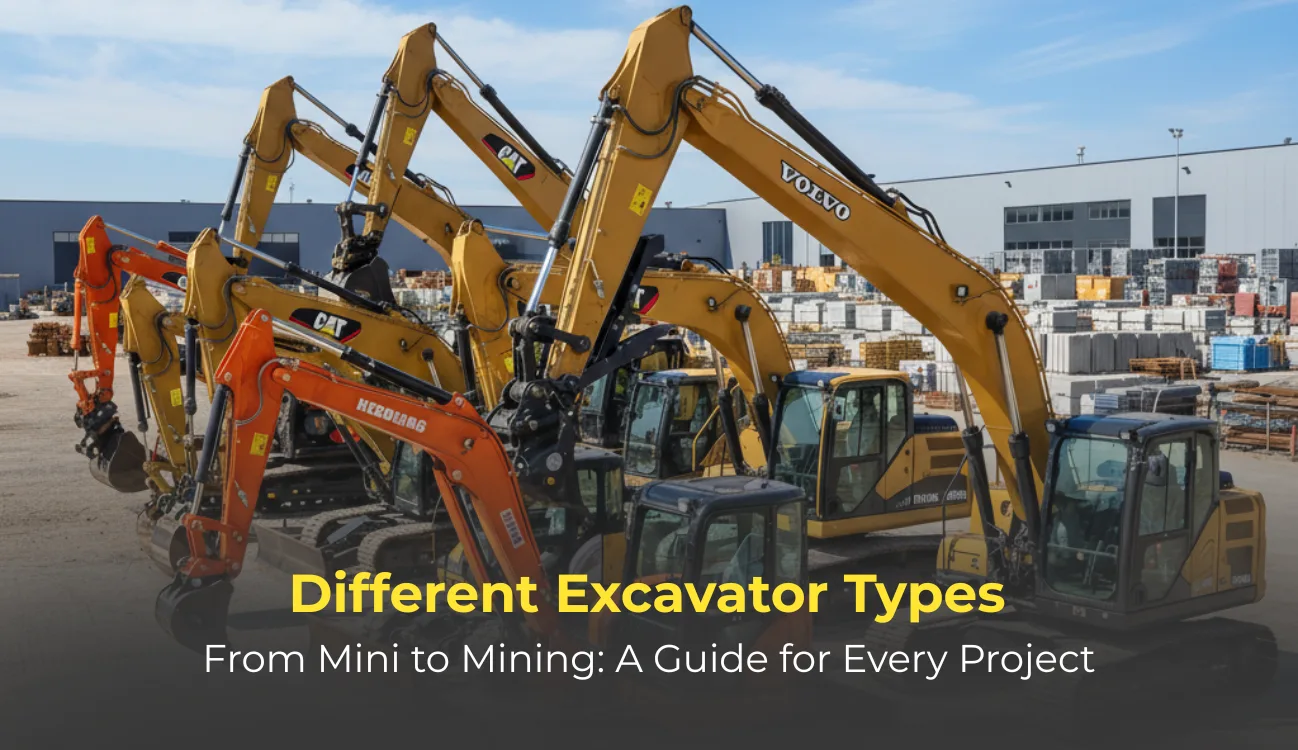
From mini to large, the different types of excavator machine are versatile tools vital for construction, mining, and earthmoving projects. They come in various types based on size, mobility, and purpose. From compact mini excavators for urban sites to massive mining excavators for large-scale operations. Specialized excavator types like long-reach excavators add further flexibility. With Desi Machines, contractors, builders, and fleet owners can compare excavator prices, brands, and specifications, ensuring the right investment for every project.
All projects, whether successful or not, should begin with the right machine. Of all heavy construction equipment, no machine better shows versatility, power, and precision than the excavator. From digging foundations of skyscrapers to mining raw materials deep beneath the earth, the excavator machine has been a significant player in building, earthmoving, and industrial projects.
Introduction: What is an Excavator Machine
Excavator machine (or poclain machine) is a hydraulically driven machine that is designed to dig, lift, break up, and manage heavy building materials. Consisting of a boom, stick, and bucket connected to a rotatable cab (the cab will rotate 360 degrees), it offers unparalleled versatility in the worksite. Excavators either ride along tracks (crawler excavators) or wheels (wheeled excavators) and are hence perfect for varying terrain and types of projects.
Excavation machines today are more than digging machines. They are multifunctional construction machines that can be easily swapped out with attachments, such as hydraulic breakers, augers, clamshells, and grapples, to handle specialized work. While trenching, drilling, and materials handling are among the capabilities of hydraulic excavators, there is more.
Construction contractors in this contemporary world don’t simply consider excavator price and mini excavator price. They also weigh operating cost, resale value, fuel efficiency, and possible money back upon investment. Most organizations also consider used excavators for sale by owner in search of ultimate affordability. Knowledge about excavator types is at the core of a good buying decision.
Types of Excavator Machines
Excavators can be categorized based on size, mobility, and purpose. Each classification fits a unique set of applications, and selecting the wrong excavator type can reduce efficiency or increase costs.
Excavator Types Based on Size
Mini Excavator (Compact Excavator)
The mini excavators, also known as compact excavators, weigh anywhere from 0-6 tons. They’re suitable for limited areas such as city projects, residential buildings, and landscaped work.
Features and Benefits of Mini Excavator:
- Its small size makes it maneuverable in small alleys and populated building sites.
- Easy transportation between sites on a small trailer.
- Lower fuel consumption indicates minimal operating cost.
- Economical mini excavator price, hence popular among small contractors.
Common Applications of Mini Excavator:
- Utility trench excavations in residential areas.
- Landscaping and irrigation work.
- Small demolition works.
- Compact pipe-laying in locations.
Example: Some of the popular mini excavators are JCB 30 Plus, Sany SY27U, Sany SY35U, Tata Hitachi NX30, Kubota U17-3, and Tata Hitachi NX50.
Small Excavator
These small excavators weigh 6-15 tons and, by size, are bigger than compacts, yet are very maneuverable.
Features and Benefits of Small Excavator:
- Deep digging capability and bucket capacity than mini models
- Stronger hydraulics in medium building constructions
- Affordable small excavator price with higher versatility
Common Applications Small Excavator:
- Small commercial building
- Maintenance of roads and drainage works
- Bridge maintenance works
Example: Some of the popular small excavators are JCB 130, Hyundai R130 Smart Plus, LiuGong 915E, Sany SY120C, and Sany SY140C.
Medium Excavator
Medium excavators (15–25 tons) play a key role in the construction sector.
Features and Benefits of Medium Excavator:
- Balanced power output performance and fuel efficiency performance.
- It can be equipped with attachments like breakers and augers that are specialized.
- Ideal for contractors with mixed portfolios of projects
Common Applications of Medium Excavator:
- Highway expansion projects
- Mass industrial construction
- Preparation of commercial complex sites
Example: Popular medium excavators are BEML BE200, CASE CX220C, Sany SY 210C, and XCMG XE230C.
Large Excavator
Large excavators (25-50 ton) are manufactured while taking heavy lifting, deep excavations, and bulk materials into consideration.
Features and Benefits of Large Excavator:
- High-power hydraulic systems with great breakout force
- Ideal for bulk demolition and quarry work
- Tough frames to withstand harsh environments
Common Applications of Large Excavator:
- Dam building
- Large-scale mining support
- Deep foundation excavations
Example: Popular large excavators are BEML BE300LC, CAT 330GC, Tata Hitachi Zaxis 370LCH, Volvo EC 300D, Komatsu PC 300LC, and Hyundai R340L Smart.
Extra-Large Excavator
Machines of over 45 tons are extra-large excavators. They are primarily mining excavators.
Features and Benefits of Extra-Large Excavator:
- Designed to work under harsh conditions.
- Mass bucket sizes, mass productivity
- Requires professional transport and maintenance
Common Applications of Extra-Large Excavator:
- Open-pit mining operations
- Large infrastructure projects such as hydropower dams or metro tunnels.
Example: Popular models of extra-large excavators are Hyundai R130 Smart, BEML BE1000-1, BEML 1800D, CAT 374, CAT 395, Sany SY980C, and Liebherr R 9100 G6.
Long Reach Excavator
The long-reach excavator is a specialized machine designed with extended arms and booms to reach areas where standard excavators cannot operate. These machines typically weigh between 20–50 tons, depending on the configuration, and their long reach excavator reach can extend beyond 20 meters.
Features and Benefits of Long Reach Excavator:
- An extended boom and stick for deep digging or demolition at heights.
- Ideal for dredging, underwater excavation, and riverbank construction.
- Strong hydraulics and stability systems to handle extended arm operations.
- Designed for projects where safety and distance are critical, reducing the need for additional scaffolding or equipment.
Common Applications of Long Reach Excavator:
- Dredging lakes, rivers, and canals
- Demolishing tall buildings from a safe distance
- Excavating deep pits or basements
- Working in hazardous environments where proximity is unsafe
Example: Popular long-reach excavators are Sany SY245C-9LR, Komatsu PC210LC, JCB 245HD LR, LiuGong 925E XLR, Tata Hitachi EX 215LC, and XCMG XE245i LR.
Excavator Types Based on Mobility
Wheeled Excavator
The wheeled excavator runs on rubber tires and is designed for speed and flexibility.
Features and Benefits of Wheeled Excavator:
- Fast mobility between job sites
- Ideal for urban environments with paved roads
- Less ground damage compared to tracked excavators
Common Applications of Wheeled Excavator:
- City drainage and sewer repair
- Municipal pipeline projects
- Light construction in developed areas
Example: Sany SY155W is an example of a wheeled excavator.
Crawler Excavator (Track Excavator)
The crawler excavator or track excavator is mounted on tracks for stability and grip.
Features and Benefits of Crawler Excavator:
- Superior traction on rough, muddy, or uneven terrain
- Stable for heavy-duty digging and mining
- Slower movement speed compared to wheeled versions
Common Applications of Crawler Excavator:
- Quarrying and mining
- Road cutting in hilly terrain
- Foundation digging in unstable soil
Example: These are very common and generally used on uneven grounds. Popular crawlers are Tata Hitachi Zaxis 220 LCM, Hyundai 210 Smart Plus, Komatsu PC 210 LC, etc.
Excavator Types Based on Purpose
Mining Excavator
Mining excavators are engineered for extreme workloads.
Features and Benefits of Mining Excavator:
- Reinforced frames and hydraulic systems
- Buckets designed to move massive material volumes
- Optimized for durability and productivity
Common Applications of Mining Excavator:
- Coal mining
- Mineral extraction
- Quarry overburden removal
Example: Popular mining excavators include JCB NXT 205, Tata Hitachi Zaxis series, Komatsu PC5500, Komatsu 1250, CAT 375, Kobelco SK850LC, Komatsu PC2000-8, etc.
Construction Excavator
Construction excavators are the most versatile machines.
Features and Benefits of Construction Excavator:
- Wide range of sizes and attachments available
- Designed for digging, grading, and demolition
- Easy adaptability for various project scales
Common Applications of Construction Excavator:
- Building foundation excavation
- Road and bridge construction
- Urban redevelopment projects
Example: Construction excavators include Tata Hitachi EX 210LC Prime, CAT 320D3, Volvo EC210, Case CX220C, Kobelco SK220C, etc.
Why Desi Machines is the Best Platform for Your Excavator Needs
Buying an excavator is more than just paying the excavator machine price, it’s about choosing the right excavator machine for your project’s success.
Here’s why Desi Machines is India’s most authoritative platform for heavy construction equipment:
- Wide Portfolio: Mini excavators to large excavators, we include all types of machines.
- Transparent Information: Compare excavator brands, specifications, and excavator cost transparently.
- Financing & Insurance: Identify specialized solutions that make ownership easy.
- Verified Sellers: Find new and used excavators for sale by owner with trust and transparency.
- Expertise: With more than 10 years of industry knowledge, our team assists in selecting whether you require a long-reach excavator, backhoe excavator, or track excavator.
At Desi Machines, we don’t just showcase machines, we provide clarity, insights, and trusted solutions that empower you to make confident decisions.
Final Thoughts
From a compact excavator for tight urban spaces to mining excavators for massive earthmoving, every project demands the right machine. Choosing the right excavator requires balancing size, mobility, purpose, and cost against the specific requirements of your jobsite.
Desi Machines simplifies this decision with a transparent platform that allows contractors, builders, and fleet owners to evaluate options, compare excavator machine price, and explore both new and used excavators for sale.
In the world of construction and mining, Desi Machines is not just another platform, it’s your trusted partner for all excavator solutions.