Excavator
294 models
Excavator
294 models  Backhoe Loader
51 models
Backhoe Loader
51 models  Crane
68 models
Crane
68 models  Concrete Mixer
79 models
Concrete Mixer
79 models  Wheel Loader
54 models
Wheel Loader
54 models  Compactor / Roller
45 models
Compactor / Roller
45 models  Motor Grader
42 models
Motor Grader
42 models  Concrete Pump
66 models
Concrete Pump
66 models  Skid Steer Loader
11 models
Skid Steer Loader
11 models  Telehandler
13 models
Telehandler
13 models 


In short: A mini excavator is a tracked excavator under about 6 tonnes, built to dig accurately where a full-size machine cannot fit or cannot be allowed to work. The class listed in India runs from roughly 1,800 kg to 5,800 kg, at an indicative ₹20–36 lakh ex-showroom (September 2026). What you are really buying is access — the ability to work in a narrow lane, beside a building that has to stay standing, or over live services underfoot.
Mini excavators have become standard equipment on constrained sites. Population growth in cities is rapidly increasing, with construction sites becoming smaller and more constrained. Therefore, contractors require machines that can operate efficiently in confined areas. Mini excavators fill this need perfectly.
Mini-excavators have been created specifically for precise digging and working in tight spaces. Unlike large excavator machines that cannot fit into narrow work sites, these compact excavating machines can be operated without hindrance in small spaces. Contractors utilize them for municipal projects, utility construction and maintenance, landscaping, and many other applications. While the mini-excavator’s size limits its physical capabilities, it actually increases the operator’s ability to control and accurately complete the project.
Mini excavators are now used widely in a variety of construction projects, from residential to municipal governmental infrastructure maintenance and repair projects. Since mini-excavators are versatile and can be used in a variety of applications, they have become an integral part of any construction contractor’s equipment fleet.
This blog explains the operation of a mini-excavator, where and how mini-excavators are utilized in the construction industry, and what makes them so valuable to the construction industry.
What Is a Mini Excavator?
A mini excavator is a small excavation machine that can do small-scale jobs and precision-type jobs like digging, trenching, lifting, and grading in tight quarters.
Unlike larger excavators that rely solely on strength, mini excavators are built with control in mind. An operator can use them in buildings, streets, and utilities without fear. Therefore, they are well-suited for urban and residential applications.
Additionally, you can operate many different tools from the same machine, which reduces downtime and improves efficiency.
Types of Mini Excavators Used in Construction
Mini excavators are made in different weight categories. Each category has its own specific type of work.
Small Mini Excavators
Small mini excavators are best suited for work in extremely tight spaces. You can use them on the interior of buildings, in very narrow lanes, and on residential projects.
They suit:
- Interior demolition
- Garden and landscaping projects
- Utility repairs in densely populated areas
They have a small footprint and can easily move around without causing damage to other structures.
Medium Mini Excavators
Medium mini excavators are suitable for performing more demanding types of work while still being able to fit into a tight space. They are able to balance power with being able to use them in tight areas.
They are best suited for:
- Foundation excavation
- Drainage and pipeline work
- Small road-building projects
These types of machines can operate in a mixed job site where the available space and scope of workload are varied.
Large Mini Excavators
Larger mini excavators can perform heavier tasks than regular excavators but are smaller than full-size excavators.
They are best suited for:
- Structural excavation
- Material loading
- Small demolitions work
Contractors will prefer to use a mini excavator over purchasing a full-size excavator when they require strength but do not have a need for a full-size excavator.
What the three mini excavator classes weigh and cost
The three categories above are separated by operating weight, and weight is what decides whether a machine can reach the work at all. The bands below come from the machines currently listed in the mini (0–6 tonne) class, with indicative ex-showroom prices as of September 2026.
| Class | Operating weight | Indicative price | Example machines |
|---|---|---|---|
| Small mini | 1,800 – 2,356 kg | ₹20 – 26 lakh | XCMG XE20U (1,800 kg), Kubota U17-3 (1,800 kg), Tata Hitachi ZAXIS 23U (2,356 kg) |
| Medium mini | 2,680 – 3,980 kg | ₹22 – 32 lakh | SANY SY27U (2,680 kg), Kubota KX033-4 (3,540 kg), JCB 30 PLUS (2,870 kg) |
| Large mini | 4,052 – 5,780 kg | ₹26 – 36 lakh | JCB 55Z (5,520 kg), Bobcat E50z (5,019 kg), SANY SY60C (5,780 kg) |
Price does not track weight as tightly as buyers expect. A 1,800 kg Kubota U17-3 lists at ₹24 – 26 lakh, above a 2,680 kg SANY SY27U at ₹23 – 25 lakh — brand, hydraulics and cab specification move the figure as much as size does. Compare on the work the machine has to do, not on tonnage alone.
Choosing between a mini excavator and the alternatives
If the job also involves loading or road work, compare the mini against a backhoe loader, which digs and loads with one operator, and against a skid steer loader for attachment-heavy urban work. The guide to excavator specifications explains how to read operating weight and dig depth before you shortlist, the types of excavator machines places the mini within the wider range, and rental versus purchase is worth running if the machine is only needed for one contract.
Key Benefits of Using Mini Excavators in Construction
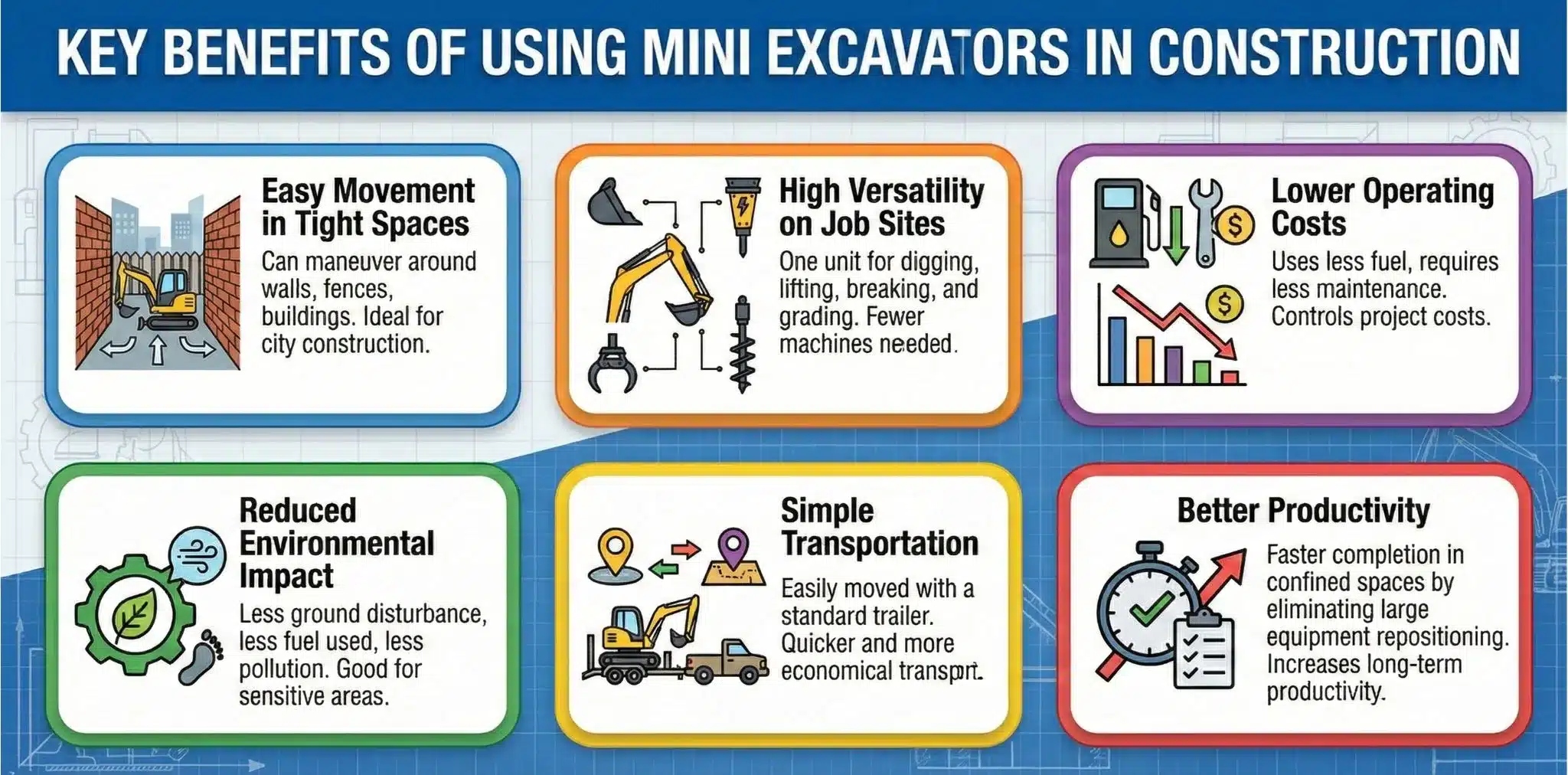
The following are some of the major advantages of mini excavators in the construction industry:
Easy Movement in Tight Spaces
Mini excavators can easily maneuver around tight spaces where operators have to work adjacent to walls, fences, and buildings. This is one of the significant reasons mini excavators are commonly used when doing construction within cities.
High Versatility on Job Sites
Mini excavators can be used with many types of attachments, allowing for a single unit to be used for digging, lifting, breaking, and grading. This reduces the number of machines that need to be on jobsites.
Lower Operating Costs
Mini excavators also use less fuel and therefore require less maintenance, which helps contractors control project costs without compromising on performance.
Reduced Environmental Impact
The compact size of mini excavators means they will create less ground disturbance; thus, there will be less fuel used and pollution created. This is why mini excavators are a preferred option for use in environmentally sensitive areas.
Simple Transportation
Mini excavators are relatively easy to transport, as they can be moved with a standard-sized trailer. Moving them from jobsite to jobsite is quicker and much more economical than moving large equipment.
Better Productivity
When working in confined spaces, mini excavators help increase the speed at which operators can complete work because repositioning large equipment is eliminated. This increases productivity long-term.
Common Uses of Mini Excavators in Construction Operations
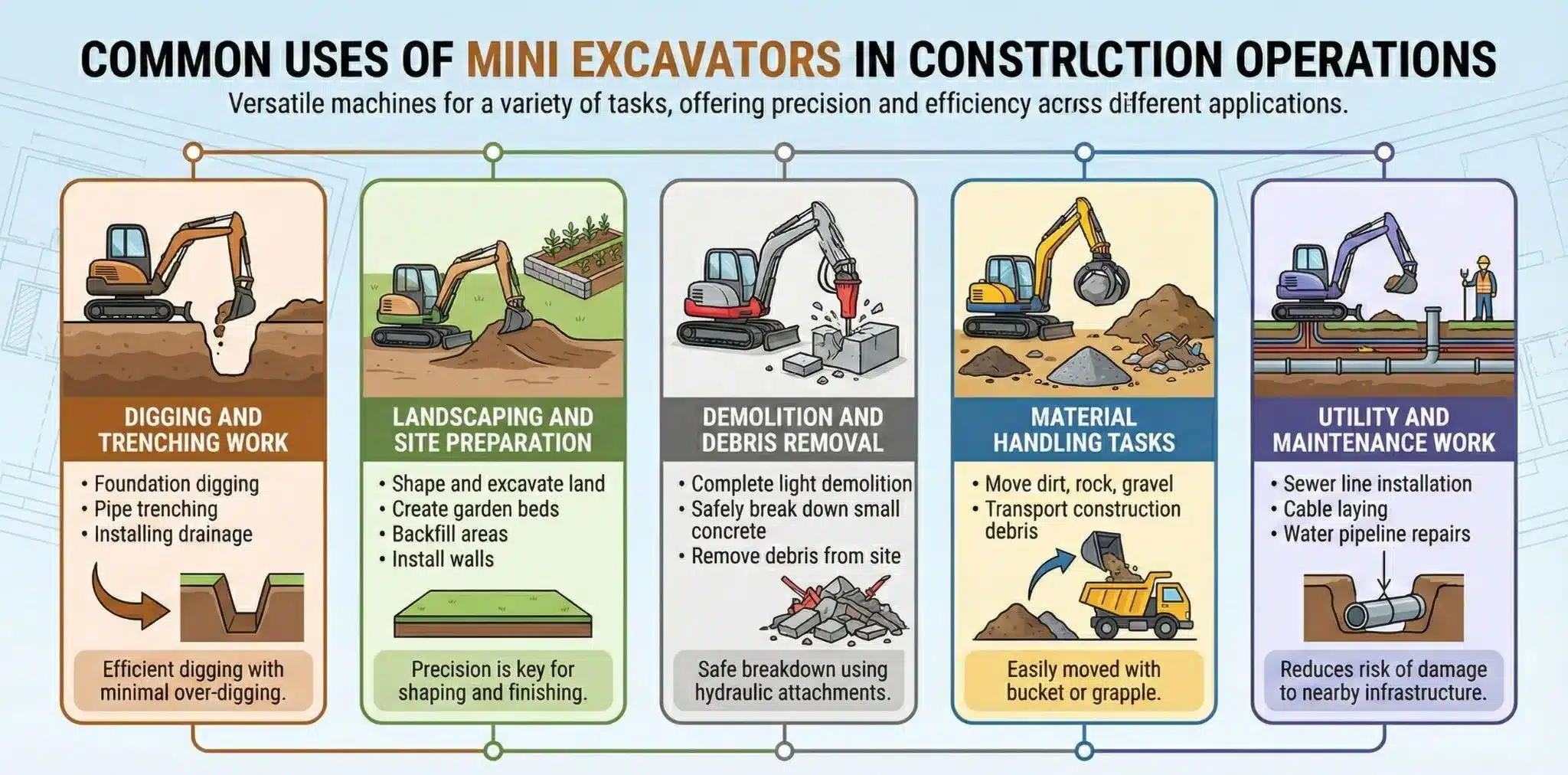
In construction, mini excavators are versatile machines that can do a variety of things.
Digging and Trenching Work
Contractors use mini excavators for:
- Foundation digging
- Pipe trenching
- Installing drainage
Mini-excavators have the ability to dig in an efficient way without creating too much over-digging at the same time.
Landscaping and Site Preparation
Shape and excavate land with a mini excavator to create a garden bed, backfill areas, and install walls using a mini excavator, where precision is key.
Demolition and Debris Removal
Mini excavators equipped with hydraulic attachment tools are used to complete light demolition. When demolishing, you can safely break down small concrete items, and you can also use a mini-excavator to remove debris from a site.
Material Handling Tasks
Mini excavators are used to move dirt, rock, gravel, and construction debris. Material can be easily moved with a mini excavator with the help of either a bucket or a grapple.
Utility and Maintenance Work
Utility contractors rely on mini excavators for:
- Sewer line installation
- Cable laying
- Water pipeline repairs
They reduce the risk of damage to nearby infrastructure.
Municipal Renovation and Repair Work
Municipal work is where the access argument is sharpest. Footpath and drain renovation, road restoration after a utility cut, park and civic landscaping and small culvert repairs all happen on live streets, between parked vehicles and over services that are already in the ground. A machine in the small mini band can be walked into a footpath-width working front and set up without closing the road, which is usually the constraint the department is actually managing.
Two practical points follow from that. The first is reach rather than power: on a cut-and-restore job the limit is normally how far the machine can work from where it is standing, not how hard it can dig. The second is ground protection, because rubber tracks and a low ground pressure are what let the machine cross finished surfaces without leaving a second repair behind it.
Why Mini Excavators Work Best for Urban Construction
Urban construction is sometimes very challenging. There is limited space to work, consistent traffic, and concerns over excessive noise at times.
Using a mini-excavator can help to overcome many urban construction challenges. Mini-excavators are compact enough to fit within narrow streets; they can also be operated close to existing buildings because mini-excavators create controlled movement with a low risk of accidents and minimal damage to the site, making them ideal for projects taking place within cities.
Mini Excavators vs Standard Excavators
| Feature | Mini Excavator | Standard Excavator |
|---|---|---|
| Job site size | Confined spaces | Open areas |
| Precision work | High | Moderate |
| Fuel consumption | Low | Higher |
| Transport ease | Easy | Complex |
| Urban suitability | Excellent | Limited |
This comparison shows why mini excavators dominate small and medium construction projects.
Future Scope of Mini Excavators in Construction
The need for mini-excavators is growing steadily, with urban developments on the rise and maintenance of current infrastructure happening as always; contractors are looking for compact/efficient equipment to get their jobs done faster and easier. Mini-excavator manufacturers are continuing to provide solutions that improve operator comfort, add safety features, widen attachment compatibility, and increase ability to use technological advancements (increase capacity for monitoring and controlling the performance of the machine).
Mini excavators will stay central as cities grow and job sites get smaller, because they let contractors work quickly and safely where a full-size machine cannot.
Conclusion
Mini excavators have revolutionized how the construction industry operates by providing an innovative combination of compactness and dependability. These machines are often necessary when constructing buildings in cities that have limited space and when building homes within residential areas where there is little room to build on.
Whether used for residential or commercial purposes, mini excavators can increase the overall productivity of contractors by allowing them to share a piece of equipment with other contractors during the duration of a project. In addition, the multi-functional abilities of mini excavators allow contractors to be less reliant on equipment rental contracts. They have access to all of the necessary equipment and utilities for multiple jobs and for multiple contractors using a single piece of equipment, which leads to better contractor productivity.
As the construction industry continues to evolve, mini excavators have also continued to evolve in respect of new construction methods that require speed, safety, and precision. From utility work to landscaping and structural works, mini excavators have consistently produced quality work.
Mini excavators aren’t just smaller versions of regular excavators; they also offer innovative solutions to today’s construction problems.
Prices on this page and on the linked product pages are indicative ex-showroom ranges as of September 2026 and move with variant, GST, freight and state registration. Confirm the current on-road price and variant with the dealer or OEM before you buy.