Key Facts
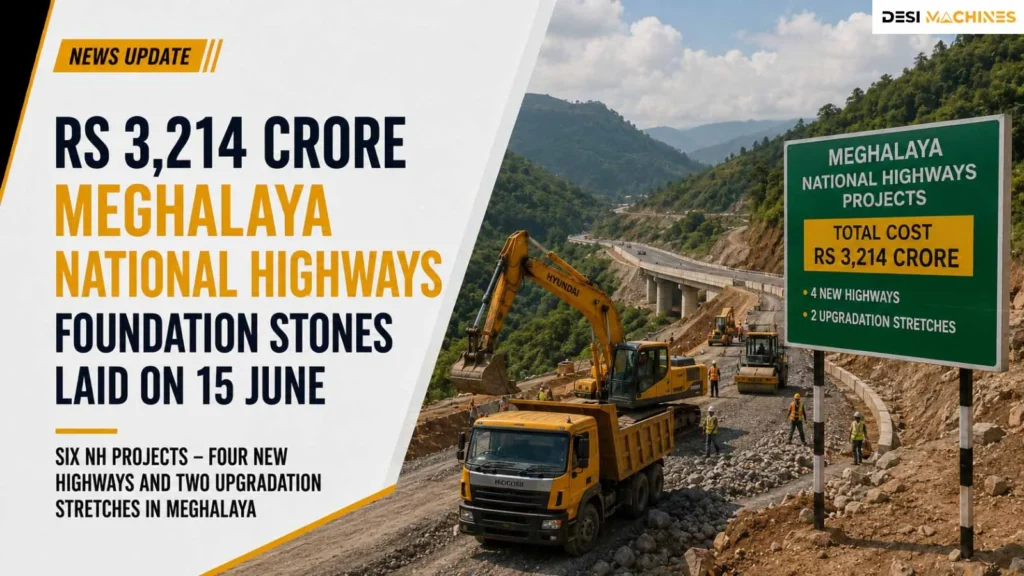
- Union Minister Nitin Gadkari laid foundation stones for six national-highway projects worth Rs 3,214 crore at Shillong on 15 June 2026 — four new highways and two upgradation stretches.
- Biggest packages: the 29 km Tura Bypass on NH-217 (Rs 951 crore) and the 31.5 km Dhubri-Phulbari Bridge-to-Selsella stretch on NH-127B (Rs 737 crore), per Business Today and the Assam Tribune.
- Other works: the 7.76 km Pynursla Bypass (NH-206, Rs 564 crore), the 31.7 km Selsella-Goeragre stretch (NH-206, Rs 504 crore), a 10.67 km Shillong-Dawki improvement (Rs 351 crore) and the 5.44 km Jowai Bypass upgrade (Rs 106 crore).
- Foundation-laying starts the build clock—earthmoving and road-building packages in a hilly, underserved Northeast market.
What happened
Gadkari laid the foundation stones for six NH projects totalling Rs 3,214 crore at the Polo Grounds in Shillong on 15 June 2026, covering four new highways and the upgradation of two existing stretches, as reported by Business Today An official government account (Akashvani/PIB) and the Assam Tribune carried the same total, date and project count; the per-package costs and lengths are as reported by Business Today and the Assam Tribune. The works span bypasses at Tura, Pynursla, and Jowai; the Selsella-Goeragre and Shillong-Dawki stretches; and the NH-127B link feeding the Dhubri-Phulbari bridge corridor.
What it meant for buyers?
A foundation-stone event is not just a ceremony — it is the start signal for the construction clock. Once these six packages move to award and mobilisation, they pull in the standard road-building fleet: excavators and backhoe loaders for earthwork, motor graders and soil compactors for the formation, crushers and pavers for surfacing, and tippers to keep material moving. For a buyer or rental operator near the Garo Hills, the Khasi Hills or the Assam–Meghalaya border, that points to firmer local demand over the next one to three build years.
The regional angle matters. The Northeast is a thinner construction-equipment market than the Hindi-belt highway corridors, so a Rs 3,214 crore cluster is a meaningful local catalyst rather than a rounding error. Hilly alignments and the bridge-approach work on NH-127B also skew the machine mix — more hard-rock excavation, breakers and compaction, plus crane and piling support around structures—which is different from plains four-laning.
Two cautions keep this grounded. First, foundation-laying is the start, not the award: the real demand trigger is when each package is tendered, and a contractor mobilises, which can lag the ceremony by months. Second, one regional cluster does not move national volumes; ICEMA put FY26 domestic construction-equipment sales down about 7%, so this is a pocket of demand, not a market turn.
DesiMachines view: spread across six packages and several contractors, this build is likely to lean rental-heavy and favour mid-size earthmoving and compaction fleets, which could support utilisation and machinery-loan demand in the Northeast through 2026-28—though timing hinges on how quickly the packages are awarded.
What should buyers watch?
- Tender and award flow for the six packages — that, not the foundation stone, is what triggers equipment orders and rentals.
- The machine mix for the NH-127B and hill stretches — hard-rock and bridge-approach work favours breakers, larger excavators and crane support.
- Financing appetite for first-time and small contractors in the Northeast, where rental and machinery loans typically carry the build.

 Excavator
294 models
Excavator
294 models  Backhoe Loader
51 models
Backhoe Loader
51 models  Crane
68 models
Crane
68 models  Concrete Mixer
79 models
Concrete Mixer
79 models  Wheel Loader
54 models
Wheel Loader
54 models  Compactor / Roller
45 models
Compactor / Roller
45 models  Motor Grader
42 models
Motor Grader
42 models  Concrete Pump
66 models
Concrete Pump
66 models  Skid Steer Loader
11 models
Skid Steer Loader
11 models  Telehandler
13 models
Telehandler
13 models